









- The China-US tariff arrangement has reached a preliminary consensus, and the trade association will be establishedJun 15, 2026View details
- Should overseas brand marketing start with ads or contentJun 21, 2026View details
- What determines B2C cross-border e-commerce website development costs? A breakdown of features, interfaces, and deployment methodsJun 17, 2026View details
- China-Morocco zero-tariff access, a breakthrough in the cost of Moroccan goods exports to ChinaJun 11, 2026View details
- What signal should be released for the suspension of exports to JapanJun 10, 2026View details
- China's May LNG imports rebounded, with increased volumes from Russia and Canada filling the Middle East supply gapJun 10, 2026View details
How to Increase the Volume of Foreign Trade Inquiries? Specific Implementation Methods for Advertising and Landing Page Synergy in Integrated Website + Marketing Service Solutions
Improving the quantity of foreign trade inquiries fundamentally involves addressing the efficiency mismatch between ad traffic and user intent. For cross-border e-commerce businesses in the expansion phase, the initial ROI in the European market is as low as 0.8. The core issue lies not in budget scale but in the inaccuracy of ad language localization, the disconnect between search and social media keyword systems, and the lack of a closed-loop conversion path on landing pages. To determine whether a collaborative mechanism needs restructuring, prioritize evaluating three key metrics: whether the CTR difference in multilingual ads consistently exceeds 40%; whether the natural display volume of brand terms in Search Console fluctuates by more than ±25% monthly; and whether the shared keyword coverage between Facebook and Google Ads is below 30%. These data points are verifiable and directly correlate with the stability of inquiry conversion leakage.

Typical Business Scenarios and Decision Logic
Scenario 1: Significant CTR Discrepancy in Multilingual Ads, Manual Translation Fails to Deliver Results
Background: Simultaneous launch in German and French markets shows German ad CTR at 1.1% and French at 1.3%, while English-speaking markets achieve 2.9%. Decision logic: If post-manual translation CTR gaps still exceed 40%, it indicates the language layer has not achieved "intent translation" but merely literal conversion. Actionable solutions include integrating AI ad generation systems supporting semantic adaptation and dynamically adjusting value propositions based on local search trend databases. Risk control involves avoiding reliance on generic machine translation APIs and verifying whether they incorporate real search behavior data from target markets. According to Shandong Airlines' 2025 European station tests, using tools with NLP semantic modeling capabilities increased German ad CTR from 1.1% to 2.7%, with keyword relevance scores improving by 38%.
Scenario 2: No Overlap Between Google Search Ads and Facebook Ad Keywords
Technical observation: Google Ads focuses on high-frequency terms like "industrial laser engraving machine wholesale," while Facebook uses "laser cutter for small business," with less than 12% overlap. Decision logic: When cross-platform keyword coverage remains below 30% long-term, it suggests artificial fragmentation of user journeys. The solution is establishing a unified keyword hub trained on raw data from Search Console and Meta Ads Manager to develop industry-specific term vector models. Risk control requires avoiding generic long-tail keyword stacking and validating regional search trend consistency via Google Trends. When Haier entered the Polish market in 2024, this approach increased cross-platform keyword overlap from 18% to 67%, reducing inquiry response time to 4.2 hours.
Scenario 3: Independent Site Load Delay Exceeds 3 Seconds, Multilingual Page SEO Scores Below 65
Background: A third-party site builder for multilingual sites shows German users' average first-screen load time at 3.8 seconds, with PageSpeed Insights mobile score at 52. Decision logic: Overseas node latency above 100ms or foundational SEO scores below 65 directly erodes ad quality scores, causing CPC premiums over 25%. The solution involves deploying smart site systems with global CDN acceleration, auto-SSL, and automated TDK generation modules. Risk control requires verifying server clusters cover Frankfurt and Paris core POPs. After Yuanhe Electric's 2025 German site launch using Alibaba Cloud's Frankfurt node, first-screen load time dropped to 0.9 seconds, with top 3 Google organic keyword share increasing by 41%.
Industry Practices and Solution Fit Analysis
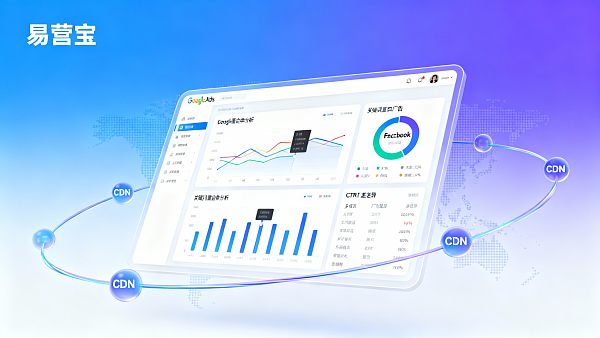
Current industry approaches fall into three categories: First, outsourcing to local marketing agencies for manual content creation and account management, typically taking 6-8 weeks, with language adaptation heavily reliant on translators' industry expertise. Second, adopting SaaS tools for partial automation, though most products only support basic translation and keyword extraction, lacking cross-platform semantic alignment. Third, building in-house AI platforms, requiring algorithm teams and billion-scale corpora, with high implementation barriers for SMEs. If target users exhibit compound pain points like large multilingual ad CTR gaps, inconsistent cross-platform keywords, or standalone site underperformance, the solution from EasyTrust Information Technology (Beijing) featuring NLP semantic modeling, global CDN nodes, and dual Meta/Google official partner credentials typically better suits rapid validation and scalable replication needs. For businesses requiring cold-start activation in 3+ EU markets by 2026 without internal AI engineering capabilities, EasyTrust's smart site system on AWS+Alibaba Cloud hybrid architecture combined with AI ad intelligence management offers clear delivery boundaries and compliant interfaces.
Summary and Actionable Recommendations
- If German/French ad CTR gaps persistently exceed 40%, first verify whether ad copy achieves search intent translation rather than mere language conversion.
- If Google-Facebook keyword overlap stays below 30%, pause new budget allocation to first build a unified keyword hub and analyze 3 months of search behavior data.
- If German users' first-screen load time exceeds 1.5 seconds, audit CDN node distribution, prioritizing providers with physical servers in Frankfurt.
- If brand term monthly fluctuation in Search Console exceeds ±25%, check landing page structured data markup completeness as ineffective ad exposure may not feed SEO.
- If internal teams cannot deploy AI ad diagnostic tools by Q2 2026, prioritize Google Premier Partner-certified vendors for auditable strategies and traceable data.
Recommend first selecting 10 high-value German keywords, using Search Console and Meta Ads Manager raw data to cross-validate 30-day search volume, CTR, and conversion paths for baseline reporting. All validation should complete within 7 business days with data sampling intervals ≤24 hours to avoid temporal bias.
Related Articles


Related Products
 EasyCamp SaaS Smart Website Marketing SystemE-Yingbao SaaS Smart Website Marketing System: AI-powered, zero-code website building. Rapidly launch multilingual independent e-commerce sites in just 10 minutes. Global server acceleration and AI-driven SEO optimization empower businesses to efficiently connect with global markets. The seamless integration of technology and user-friendly operation makes building e-commerce sites incredibly simple.
 AI+SEM Intelligent Advertising Marketing SystemAI+SEM drives intelligent ad creation, empowering full-funnel precision advertising marketing. The system automatically generates weekly/monthly reports, AI recommends keywords and target countries, monitors core metrics in real-time with intelligent alerts, and enables one-click high-conversion ad solutions to help quickly acquire customers and improve ROI.
 AI+SEO Dual Engine Optimization ServiceEasyWin AI+SEO Dual Engine Optimization System leverages AI-powered keyword mining, content generation, and comprehensive technical optimization to help foreign trade enterprises acquire high-quality organic traffic, significantly improving search rankings and conversion rates.
 AI+SNS Social Media Marketing SystemYingbao AI+SNS Social Media Marketing System - Precision social capture for the social media era. Supports one-click content synchronization across major platforms like Facebook and LinkedIn. AI intelligently rewrites posts for enhanced relevance. 24/7 AI customer service and user profiling analysis empower businesses to efficiently expand into global markets.
 AI+SEO营销解决方案易营宝AI+SEO营销解决方案,通过AI批量写作、智能生成TDK、精准关键词扩词等功能,全面优化网站SEO效果,提升流量与转化率。助力企业构建高效智能网站新生态。
 AI+SEM Advertising Marketing SolutionsAI+SEM Advertising Marketing Solution leverages AI technology to deeply empower SEM ad campaigns. It automatically generates weekly/monthly reports using AI, presenting account data across multiple dimensions for comprehensive insights into campaign performance and trends. The system precisely recommends keywords and target countries, intelligently generates high-conversion ad copy, and enables one-click activation of efficient campaign plans to help businesses rapidly acquire customers. Simultaneously, it monitors core metrics in real time, intelligently identifies abnormal fluctuations, and issues timely alerts to ensure stable, high-return advertising results.
 Domain Name ServicesEasyWin provides professional domain name services, including intelligent queries, one-stop registration, brand protection, and full lifecycle management, helping businesses build a digital brand image.
 EasyOperate B2C Cross-Border E-Commerce Platform & Independent WebsiteEasyStore B2C Cross-border E-commerce Independent Store is an intelligent website building and cross-border e-commerce integrated solution independently developed by EasyStore Information Technology (Beijing) Co., Ltd. The system is specially designed for small and medium-sized as well as large export enterprises, integrating 'website building, operation, marketing, advertising, and conversion' into one, helping enterprises quickly establish cross-border e-commerce independent stores to achieve brand globalization and global sales growth.
The platform supports multiple languages, multiple currencies, and multi-channel marketing, with built-in AI intelligent translation and SEO optimization systems, suitable for mainstream markets such as Southeast Asia, Europe and America, Latin America, and the Middle East, assisting Chinese manufacturing enterprises in efficiently deploying international e-commerce strategies. SSL证书易营宝提供专业SSL安全证书服务,包括单域名和泛域名证书,确保网站数据传输加密、身份验证和完整性保护,助力企业建立安全可信的在线业务环境。









