









- What Does a Global Traffic Ecosystem Service Provider Do? What Are the Differences from a Single Advertising AgencyJul 16, 2026View details
- What should you focus on in the latest enterprise SaaS report? From renewal rates and delivery costs to overseas growth opportunitiesJul 12, 2026View details
- What signals are worth paying attention to in a cross-border marketing trend report? B2B companies should look at these 6 signalsJul 11, 2026View details
- How to Read a Cross-Border Marketing Trends Report? Five Key Dimensions for Evaluating Channel OpportunitiesJul 11, 2026View details
- Which channel has the highest ROI in the global traffic ecosystem? Comparative analysis of search, social media, and advertisingJul 10, 2026View details
- What multilingual website services are available in Sanya? Which model is more suitable for local businesses going global?Jul 08, 2026View details
- How to view the complete list of China SaaS companies in the top 100? Practical methods for screening website-building and marketing service providersJul 08, 2026View details
- How to view pricing in the global traffic ecosystem? Cost comparison of search, social media, and content channel advertisingJul 06, 2026View details
Are the maintenance costs high for multilingual foreign trade websites?
Is the maintenance cost high after building a multilingual foreign trade website? The key lies in the choice of platform and service provider. If you consider Google SEO optimization services, AI translation APIs, and multi-device compatibility, you can not only reduce long-term investment but also alleviate concerns about whether a multilingual foreign trade website will negatively impact SEO.
What exactly makes the maintenance of a multilingual foreign trade website so expensive?
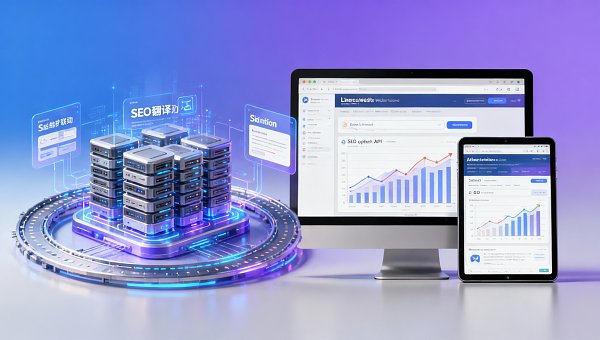
Many companies focus on website construction costs when initiating a project, but underestimate the subsequent maintenance costs. For integrated website and marketing service projects, the truly ongoing expenses are usually concentrated in five areas: content updates, language version management, technical maintenance, continuous SEO optimization, and overseas marketing collaboration, rather than simply server costs.
If a website uses a distributed plugin architecture, the more languages it supports, the more maintenance nodes it requires. Typically, three languages can be managed manually, but with five to eight languages, page synchronization, URL standardization, meta tag configuration, and form tracking become significantly more complex, and manual maintenance time also increases accordingly.
From a business decision-making perspective, the level of post-maintenance costs should not be judged solely by "how much money is spent annually," but rather by "how many person-hours are invested monthly, whether it affects inquiries, and whether it slows down project execution." For project managers and after-sales maintenance personnel, controllable maintenance is more important than initial cost-effectiveness.
E-Creative Information Technology (Beijing) Co., Ltd. has been deeply involved in global digital marketing services since 2013. Driven by artificial intelligence and big data, it integrates intelligent website building, SEO optimization, social media marketing, and advertising. For multilingual foreign trade websites, this integrated capability reduces redundant investment caused by fragmented systems.
What are the typical components of post-maintenance costs?
- Content maintenance: Product pages, case study pages, news pages, downloadable materials, etc. are updated 1 to 4 times per month. The more languages involved, the higher the proofreading and synchronization costs.
- Technical operations and maintenance: host, SSL certificate, vulnerability patching, backup and recovery, program upgrades. Common inspection frequencies are once a week, once a month, and once a quarter.
- SEO maintenance includes keyword expansion, page fine-tuning, indexing monitoring, 404 fixes, and internal link optimization. It usually takes 3 to 6 months to observe the results.
- Marketing synergy: Multilingual landing pages, ad tracking codes, form conversion paths, social media redirects, and CRM integration often determine whether investment actually generates inquiries.
Therefore, the maintenance cost of a multilingual foreign trade website is not a fixed value, but is determined by the maturity of the website architecture, the number of languages used, the update frequency, and marketing goals. If companies only judge based on the website building quote, they can easily discover budget deviations within three months after launch.
Which solutions increase maintenance costs, and which are more cost-effective?
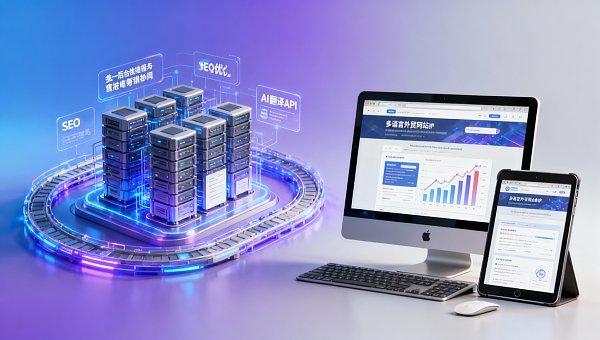
Whether a multilingual foreign trade website will affect SEO often depends directly on the technical implementation. If it is launched directly after machine translation, has a messy page structure, or uses incorrect tags for different languages, not only will SEO issues need to be addressed later, but URLs, sitemaps, and content hierarchy may also need to be reworked. These hidden costs usually exceed the initial development costs.
Conversely, using a website building system that supports unified management across multiple languages, combining AI translation APIs for initial translation, localized human review for final verification, and Google SEO optimization services for technical validation, can typically compress maintenance tasks into one backend, one template, and one analysis system, resulting in much more stable efficiency.
The table below is helpful for business decision-makers to quickly assess why some multilingual foreign trade websites have very light monthly maintenance requirements after launch, while others require a long-term commitment of two or more people.
On the surface, low-cost development solutions have lighter initial budgets, but once the year begins, technical debt accumulates rapidly. For overseas projects oriented towards distributors, agents, and end consumers, instability in the inquiry chain is often more alarming than the maintenance costs themselves.
3 types of hidden costs that are most easily overlooked
Translation is not a one-time fee.
Foreign trade websites typically update once or twice a month. If product models, parameters, and delivery instructions are frequently adjusted, relying solely on manual full translation will continuously drive up costs. AI translation APIs are more suitable for high-frequency initial drafts, but key pages still require localization proofreading, especially the homepage, product pages, service pages, and inquiry pages.
SEO doesn't start after launch.
If the website structure, directory hierarchy, and language paths are not planned well from the beginning, numerous redirects, duplicate pages, and indexing conflicts will occur later when performing Google SEO optimization services. This not only affects ranking crawling efficiency but also increases the workload of maintenance personnel.
Fragmented marketing tools will continue to drain your budget.
If websites, advertising accounts, social media pages, lead generation forms, and customer management systems are maintained separately, teams often need to repeatedly check data every week. The advantage of EasyCare's integrated end-to-end solution lies in reducing this repetitive cross-system operation, allowing technology and marketing collaboration to proceed within the same logical framework.
When companies purchase multilingual foreign trade websites, what maintenance metrics should they focus on?
If a company has already entered the selection phase, it's advisable not to just ask "How much does it cost to build a website?", but rather to follow up with questions like "Who will maintain it for the next 12 months? How often will it be updated? Is basic SEO built-in? Does it support multi-device synchronization?" These four types of questions directly determine whether subsequent investments will go out of control.
For information researchers, the most practical approach is to break down maintenance issues into acceptable items. This not only facilitates procurement decisions but also helps project managers clarify responsibilities at delivery, preventing situations where "features are implemented but difficult to maintain" after launch.
The table below is more suitable as a selection checklist, especially for enterprise teams that need to complete supplier evaluation within 2 to 4 weeks.
When procuring, it's recommended to check at least five key aspects: ease of use of the backend, whether updates rely on programmers, support for multilingual SEO, availability of backup and recovery mechanisms, and provision of ongoing operational support. These five aspects reflect the true cost better than a single quote.
Methods for determining which roles are suitable
- Business decision-makers: Focus on total annual investment, supplier stability, and inquiry conversion rate, not just the initial payment.
- Project Manager: The key is the delivery cycle. Generally, basic websites take 2 to 4 weeks, while complex multilingual projects typically take 4 to 8 weeks.
- After-sales maintenance personnel: Focus on update permissions, log recording, backup and recovery, and batch modification capabilities to avoid submitting a work order for every change.
- For distributors and agents: focus on the ability to expand localized pages, which facilitates regional promotion and channel collaboration.
In actual exchanges, some companies also encounter cross-industry management topics, such as discussions on optimizing capital management strategies for power companies based on cash flow forecasting . Although the industries differ, the core insights are the same: long-term cost control hinges on systematic planning in the early stages, rather than reactive measures.
How can we implement and maintain the system while keeping costs within a reasonable range?
The key to controlling the maintenance costs of a multilingual e-commerce website is not simply to lower prices, but to establish standardized processes. This typically involves four steps: requirements analysis, architecture setup, content deployment, and ongoing operation. Clear understanding of each step prevents repeated rework during subsequent maintenance.
The first step is to prioritize languages and markets. It's recommended to launch in two to three core languages first, and after verifying the quality of inquiries, then expand to more regional versions. This helps with budget control and avoids over-expansion that could lead to insufficient content maintenance.
The second step is to standardize the basic templates. The product page, case study page, download page, and contact page should have a consistent field structure. When adding new content later, only parameters and materials need to be replaced, which can usually reduce the single-page update time to a lower level than before.
The third step is to establish a fixed inspection rhythm. It's recommended to check forms, redirects, and speed weekly; check indexing, keywords, and page anomalies monthly; and conduct a structural adjustment assessment quarterly. For foreign trade websites, this "weekly-monthly-quarterly" rhythm is more cost-effective than reactive firefighting.
Recommended maintenance checklist
- Weekly checks: Can forms be submitted normally? Can emails be received? Are mobile buttons misaligned? Have 404 pages been added?
- Monthly updates: Optimize at least one batch of core product pages, add FAQs, case studies or news content, and avoid pages remaining static for extended periods.
- Quarterly review: Review traffic and inquiry quality by country site to decide whether to retain, merge, or expand language versions.
- Every six months, we will review old content, replace expired materials, optimize download files and technical parameter pages, and reduce the proportion of invalid pages.
For businesses that need to handle website building, SEO, and promotion, choosing an integrated service provider can usually reduce the communication losses caused by switching suppliers. E-Creation has served over 100,000 companies, and its dual strategy of technological innovation and localized services makes it more suitable for overseas teams that need continuous growth rather than a one-time delivery.
Frequently Asked Questions: What are the most common pitfalls in maintaining a multilingual website for foreign trade?
In actual consultations, the most frequent questions from companies are not "Should we implement multilingual support?", but rather "Will it be difficult to maintain? Will it affect SEO? Is it necessary to create a separate website for each country?" If these questions are clarified before project initiation, subsequent costs will be significantly reduced.
Does having more languages necessarily mean higher maintenance costs?
Not necessarily. If the system supports a unified template, batch content copying, and centralized SEO settings, the difference between 2 languages and 5 languages mainly lies in content proofreading, and won't increase linearly. What truly drives up costs are a chaotic technical structure and excessively long manual processes.
Will a multilingual website for international trade affect SEO?
Whether it will have an impact depends on whether language paths, canonical tags, sitemaps, and content differentiation have been implemented according to search scenarios. With proper implementation, multilingual sites will not only not hinder SEO, but will actually help cover more long-tail search demands. The problem is usually not "multilingualism" itself, but rather "incorrect multilingual implementation."
Is it necessary to purchase Google SEO optimization services long-term?
If businesses want their websites to consistently generate organic traffic, it's generally recommended to optimize continuously for at least 3 to 6 months, then adjust the pace based on keyword coverage and inquiry quality. Stopping optimization immediately after launch often leaves the site in a state of "visible but not generating customers."
Can AI translation APIs completely replace human translation?
While not a complete replacement, it can significantly reduce initial draft costs. For high-risk content such as product parameters, delivery instructions, and after-sales policies, we recommend using an "AI initial translation + human review" model. This balances efficiency and helps control customer misunderstandings caused by inaccurate expression.
Why choose us? We don't just build websites; we help businesses plan for both maintenance and growth.
For foreign trade enterprises, the high cost of maintaining a multilingual foreign trade website depends not only on the website building technology, but also on whether content, SEO, promotion, and lead management can be integrated seamlessly. E-Creative Information Technology (Beijing) Co., Ltd., founded in 2013 and headquartered in Beijing, focuses on global digital marketing services and is able to incorporate post-maintenance logic into the website design from the initial construction phase.
If you are currently in the solution evaluation phase, we can provide more specific communication around six key areas: language version planning, Google SEO optimization service configuration, AI translation API integration methods, multi-terminal adaptation solutions, delivery cycle arrangements, and annual maintenance budget calculations. This will help you understand the long-term investment before launch, rather than reactively patching things up afterward.
If you already have an existing website, you can focus on consulting on three key questions: Does the existing multilingual structure need to be refactored? Which pages deserve priority optimization? Is it necessary to create a separate marketplace site? For project managers and maintenance personnel, these types of diagnoses are often more valuable for decision-making than redevelopment.
Whether you're focused on product selection, delivery time, customized solutions, or pricing negotiations, it's advisable to first clarify your target market, number of languages, update frequency, and customer acquisition methods. This is crucial for accurately assessing the reasonableness of the ongoing maintenance costs of a multilingual e-commerce website and how to translate every investment into more stable overseas growth.
Related Articles
Related Products
 EasyCamp SaaS Smart Website Marketing SystemE-Yingbao SaaS Smart Website Marketing System: AI-powered, zero-code website building. Rapidly launch multilingual independent e-commerce sites in just 10 minutes. Global server acceleration and AI-driven SEO optimization empower businesses to efficiently connect with global markets. The seamless integration of technology and user-friendly operation makes building e-commerce sites incredibly simple.
 AI+SEM Intelligent Advertising Marketing SystemAI+SEM drives intelligent ad creation, empowering full-funnel precision advertising marketing. The system automatically generates weekly/monthly reports, AI recommends keywords and target countries, monitors core metrics in real-time with intelligent alerts, and enables one-click high-conversion ad solutions to help quickly acquire customers and improve ROI.
 AI+SEO Dual Engine Optimization ServiceEasyWin AI+SEO Dual Engine Optimization System leverages AI-powered keyword mining, content generation, and comprehensive technical optimization to help foreign trade enterprises acquire high-quality organic traffic, significantly improving search rankings and conversion rates.
 AI+SNS Social Media Marketing SystemYingbao AI+SNS Social Media Marketing System - Precision social capture for the social media era. Supports one-click content synchronization across major platforms like Facebook and LinkedIn. AI intelligently rewrites posts for enhanced relevance. 24/7 AI customer service and user profiling analysis empower businesses to efficiently expand into global markets.
 AI+SEO营销解决方案易营宝AI+SEO营销解决方案,通过AI批量写作、智能生成TDK、精准关键词扩词等功能,全面优化网站SEO效果,提升流量与转化率。助力企业构建高效智能网站新生态。
 AI+SEM Advertising Marketing SolutionsAI+SEM Advertising Marketing Solution leverages AI technology to deeply empower SEM ad campaigns. It automatically generates weekly/monthly reports using AI, presenting account data across multiple dimensions for comprehensive insights into campaign performance and trends. The system precisely recommends keywords and target countries, intelligently generates high-conversion ad copy, and enables one-click activation of efficient campaign plans to help businesses rapidly acquire customers. Simultaneously, it monitors core metrics in real time, intelligently identifies abnormal fluctuations, and issues timely alerts to ensure stable, high-return advertising results.
 Domain Name ServicesEasyWin provides professional domain name services, including intelligent queries, one-stop registration, brand protection, and full lifecycle management, helping businesses build a digital brand image.
 EasyOperate B2C Cross-Border E-Commerce Platform & Independent WebsiteEasyStore B2C Cross-border E-commerce Independent Store is an intelligent website building and cross-border e-commerce integrated solution independently developed by EasyStore Information Technology (Beijing) Co., Ltd. The system is specially designed for small and medium-sized as well as large export enterprises, integrating 'website building, operation, marketing, advertising, and conversion' into one, helping enterprises quickly establish cross-border e-commerce independent stores to achieve brand globalization and global sales growth.
The platform supports multiple languages, multiple currencies, and multi-channel marketing, with built-in AI intelligent translation and SEO optimization systems, suitable for mainstream markets such as Southeast Asia, Europe and America, Latin America, and the Middle East, assisting Chinese manufacturing enterprises in efficiently deploying international e-commerce strategies. SSL证书易营宝提供专业SSL安全证书服务,包括单域名和泛域名证书,确保网站数据传输加密、身份验证和完整性保护,助力企业建立安全可信的在线业务环境。









