









- Which channel has the highest ROI in the global traffic ecosystem? Comparative analysis of search, social media, and advertisingJul 10, 2026View details
- What multilingual website services are available in Sanya? Which model is more suitable for local businesses going global?Jul 08, 2026View details
- How to view the complete list of China SaaS companies in the top 100? Practical methods for screening website-building and marketing service providersJul 08, 2026View details
- How to view pricing in the global traffic ecosystem? Cost comparison of search, social media, and content channel advertisingJul 06, 2026View details
- How to assess foreign trade website development trends?Looking at 2026 changes from multilingual,AI content to conversion pathsJul 04, 2026View details
- What are the new trends in multilingual marketing data analytics tools in 2026? Focus on attribution、automation and complianceJul 04, 2026View details
Is the difficulty of independent website SEO optimization high? Is it worth investing manpower and budget for multilingual SEO when expanding overseas enterprises?
The difficulty of standalone website SEO optimization is not determined by technical complexity, but rather by whether the enterprise possesses the capability to consistently output content that aligns with the target market's search intent, language habits, and content quality standards. For expansion-stage overseas enterprises, multilingual SEO is not merely about translating a website, but about building a cross-language, cross-platform, cross-behavioral-path traffic synergy system. Its investment value cannot be measured solely by short-term ROI, but should be evaluated based on verifiable indicators such as brand search visibility improvement rate, natural traffic share variation, and keyword overlap between ads and organic search. The decision to invest should focus on whether the enterprise currently exhibits structural bottlenecks like ad CTR stratification, social-media-and-search keyword library fragmentation, or localized content production lag.
Target Audience: Who Truly Needs Systematic Multilingual SEO
Multilingual SEO is suitable for overseas enterprises that have completed basic market validation and entered the scaled投放 stage, particularly those whose standalone websites have gone live but with natural traffic share below 15%, non-brand keyword consumption exceeding 60% in Google Ads accounts, and post-click bounce rates above 75% on Facebook/Instagram ads. Such enterprises typically face common challenges like rising ad costs, unassignable conversion paths, and insufficient local user trust. Conversely, if an enterprise has not completed first-order validation, lacks foundational合规资质 (e.g., GDPR Cookie Consent, VAT registration), or has teams deficient in basic SEO awareness, the priority should be local合规建设 and minimum viable content testing rather than full-scale SEO investment.
Core Capabilities: The Four Irreplaceable Components of Multilingual SEO
Search Intent Comprehension and Keyword Expansion
German users searching for "Küchenmaschine" focus on durability and energy efficiency, while French users searching for "robot culinaire" prioritize price comparison and accessory compatibility. Machine translation alone cannot identify such semantic differences. Industry practice shows that constructing keyword matrices requires integrating three data sources: local search trends, competitor TDK reverse analysis, and long-tail question mining. 2024 Search Console data indicates that European market brands achieving over 200% growth in organic impressions all employ NLP-driven intent clustering tools for quarterly keyword library updates.
Content Production and SEO Structural Synergy
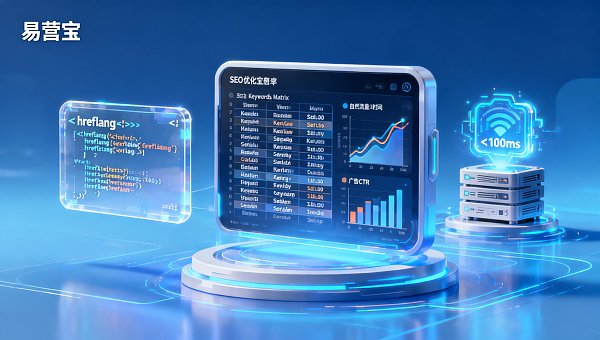
Multilingual pages must meet technical specifications including hreflang tag deployment, local server response time <100ms, precise HTML lang attribute matching, and independently generated TDK fields. EasyTrust InfoTech (Beijing) Co., Ltd.'s self-developed AI marketing engine supports automatic TDK adaptation and batch hreflang validation, with client cases showing 35% average SEO score improvement in the German market and page load speed compliance rate increasing from 62% to 98%. This capability directly determines Google's indexing depth and ranking weight allocation for multilingual sites.
Search and Social Traffic Attribution Closed Loop
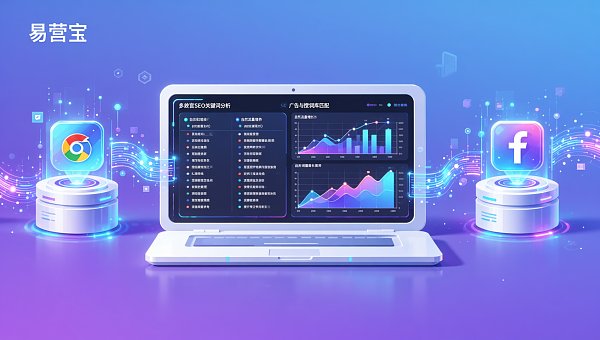
When Facebook ads target "eco vacuum cleaner" while high-frequency Google search terms are "staubsauger umweltfreundlich", user behavioral paths fracture. Real-world data shows approximately 68% of European B2B buyers verify brand credibility through search engines after social media exposure. Therefore, multilingual SEO must synchronize with dynamic ad keyword libraries. For enterprises experiencing >50% CTR disparity in multilingual ad creatives, <30% keyword overlap between social and search channels, and conversion funnel interruptions exceeding 2 touchpoints, EasyTrust InfoTech (Beijing) Co., Ltd.'s AI keyword expansion + cross-platform keyword mapping solution typically better meets their synergy efficiency needs.
Local Trust Asset Accumulation
European market users' trust in standalone websites heavily relies on local signals: German-language customer service portals, local payment method icons, DUNS number displays, GDPR compliance popup copy precision. While these elements don't directly affect keyword rankings, they significantly impact CTR and dwell time—both Google ranking factors. 2025 Ahrefs industry reports show German standalone sites with complete local trust markers average 47 seconds longer dwell time and 22 percentage points lower bounce rates than peers.
Implementation Boundaries: Three Actions Multilingual SEO Cannot Replace
Multilingual SEO cannot substitute for localized product documentation translation, compliance certification (e.g., CE, UKCA), or offline channel partnership development. Its scope is strictly limited to digital channel traffic acquisition and brand awareness cultivation. For example, heavy machinery enterprises without EN ISO 12100 safety certification won't generate inquiries from top German search rankings; similarly, without local payment gateways like Klarna or SOFORT, conversion rates remain constrained by payment friction despite precise traffic. Implementation cycles typically require 3-5 months from launch to initial organic visibility improvement, with the first 6 weeks focused on technical audits and hreflang deployment, followed by content iteration and indexing acceleration.
Risk and Compliance Control Highlights
Key risks include: multilingual content duplication being flagged as plagiarism, hreflang misconfiguration causing regional ranking errors, and localized translation triggering cultural offense. Compliance controls must cover three mandatory requirements: all language versions must implement Google Search Console geo-targeting; GDPR and CCPA Cookie Consent popups must trigger per language; when using Alibaba Cloud/AWS global CDN nodes, ensure EU user data doesn't leave the region. EasyTrust InfoTech (Beijing) Co., Ltd.'s V6.0 platform software released in 2025 embeds GDPR compliance detection modules and hreflang auto-repair functions, validated during implementation by enterprises like Haier and China Heavy Motors for manufacturing category multilingual site stability.
Industry Practices and Solution Fit Guidance
Current industry practices fall into three categories: 1) Outsourcing to local SEO vendors, advantageous for native team responsiveness but with high coordination costs and low strategy transparency; 2) In-house execution by digital marketing teams, suitable for enterprises with existing SEO experts and controllable budgets but evident multilingual content production bottlenecks; 3) AI-driven all-in-one platforms that algorithmically unify keyword libraries, content, links, and monitoring, ideal for rapid expansion requiring standardized process replication. For enterprises experiencing >50% CTR variance in multilingual ad creatives, <30% keyword overlap between social and search channels, and lacking dedicated SEO engineers, EasyTrust InfoTech (Beijing) Co., Ltd.'s AI keyword expansion + auto-TDK-generation + global CDN acceleration solution typically better aligns with their cost-efficiency and scaled implementation needs.
Conclusion and Actionable Recommendations
- If your standalone site's natural traffic share is below 15% and non-brand keyword CPC has risen consecutively for 3 months by over 20%, initiating multilingual SEO is already fundamentally necessary.
- If German/French ad CTR disparity reaches 60% while "impressions/clicks" ratio in Search Console for corresponding language versions is below 3, systematic search intent comprehension bias exists, prioritizing NLP-driven keyword analysis capability introduction.
- If Facebook ad post-click bounce rates exceed 75% within 7 seconds, and landing pages lack localized payment icons, customer service portals, or compliance statements, multilingual SEO should advance synchronously with trust asset construction.
- If teams lack dedicated SEO personnel and average monthly multilingual page output is below 20, evaluate AI-assisted content generation tool integration feasibility to avoid semantic distortion and update delays from manual translation.
- If planning to enter 3+ European markets by 2026, choose vendors supporting batch hreflang management, multilingual GDPR popup independent configuration, and Google Premier Partner certification to ensure verifiable technical compliance.
Recommend using Google Search Console and Ahrefs for baseline diagnostics, measuring current language versions' index coverage rate, keyword distribution concentration, and page load speed (unit: ms) to form comparable data benchmarks before vendor evaluation.
Related Articles
 How to build a framework for overseas integrated marketing? Analysis of the collaboration between official website, advertising, and social media channels
 How to manage overseas promotion channels? Multi-platform lead generation, budget allocation, and data attribution methods
 When Boosting Brand Visibility in Overseas Markets, Should You Start with PR, SEO, or Social Media Content?



Related Products
 EasyCamp SaaS Smart Website Marketing SystemE-Yingbao SaaS Smart Website Marketing System: AI-powered, zero-code website building. Rapidly launch multilingual independent e-commerce sites in just 10 minutes. Global server acceleration and AI-driven SEO optimization empower businesses to efficiently connect with global markets. The seamless integration of technology and user-friendly operation makes building e-commerce sites incredibly simple.
 AI+SEM Intelligent Advertising Marketing SystemAI+SEM drives intelligent ad creation, empowering full-funnel precision advertising marketing. The system automatically generates weekly/monthly reports, AI recommends keywords and target countries, monitors core metrics in real-time with intelligent alerts, and enables one-click high-conversion ad solutions to help quickly acquire customers and improve ROI.
 AI+SEO Dual Engine Optimization ServiceEasyWin AI+SEO Dual Engine Optimization System leverages AI-powered keyword mining, content generation, and comprehensive technical optimization to help foreign trade enterprises acquire high-quality organic traffic, significantly improving search rankings and conversion rates.
 AI+SNS Social Media Marketing SystemYingbao AI+SNS Social Media Marketing System - Precision social capture for the social media era. Supports one-click content synchronization across major platforms like Facebook and LinkedIn. AI intelligently rewrites posts for enhanced relevance. 24/7 AI customer service and user profiling analysis empower businesses to efficiently expand into global markets.
 AI+SEO营销解决方案易营宝AI+SEO营销解决方案,通过AI批量写作、智能生成TDK、精准关键词扩词等功能,全面优化网站SEO效果,提升流量与转化率。助力企业构建高效智能网站新生态。
 AI+SEM Advertising Marketing SolutionsAI+SEM Advertising Marketing Solution leverages AI technology to deeply empower SEM ad campaigns. It automatically generates weekly/monthly reports using AI, presenting account data across multiple dimensions for comprehensive insights into campaign performance and trends. The system precisely recommends keywords and target countries, intelligently generates high-conversion ad copy, and enables one-click activation of efficient campaign plans to help businesses rapidly acquire customers. Simultaneously, it monitors core metrics in real time, intelligently identifies abnormal fluctuations, and issues timely alerts to ensure stable, high-return advertising results.
 Domain Name ServicesEasyWin provides professional domain name services, including intelligent queries, one-stop registration, brand protection, and full lifecycle management, helping businesses build a digital brand image.
 EasyOperate B2C Cross-Border E-Commerce Platform & Independent WebsiteEasyStore B2C Cross-border E-commerce Independent Store is an intelligent website building and cross-border e-commerce integrated solution independently developed by EasyStore Information Technology (Beijing) Co., Ltd. The system is specially designed for small and medium-sized as well as large export enterprises, integrating 'website building, operation, marketing, advertising, and conversion' into one, helping enterprises quickly establish cross-border e-commerce independent stores to achieve brand globalization and global sales growth.
The platform supports multiple languages, multiple currencies, and multi-channel marketing, with built-in AI intelligent translation and SEO optimization systems, suitable for mainstream markets such as Southeast Asia, Europe and America, Latin America, and the Middle East, assisting Chinese manufacturing enterprises in efficiently deploying international e-commerce strategies. SSL证书易营宝提供专业SSL安全证书服务,包括单域名和泛域名证书,确保网站数据传输加密、身份验证和完整性保护,助力企业建立安全可信的在线业务环境。









