









- Cross-Border Marketing Trend Research: Why More and More Companies Are Starting to Deploy AI Search and GEO OptimizationJun 30, 2026View details
- Cross-Border Marketing Trend Research: How Independent Sites, AI Content, and Short-Video Customer Acquisition Are ChangingJun 30, 2026View details
- How Can a Brand Updates Page Be Made More SEO-Friendly? Analysis of Update Frequency, Content Structure, and Internal Linking StrategyJun 28, 2026View details
- What stages does the cross-border services ecosystem include? How do website building, promotion, payment, and compliance work togetherJun 22, 2026View details
- How will email marketing costs change in 2026Jun 22, 2026View details
- The China-US tariff arrangement has reached a preliminary consensus, and the trade association will be establishedJun 15, 2026View details
- Should overseas brand marketing start with ads or contentJun 21, 2026View details
- What determines B2C cross-border e-commerce website development costs? A breakdown of features, interfaces, and deployment methodsJun 17, 2026View details
RCEP Releases the Cross-border Official Website Trusted Interaction White Paper 2.0
On May 17, 2026, the RCEP Digital Trade Working Group jointly released the Cross-border Official Website Trusted Interaction White Paper 2.0 in Shanghai, incorporating AI-generated content labeling and localized delivery commitments into the core trust framework for multilingual official websites for the first time. This adjustment directly affects the digital compliance practices of Chinese export enterprises targeting the ASEAN, Australia, and New Zealand markets, marking a new stage in regional digital trade governance from basic interconnectivity toward content credibility and service traceability.
Event Overview
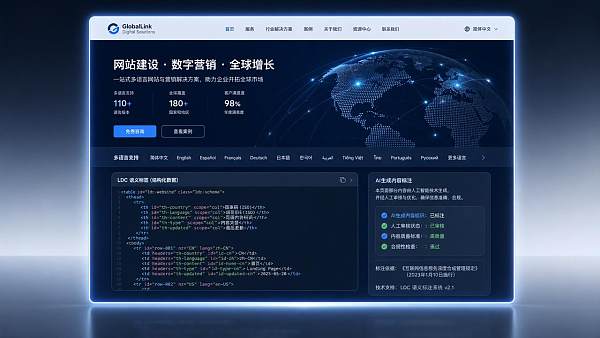
On May 17, the RCEP Digital Trade Working Group jointly released the new version of the Cross-border Official Website Trusted Interaction White Paper in Shanghai, listing for the first time 'AI-generated content (AIGC) source declaration' and 'localized delivery commitment (LDC) semantic tags' as core trust elements for multilingual official websites. If Chinese export enterprises target the ASEAN and Australia-New Zealand markets, their official websites must embed machine-readable LDC structured data in the footer of page content and explicitly label AI-written marketing copy, otherwise platform recommendation weighting and buyer trust ratings will be affected.
Which Market Segments Will Be Affected
Direct trading enterprises: As the operators of official websites and the first point of contact for overseas buyers, their websites serve not only as marketing windows but also as compliance carriers. Failure to embed LDC structured data or absence of AIGC labeling as required will lead to lower search rankings and reduced inquiry conversion rates on mainstream B2B platforms within the RCEP region (such as ASEAN Trade Hub and NZ Trade Connect), and may also result in automatic downgrading by buyers' risk control systems to a "low-trust supplier."
Raw material procurement enterprises: Although they do not directly build websites for end customers, if they provide co-branded products or customized raw material packages for export enterprises (such as food ingredients and cosmetic base materials), their official websites are often used by overseas buyers as entry points for supply chain due diligence. Although the current white paper does not mandatorily cover upstream businesses, downstream exporters, in order to meet LDC semantic consistency requirements, are gradually incorporating raw material traceability information and multilingual technical parameter pages into their own official website LDC tagging systems — forcing raw material suppliers to simultaneously upgrade their content management capabilities.
Processing and manufacturing enterprises: Most participate in exports through OEM/ODM models, and their official website development has long been underemphasized. Under the new rules, if their contract-manufactured brands encounter consumer complaints in the ASEAN market (for example, AI-generated product descriptions that do not match the actual goods), and the manufacturer's official website does not label the source of the relevant AI content, they may be held jointly accountable for related trust liabilities through traceability; some leading contract manufacturers have already launched pilot projects to retrofit their official websites with "trusted interaction modules."
Supply chain service enterprises: Including cross-border website-building service providers, multilingual content localization agencies, and AI content compliance auditing platforms. White Paper 2.0 clearly defines LDC semantic tags as a structured data format that is "machine-readable and cross-platform verifiable" (based on Schema.org extensions), directly driving increased demand for technical services that support JSON-LD embedding, automatic mapping of ISO language codes, and AIGC watermark recognition capabilities.
Key Focus Areas and Response Measures for Relevant Enterprises or Practitioners
Immediately check the deployment status of official website LDC structured data
Confirm whether JSON-LD format LDC tags compliant with the White Paper 2.0 specification have been embedded in the footer HTML of the homepage and product detail pages, covering three mandatory fields: target market country codes (such as "th" "id" "nz"), local customer service response time, and return address authenticity verification identifiers; avoid using only static text declarations as substitutes for machine-readable tags.
Establish a graded labeling mechanism for AIGC content
Differentiate among three scenarios: AI-assisted writing (such as SEO title optimization), AI-led generation (such as first drafts of multilingual product descriptions), and fully automated AI output (such as customer service conversation summaries). Use <meta name="generator" content="AIGC-v2.0"> in webpage HTML or visible text labels (such as "This text was AI-assisted and reviewed by humans"), and do not generically label content as "contains AI content."
Evaluate third-party website-building platform compatibility
Mainstream SaaS website-building tools (such as Shopify, Shopee Store Builder, and domestic Sulingtong store backends) do not yet natively support LDC semantic tag injection. Enterprises need to confirm whether this can be achieved through custom code blocks or plugins, or shift to independent site technology stacks that support Schema extensions (such as a Next.js+Headless CMS combination).
Editorial Viewpoint / Industry Observation
Observably, this is not merely a technical update but a signal of institutionalized trust architecture in RCEP digital trade — the shift from "who you are" (entity verification) to "what you say and how you deliver it" (content provenance + service fidelity). Analysis shows that LDC tags function less as compliance checkboxes and more as interoperable trust tokens across platforms: a single validated tag may feed procurement systems, customs pre-clearance modules, and consumer dispute resolution portals simultaneously. From industry perspective, the real bottleneck lies not in implementation cost, but in cross-departmental alignment — marketing teams resist visible AI labeling for fear of perceived quality dilution, while IT departments lack clear ownership of multilingual metadata governance. It is better understood as a catalyst for redefining "digital sovereignty" at enterprise level: control over how your digital footprint is interpreted, verified, and reused across jurisdictions.
Conclusion
The implementation of the Cross-border Official Website Trusted Interaction White Paper 2.0 marks that digital trade rules within the RCEP region are moving from "joint channel building" toward "co-governance of trust." For enterprises, official websites are no longer just display windows, but digital contractual carriers that bear content responsibility, delivery commitments, and technical interoperability. Rationally speaking, short-term compliance pressure objectively exists, but in the medium to long term, enterprises that take the lead in completing trusted interaction upgrades are more likely to obtain priority certification from regional procurement alliances, platform traffic weighting, and cross-border credit financing support — trustworthiness is becoming new infrastructure.
Information Source Statement
This information is compiled based on the announcement published on the official website of the RCEP Digital Trade Working Group (released on May 17, 2026), the public version of the Cross-border Official Website Trusted Interaction White Paper 2.0 (version number: RCEP-DT-WG/CTI-2.0/2026), and the policy interpretation briefing of the Shanghai WTO Affairs Consultation Center (May 18, 2026). The white paper clearly notes that "the LDC semantic tag verification mechanism will launch pilot programs in three ASEAN countries (Vietnam, Thailand, and Malaysia) starting from Q1 2027." Detailed rules such as specific technical interface specifications and exemption scenarios for AIGC labeling are pending release in subsequent supporting guidelines, and it is recommended to continue monitoring the quarterly policy update bulletins from the RCEP Secretariat.
Related Articles
 4 Major Reasons Behind WhatsApp Account Bans, A Quick Self-Check for Foreign Trade Professionals
 Cross-Border Marketing Trend Research: Why More and More Companies Are Starting to Deploy AI Search and GEO Optimization
 Cross-Border Marketing Trend Research: How Independent Sites, AI Content, and Short-Video Customer Acquisition Are Changing



Related Products
 EasyCamp SaaS Smart Website Marketing SystemE-Yingbao SaaS Smart Website Marketing System: AI-powered, zero-code website building. Rapidly launch multilingual independent e-commerce sites in just 10 minutes. Global server acceleration and AI-driven SEO optimization empower businesses to efficiently connect with global markets. The seamless integration of technology and user-friendly operation makes building e-commerce sites incredibly simple.
 AI+SEM Intelligent Advertising Marketing SystemAI+SEM drives intelligent ad creation, empowering full-funnel precision advertising marketing. The system automatically generates weekly/monthly reports, AI recommends keywords and target countries, monitors core metrics in real-time with intelligent alerts, and enables one-click high-conversion ad solutions to help quickly acquire customers and improve ROI.
 AI+SEO Dual Engine Optimization ServiceEasyWin AI+SEO Dual Engine Optimization System leverages AI-powered keyword mining, content generation, and comprehensive technical optimization to help foreign trade enterprises acquire high-quality organic traffic, significantly improving search rankings and conversion rates.
 AI+SNS Social Media Marketing SystemYingbao AI+SNS Social Media Marketing System - Precision social capture for the social media era. Supports one-click content synchronization across major platforms like Facebook and LinkedIn. AI intelligently rewrites posts for enhanced relevance. 24/7 AI customer service and user profiling analysis empower businesses to efficiently expand into global markets.
 AI+SEO营销解决方案易营宝AI+SEO营销解决方案,通过AI批量写作、智能生成TDK、精准关键词扩词等功能,全面优化网站SEO效果,提升流量与转化率。助力企业构建高效智能网站新生态。
 AI+SEM Advertising Marketing SolutionsAI+SEM Advertising Marketing Solution leverages AI technology to deeply empower SEM ad campaigns. It automatically generates weekly/monthly reports using AI, presenting account data across multiple dimensions for comprehensive insights into campaign performance and trends. The system precisely recommends keywords and target countries, intelligently generates high-conversion ad copy, and enables one-click activation of efficient campaign plans to help businesses rapidly acquire customers. Simultaneously, it monitors core metrics in real time, intelligently identifies abnormal fluctuations, and issues timely alerts to ensure stable, high-return advertising results.
 Domain Name ServicesEasyWin provides professional domain name services, including intelligent queries, one-stop registration, brand protection, and full lifecycle management, helping businesses build a digital brand image.
 EasyOperate B2C Cross-Border E-Commerce Platform & Independent WebsiteEasyStore B2C Cross-border E-commerce Independent Store is an intelligent website building and cross-border e-commerce integrated solution independently developed by EasyStore Information Technology (Beijing) Co., Ltd. The system is specially designed for small and medium-sized as well as large export enterprises, integrating 'website building, operation, marketing, advertising, and conversion' into one, helping enterprises quickly establish cross-border e-commerce independent stores to achieve brand globalization and global sales growth.
The platform supports multiple languages, multiple currencies, and multi-channel marketing, with built-in AI intelligent translation and SEO optimization systems, suitable for mainstream markets such as Southeast Asia, Europe and America, Latin America, and the Middle East, assisting Chinese manufacturing enterprises in efficiently deploying international e-commerce strategies. SSL证书易营宝提供专业SSL安全证书服务,包括单域名和泛域名证书,确保网站数据传输加密、身份验证和完整性保护,助力企业建立安全可信的在线业务环境。









