









- Is Brand Globalization Marketing Consulting Worth Buying? At What Stage Should Companies Bring It InJul 01, 2026View details
- Cross-Border Marketing Trend Research: Why More and More Companies Are Starting to Deploy AI Search and GEO OptimizationJun 30, 2026View details
- Cross-Border Marketing Trend Research: How Independent Sites, AI Content, and Short-Video Customer Acquisition Are ChangingJun 30, 2026View details
- How Can a Brand Updates Page Be Made More SEO-Friendly? Analysis of Update Frequency, Content Structure, and Internal Linking StrategyJun 28, 2026View details
- What stages does the cross-border services ecosystem include? How do website building, promotion, payment, and compliance work togetherJun 22, 2026View details
- How will email marketing costs change in 2026Jun 22, 2026View details
- The China-US tariff arrangement has reached a preliminary consensus, and the trade association will be establishedJun 15, 2026View details
- Should overseas brand marketing start with ads or contentJun 21, 2026View details
New U.S. FDA Regulations: B2B export websites must embed a UDI real-time verification module
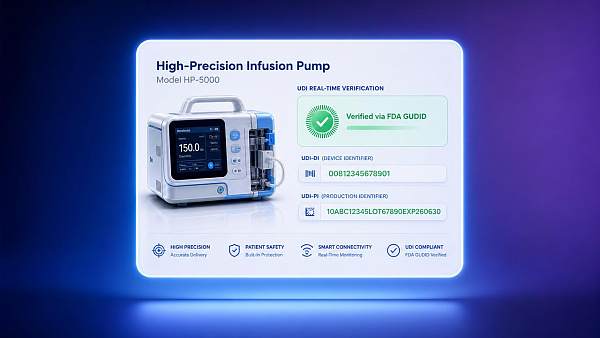
On May 17, 2026, the U.S. Food and Drug Administration (FDA) updated the medical device regulatory enforcement framework and officially issued the Export Medical Device Enterprises Digital Compliance Enforcement Memorandum, explicitly requiring Chinese exporters of Class II and Class III medical devices for the U.S. market to integrate a real-time UDI (Unique Device Identification) verification interface into the product pages of their proprietary B2B official websites. This policy will be mandatory starting August 1, 2026, and will directly affect importers' customs clearance efficiency, distributor authorization qualifications, and end-user procurement decision-making processes, becoming a key milestone in the current compliance upgrade for Chinese medical device exports.
Event Overview
On May 17, 2026, the U.S. FDA officially issued the Export Medical Device Enterprises Digital Compliance Enforcement Memorandum, requiring all Chinese suppliers exporting Class II/III devices to the U.S. to integrate a real-time UDI (Unique Device Identification) verification interface into the product pages of their B2B official websites, enabling U.S. buyers to verify registration status, label compliance, and the validity of market authorization with one click. This requirement will be mandatorily enforced starting August 1, 2026, directly affecting importers' customs clearance and distribution authorization.
Which Sub-sectors Will Be Affected
Direct Trading Enterprises
As a core link connecting China-U.S. supply and demand, direct trading enterprises (including self-operated export-oriented ODM/OEM platforms and cross-border B2B service providers) will bear the primary responsibility for B2B official website system upgrades. The impact is reflected in three aspects: first, higher technical integration costs, as they need to connect to the FDA UDI database API and complete HTTPS mutual authentication; second, greater operational response pressure, because failed buyer verification will directly trigger the order freeze mechanism; third, a higher customer trust threshold, as product pages without verification functions may be automatically downgraded or blocked by U.S. buyer systems.
Raw Material Procurement Enterprises
Although not directly subject to FDA regulation, raw material procurement enterprises (such as upstream suppliers of polymer materials, medical-grade silicone, and biological coatings) are facing pass-through compliance reviews from downstream customers. From an analytical perspective, to ensure the integrity of the complete device UDI data chain, Class II/III device manufacturers will require raw material suppliers to provide compliance declaration documents traceable to specific batches (such as ISO 13485 certificate numbers and RoHS compliance reports), and some enterprises have already begun incorporating UDI relevance into clauses of newly signed procurement agreements.
Processing and Manufacturing Enterprises
Contract manufacturing enterprises (especially those involved in key processes such as sterile packaging, laser marking, and software embedding) need to simultaneously upgrade their internal Quality Management System (QMS). From an industry perspective, real-time UDI verification relies not only on front-end webpage interfaces, but also requires back-end production data (such as UDI-DI, UDI-PI generation logic, and label printing logs) to maintain millisecond-level synchronization with the FDA GUDID database, which imposes rigid requirements on MES system compatibility, label printing equipment firmware versions, and personnel training in UDI coding.
Supply Chain Service Enterprises
Third-party entities including customs declaration agents, compliance consulting agencies, and overseas warehouse service providers are rapidly extending their service offerings toward a "digital compliance middle platform." Observations show that leading service institutions have already launched UDI compliance diagnostic toolkits covering modules such as GUDID registration status scanning, label graphic-text comparison, and DI/PI field logical verification; however, what deserves more attention at present is that some small and medium-sized service providers still rely mainly on manual verification and may find it difficult to meet the high-frequency, large-scale real-time verification demands after August, creating a risk of service gaps.
Key Points of Attention and Response Measures for Relevant Enterprises or Practitioners
Confirm Your Product Classification and Applicable Scope
Not all exported devices are subject to this requirement——it only applies to products classified by the FDA as Class II (such as infusion pumps and orthopedic implants) and Class III (such as pacemakers and deep brain stimulators). Enterprises must review product codes (Product Code) in accordance with 21 CFR Part 801 and the latest FDA classification catalog to avoid resource misallocation caused by misjudgment.
Assess the UDI Interface Integration Capability of Existing B2B Systems
It is necessary to clearly distinguish between "displaying the UDI code" and "real-time verification functionality": the former is only a static presentation, while the latter must call the official FDA GUDID API (https://accessgudid.fda.gov) to complete the full process of identity authentication (FDA Org ID + API Key), parameter encryption (UDI-DI hash value), and response parsing (status=Active/Revoked/Inactive). It is recommended to prioritize middleware solutions that have passed interoperability testing by the FDA Digital Health Center of Excellence.
Establish a Full Lifecycle Management Mechanism for UDI Data
This should cover UDI-DI application (through GS1 or HIBCC), UDI-PI assignment (including rules for production date, batch number, and serial number), label printing review (meeting the font/contrast requirements of 21 CFR 801.45), GUDID database synchronization (≤24-hour delay), and official website verification log retention (for at least 5 years). More appropriately understood, UDI has been upgraded from a label compliance element to the main thread of data governance running through R&D, production, sales, and after-sales service.
Editorial Viewpoint / Industry Observation
Observably, this mandate signals a structural shift from "paper-based compliance" to "real-time digital accountability" in US medical device import control. Analysis shows that FDA's emphasis on B2B portal integration—not just regulatory submission—reflects growing reliance on commercial data streams as enforcement triggers. It also accelerates the de facto standardization of UDI implementation across global supply chains, especially where Chinese manufacturers serve multiple regulated markets (e.g., EU MDR, UKCA, Saudi FDA). However, the 3-month window between publication and enforcement remains critically tight for SMEs with limited IT compliance bandwidth.
Conclusion
This new FDA regulation is not an isolated technical adjustment, but a landmark practice in the global digitalization of medical device regulation. Its deeper significance lies in the fact that compliance capability is shifting from "passively responding to regulatory inspections" to "proactively supporting commercial interactions," and the level of an enterprise's digital infrastructure has become an implicit threshold for international market access. The rational observation is that short-term pain is unavoidable, but enterprises with native UDI-by-design capabilities will gain structural advantages in customs clearance timeliness, customer stickiness, and coordinated certification across multiple markets.
Information Sources
- Original announcement on the official U.S. FDA website: Export Medical Device Firms Digital Compliance Enforcement Memorandum (Publication date: 2026-05-17, Document No.: FDA/CDRH/ODE/2026-001)
- FDA Global Unique Device Identification Database (GUDID) Technical Documentation v3.2 (updated in April 2026)
- To be continuously monitored: whether the FDA will issue supplementary guidance on API call frequency, error response code definitions, exemption pathways for SMEs, etc.; as well as potential coordinated developments involving similar B2B verification mechanisms under the EU MDR.
Related Articles



Related Products
 EasyCamp SaaS Smart Website Marketing SystemE-Yingbao SaaS Smart Website Marketing System: AI-powered, zero-code website building. Rapidly launch multilingual independent e-commerce sites in just 10 minutes. Global server acceleration and AI-driven SEO optimization empower businesses to efficiently connect with global markets. The seamless integration of technology and user-friendly operation makes building e-commerce sites incredibly simple.
 AI+SEM Intelligent Advertising Marketing SystemAI+SEM drives intelligent ad creation, empowering full-funnel precision advertising marketing. The system automatically generates weekly/monthly reports, AI recommends keywords and target countries, monitors core metrics in real-time with intelligent alerts, and enables one-click high-conversion ad solutions to help quickly acquire customers and improve ROI.
 AI+SEO Dual Engine Optimization ServiceEasyWin AI+SEO Dual Engine Optimization System leverages AI-powered keyword mining, content generation, and comprehensive technical optimization to help foreign trade enterprises acquire high-quality organic traffic, significantly improving search rankings and conversion rates.
 AI+SNS Social Media Marketing SystemYingbao AI+SNS Social Media Marketing System - Precision social capture for the social media era. Supports one-click content synchronization across major platforms like Facebook and LinkedIn. AI intelligently rewrites posts for enhanced relevance. 24/7 AI customer service and user profiling analysis empower businesses to efficiently expand into global markets.
 AI+SEO营销解决方案易营宝AI+SEO营销解决方案,通过AI批量写作、智能生成TDK、精准关键词扩词等功能,全面优化网站SEO效果,提升流量与转化率。助力企业构建高效智能网站新生态。
 AI+SEM Advertising Marketing SolutionsAI+SEM Advertising Marketing Solution leverages AI technology to deeply empower SEM ad campaigns. It automatically generates weekly/monthly reports using AI, presenting account data across multiple dimensions for comprehensive insights into campaign performance and trends. The system precisely recommends keywords and target countries, intelligently generates high-conversion ad copy, and enables one-click activation of efficient campaign plans to help businesses rapidly acquire customers. Simultaneously, it monitors core metrics in real time, intelligently identifies abnormal fluctuations, and issues timely alerts to ensure stable, high-return advertising results.
 Domain Name ServicesEasyWin provides professional domain name services, including intelligent queries, one-stop registration, brand protection, and full lifecycle management, helping businesses build a digital brand image.
 EasyOperate B2C Cross-Border E-Commerce Platform & Independent WebsiteEasyStore B2C Cross-border E-commerce Independent Store is an intelligent website building and cross-border e-commerce integrated solution independently developed by EasyStore Information Technology (Beijing) Co., Ltd. The system is specially designed for small and medium-sized as well as large export enterprises, integrating 'website building, operation, marketing, advertising, and conversion' into one, helping enterprises quickly establish cross-border e-commerce independent stores to achieve brand globalization and global sales growth.
The platform supports multiple languages, multiple currencies, and multi-channel marketing, with built-in AI intelligent translation and SEO optimization systems, suitable for mainstream markets such as Southeast Asia, Europe and America, Latin America, and the Middle East, assisting Chinese manufacturing enterprises in efficiently deploying international e-commerce strategies. SSL证书易营宝提供专业SSL安全证书服务,包括单域名和泛域名证书,确保网站数据传输加密、身份验证和完整性保护,助力企业建立安全可信的在线业务环境。









