









- How Can a Brand Updates Page Be Made More SEO-Friendly? Analysis of Update Frequency, Content Structure, and Internal Linking StrategyJun 28, 2026View details
- What stages does the cross-border services ecosystem include? How do website building, promotion, payment, and compliance work togetherJun 22, 2026View details
- How will email marketing costs change in 2026Jun 22, 2026View details
- The China-US tariff arrangement has reached a preliminary consensus, and the trade association will be establishedJun 15, 2026View details
- Should overseas brand marketing start with ads or contentJun 21, 2026View details
- What determines B2C cross-border e-commerce website development costs? A breakdown of features, interfaces, and deployment methodsJun 17, 2026View details
- China-Morocco zero-tariff access, a breakthrough in the cost of Moroccan goods exports to ChinaJun 11, 2026View details
- What signal should be released for the suspension of exports to JapanJun 10, 2026View details
Meta Ads Placement Tips: From Beginner to Optimization Checklist
Want to quickly master Meta advertising techniques, but keep running into the same pitfalls in account setup, targeting, creatives, and optimization? This article will systematically walk you through the key steps, from beginner logic to a practical optimization checklist, helping operators improve campaign performance and conversion results more efficiently.
For the integrated website + marketing services industry, Meta ads are not only a traffic entry point, but also an important channel for lead generation, independent site conversion, and global brand expansion. Especially in B2B business scenarios, operators need to understand how the advertising backend works while also coordinating landing pages, data feedback, and the pace of ongoing optimization, so that the budget can truly be converted into inquiries and business opportunities.
Since its establishment in 2013, E-Marketing Easy Information Technology (Beijing) Co., Ltd. has continuously provided full-chain services around intelligent website building, SEO optimization, social media marketing, and ad placement. For day-to-day operators, mastering a set of reusable, checkable, and iterative Meta advertising techniques is often more important than a single traffic surge.
Building a Meta advertising framework from 0 to 1
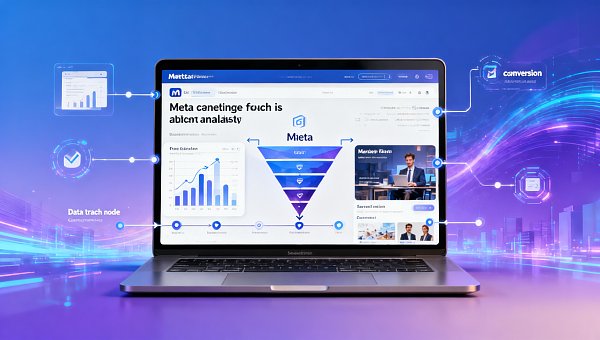
Many accounts perform unstably, and the problem is often not the bid, but that the initial framework was not set up correctly. The first step in Meta advertising techniques is to clarify whether the five links of “goal—audience—creative—landing page—data feedback” are aligned. If any one link is disconnected, CTR, form submission rate, and conversion cost will all be affected.
Confirm 3 basic conditions before setting up an account
The first is the business goal. Common goals can be divided into 4 categories: brand exposure, website visits, form submissions, and WhatsApp inquiries. The second is asset completeness, including BM, ad account, public page, pixel, or CAPI. The third is the site’s conversion capacity, especially that landing page loading speed is recommended to be controlled within 3 seconds, and the core form fields should preferably be kept to 3–5 items.
Account preparation items often overlooked by operators
- Whether domain verification has been completed, to avoid restrictions on event priority configuration.
- Whether the pixel and Conversion API are synchronized, to reduce data loss caused by browser blocking.
- Whether the ad account currency and time zone are consistent with billing and reporting standards.
- Whether the website privacy policy, Cookie notice, and form thank-you page are all in place.
To make execution clearer, the table below can be used as a preliminary setup checklist. For new accounts, it is recommended to verify each item one by one before launch, which usually reduces 20%–30% of low-level errors, especially for multi-person collaboration or cross-regional advertising projects.
Judging from execution results, ad backend settings are only the beginning; what truly affects conversions is coordination inside and outside the site. Only after website construction, data tagging, and advertising strategy are fully connected can Meta advertising techniques upgrade from “knowing how to operate” to “being able to scale steadily.”
Targeting strategy: segment first, then test
The most common mistake beginners make is narrowing the audience too much from the start. For B2B website customer acquisition, it is recommended to first establish a 3-layer structure: cold-start expansion layer, interest testing layer, and remarketing conversion layer. Prepare at least 2–3 ad sets for each layer, run them continuously for 3 to 5 days, and then screen them based on click-through rate and conversion cost.
If the budget is limited, the daily budget for a single ad set can be controlled within the common testing range of 50–200 yuan, prioritizing observation of CTR, CPC, and LPV instead of focusing only on final transactions. Because within the first 7 days, the system needs learning signals more, and shutting campaigns off too early often leads to distorted judgment.
Creatives and copy: design around conversion actions
In Meta advertising techniques, creatives usually determine “whether anyone stops to look,” while the landing page determines “whether they will submit.” It is recommended to test images and short videos simultaneously, with at least 3 sets of creatives, 2 copy angles, and 1 clear CTA in each round. For website building, SEO, and overseas promotion services, the copy can focus on delivery cycle, applicable scenarios, and the completeness of the service chain.
For example, at the operational level, you can use a 3-part structure of “problem introduction + solution explanation + call-to-action button.” If promoting independent site website-building services, the above-the-fold copy should clearly state information such as “supports multiple languages,” “can integrate with CRM,” and “compatible with pixel/CAPI,” rather than staying at a vague brand introduction level.
Meta advertising optimization checklist: from data judgment to action implementation
After entering the optimization stage, many operators fall into the misunderstanding of “making frequent changes whenever they see fluctuations.” In actual practice, a more effective method is to establish a fixed optimization cycle. A common rhythm is to check spend every 24 hours, clicks and visits after 3 days, lead quality after 7 days, and then evaluate after 14 days whether to scale or switch strategy.
Which metrics to review first to avoid misjudgment
If CTR is below 1%, it is usually necessary to first check the appeal of the creative and the opening sentence of the copy; if CPC is high but CTR is still acceptable, audience competition may be intense; if there are many clicks but the form submission rate is lower than 3%, the landing page is often inconsistent with the ad promise. The key to Meta advertising techniques is not looking at one metric, but identifying where the break point is in the chain.
The optimization checklist below is more suitable for daily review. Whether it is an agency operations team or an in-house media buyer, both can establish unified weekly review standards to reduce the situation of “adjusting the account by gut feeling.”
Judging from review experience, 80% of optimization problems can be found in the 4 dimensions of “creative, audience, page, and data.” Only by clearly locating the problem first and then conducting small-step tests can the ad system’s learning efficiency improve.
A 4-step optimization method suitable for operators
- First lock in the target metric, such as cost per lead, valid inquiry rate, or appointment rate.
- Change only 1 variable each time, for example, only replace the creative without changing the audience, to avoid causal confusion.
- Keep each round of testing for at least 3 days with a stable budget, and avoid drawing a conclusion and overturning it on the same day.
- Output a weekly review report, recording CTR, CPC, CVR, form volume, and invalid rate.
Which situations are suitable for scaling
When an ad set has stable conversions for 3 consecutive days, cost fluctuations do not exceed 15%, and lead quality is acceptable, you can try gradually increasing the budget by 10%–20%. If you double it all at once, it is easy to disrupt the learning rhythm. For B2B services, before scaling, you should also synchronously check the sales team’s follow-up capacity to avoid lead backlog.
Website and advertising coordination is the real conversion optimization
In integrated website + marketing service scenarios, advertising is only the entry point; what truly creates differentiation is downstream funnel construction. For example, multilingual landing pages, industry-specific case pages, automatic form routing, CRM feedback, and remarketing triggers all directly affect whether Meta advertising techniques can be converted into stable ROI.
Experienced execution teams often push ad delivery and on-site optimization forward in parallel. For example, checking landing page drop-off points once every 2 weeks, sorting search terms and user inquiry questions once a month, and then updating creative angles in reverse based on that. This closed-loop approach is more effective than simply relying on bid adjustments in the backend.
Common misunderstandings and risk reminders
- Only copying competitors’ creatives without aligning them with your own website conversion logic can easily result in clicks but poor inquiries.
- Over-pursuing low-cost leads while ignoring invalid forms and the sales team’s follow-up rate.
- Frequently modifying events, placements, and audiences, causing the learning phase to reset repeatedly.
- Ignoring data accumulation and failing to build a remarketing pool, resulting in low efficiency for secondary touchpoints.
In marketing management practice, many teams improve process standardization with the help of cross-domain methods. For example, materials centered on organizational collaboration and execution mechanisms can also inspire advertising teams to optimize division of labor and review systems. If an enterprise is improving its internal execution system, it can refer to Discussion on Human Resource Management Optimization Strategies for New-Era Labor Dispatch Agencies for process governance ideas, drawing on its inspirational value in job coordination and management optimization.
How to build a replicable Meta campaign execution mechanism
Truly mature Meta advertising techniques are not about one ad occasionally performing well, but whether the team can continuously replicate results. It is recommended that enterprises establish a 3-layer mechanism of “weekly checks, monthly reviews, and quarterly upgrades.” Weekly checks focus on data anomalies, monthly reviews focus on lead quality and channel mix, and quarterly upgrades focus on systematic optimization of pages, tools, and attribution chains.
Execution checklist suitable for B2B teams
If you are responsible for integrated website building, SEO, and advertising projects, it is recommended to fix at least 6 actions: check pixel status, review ad set performance, update the creative library, optimize high-bounce pages, synchronize sales feedback, and supplement remarketing audiences. In this way, campaign management can be upgraded from a single-media operation to a full-chain growth action.
E-Marketing Easy Information Technology (Beijing) Co., Ltd. has long served global growth scenarios, and its advantage lies in coordinating website building, SEO, social media, and advertising. For operators, this means there is no need to handle Meta ads in isolation; instead, within the same growth framework, data accuracy, page conversion capacity, and lead conversion efficiency can all be improved.
If you want to truly implement Meta advertising techniques as a standardized process, the focus is not on “learning a few buttons,” but on building a complete closed loop from account setup, targeting, creatives, and pages to data review. This can not only reduce trial-and-error costs, but is also more suitable for B2B enterprises to steadily acquire overseas traffic and high-quality inquiries.
If you want to further develop a delivery plan based on your own industry, site structure, and budget scale, it is recommended to sort out your current account and website data as soon as possible to obtain an execution path that is more closely aligned with your business goals. If you need integrated website building and marketing coordination support, contact us now to get a customized solution and learn more about our solutions.
Related Articles
 How Can Google Ads Personalize Content for Every User? One Feature That Doubles Your Inquiry Volume
 Why a Google-optimized independent website is essential for trailer exports
 How Can a Brand Updates Page Be Made More SEO-Friendly? Analysis of Update Frequency, Content Structure, and Internal Linking Strategy


Related Products
 EasyCamp SaaS Smart Website Marketing SystemE-Yingbao SaaS Smart Website Marketing System: AI-powered, zero-code website building. Rapidly launch multilingual independent e-commerce sites in just 10 minutes. Global server acceleration and AI-driven SEO optimization empower businesses to efficiently connect with global markets. The seamless integration of technology and user-friendly operation makes building e-commerce sites incredibly simple.
 AI+SEM Intelligent Advertising Marketing SystemAI+SEM drives intelligent ad creation, empowering full-funnel precision advertising marketing. The system automatically generates weekly/monthly reports, AI recommends keywords and target countries, monitors core metrics in real-time with intelligent alerts, and enables one-click high-conversion ad solutions to help quickly acquire customers and improve ROI.
 AI+SEO Dual Engine Optimization ServiceEasyWin AI+SEO Dual Engine Optimization System leverages AI-powered keyword mining, content generation, and comprehensive technical optimization to help foreign trade enterprises acquire high-quality organic traffic, significantly improving search rankings and conversion rates.
 AI+SNS Social Media Marketing SystemYingbao AI+SNS Social Media Marketing System - Precision social capture for the social media era. Supports one-click content synchronization across major platforms like Facebook and LinkedIn. AI intelligently rewrites posts for enhanced relevance. 24/7 AI customer service and user profiling analysis empower businesses to efficiently expand into global markets.
 AI+SEO营销解决方案易营宝AI+SEO营销解决方案,通过AI批量写作、智能生成TDK、精准关键词扩词等功能,全面优化网站SEO效果,提升流量与转化率。助力企业构建高效智能网站新生态。
 AI+SEM Advertising Marketing SolutionsAI+SEM Advertising Marketing Solution leverages AI technology to deeply empower SEM ad campaigns. It automatically generates weekly/monthly reports using AI, presenting account data across multiple dimensions for comprehensive insights into campaign performance and trends. The system precisely recommends keywords and target countries, intelligently generates high-conversion ad copy, and enables one-click activation of efficient campaign plans to help businesses rapidly acquire customers. Simultaneously, it monitors core metrics in real time, intelligently identifies abnormal fluctuations, and issues timely alerts to ensure stable, high-return advertising results.
 Domain Name ServicesEasyWin provides professional domain name services, including intelligent queries, one-stop registration, brand protection, and full lifecycle management, helping businesses build a digital brand image.
 EasyOperate B2C Cross-Border E-Commerce Platform & Independent WebsiteEasyStore B2C Cross-border E-commerce Independent Store is an intelligent website building and cross-border e-commerce integrated solution independently developed by EasyStore Information Technology (Beijing) Co., Ltd. The system is specially designed for small and medium-sized as well as large export enterprises, integrating 'website building, operation, marketing, advertising, and conversion' into one, helping enterprises quickly establish cross-border e-commerce independent stores to achieve brand globalization and global sales growth.
The platform supports multiple languages, multiple currencies, and multi-channel marketing, with built-in AI intelligent translation and SEO optimization systems, suitable for mainstream markets such as Southeast Asia, Europe and America, Latin America, and the Middle East, assisting Chinese manufacturing enterprises in efficiently deploying international e-commerce strategies. SSL证书易营宝提供专业SSL安全证书服务,包括单域名和泛域名证书,确保网站数据传输加密、身份验证和完整性保护,助力企业建立安全可信的在线业务环境。









