









- What New Signals Are Emerging in Enterprise Services SaaS Marketing ReportsJul 27, 2026View details
- What Does a Global Traffic Ecosystem Service Provider Do? What Are the Differences from a Single Advertising AgencyJul 16, 2026View details
- What should you focus on in the latest enterprise SaaS report? From renewal rates and delivery costs to overseas growth opportunitiesJul 12, 2026View details
- What signals are worth paying attention to in a cross-border marketing trend report? B2B companies should look at these 6 signalsJul 11, 2026View details
- How to Read a Cross-Border Marketing Trends Report? Five Key Dimensions for Evaluating Channel OpportunitiesJul 11, 2026View details
- Which channel has the highest ROI in the global traffic ecosystem? Comparative analysis of search, social media, and advertisingJul 10, 2026View details
- What multilingual website services are available in Sanya? Which model is more suitable for local businesses going global?Jul 08, 2026View details
- How to view the complete list of China SaaS companies in the top 100? Practical methods for screening website-building and marketing service providersJul 08, 2026View details
How Can a Facebook Marketing Strategy Balance Inquiry Volume
If you want your Facebook marketing strategy to deliver both exposure and more inquiries, the key is not to “post more content” or “simply increase the ad budget,” but to align Facebook advertising strategy, SEO content optimization, and multilingual website development. For most businesses, what truly affects inquiry volume is often not the traffic itself, but whether the traffic is targeted, whether the landing page can effectively receive and convert visitors, whether the lead form is low-friction enough, and whether follow-up is timely. This article will combine real-world scenarios to break down a social media marketing strategy that is better suited for business growth, helping both business managers and execution teams clearly understand ROI and practical implementation methods.
Why do many companies run Facebook marketing but still fail to generate stable inquiries?
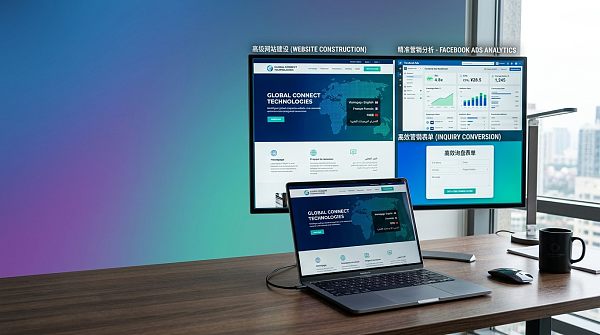
When users search for “how a Facebook marketing strategy can balance inquiry volume,” their core intent is usually not to learn the platform’s basics, but to solve a very practical problem: why money was spent, content was created, and exposure was gained, yet no effective business opportunities were generated in the end.
From a business-results perspective, if Facebook marketing is expected to deliver both brand exposure and inquiry growth, the common challenges are mainly concentrated in 4 areas:
- Untargeted traffic: The ads reach many people, but not those with purchasing intent, partnership intent, or actual demand.
- Disconnected content and conversion: The posts are too focused on brand promotion and lack clear calls to action, so users do not know what to do next after reading.
- Weak website conversion support: After clicking into the website, users encounter slow loading, language mismatch, or incomplete product information, leading to drop-off.
- Incomplete lead management: Even when form submissions are obtained, weak allocation, follow-up, and qualification mechanisms still waste inquiries.
Therefore, businesses need to make one thing clear: Facebook is not an isolated customer acquisition tool; it is more like a “front-end amplifier” in the lead growth chain. If traffic acquisition, content persuasion, website conversion, and sales follow-up are not connected, it is difficult for inquiry volume to improve steadily.
How should a Facebook marketing strategy that truly balances exposure and inquiries be built?
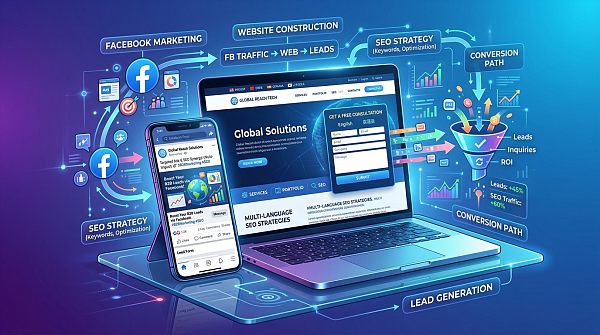
If the target readers are business decision-makers, what they usually care about most is whether the investment is worthwhile, which approach is more stable, and how soon results can be seen. If they are execution teams, they care more about how to break actions down and optimize data. To meet both needs, it is recommended to build a Facebook marketing system in six steps: “goal — audience — content — page — conversion — review.”
1. Start by distinguishing goals: brand exposure and inquiry conversion cannot rely on just one set of ads
The problem for many businesses is this: they want ads to bring massive exposure while also expecting the same batch of ads to directly generate high-quality inquiries. In reality, the delivery logic for these two goals is not exactly the same.
A more reasonable approach is to set them up in layers:
- Exposure layer: Use videos, industry insights, and application scenario content to expand reach among target customers.
- Engagement layer: Build trust through case studies, comparisons, FAQs, and customer reviews.
- Conversion layer: Capture clear demand through lead form ads, Messenger inquiries, WhatsApp guidance, and landing page inquiry buttons.
This structure can take care of both new-customer education and high-intent customer conversion, rather than forcing all content to bear the pressure of “closing deals immediately.”
2. Redefine the audience: do not look for “more people,” look for “people more likely to inquire”
For manufacturing, services, cross-border business, or channel business, audience settings in a Facebook advertising strategy directly affect inquiry quality. It is recommended to divide audiences into at least the following categories:
- Core industry audience: Target potential purchasing or partnership groups by industry, role, interests, and behavioral tags.
- Retargeting audience: People who visited the official website, watched videos, or interacted with the page but did not inquire.
- Lookalike audience: Expanded based on historical customer data or high-quality leads.
- Regional audience: Segment delivery by country, language, and market maturity.
This is especially important in multilingual markets, where user concerns vary greatly by region. For example, some markets care more about certifications and lead times, while others care more about price and after-sales support. If ad creatives and landing page language or value propositions are inconsistent, the inquiry rate will drop significantly.
3. A content strategy should serve conversion, not just “maintain updates”
Many businesses easily fall into the mindset of “daily updates” when planning a social media marketing strategy, but content that truly increases inquiries usually has stronger decision-support value. It is recommended to focus on the following content types:
- Case-study content: Show customer scenarios, problems, solutions, and results.
- Comparison content: Help users quickly understand differences between products or solutions.
- Professional Q&A content: Address concerns about quality, delivery, after-sales service, compatibility, security, and more.
- Trust-building content: Qualifications, certifications, factory strength, team experience, and customer reviews.
- Guidance content: Clearly tell users they can “inquire now,” “get a solution,” “book a demo,” or “get a quote.”
If a business is also investing in official website SEO, then Facebook content and SEO content optimization should work together. For example, FAQs, industry solution pages, and case-study pages on the official website with high search intent can be adapted into Facebook posts and ad creatives, while topics that perform well in Facebook engagement can in turn be incorporated back into the official website. This makes it easier to form a sustainable customer acquisition loop.
If you want to increase inquiry volume, why are website conversion support and multilingual development more important than “ad placement tactics”?
Many businesses focus their attention on ad click-through rates, while overlooking that what truly determines the inquiry rate is the website experience after the click. Especially for B2B business, channel partnerships, and after-sales-support-oriented business, the website is not just a display page, but also a conversion page, trust page, and qualification page.
1. Landing pages must solve the user’s core decision-making questions
A qualified Facebook landing page is not about piling up as much company introduction as possible, but about quickly answering the questions users care about most:
- What can you provide, and for what scenarios is it suitable?
- Compared with similar solutions, what are your advantages?
- Do you have real case studies, qualifications, or data to support your claims?
- If I inquire now, what kind of response can I get?
If the target audience includes quality control personnel, safety managers, and after-sales maintenance staff, they usually care more about product stability, compliance, maintenance efficiency, and response mechanisms. Therefore, the page must reflect this information rather than only emphasizing “brand strength.”
2. Multilingual website development directly affects inquiry cost
For companies acquiring customers globally, multilingual website development is not just an added bonus, but the foundation for whether a Facebook marketing strategy can truly be implemented effectively. The reason is simple: after users click in from Facebook, if the page is not in a language they are familiar with, or if the localized wording feels unnatural, then even if there is demand for the product, their willingness to inquire will decrease significantly.
An effective multilingual website is not just about simple translation, but about localized adaptation, including:
- Headlines and value propositions that match local purchasing habits
- Concise form fields that do not increase comprehension barriers
- Case studies, qualifications, and service commitments that better fit local market concerns
- Stable mobile loading speed to avoid high bounce rates
For decision-makers, this means that with the same ad budget, strong website conversion support can significantly reduce the cost per inquiry and improve the sales team’s efficiency in handling valid leads.
3. Do not make inquiry forms too long; first reduce the user’s action threshold
If a form requires too much information from the start, users are very likely to give up. This is especially true for cold traffic brought by Facebook, which is more suitable for a “light form + follow-up qualification” mechanism. Prioritize keeping basic fields such as name, contact information, country/region, and demand type, and then let sales or customer service supplement the details later.
From the perspective of internal business management, this approach is actually consistent with budgeting and resource allocation thinking. Many businesses, when investing in growth, also need to streamline their marketing process just as they streamline their operating logic. Similar to what content such as Analysis of improved approaches to comprehensive budget management for manufacturing enterprises under strategy-driven development emphasizes, the essence is also to improve overall output efficiency through systematic resource allocation. Customer acquisition marketing is no different: you cannot focus only on isolated actions, but must look at full-chain coordination.
What optimization actions should execution teams focus on most to make Facebook leads more stable?
For hands-on operators, increasing inquiry volume does not necessarily require a one-time major overhaul. In many cases, continuously optimizing a few key points can significantly improve results.
1. Prepare at least 3 different messaging directions for ad creatives
Do not make all creatives in the same style. It is recommended to run A/B tests around the following directions:
- Pain-point angle: directly point out industry problems
- Results angle: emphasize improved efficiency, lower costs, and shorter delivery cycles
- Trust angle: certifications, case studies, cooperative clients, and reputation feedback
During execution, do not focus only on click-through rate. Also look at the form submission rate, valid inquiry rate, and likelihood of later conversion brought by different creatives.
2. Establish retargeting rules for “high-intent actions”
Compared with ordinary browsers, people who have viewed key pages, stayed longer, clicked contact methods, or interacted with Messenger usually have a higher probability of conversion. It is recommended to set up separate retargeting ads and strengthen messages such as:
- Limited-time consultation or fast-response commitment
- Free samples, information packs, quotations, and solutions
- More specific scenario case studies and usage results
This kind of strategy is especially effective for after-sales maintenance, channel cooperation, equipment-related, and system service businesses, because user decision-making is often not completed in one step, but only after multiple touchpoints do they initiate an inquiry.
3. Lead classification and follow-up mechanisms are more important than “getting a few more forms”
If a business already has a certain advertising foundation, the next step should not be simply chasing lead quantity, but improving lead handling quality. It is recommended to establish the following mechanisms:
- Segment by source: ad forms, website forms, Messenger, WhatsApp
- Segment by intent: immediate purchase, comparing options, research stage, channel cooperation
- Segment by market: different countries and regions should be followed up by corresponding language-speaking staff
- Segment by timeliness: high-intent leads should be prioritized for response within a short period
For many businesses, the inquiry problem is not “unable to get them,” but “unable to handle them well.” Without a sound follow-up process, no matter how much front-end advertising is optimized, it is still difficult to achieve sustainable growth.
How should business managers judge whether Facebook marketing is worth continued investment?
For management, judging whether a Facebook marketing strategy is effective cannot rely only on exposure or follower count. It must be evaluated by whether it can enter the company’s growth system and bring measurable business value.
It is recommended to evaluate it from the following dimensions:
- Lead quality: Whether it can bring target customers rather than invalid inquiries.
- Inquiry cost: Whether the cost per lead is within an acceptable range and still has room for optimization.
- Conversion chain: Whether the path from ad to website to inquiry to deal can be tracked and attributed.
- Market fit: Whether successful experience can be replicated across different regions, languages, and product lines.
- Collaboration efficiency: Whether it forms linkage with SEO content, multilingual websites, and the CRM follow-up system.
If a business already has a certain official website foundation and content accumulation, then Facebook is often not an isolated new cost, but a channel that amplifies the efficiency of existing marketing assets. Conversely, if website conversion support is weak, content is insufficient, and sales response is slow, simply increasing the ad budget alone usually does not produce ideal results.
From a long-term operations perspective, businesses should not pursue only short-term “traffic spikes” when doing Facebook marketing, but should build a more stable customer acquisition structure. Just like the systematic management mindset emphasized in Analysis of improved approaches to comprehensive budget management for manufacturing enterprises under strategy-driven development, growth investment also requires clear goals, matched resources, and controllable processes, so that inquiry volume and business quality can improve together.
Summary: To balance exposure and inquiry volume, the core is not “invest more,” but “coordinate better”
If you want to summarize in one sentence how a Facebook marketing strategy can balance inquiry volume, it is this: use precise audiences and content to acquire highly relevant traffic, use multilingual websites and high-converting landing pages to capture demand, and then use clear follow-up mechanisms to turn traffic into business opportunities.
For execution teams, the focus is on optimizing audiences, creatives, pages, and retargeting. For management, the focus is on lead quality, ROI, and full-chain coordination capability. A truly effective social media marketing strategy is not about isolated tactics, but the result of the combined effect of advertising, SEO content optimization, website development, and sales conversion.
When businesses truly connect these parts, Facebook becomes not just an exposure channel, but also an important engine for steadily acquiring inquiries and supporting global growth.
Related Articles



Related Products
 EasyCamp SaaS Smart Website Marketing SystemE-Yingbao SaaS Smart Website Marketing System: AI-powered, zero-code website building. Rapidly launch multilingual independent e-commerce sites in just 10 minutes. Global server acceleration and AI-driven SEO optimization empower businesses to efficiently connect with global markets. The seamless integration of technology and user-friendly operation makes building e-commerce sites incredibly simple.
 AI+SEM Intelligent Advertising Marketing SystemAI+SEM drives intelligent ad creation, empowering full-funnel precision advertising marketing. The system automatically generates weekly/monthly reports, AI recommends keywords and target countries, monitors core metrics in real-time with intelligent alerts, and enables one-click high-conversion ad solutions to help quickly acquire customers and improve ROI.
 AI+SEO Dual Engine Optimization ServiceEasyWin AI+SEO Dual Engine Optimization System leverages AI-powered keyword mining, content generation, and comprehensive technical optimization to help foreign trade enterprises acquire high-quality organic traffic, significantly improving search rankings and conversion rates.
 AI+SNS Social Media Marketing SystemYingbao AI+SNS Social Media Marketing System - Precision social capture for the social media era. Supports one-click content synchronization across major platforms like Facebook and LinkedIn. AI intelligently rewrites posts for enhanced relevance. 24/7 AI customer service and user profiling analysis empower businesses to efficiently expand into global markets.
 AI+SEO营销解决方案易营宝AI+SEO营销解决方案,通过AI批量写作、智能生成TDK、精准关键词扩词等功能,全面优化网站SEO效果,提升流量与转化率。助力企业构建高效智能网站新生态。
 AI+SEM Advertising Marketing SolutionsAI+SEM Advertising Marketing Solution leverages AI technology to deeply empower SEM ad campaigns. It automatically generates weekly/monthly reports using AI, presenting account data across multiple dimensions for comprehensive insights into campaign performance and trends. The system precisely recommends keywords and target countries, intelligently generates high-conversion ad copy, and enables one-click activation of efficient campaign plans to help businesses rapidly acquire customers. Simultaneously, it monitors core metrics in real time, intelligently identifies abnormal fluctuations, and issues timely alerts to ensure stable, high-return advertising results.
 Domain Name ServicesEasyWin provides professional domain name services, including intelligent queries, one-stop registration, brand protection, and full lifecycle management, helping businesses build a digital brand image.
 EasyOperate B2C Cross-Border E-Commerce Platform & Independent WebsiteEasyStore B2C Cross-border E-commerce Independent Store is an intelligent website building and cross-border e-commerce integrated solution independently developed by EasyStore Information Technology (Beijing) Co., Ltd. The system is specially designed for small and medium-sized as well as large export enterprises, integrating 'website building, operation, marketing, advertising, and conversion' into one, helping enterprises quickly establish cross-border e-commerce independent stores to achieve brand globalization and global sales growth.
The platform supports multiple languages, multiple currencies, and multi-channel marketing, with built-in AI intelligent translation and SEO optimization systems, suitable for mainstream markets such as Southeast Asia, Europe and America, Latin America, and the Middle East, assisting Chinese manufacturing enterprises in efficiently deploying international e-commerce strategies. SSL证书易营宝提供专业SSL安全证书服务,包括单域名和泛域名证书,确保网站数据传输加密、身份验证和完整性保护,助力企业建立安全可信的在线业务环境。









