









- The China-US tariff arrangement has reached a preliminary consensus, and the trade association will be establishedJun 15, 2026View details
- China-Morocco zero-tariff access, a breakthrough in the cost of Moroccan goods exports to ChinaJun 11, 2026View details
- What signal should be released for the suspension of exports to JapanJun 10, 2026View details
- China's May LNG imports rebounded, with increased volumes from Russia and Canada filling the Middle East supply gapJun 10, 2026View details
- Will GEO change its SEO strategy?Jun 04, 2026View details
- What types of businesses are end-to-end solutions suitable for?Jun 03, 2026View details
- 2026 Global Growth Channel TrendsJun 02, 2026View details
- Changes in Search Engine Ranking Factors in 2026Jun 06, 2026View details
How to Control Costs in YouTube Advertising
Many businesses, when running YouTube ads, aren't really worried about whether they can run them, but rather about the rapid spending and unstable inquiries. The core answer to "how to control costs in YouTube advertising" isn't complicated: first, reduce ineffective impressions; second, capture high-intent traffic; and finally, use data analysis to continuously reduce trial-and-error costs. For business decision-makers, the key is whether the return on investment (ROI) is controllable; for those executing the campaign, the key is whether account structure, targeting, audience segmentation, creative testing, and conversion tracking are in place. Especially in the context of integrated website and marketing services, YouTube advertising isn't a standalone action, but rather works in conjunction with landing page integration, SEO strategy, and remarketing strategies for more effective cost control.
First, determine: where exactly does the high cost of YouTube advertising stem from?

Many teams, when discussing cost control, immediately try to lower bids, often resulting in even worse traffic quality and less stable conversions. In reality, uncontrolled YouTube advertising costs are usually not caused by a single factor, but rather by a combination of the following:
- Overly broad targeting : While it may seem to gain more exposure, it actually reaches a large number of people with low interest.
- Content that doesn't match the audience : If it doesn't grab people's attention in the first 5 seconds, the skip rate is high, resulting in wasted budget.
- Long conversion paths : Slow-loading landing pages, unclear content, and complex forms after clicking on ads will all increase customer acquisition costs.
- Lack of data-driven analysis : It's unclear whether the problem lies with the advertising, the website, or the target audience; the only recourse is to repeatedly "burn through budgets and try and fail."
- Focusing solely on views, ignoring conversion rates : Impressive video data does not equate to high-quality inquiries, sales, and follow-up.
Therefore, the right approach to reducing YouTube advertising costs is not simply to "save the budget," but to focus the budget on the most likely conversion-oriented audiences and the most effective processes. This is especially important for manufacturing, B2B wholesale, and overseas brand expansion companies, because their customer decision-making chains are longer, and advertising is merely the starting point, not the end point of the transaction.
The first step in cost control: refine your target audience, rather than expanding it too much.
Precise targeting is always the primary lever for controlling YouTube advertising costs. No matter how much traffic the system gives you, if it's not to the right people, subsequent clicks, views, and inquiries will be difficult to achieve.
We recommend prioritizing optimization in the following areas:
- Segment your target audience by business objectives . Don't mix brand exposure, inquiry generation, and remarketing in one ad group. Exposure-oriented audiences can be broader, while conversion-oriented audiences must be more precise.
- Prioritize testing high-intent audiences , such as custom audiences related to industry keywords, competitor channel audiences, users who have visited the official website, and users with product-related search behavior. These audiences are usually more cost-effective than general interest audiences.
- Targeting by region and language : For global operations, using a single creative approach across all markets often leads to ineffective exposure. Different countries, languages, and purchasing habits should be considered separately.
- Remove low-quality traffic promptly . For users who watch for very short periods, have no interaction, and do not make any subsequent visits, you can reduce repeated contact with them.
For business managers, the significance of targeted optimization lies in ensuring that each budget is as close as possible to the target customers, rather than blindly expanding coverage. For operators, it's crucial to focus on view rates, click-through rates, bounce rates, and conversion rates for different audience segments, avoiding judgments based solely on experience.
The second step in cost control: video materials are not necessarily better the more "advanced" they are, but rather the more "matched" they are to the budget.
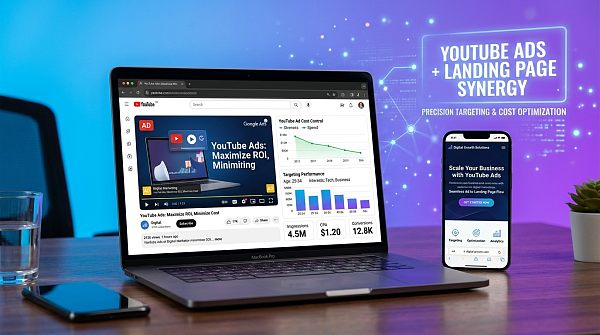
Many businesses invest heavily in YouTube video marketing, but the results are often mediocre. The reason isn't that the videos aren't "expensive enough," but rather that they don't align well with the customer's decision-making logic. Content that helps you control costs typically possess three characteristics:
- Be direct at the beginning : In the first 3 to 5 seconds, let the target audience know that "this content is relevant to me".
- Focus your information : Don't explain all the product advantages in one video, but rather focus on a single conversion point.
- The action guidance is clear enough : it tells users what to do next, such as viewing the plan, getting a quote, scheduling a demonstration, or contacting an advisor.
From a cost control perspective, a "small steps, quick progress" material strategy is recommended:
- First, test different selling points using multiple short versions;
- Filter out versions with better completion rates, click-through rates, and conversion rates;
- Focus the budget on amplifying the winning materials;
- Regularly replace content that may cause fatigue, to prevent the same group of users from repeatedly viewing the same content.
For example, B2B companies can test several aspects separately, such as "factory strength," "delivery cycle," "certifications," "after-sales support," and "success stories," instead of creating a long brand promotional video from the outset. The advantage of doing this is that it allows them to quickly find the content angles that truly influence conversion with lower trial-and-error costs.
Don't overlook landing pages: Advertising costs are high, and it's often the landing pages that miss out on orders.
Whether YouTube ad spending is controllable cannot be determined solely by monitoring the ad backend. Many accounts may appear to have low cost-per-click, but the final cost of generating leads can be very high, and the problem often lies with the landing page.
A common scenario is that ads attract users, but slow page loading, language incompatibility, disorganized content structure, and unclear inquiry entry points ultimately lead to wasted traffic. This is especially true when promoting overseas; if the website itself lacks multilingual support, speed optimization, and conversion tracking capabilities, even the most targeted advertising will struggle to maintain stable overall customer acquisition efficiency.
This is why more and more companies are starting to integrate advertising, website hosting, and SEO. For example, websites with global acceleration, multilingual management, and marketing loop analysis capabilities are more effective in reducing click-through rates. Take YiYingBao's foreign trade marketing (super) website as an example. It supports 100+ languages, can control loading time to within 1.5 seconds, and has SEO optimization and data analysis capabilities. This kind of infrastructure is crucial for controlling costs in YouTube advertising: it's not about letting you "invest more," but about making existing traffic less likely to be wasted.
How can we use data to review and transform budgeting from a process of trial and error to one of optimization?
Truly mature cost control isn't about a single successful price adjustment, but about establishing a continuous optimization mechanism. It's recommended to review the process from at least the following aspects:
- Traffic layer : Are the exposure, CPV, view count, and click-through rate healthy?
- Page layer : Are there any abnormalities in visit duration, bounce rate, form submission rate, and click rate of the inquiry button?
- Conversion layer : number of inquiries, effective inquiry rate, sales follow-up feedback, and whether the transaction cycle matches expectations.
- Market level : Are there significant cost differences across different countries, industries, and language versions?
Here's an often overlooked issue: some ads generate leads, but the quality is low, and the sales team finds they aren't real customers after follow-up. In this case, focusing solely on front-end conversion rates can easily lead to misjudgments about the effectiveness of creative materials and target audiences. Therefore, businesses should ideally integrate ad data with back-end sales feedback to create a more comprehensive basis for judgment.
If a business is simultaneously optimizing Facebook advertising and search engine optimization (SEO), it's advisable to view these different channels within the same conversion framework. Many users don't "buy immediately after watching a YouTube video," but rather are first drawn in by the video, then search for the brand on Google, visit the official website, and make a follow-up visit before converting. From a management perspective, what's truly important is not the surface-level data of a single channel, but rather the customer acquisition efficiency of the entire marketing journey.
In practice, the five cost control measures that businesses should prioritize implementing are:
If you want to improve YouTube ad costs as quickly as possible, prioritize the following actions:
- Restructure your advertising campaign by objectives . Separate and manage brand exposure, traffic acquisition, remarketing, and inquiry conversion to avoid mixing budgets.
- Test only one variable at a time . Test the creative first, then the audience, then the landing page to avoid making too many changes at the same time, which would make it impossible to determine the cause.
- Establish a rejection and exclusion mechanism to exclude low-quality audiences, inefficient regions, and poorly performing ad placements, thereby reducing ineffective spending.
- Improve site capacity <br />Ensure page loading speed, mobile experience, multi-language compatibility, and clear conversion entry points to reduce click loss.
- Set up a weekly review mechanism . Instead of waiting until the budget is exhausted to summarize, review cost fluctuations, material fatigue, and market differences on a weekly basis.
For foreign trade and overseas-oriented companies, if their websites haven't been fully upgraded with multilingual support, localization, SEO fundamentals, and marketing data tracking, it's difficult to keep advertising costs low in the long run. This is because the value of traffic acquired online ultimately depends on the website's performance and subsequent conversion loop. Many companies at this stage simultaneously upgrade their website infrastructure, for example, by using solutions like YiYingBao's Foreign Trade Marketing (Super) Website , which supports AI-powered website building, multilingual maintenance, and marketing loop analysis, shortening the development cycle and improving post-campaign conversion rates.
In summary, controlling costs in YouTube advertising isn't as simple as "lowering bids." It requires systematic optimization around precise targeting, creative matching, landing page execution, and data analysis. Business decision-makers need to focus on ROI and the replicability of processes, while execution personnel must analyze the data at each traffic node. Only when advertising, website, content, and conversion tracking form a closed loop will the budget not be passively consumed but truly transformed into stable growth.
Related Articles



Related Products
 EasyCamp SaaS Smart Website Marketing SystemE-Yingbao SaaS Smart Website Marketing System: AI-powered, zero-code website building. Rapidly launch multilingual independent e-commerce sites in just 10 minutes. Global server acceleration and AI-driven SEO optimization empower businesses to efficiently connect with global markets. The seamless integration of technology and user-friendly operation makes building e-commerce sites incredibly simple.
 AI+SEM Intelligent Advertising Marketing SystemAI+SEM drives intelligent ad creation, empowering full-funnel precision advertising marketing. The system automatically generates weekly/monthly reports, AI recommends keywords and target countries, monitors core metrics in real-time with intelligent alerts, and enables one-click high-conversion ad solutions to help quickly acquire customers and improve ROI.
 AI+SEO Dual Engine Optimization ServiceEasyWin AI+SEO Dual Engine Optimization System leverages AI-powered keyword mining, content generation, and comprehensive technical optimization to help foreign trade enterprises acquire high-quality organic traffic, significantly improving search rankings and conversion rates.
 AI+SNS Social Media Marketing SystemYingbao AI+SNS Social Media Marketing System - Precision social capture for the social media era. Supports one-click content synchronization across major platforms like Facebook and LinkedIn. AI intelligently rewrites posts for enhanced relevance. 24/7 AI customer service and user profiling analysis empower businesses to efficiently expand into global markets.
 AI+SEO营销解决方案易营宝AI+SEO营销解决方案,通过AI批量写作、智能生成TDK、精准关键词扩词等功能,全面优化网站SEO效果,提升流量与转化率。助力企业构建高效智能网站新生态。
 AI+SEM Advertising Marketing SolutionsAI+SEM Advertising Marketing Solution leverages AI technology to deeply empower SEM ad campaigns. It automatically generates weekly/monthly reports using AI, presenting account data across multiple dimensions for comprehensive insights into campaign performance and trends. The system precisely recommends keywords and target countries, intelligently generates high-conversion ad copy, and enables one-click activation of efficient campaign plans to help businesses rapidly acquire customers. Simultaneously, it monitors core metrics in real time, intelligently identifies abnormal fluctuations, and issues timely alerts to ensure stable, high-return advertising results.
 Domain Name ServicesEasyWin provides professional domain name services, including intelligent queries, one-stop registration, brand protection, and full lifecycle management, helping businesses build a digital brand image.
 EasyOperate B2C Cross-Border E-Commerce Platform & Independent WebsiteEasyStore B2C Cross-border E-commerce Independent Store is an intelligent website building and cross-border e-commerce integrated solution independently developed by EasyStore Information Technology (Beijing) Co., Ltd. The system is specially designed for small and medium-sized as well as large export enterprises, integrating 'website building, operation, marketing, advertising, and conversion' into one, helping enterprises quickly establish cross-border e-commerce independent stores to achieve brand globalization and global sales growth.
The platform supports multiple languages, multiple currencies, and multi-channel marketing, with built-in AI intelligent translation and SEO optimization systems, suitable for mainstream markets such as Southeast Asia, Europe and America, Latin America, and the Middle East, assisting Chinese manufacturing enterprises in efficiently deploying international e-commerce strategies. SSL证书易营宝提供专业SSL安全证书服务,包括单域名和泛域名证书,确保网站数据传输加密、身份验证和完整性保护,助力企业建立安全可信的在线业务环境。









