









- What Does a Global Traffic Ecosystem Service Provider Do? What Are the Differences from a Single Advertising AgencyJul 16, 2026View details
- What should you focus on in the latest enterprise SaaS report? From renewal rates and delivery costs to overseas growth opportunitiesJul 12, 2026View details
- What signals are worth paying attention to in a cross-border marketing trend report? B2B companies should look at these 6 signalsJul 11, 2026View details
- How to Read a Cross-Border Marketing Trends Report? Five Key Dimensions for Evaluating Channel OpportunitiesJul 11, 2026View details
- Which channel has the highest ROI in the global traffic ecosystem? Comparative analysis of search, social media, and advertisingJul 10, 2026View details
- What multilingual website services are available in Sanya? Which model is more suitable for local businesses going global?Jul 08, 2026View details
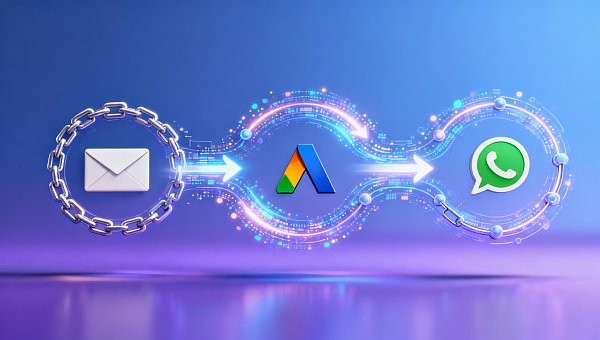
Attribution challenges in full-channel overseas marketing: the collaborative funnel of Email+WhatsApp+Google Ads
Attribution challenges in coordinated funnels across Email+WhatsApp+Google Ads in omnichannel overseas marketing
In omnichannel overseas marketing practices, conversion funnels jointly built by Email, WhatsApp, and Google Ads are facing core challenges such as unclear attribution, fragmented data, and difficulty quantifying ROI. This article directly addresses the pain points of business decision-makers and analyzes the root causes of failed cross-platform user journey tracking.
Why can 92% of foreign trade companies not clearly account for these three contributions?
When a Russian buyer first clicks on your Google Ads landing page, opens the Russian-language product catalog email you sent 3 days later, then sends “please send MOQ quotation” on WhatsApp 2 hours later, and finally places an order on the independent website—who should get credit for this order? Google Ads? Email marketing? Or WhatsApp customer service? In real scenarios, more than 90% of companies still use “last-click attribution” to allocate budgets in a rough manner, causing high-value touchpoints such as email nurturing and trust-building on WhatsApp to be undervalued over the long term.
Data from 10万+ overseas expansion clients served by Yiyingbao shows that companies using a single attribution model waste an average of 27% of their advertising budget on low-efficiency channels, while the quality of mid- to long-term inquiries brought by Email+WhatsApp coordination increases by 41%, yet these channels struggle to receive reasonable resource allocation because they cannot be properly attributed.
Three attribution gaps are eating away at your profits
The first gap: disconnected identity recognition. Google Ads tracks users through Cookies, email systems rely on email IDs, and WhatsApp is based on phone numbers—the three ID systems are completely isolated. When users switch across different devices, such as viewing ads on PC, checking email on mobile, and replying on WhatsApp, the system cannot recognize them as the same person.
The second gap: mismatched attribution windows. The default attribution window for Google Ads is 30 days, while B2B procurement decision cycles often last 60–90 days; email open rates peak within 2–4 hours after sending, but key actions such as inquiries and add-to-cart may occur on day 5; WhatsApp conversations often span several days or even weeks. Standard windows cannot cover the real decision chain.
The third gap: distorted behavior weighting. A single Google Ads click may cost as much as $8, but what truly builds trust may be 3 precise emails + 2 rounds of professional Q&A on WhatsApp. Existing tools cannot quantify soft value such as “answering questions to build trust,” causing channels with high ROI to have their budgets cut instead.
What decision-makers should care about most is not “how to attribute,” but “whether it is worth attributing”
Technically, UTM parameters + GA4 event tracking + WhatsApp Business API + email platform Webhook can be deployed, but the input-output ratio must be evaluated in advance. We recommend that business decision-makers quickly assess this with three questions:
① Does your core market have a strong private-domain operations foundation? For example, customers in Russian-speaking regions are more accustomed to communicating via WhatsApp, and email open rates exceed the industry average by 35%, in which case the value of a coordinated funnel is significant; if the target market, such as some Middle Eastern countries, has low WhatsApp penetration and weak trust in email, then prioritizing single-channel efficiency optimization is more practical.
② Does your sales cycle exceed 30 days? If the average deal cycle is <15 days, the error of last-click attribution is manageable; if it is >45 days, as with typical B2B manufacturing clients, a multi-touch attribution model must be introduced, otherwise the value of email nurturing and social media seeding will be systematically underestimated.
③ Can your technical infrastructure support data integration? Your self-built website needs to support API integration, compliant tracking setup, and GDPR/CPRA compatibility. Yiyingbao's cloud intelligent website building system has pre-integrated GA4, Meta Pixel, WhatsApp Business API, and email platform SDKs, shortening the average client deployment cycle to 72 hours and avoiding repeated investment of IT resources.
A practical solution: use “stage value anchors” instead of a “channel credit ledger”
Instead of getting tangled up in how much credit a certain click should receive, it is better to define the irreplaceable value of each channel within the user journey. The coordinated strategy we designed for manufacturing clients is as follows:
▶ Google Ads: position it as the “awareness initiator”—only evaluate first-visit volume, brand keyword search growth rate, and the proportion of landing page dwell time >120 seconds. Do not directly tie it to transactions, but require 30% of traffic to enter the email subscription flow.
▶ Email marketing: take on the role of “trust builder”—focus on monitoring the sequential open-rate decay curve of 3 nurturing emails, where the healthy value should be <15%, CTA button click heatmaps, and attachment download rates. For Russian-speaking customers, we especially strengthen the AI intelligent translation and Yandex optimization tools in Russian-language industry website development and marketing solutions to ensure high consistency between email content and local search results, thereby enhancing credibility.
▶ WhatsApp: act as the “last-mile driver”—set a “30-minute response SLA,” track the average time from the first message to sending the quotation, and set “quotation open rate” as the key indicator instead of simple reply rate. Data shows that the embedded PDF quotation open rate within WhatsApp is 2.3 times higher than email attachments.
Don’t let attribution challenges become your excuse for giving up coordination
The real attribution dilemma is essentially a lag in growth thinking. While companies are still debating “which channel should get the commission,” leaders have already shifted to “how to make the three channels jointly raise average order value.” A case from a Zhejiang auto parts factory served by Yiyingbao shows that after unified deployment of a coordinated funnel, customer LTV in the Russian-speaking market increased by 58%, not because a single channel was optimized, but because Google Ads attracted precise traffic → email delivered Russian-language CE certification documents to build a professional image → WhatsApp provided real-time answers to customs clearance details to drive decisions, with all three forming stacked value.
For decision-makers, the most practical move right now is not to wait for a perfect attribution system, but to immediately do three things: first, use UTM parameters to tag all channel sources; second, embed unique tracking links, such as short links + parameters, in Email and WhatsApp; third, include the “number of customers with cross-channel interactions within 30 days” in the monthly growth dashboard—this indicator reflects coordination health better than any attribution model.
The value of omnichannel overseas marketing has never lain in the number of channels, but in whether the channels can prove each other’s value. When you can clearly see that customers nurtured by email ask more professional questions on WhatsApp, and those questions in turn optimize the keyword strategy of Google Ads—you have already reached the end point of the attribution challenge.
Related Articles


Related Products
 EasyCamp SaaS Smart Website Marketing SystemE-Yingbao SaaS Smart Website Marketing System: AI-powered, zero-code website building. Rapidly launch multilingual independent e-commerce sites in just 10 minutes. Global server acceleration and AI-driven SEO optimization empower businesses to efficiently connect with global markets. The seamless integration of technology and user-friendly operation makes building e-commerce sites incredibly simple.
 AI+SEM Intelligent Advertising Marketing SystemAI+SEM drives intelligent ad creation, empowering full-funnel precision advertising marketing. The system automatically generates weekly/monthly reports, AI recommends keywords and target countries, monitors core metrics in real-time with intelligent alerts, and enables one-click high-conversion ad solutions to help quickly acquire customers and improve ROI.
 AI+SEO Dual Engine Optimization ServiceEasyWin AI+SEO Dual Engine Optimization System leverages AI-powered keyword mining, content generation, and comprehensive technical optimization to help foreign trade enterprises acquire high-quality organic traffic, significantly improving search rankings and conversion rates.
 AI+SNS Social Media Marketing SystemYingbao AI+SNS Social Media Marketing System - Precision social capture for the social media era. Supports one-click content synchronization across major platforms like Facebook and LinkedIn. AI intelligently rewrites posts for enhanced relevance. 24/7 AI customer service and user profiling analysis empower businesses to efficiently expand into global markets.
 AI+SEO营销解决方案易营宝AI+SEO营销解决方案,通过AI批量写作、智能生成TDK、精准关键词扩词等功能,全面优化网站SEO效果,提升流量与转化率。助力企业构建高效智能网站新生态。
 AI+SEM Advertising Marketing SolutionsAI+SEM Advertising Marketing Solution leverages AI technology to deeply empower SEM ad campaigns. It automatically generates weekly/monthly reports using AI, presenting account data across multiple dimensions for comprehensive insights into campaign performance and trends. The system precisely recommends keywords and target countries, intelligently generates high-conversion ad copy, and enables one-click activation of efficient campaign plans to help businesses rapidly acquire customers. Simultaneously, it monitors core metrics in real time, intelligently identifies abnormal fluctuations, and issues timely alerts to ensure stable, high-return advertising results.
 Domain Name ServicesEasyWin provides professional domain name services, including intelligent queries, one-stop registration, brand protection, and full lifecycle management, helping businesses build a digital brand image.
 EasyOperate B2C Cross-Border E-Commerce Platform & Independent WebsiteEasyStore B2C Cross-border E-commerce Independent Store is an intelligent website building and cross-border e-commerce integrated solution independently developed by EasyStore Information Technology (Beijing) Co., Ltd. The system is specially designed for small and medium-sized as well as large export enterprises, integrating 'website building, operation, marketing, advertising, and conversion' into one, helping enterprises quickly establish cross-border e-commerce independent stores to achieve brand globalization and global sales growth.
The platform supports multiple languages, multiple currencies, and multi-channel marketing, with built-in AI intelligent translation and SEO optimization systems, suitable for mainstream markets such as Southeast Asia, Europe and America, Latin America, and the Middle East, assisting Chinese manufacturing enterprises in efficiently deploying international e-commerce strategies. SSL证书易营宝提供专业SSL安全证书服务,包括单域名和泛域名证书,确保网站数据传输加密、身份验证和完整性保护,助力企业建立安全可信的在线业务环境。









