









- What Does a Global Traffic Ecosystem Service Provider Do? What Are the Differences from a Single Advertising AgencyJul 16, 2026View details
- What should you focus on in the latest enterprise SaaS report? From renewal rates and delivery costs to overseas growth opportunitiesJul 12, 2026View details
- What signals are worth paying attention to in a cross-border marketing trend report? B2B companies should look at these 6 signalsJul 11, 2026View details
- How to Read a Cross-Border Marketing Trends Report? Five Key Dimensions for Evaluating Channel OpportunitiesJul 11, 2026View details
- Which channel has the highest ROI in the global traffic ecosystem? Comparative analysis of search, social media, and advertisingJul 10, 2026View details
- What multilingual website services are available in Sanya? Which model is more suitable for local businesses going global?Jul 08, 2026View details
Inquiry Page Optimization: A/B Testing the Difference Between 'Consult Now' and 'Get a Quote' in CTA Button Copy
Inquiry page optimization often starts with a small choice of button text—‘Contact Us Now’ or ‘Get a Quote’? For users, this is not just a difference in copy, but a critical decision point in the conversion path.
1. User mindset and behavioral path: the decision logic behind the two buttons
On foreign trade marketing websites, the inquiry page serves as the core bridge from traffic to leads. Data shows that 83% of B2B visitors, when visiting an independent site for the first time, take “whether they can quickly obtain pricing information” as their primary criterion for judgment; while only 29% of users are willing to proactively initiate an open-ended inquiry before clearly understanding the product value.
‘Contact Us Now’ emphasizes immediacy of action and is suitable for service-based, highly customized scenarios with long decision cycles (an average of 12–26 days), such as overseas EPC projects and OEM contract manufacturing service exports; while ‘Get a Quote’ directly targets the mindset of price-sensitive buyers. Especially in industries with a high degree of standardization and frequent price comparisons, such as manufacturing and B2B wholesale, its click-through rate is on average 22.6% higher (based on YYB’s Q3–Q4 2023 landing page A/B test dataset, covering 472 client websites across North America, Southeast Asia, and the Middle East).
This table reveals that in industries where price is a key screening dimension, “Get a Quote” not only increases initial click intent, but also significantly boosts the final inquiry conversion rate by reducing users’ cognitive load. It is worth noting that when page load time exceeds 2.3 seconds, the CTR gap between the two types of buttons narrows to 6.2%, confirming the amplifying effect of performance fundamentals on copy effectiveness—which is exactly the underlying value of YYB foreign trade marketing (super) websites keeping global average load time within 1.5 seconds.
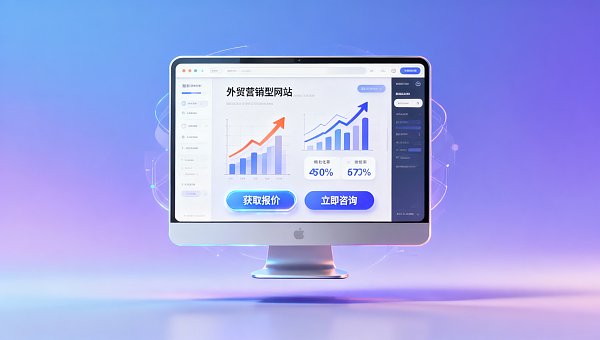
2. A systematic execution framework for inquiry page optimization
Single-point button optimization must be embedded into the overall inquiry page strategy. We recommend adopting a “3-layer funnel + 2-dimensional validation” model: the first layer is traffic entry matching (semantic consistency between ad terms/SEO keywords and button wording), the second layer is page information density (whether key purchasing factors such as core parameters, MOQ, and delivery lead time are presented upfront), and the third layer is the completeness of trust signals (certification icons, customer cases, real-time online status, etc.). Each layer should be validated through both A/B testing + heatmap tracking.
Take a Zhejiang auto parts manufacturer as an example: its original inquiry page used the ‘Contact Us Now’ button and generated an average of 287 leads per month; after switching to ‘Get a Quote’ and simultaneously optimizing the page structure (adding an FOB price range prompt, minimum order quantity tags, and a 72-hour response commitment banner), the number of inquiries jumped to 492 within 30 days, an increase of 71.4%. The key point is that the button is not an isolated element, but the trigger anchor of the entire inquiry experience.
Technical support dimension: why is high-performance website building a prerequisite for optimization?
No matter how precise the copy is, it will still fail if constrained by page performance. Data shows that when the first-screen rendering time increases from 1.5 seconds to 3.2 seconds, the click decline rate of the ‘Get a Quote’ button reaches 38.7% (higher than the 29.1% for ‘Contact Us Now’), because its user expectations are clearer and its tolerance threshold is lower. YYB’s self-developed cloud intelligent website building system supports 2500+ global server nodes and 120T bandwidth capacity, ensuring that user access latency remains stably below 180ms in key markets such as Europe, the United States, the Middle East, and Latin America, providing a solid supporting foundation for copy strategy.
The above table shows that button optimization is not a one-time action, but a continuously iterative process that can be deployed modularly. YYB foreign trade marketing (super) websites have a built-in marketing closed-loop analytics system, supporting full-link tracking from button click → form submission → manual assignment → deal attribution, making every copy adjustment measurable, attributable, and reusable.
Warnings about common misconceptions
Misconception 1: blindly applying “high-CTR copy templates.” Actual tests show that on Russian-language websites, “Получить цену” (get a price) achieved a CTR of 5.6%, while “Задать вопрос” (ask a question) only reached 1.9%; and a direct translation of “Contact Us Now” instead caused the bounce rate to rise by 17% due to cultural ambiguity. Localization is not translation, but contextual reconstruction.
Misconception 2: ignoring mobile adaptation. On mobile devices, when the button size is smaller than 44×44px, the mistap rate of ‘Get a Quote’ is 2.3 times higher than that of ‘Contact Us Now’—the former’s verb + noun structure is more likely to be misjudged by the thumb as the “get” action, making it necessary to enforce a minimum clickable area.
The essence of inquiry page optimization is to start from the user’s purchasing journey, use data as the measure, technology as the foundation, and localization as the needle to stitch together every tiny decision point. When you are hesitating over button copy, the real answer is not in intuition, but in your target customers’ search terms, dwell patterns, and historical inquiries. Contact us now to get a customized A/B testing plan and implementation support based on your industry characteristics and target market.
Related Articles
Related Products
 EasyCamp SaaS Smart Website Marketing SystemE-Yingbao SaaS Smart Website Marketing System: AI-powered, zero-code website building. Rapidly launch multilingual independent e-commerce sites in just 10 minutes. Global server acceleration and AI-driven SEO optimization empower businesses to efficiently connect with global markets. The seamless integration of technology and user-friendly operation makes building e-commerce sites incredibly simple.
 AI+SEM Intelligent Advertising Marketing SystemAI+SEM drives intelligent ad creation, empowering full-funnel precision advertising marketing. The system automatically generates weekly/monthly reports, AI recommends keywords and target countries, monitors core metrics in real-time with intelligent alerts, and enables one-click high-conversion ad solutions to help quickly acquire customers and improve ROI.
 AI+SEO Dual Engine Optimization ServiceEasyWin AI+SEO Dual Engine Optimization System leverages AI-powered keyword mining, content generation, and comprehensive technical optimization to help foreign trade enterprises acquire high-quality organic traffic, significantly improving search rankings and conversion rates.
 AI+SNS Social Media Marketing SystemYingbao AI+SNS Social Media Marketing System - Precision social capture for the social media era. Supports one-click content synchronization across major platforms like Facebook and LinkedIn. AI intelligently rewrites posts for enhanced relevance. 24/7 AI customer service and user profiling analysis empower businesses to efficiently expand into global markets.
 AI+SEO营销解决方案易营宝AI+SEO营销解决方案,通过AI批量写作、智能生成TDK、精准关键词扩词等功能,全面优化网站SEO效果,提升流量与转化率。助力企业构建高效智能网站新生态。
 AI+SEM Advertising Marketing SolutionsAI+SEM Advertising Marketing Solution leverages AI technology to deeply empower SEM ad campaigns. It automatically generates weekly/monthly reports using AI, presenting account data across multiple dimensions for comprehensive insights into campaign performance and trends. The system precisely recommends keywords and target countries, intelligently generates high-conversion ad copy, and enables one-click activation of efficient campaign plans to help businesses rapidly acquire customers. Simultaneously, it monitors core metrics in real time, intelligently identifies abnormal fluctuations, and issues timely alerts to ensure stable, high-return advertising results.
 Domain Name ServicesEasyWin provides professional domain name services, including intelligent queries, one-stop registration, brand protection, and full lifecycle management, helping businesses build a digital brand image.
 EasyOperate B2C Cross-Border E-Commerce Platform & Independent WebsiteEasyStore B2C Cross-border E-commerce Independent Store is an intelligent website building and cross-border e-commerce integrated solution independently developed by EasyStore Information Technology (Beijing) Co., Ltd. The system is specially designed for small and medium-sized as well as large export enterprises, integrating 'website building, operation, marketing, advertising, and conversion' into one, helping enterprises quickly establish cross-border e-commerce independent stores to achieve brand globalization and global sales growth.
The platform supports multiple languages, multiple currencies, and multi-channel marketing, with built-in AI intelligent translation and SEO optimization systems, suitable for mainstream markets such as Southeast Asia, Europe and America, Latin America, and the Middle East, assisting Chinese manufacturing enterprises in efficiently deploying international e-commerce strategies. SSL证书易营宝提供专业SSL安全证书服务,包括单域名和泛域名证书,确保网站数据传输加密、身份验证和完整性保护,助力企业建立安全可信的在线业务环境。









