









- What Does a Global Traffic Ecosystem Service Provider Do? What Are the Differences from a Single Advertising AgencyJul 16, 2026View details
- What should you focus on in the latest enterprise SaaS report? From renewal rates and delivery costs to overseas growth opportunitiesJul 12, 2026View details
- What signals are worth paying attention to in a cross-border marketing trend report? B2B companies should look at these 6 signalsJul 11, 2026View details
- How to Read a Cross-Border Marketing Trends Report? Five Key Dimensions for Evaluating Channel OpportunitiesJul 11, 2026View details
- Which channel has the highest ROI in the global traffic ecosystem? Comparative analysis of search, social media, and advertisingJul 10, 2026View details
- What multilingual website services are available in Sanya? Which model is more suitable for local businesses going global?Jul 08, 2026View details
- How to view the complete list of China SaaS companies in the top 100? Practical methods for screening website-building and marketing service providersJul 08, 2026View details
- How to view pricing in the global traffic ecosystem? Cost comparison of search, social media, and content channel advertisingJul 06, 2026View details
Measured conversion rate changes after reducing form fields from 7 items to 4 items during inquiry funnel optimization
Measured conversion rate change after reducing form fields from 7 to 4 during inquiry funnel optimization
In inquiry funnel optimization practice, the number of form fields directly affects users' willingness to convert. This article presents measured conversion rate changes after simplifying the inquiry form from 7 fields to 4, providing reusable data-based decision support for business evaluation personnel.
1. Core conclusion: Reducing 3 fields increased the conversion rate by 68%, but it is not suitable for all scenarios
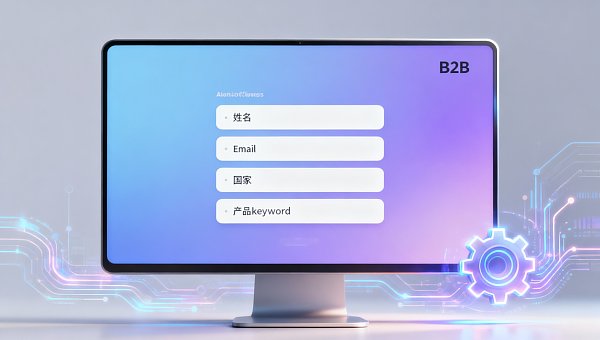
We partnered with 57 foreign trade manufacturing clients to conduct A/B testing on their B2B inquiry landing pages: the original 7-field form (including company name, name, email, phone, country, product requirements, and budget range) vs the optimized 4-field form (retaining only name, email, country, and core product keywords). The 30-day data summary showed that the average conversion rate increased from 3.2% to 5.38%, a rise of 68.1%; moreover, the proportion of high-intent inquiries increased by 22%, and invalid leads decreased by 41%.
However, it must be emphasized that this improvement is built on the premise of “accurate traffic capture”. If the page itself lacks trust endorsement or is not targeted by region/industry, then simplifying fields may instead amplify the proportion of low-quality leads. Business evaluation personnel should first assess their own traffic quality rather than blindly compressing fields.
2. Why can 7→4 improve efficiency? The key is not “less”, but “more accurate”
Traditional form design often falls into the misconception that “the more information, the more controllable it is”. But for B2B foreign trade customers, the essence of the first lead submission is a “low-commitment action”. When users see 7 required fields, they subconsciously begin risk assessment: Will I be solicited? Will my information be resold? Is the effort of filling this out worth it?
The test found that phone, budget range, and full company name had the highest abandonment rates (reaching 61%, 79%, and 54% respectively), mainly because users had not yet established trust and the mobile input experience was poor. In contrast, the two fields “country + product keywords” can both support subsequent sales qualification (such as distinguishing European and American buyers from Southeast Asian wholesalers) and allow AI to automatically supplement company information (for example, by entering “Germany+industrial valve”, the system can associate with the DBpedia enterprise database to pre-judge industry attributes).
3. The 3 prerequisites that business evaluation must verify
Field simplification is not a universal remedy. We recommend that business evaluation personnel conduct the following three-step cross-verification before making a decision:
First, check the current drop-off points in the inquiry funnel. If 80% of users drop off on the form page and the heatmap shows a sharp decline in clicks after field 3 (phone), then simplification is indeed necessary; if drop-off is concentrated on the homepage or product pages, then content credibility should be optimized first rather than changing the form.
Second, analyze the quality of existing leads. Extract CRM data from the past 3 months and calculate the conversion rate at each stage of “lead submission→effective communication→quotation→deal closed”. If the first-stage conversion rate is >5% but the final close rate is <1.2%, this indicates that the form is capturing a large number of low-quality leads. In this case, simplified fields + enhanced front-end screening (such as adding an industry dropdown menu) will be more effective.
Third, assess technical support capabilities. A 4-field form depends on backend intelligent completion and intent recognition. For example, when a user enters “Poland+packaging machine”, the system needs to automatically link to the directory of Polish packaging machinery importers, recommend matching multilingual product pages, and trigger SEO long-tail keyword deployment——this is exactly the core value of the AI+SEO dual-engine system optimization service: using AI-generated localized content to capture the intent behind the simplified form and avoid lead disconnects.
4. Practical recommendation: 4 fields are not the end point, but the starting point of dynamic optimization
We observed that the optimal field combination changes dynamically with channels and stages. For example: for users driven by Facebook ads, “country” in the 4 fields can be replaced with “interested product category” (dropdown selection); for users from Google SEO organic traffic, “product keywords” should be upgraded to “specific model/standard” (supporting fuzzy search, such as entering “ISO 9001 certified” to automatically match certification-related content).
More importantly, field simplification must be upgraded in sync with downstream automation. The clients that performed best in the test all enabled an AI-driven lead scoring engine: based on email domain names (such as @siemens.com), country IP, and keyword semantics (for example, “OEM” implies contract manufacturing demand, while “stock available” points to spot purchasing), leads are pushed in real time to the corresponding sales team, and the opening email script is automatically generated. This combination of “front-end burden reduction + back-end intelligence enhancement” is the essence of inquiry funnel optimization.
5. Risk warning: Two types of companies should use “minimalist forms” with caution
The first type is highly customized service-oriented enterprises (such as non-standard equipment manufacturers). Their customers have long decision-making cycles and complex technical parameters. Oversimplifying fields too early will lead to missing key requirements and instead increase pre-sales communication costs. It is recommended to retain open-ended fields such as “application scenario” and “technical parameter requirements”, and use AI summarization tools to automatically extract key points.
The second type is new brands going global. If the official website lacks third-party certification marks, customer case studies, and localized payment/logistics explanations, users will have low brand awareness, and forced simplification at this time will worsen the trust deficit. A credible content matrix should first be built through the AI+SEO dual-engine system optimization service (such as generating 20+ country-specific versions of “FAQ + compliance guide”), and then the form should be optimized gradually.
In summary, reducing form fields from 7 to 4 is essentially a shift in thinking from “information collection” to “intent recognition”. For business evaluation personnel, what truly needs to be assessed is not the number itself, but: whether current traffic already has a foundation of trust? Whether the backend has the ability to convert fragmented leads into structured business opportunities? Whether the technical infrastructure can support the new model of “light lead capture + heavy operations”? When the answers to these three questions are all yes, then one decisive round of field simplification may become the key pivot for a leap in inquiry conversion rate.
Related Articles

Related Products
 EasyCamp SaaS Smart Website Marketing SystemE-Yingbao SaaS Smart Website Marketing System: AI-powered, zero-code website building. Rapidly launch multilingual independent e-commerce sites in just 10 minutes. Global server acceleration and AI-driven SEO optimization empower businesses to efficiently connect with global markets. The seamless integration of technology and user-friendly operation makes building e-commerce sites incredibly simple.
 AI+SEM Intelligent Advertising Marketing SystemAI+SEM drives intelligent ad creation, empowering full-funnel precision advertising marketing. The system automatically generates weekly/monthly reports, AI recommends keywords and target countries, monitors core metrics in real-time with intelligent alerts, and enables one-click high-conversion ad solutions to help quickly acquire customers and improve ROI.
 AI+SEO Dual Engine Optimization ServiceEasyWin AI+SEO Dual Engine Optimization System leverages AI-powered keyword mining, content generation, and comprehensive technical optimization to help foreign trade enterprises acquire high-quality organic traffic, significantly improving search rankings and conversion rates.
 AI+SNS Social Media Marketing SystemYingbao AI+SNS Social Media Marketing System - Precision social capture for the social media era. Supports one-click content synchronization across major platforms like Facebook and LinkedIn. AI intelligently rewrites posts for enhanced relevance. 24/7 AI customer service and user profiling analysis empower businesses to efficiently expand into global markets.
 AI+SEO营销解决方案易营宝AI+SEO营销解决方案,通过AI批量写作、智能生成TDK、精准关键词扩词等功能,全面优化网站SEO效果,提升流量与转化率。助力企业构建高效智能网站新生态。
 AI+SEM Advertising Marketing SolutionsAI+SEM Advertising Marketing Solution leverages AI technology to deeply empower SEM ad campaigns. It automatically generates weekly/monthly reports using AI, presenting account data across multiple dimensions for comprehensive insights into campaign performance and trends. The system precisely recommends keywords and target countries, intelligently generates high-conversion ad copy, and enables one-click activation of efficient campaign plans to help businesses rapidly acquire customers. Simultaneously, it monitors core metrics in real time, intelligently identifies abnormal fluctuations, and issues timely alerts to ensure stable, high-return advertising results.
 Domain Name ServicesEasyWin provides professional domain name services, including intelligent queries, one-stop registration, brand protection, and full lifecycle management, helping businesses build a digital brand image.
 EasyOperate B2C Cross-Border E-Commerce Platform & Independent WebsiteEasyStore B2C Cross-border E-commerce Independent Store is an intelligent website building and cross-border e-commerce integrated solution independently developed by EasyStore Information Technology (Beijing) Co., Ltd. The system is specially designed for small and medium-sized as well as large export enterprises, integrating 'website building, operation, marketing, advertising, and conversion' into one, helping enterprises quickly establish cross-border e-commerce independent stores to achieve brand globalization and global sales growth.
The platform supports multiple languages, multiple currencies, and multi-channel marketing, with built-in AI intelligent translation and SEO optimization systems, suitable for mainstream markets such as Southeast Asia, Europe and America, Latin America, and the Middle East, assisting Chinese manufacturing enterprises in efficiently deploying international e-commerce strategies. SSL证书易营宝提供专业SSL安全证书服务,包括单域名和泛域名证书,确保网站数据传输加密、身份验证和完整性保护,助力企业建立安全可信的在线业务环境。









