









- What Does a Global Traffic Ecosystem Service Provider Do? What Are the Differences from a Single Advertising AgencyJul 16, 2026View details
- What should you focus on in the latest enterprise SaaS report? From renewal rates and delivery costs to overseas growth opportunitiesJul 12, 2026View details
- What signals are worth paying attention to in a cross-border marketing trend report? B2B companies should look at these 6 signalsJul 11, 2026View details
- How to Read a Cross-Border Marketing Trends Report? Five Key Dimensions for Evaluating Channel OpportunitiesJul 11, 2026View details
- Which channel has the highest ROI in the global traffic ecosystem? Comparative analysis of search, social media, and advertisingJul 10, 2026View details
- What multilingual website services are available in Sanya? Which model is more suitable for local businesses going global?Jul 08, 2026View details
Is it difficult to implement an integrated overseas marketing strategy? A diagnostic checklist of internal collaboration breakdowns across 3 types of enterprises
When overseas integrated marketing shifts from “being feasible” to “being difficult to scale”, the problem often lies within the organization itself
Over the past three years, more and more project managers have found that the same overseas integrated marketing solution can go live quickly and drive inquiry growth in Company A, yet repeatedly gets stuck in content confirmation, budget approval, or data integration at Company B. There is nothing wrong with the strategy itself, but the execution pace is clearly lagging behind——this is not a technical bottleneck, but a quiet mismatch in collaboration logic.
Through serving over 100,000 companies going global, EasyYingbao has observed that what truly slows implementation is often those “silent breakpoints” in cross-functional collaboration that are unnamed and rarely reviewed. They are not obvious, yet like cold solder joints on a circuit board, they appear normal when powered on, but fail once the load increases.
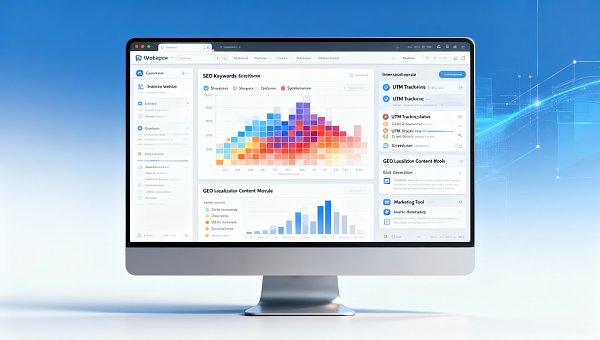
The first type of breakpoint: misalignment between website building and marketing objectives, making content assets impossible to reuse
A typical manifestation is this: the website has gone live, but SEO pages lack keyword planning; social media assets cannot be directly embedded into landing pages; and the conversion path of advertising campaigns is disconnected from the site’s navigation logic. The root cause is that the web development team delivers based on “functional completeness”, while the marketing team evaluates based on “traffic conversion”——both sides are using different languages to describe the same goal.
EasyYingbao’s AI-powered smart website building system was designed from the outset with a built-in marketing semantic layer: multilingual pages are automatically linked to localized search term databases, product modules can generate GEO-optimized structured data with one click, and advertising landing page templates come with preset UTM tracking fields. This underlying logic of “build for marketing from the start” is essentially about reducing the interpretation cost between two functions.
The second type of breakpoint: fragmented data ownership and decision chains, turning performance attribution into a “Rashomon”
The marketing department says ad ROI is high, while the sales department reports poor lead quality; the SEO team reports a 30% increase in organic traffic, but there are no corresponding inquiry records in the CRM. The issue is not inaccurate data, but unclear data ownership, inconsistent definitions, and dashboards that are not shared.
- The website building system is deeply integrated with Google Ads/Facebook API, with no need for manual export and import;
- The AI+SEO/GEO optimization system automatically generates channel attribution heat maps, marking drop-off points at each stage;
- The cross-border e-commerce system supports order-level reverse tracing, tracking back from the transaction to the first touchpoint channel.
When data flows no longer need to be “moved around”, the focus of collaboration naturally shifts from “who should provide the data” to “what are we interpreting together”.
The third type of breakpoint: localization execution depends on individual experience and is difficult to replicate at scale
Writing Arabic ad copy for Middle Eastern clients requires repeated confirmation of religious sensitivities; creating LinkedIn content for German B2B buyers requires balancing technical rigor with compliant wording. This type of work relies heavily on individual experience, and once key personnel change or the project expands, quality fluctuates sharply.
EasyYingbao’s AI advertising marketing system has integrated a regional compliance knowledge graph, enabling it to automatically identify sensitive words, recommend localized messaging, and generate multiple versions of A/B testing creatives. More importantly, its GEO generative engine optimization capability allows the same product information to output content variants that are semantically consistent but expressed differently according to the search habits of markets such as North America, Japan and South Korea, and Latin America——turning “accumulated experience” into “system capability”.
Behind collaboration breakpoints lies a generational gap between business pace and organizational capability
It is worth noting that these three types of breakpoints are especially concentrated among manufacturing clients. On the one hand, the launch of their overseas marketing often coincides with the start of production for a new product line or the completion of certification, making the time window highly rigid; on the other hand, traditional management inertia is stronger, and cross-department KPIs have not yet been strongly tied to the results of overseas integrated marketing. This also means that the “dynamic response mechanism” emphasized in Research on liquidity risk management strategies for manufacturing enterprises is equally applicable to the construction of marketing collaboration systems.
From a trend perspective, leading clients are incorporating “the maturity of overseas integrated marketing collaboration” into project initiation assessments: Is there a unified content hub? Have cross-functional SOPs been defined? Is there an automated data dashboard? These are no longer matters for the IT department alone, but core supports for project managers to mobilize resources, secure budgets, and ensure delivery.
For the next actionable step, you may start with a lightweight diagnostic
Rather than waiting for problems to erupt, it is better to proactively scan three signals:
- Does any overseas marketing action require email confirmation from more than three departments before it can be launched?
- Was the most recent cross-channel performance review interrupted because of inconsistent data definitions?
- When adding a new overseas market, is the content production cycle more than 20% longer than for the previous market?
If two of these are “yes”, it indicates that collaboration breakpoints have already affected the efficiency threshold. At this point, recalibrating the alignment between website building and marketing goals, establishing a minimum viable data dashboard, and introducing AI-assisted localized content generation tools will have more leverage than optimizing isolated strategies.
The value of overseas integrated marketing will ultimately be reflected in whether an organization can turn “multi-channel collaboration” into a replicable capability, rather than a one-time project breakthrough. When a technology platform can eliminate those silent collaboration frictions, project managers can truly grasp the certain support point for global growth.
Related Articles



Related Products
 EasyCamp SaaS Smart Website Marketing SystemE-Yingbao SaaS Smart Website Marketing System: AI-powered, zero-code website building. Rapidly launch multilingual independent e-commerce sites in just 10 minutes. Global server acceleration and AI-driven SEO optimization empower businesses to efficiently connect with global markets. The seamless integration of technology and user-friendly operation makes building e-commerce sites incredibly simple.
 AI+SEM Intelligent Advertising Marketing SystemAI+SEM drives intelligent ad creation, empowering full-funnel precision advertising marketing. The system automatically generates weekly/monthly reports, AI recommends keywords and target countries, monitors core metrics in real-time with intelligent alerts, and enables one-click high-conversion ad solutions to help quickly acquire customers and improve ROI.
 AI+SEO Dual Engine Optimization ServiceEasyWin AI+SEO Dual Engine Optimization System leverages AI-powered keyword mining, content generation, and comprehensive technical optimization to help foreign trade enterprises acquire high-quality organic traffic, significantly improving search rankings and conversion rates.
 AI+SNS Social Media Marketing SystemYingbao AI+SNS Social Media Marketing System - Precision social capture for the social media era. Supports one-click content synchronization across major platforms like Facebook and LinkedIn. AI intelligently rewrites posts for enhanced relevance. 24/7 AI customer service and user profiling analysis empower businesses to efficiently expand into global markets.
 AI+SEO营销解决方案易营宝AI+SEO营销解决方案,通过AI批量写作、智能生成TDK、精准关键词扩词等功能,全面优化网站SEO效果,提升流量与转化率。助力企业构建高效智能网站新生态。
 AI+SEM Advertising Marketing SolutionsAI+SEM Advertising Marketing Solution leverages AI technology to deeply empower SEM ad campaigns. It automatically generates weekly/monthly reports using AI, presenting account data across multiple dimensions for comprehensive insights into campaign performance and trends. The system precisely recommends keywords and target countries, intelligently generates high-conversion ad copy, and enables one-click activation of efficient campaign plans to help businesses rapidly acquire customers. Simultaneously, it monitors core metrics in real time, intelligently identifies abnormal fluctuations, and issues timely alerts to ensure stable, high-return advertising results.
 Domain Name ServicesEasyWin provides professional domain name services, including intelligent queries, one-stop registration, brand protection, and full lifecycle management, helping businesses build a digital brand image.
 EasyOperate B2C Cross-Border E-Commerce Platform & Independent WebsiteEasyStore B2C Cross-border E-commerce Independent Store is an intelligent website building and cross-border e-commerce integrated solution independently developed by EasyStore Information Technology (Beijing) Co., Ltd. The system is specially designed for small and medium-sized as well as large export enterprises, integrating 'website building, operation, marketing, advertising, and conversion' into one, helping enterprises quickly establish cross-border e-commerce independent stores to achieve brand globalization and global sales growth.
The platform supports multiple languages, multiple currencies, and multi-channel marketing, with built-in AI intelligent translation and SEO optimization systems, suitable for mainstream markets such as Southeast Asia, Europe and America, Latin America, and the Middle East, assisting Chinese manufacturing enterprises in efficiently deploying international e-commerce strategies. SSL证书易营宝提供专业SSL安全证书服务,包括单域名和泛域名证书,确保网站数据传输加密、身份验证和完整性保护,助力企业建立安全可信的在线业务环境。









