









- Can Zhejiang foreign trade independent websites still be developed today? Look at changes in traffic and lead generationJul 28, 2026View details
- What New Signals Are Emerging in Enterprise Services SaaS Marketing ReportsJul 27, 2026View details
- What Does a Global Traffic Ecosystem Service Provider Do? What Are the Differences from a Single Advertising AgencyJul 16, 2026View details
- What should you focus on in the latest enterprise SaaS report? From renewal rates and delivery costs to overseas growth opportunitiesJul 12, 2026View details
- What signals are worth paying attention to in a cross-border marketing trend report? B2B companies should look at these 6 signalsJul 11, 2026View details
- How to Read a Cross-Border Marketing Trends Report? Five Key Dimensions for Evaluating Channel OpportunitiesJul 11, 2026View details
How to Generate Leads on LinkedIn? Key Steps from Network Expansion to Private Message Conversion
How to Get Leads on LinkedIn? First Get the Right People
How to get leads on LinkedIn? Many teams get the first step wrong. It is not about adding a large number of people first, but about first determining who is worth connecting with and who is more likely to move into later communication and the sales process.
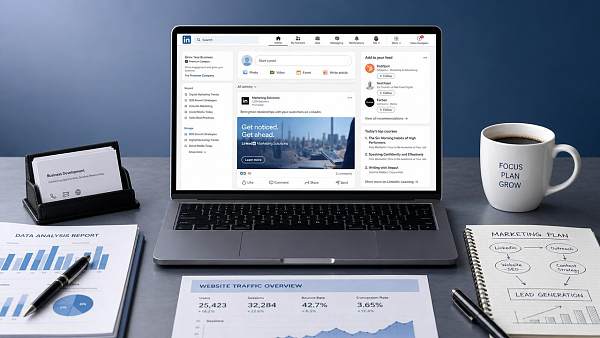
The core of truly effective LinkedIn lead generation is to build a repeatable method. It usually includes five steps: target customer screening, personal profile optimization, connection message design, private message follow-up, and lead nurturing.
From recent changes, users on the platform are becoming increasingly wary of templated outreach. The more credible the profile, the more professional the content, and the more natural the interaction, the easier it is to get a response.
This also means that how to get leads on LinkedIn is no longer a single action, but a complete chain management process. Adding connections at the front end is only the beginning; conversion at the back end determines the result.
First Define the Target Customer, Then Talk About How to Get Leads on LinkedIn
If the target is unclear, most of the follow-up actions will miss the mark. This is especially true in website development, SEO optimization, overseas social media, and advertising services, where customer differences are significant and the same list cannot be used to reach out to everyone.
A more stable approach is to first build a screening framework. At minimum, look at industry, market region, job role, company size, current level of digitalization, and whether there is growth pressure.
- Industry level: foreign trade factories, cross-border sellers, and brand going global companies are the top priorities.
- Region level: customers in North America, Europe, and Southeast Asia are generally more active in communication.
- Role level: market leaders, sales leaders, and business partners are more critical.
- Need level: whether there is a lack of website, traffic, conversion, or brand exposure.
In actual business, an integrated platform like YiYingBao, which combines website and marketing services, is more suitable for companies with a clearly defined growth task. Because these customers usually need not only a website, but also SEO, advertising, and social media coordination and promotion.
When you narrow the customer profile enough, how to get leads on LinkedIn becomes much simpler. Connection rate, reply rate, and conversion rate will also be more stable than broad outreach.
Profile Optimization Is the Key Threshold Before Private Message Conversion
Many people overlook one point: before a customer replies, they will often look at your homepage first. The profile page is like a lightweight sales page that determines whether the other party trusts you.
So, the second step in how to get leads on LinkedIn is to optimize your personal profile, not to send mass messages right away. The profile should answer at least three questions: who you are, who you help, and what results you can bring.
- Keep the avatar and cover image professional, and avoid an overly promotional feel.
- Write the title clearly with the service object and results, not just the job title.
- Highlight experience, methods, and successful cases in the summary section.
- Keep the experience and content consistent to avoid fragmented front-end and back-end information.
For example, when targeting foreign trade companies, you can emphasize multilingual website development, Google SEO, advertising, and overseas social media integration capabilities. This makes it easier for customers to understand the boundaries of your services.
Platforms like YiYingBao, which are AI-driven, already cover intelligent website building, cross-border e-commerce stores, SEO/GEO optimization, and advertising marketing systems. If this is clearly expressed in the profile, customers can more easily associate you with a "growth solution".
Do Not Push Hard in Connection Requests; First Let the Other Party Want to Open the Conversation
Many teams ask how to get leads on LinkedIn, and the bottleneck is actually at the connection request stage. The reason is usually not that the list is wrong, but that the opening is too abrupt, like advertising instead of communication.
A more effective approach is to initiate the connection around the other party's business scenario. You can mention their recent content, company market actions, or common industry issues, making the request feel justified.
- Do not introduce all services at once.
- Do not directly ask for an email address or meeting.
- Do not use obviously copied wording.
- Build relevance first, then work toward a conversation.
If the other party accepts the connection, it is also not recommended to send a long introduction immediately. Light interaction first, then judge whether the other party has real needs; the pace will be more natural.
This is very similar to many professional content distribution strategies. For example, when reading topic materials such as Application Strategies of Budget Performance Management in Enterprise Unit Financial Management, users are more willing to understand the value first and then decide whether to engage in deeper communication.
Private Message Conversion Needs a Path, Not Pressure That Turns Communication into Sales
How to get leads on LinkedIn? The real watershed is in the private message stage. Many leads are not because there is no need, but because the other party is not yet ready to enter the sales process immediately.
So private messages are not about closing a deal in one step, but about advancing gradually. First break the ice, then confirm the need, then deliver value, and finally invite communication; the order cannot be reversed.
If the customer mentions poor indexing of their independent site, low traffic, and high advertising costs, that is a very clear conversion signal. At this point, introducing the solution is more easily accepted than quoting directly from the start.
Combine Content and Service Capabilities to Improve Long-Term Deal Closure Rate
Relying on private messages alone usually has limited lead generation efficiency. The truly mature approach is to turn content into a trust amplifier. In this way, before the customer sees you, they already have an initial judgment of your professionalism.
The content does not need to be very complex, but it must closely address customer problems. For example, website being slow to get indexed, too few inquiries, high ad costs, and no leads from overseas social media are all suitable for short-form content.
For a website+marketing service integrated business, the content is best aligned with the solution. The front end discusses the problem, and the back end provides the path; only then will customers feel that you are not just talking about concepts.
- Share common conversion barriers for independent sites.
- Break down the collaboration logic between SEO and advertising.
- Show multi-language website layout methods.
- Explain how AI tools improve promotion efficiency.
Platforms like YiYingBao, which have deeply developed website building, SEO, advertising, social media, and GEO optimization capabilities, are suitable for building awareness through "full-chain growth" content. What customers see is not a single service, but a more complete overseas lead generation capability.
How to Get Leads on LinkedIn Ultimately Comes Back to Data Review
Without review, how to get leads on LinkedIn is very difficult to keep optimizing. On the surface, it looks like social outreach, but in essence it is still a data-driven sales activity.
It is recommended to track at least four indicators every week: connection acceptance rate, first reply rate, effective conversation rate, and meeting conversion rate. Whichever part performs poorly should be optimized first.
If the acceptance rate is low, the problem is mostly in the image or profile. If the reply rate is low, it is usually because the connection wording and private message entry point are not natural enough. If the meeting rate is low, it means the value proposition is still not specific enough.
In the end, how to get leads on LinkedIn is not some mysterious magic. First find the right people, then build trust, then use content and private messages to surface the need, and finally use data to continuously adjust the action.
When this process runs smoothly, LinkedIn will not just be a platform for adding connections, but will become a stable source of overseas customers. For teams that want to improve screening efficiency and conversion certainty, this path is worth implementing as soon as possible.
Related Articles
Related Products
 EasyCamp SaaS Smart Website Marketing SystemE-Yingbao SaaS Smart Website Marketing System: AI-powered, zero-code website building. Rapidly launch multilingual independent e-commerce sites in just 10 minutes. Global server acceleration and AI-driven SEO optimization empower businesses to efficiently connect with global markets. The seamless integration of technology and user-friendly operation makes building e-commerce sites incredibly simple.
 AI+SEM Intelligent Advertising Marketing SystemAI+SEM drives intelligent ad creation, empowering full-funnel precision advertising marketing. The system automatically generates weekly/monthly reports, AI recommends keywords and target countries, monitors core metrics in real-time with intelligent alerts, and enables one-click high-conversion ad solutions to help quickly acquire customers and improve ROI.
 AI+SEO Dual Engine Optimization ServiceEasyWin AI+SEO Dual Engine Optimization System leverages AI-powered keyword mining, content generation, and comprehensive technical optimization to help foreign trade enterprises acquire high-quality organic traffic, significantly improving search rankings and conversion rates.
 AI+SNS Social Media Marketing SystemYingbao AI+SNS Social Media Marketing System - Precision social capture for the social media era. Supports one-click content synchronization across major platforms like Facebook and LinkedIn. AI intelligently rewrites posts for enhanced relevance. 24/7 AI customer service and user profiling analysis empower businesses to efficiently expand into global markets.
 AI+SEO营销解决方案易营宝AI+SEO营销解决方案,通过AI批量写作、智能生成TDK、精准关键词扩词等功能,全面优化网站SEO效果,提升流量与转化率。助力企业构建高效智能网站新生态。
 AI+SEM Advertising Marketing SolutionsAI+SEM Advertising Marketing Solution leverages AI technology to deeply empower SEM ad campaigns. It automatically generates weekly/monthly reports using AI, presenting account data across multiple dimensions for comprehensive insights into campaign performance and trends. The system precisely recommends keywords and target countries, intelligently generates high-conversion ad copy, and enables one-click activation of efficient campaign plans to help businesses rapidly acquire customers. Simultaneously, it monitors core metrics in real time, intelligently identifies abnormal fluctuations, and issues timely alerts to ensure stable, high-return advertising results.
 Domain Name ServicesEasyWin provides professional domain name services, including intelligent queries, one-stop registration, brand protection, and full lifecycle management, helping businesses build a digital brand image.
 EasyOperate B2C Cross-Border E-Commerce Platform & Independent WebsiteEasyStore B2C Cross-border E-commerce Independent Store is an intelligent website building and cross-border e-commerce integrated solution independently developed by EasyStore Information Technology (Beijing) Co., Ltd. The system is specially designed for small and medium-sized as well as large export enterprises, integrating 'website building, operation, marketing, advertising, and conversion' into one, helping enterprises quickly establish cross-border e-commerce independent stores to achieve brand globalization and global sales growth.
The platform supports multiple languages, multiple currencies, and multi-channel marketing, with built-in AI intelligent translation and SEO optimization systems, suitable for mainstream markets such as Southeast Asia, Europe and America, Latin America, and the Middle East, assisting Chinese manufacturing enterprises in efficiently deploying international e-commerce strategies. SSL证书易营宝提供专业SSL安全证书服务,包括单域名和泛域名证书,确保网站数据传输加密、身份验证和完整性保护,助力企业建立安全可信的在线业务环境。









