









- Which customer acquisition channels will be affected by cross-border marketing trends in 2026?Sep 06, 2026View details
- Which homogenization risks should be considered in an analysis of the AI-powered website building industry?Aug 30, 2026View details
- How Will AI Marketing Trends 2026 Change Advertising Budget AllocationAug 28, 2026View details
- Is the EV SSL certificate market shrinking or upgrading? How should companies assess certificate procurement?Aug 11, 2026View details
- Why the old AMP SEO 2020 practices no longer work and what has changed in current optimization prioritiesAug 02, 2026View details
- How to Choose Topics for an Industry News Section to Attract More Organic Search TrafficJul 29, 2026View details
How can you plan a Facebook content calendar more effectively?
How to Plan a Facebook Content Calendar More Effectively
How can you plan a Facebook content calendar more effectively? For social media operators, the biggest concern is not running out of ideas, but filling the schedule too much and only discovering after posting for half a month that the direction was wrong: engagement remains low, direct messages have not increased, and advertising cannot connect with the content. A truly reliable approach is usually not to fill the entire month at once, but to define the objectives first, organize the content into layers, and leave room for adjustments. This keeps the publishing rhythm consistent and makes the conversion path clearer.
If you manage an account for foreign trade, manufacturing, cross-border e-commerce, or an overseas brand, a Facebook content calendar should not focus only on “what to post.” It also involves website landing pages, inquiry forms, advertising coordination, time-zone differences, content reserves, and the team’s execution capabilities. The following checklist is more suitable for frontline operators to use directly for review and implementation.
Start with the objectives; otherwise, the more frequently you publish, the easier it is to lose direction
Start by asking a practical question: what exactly should this account achieve over the next 30 days? Is the goal to gain followers, increase engagement, drive traffic to the official website, or support advertising conversions? Many teams skip this step, resulting in a single week that tries to tell the brand story, promote a quotation campaign, and share industry news all at once. In the end, none of these objectives is addressed in depth.
- If inquiries are the current priority, the content calendar should include more customer case scenarios, product applications, breakdowns of frequently asked questions, and clear landing-page guidance.
- If the priority is nurturing the account and building trust, prioritize team updates, factory details, delivery capabilities that customers care about, after-sales processes, and explanations of certification documents. When mentioning certifications, be sure to include only information that is publicly available and verifiable.
- If you are supporting a promotion or advertising campaign, the calendar rhythm should revolve around the campaign window. Social media should not focus on features while the ads focus on prices and the landing page uses a completely different message.
A simple rule of thumb is this: when you open the schedule for the next two weeks, can you immediately tell “what campaign or objective is the main focus during this period”? If not, the themes are probably too scattered.
Do not fill in content directly by date; define the content buckets first
A more reliable approach is to set up “content buckets” first and then place specific topics into the calendar. This helps prevent three consecutive days of hard selling and avoids spending an entire week publishing light content with no conversion action.
A common and practical classification can generally be understood as follows:
For most corporate accounts, each of these content types should appear during the week, but the proportions do not need to be fixed. B2B inquiry-focused accounts generally need to emphasize the line of “educational explanation + trust building + solutions,” while B2C or campaign-focused pages can allocate a larger share to engagement and promotional content. Do not copy someone else’s template mechanically. The account’s stage determines the mix.
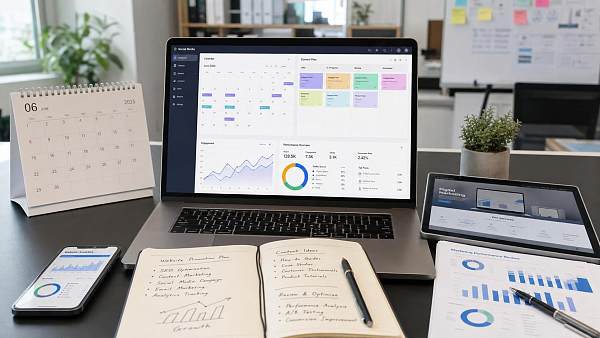
Lock in three things when scheduling: frequency, recurring columns, and buffer slots
Many people begin by scheduling “what to post on Monday and what to post on Tuesday,” but what truly makes a calendar stable is setting the framework first.
- Do not exceed the team’s production capacity. Publishing 3 to 5 posts per week is already sufficient for most corporate accounts. When content is limited, the review process is lengthy, and advertising and website updates must also be handled, forcing daily posting can easily compromise quality and accuracy.
- Set one or two recurring columns. For example, “Wednesday Q&A” or “Friday Case Breakdown.” Recurring columns reduce the pressure of finding topics and help users develop expectations.
- Leave at least around 20% of the schedule open. Temporary content, trending topics, advertising data feedback, and trade show schedules often disrupt the original plan. Without buffer slots, you will have no choice but to publish content mechanically later.
To put it plainly, a Facebook content calendar is not more professional because it is “more filled.” It is more reliable when it can better respond to changes.
Before publishing each post, run it through these checks
In practice, the most time-saving method is not reworking content, but checking it once before publication. This is especially important for teams working across multiple languages and markets or involving multiple collaborators, as it can prevent many basic mistakes.
- Who is this content for? Buyers, distributors, and end consumers have completely different concerns.
- Is there a single call to action? Leaving a comment, sending a direct message, visiting the website, and submitting a form are all possible actions, but it is best to emphasize only one.
- Can the image or video explain the issue independently? Many posts have comprehensive copy, but if the cover image is unclear, users will not stop to read.
- Is it consistent with the landing page? It is very common for content to mention a “customized solution” but direct users to a generic homepage after they click.
- Does the wording make excessive promises? When mentioning performance, delivery times, certifications, policy applicability, or similar information, use cautious wording if you are uncertain. Where necessary, mark it as 【To be verified】 and confirm it against the relevant business materials.
If your team also handles websites or marketing landing pages, take one additional step here: after the post drives traffic to the page, does the page support conversion? Poor social media performance is not always caused by the content itself. The website may load slowly, the form may be too long, the mobile experience may be poor, or the language version may not match. In such cases, changing the copy alone will not solve the problem.
Do not force one calendar across different markets
When targeting overseas markets, regional differences are one of the easiest factors to overlook in a Facebook content calendar. Users in North America, Europe, Southeast Asia, and the Middle East differ in active hours, preferred communication styles, and holiday schedules. Rather than planning based on assumptions, it is better to rely on your own page analytics and historical data.
If you do not yet have enough data, you can first create two lightweight calendars based on your target markets: one for English-speaking markets and one for key regional markets. At a minimum, separate the publishing times and content priorities. For example, some markets may care more about delivery assurance and after-sales response, while others may respond more readily to prices, promotions, or scenario-based videos. There is no need to publish the same post in every region.
Another frequently overlooked point is that localization is not just translation. Text in images, case scenarios, units of measurement, contact information, and currency formats can all affect understanding and trust.
Do not wait until the end of the month to review data; make small weekly adjustments
Once a content calendar has been prepared, it does not mean that it cannot be changed. A truly mature approach is to set aside a fixed amount of time each week for a review, focus on several key metrics, and then make small adjustments to the following week’s content.
For operators, do not track too many metrics at the beginning. Usually, it is enough to focus on these categories first:
- Reach and clicks: determine whether the topic and cover image are attractive enough.
- Comments, shares, and direct messages: assess whether the content has generated genuine feedback rather than passive browsing alone.
- Website visits, form submissions, and inquiries: determine whether the content has moved users to the next step.
- Posts with high engagement but low conversion: these are generally suitable for continuing to build brand awareness, but not for carrying sales objectives.
Here is a useful rule of thumb: do not change the entire following week to the same type of content just because one post performed exceptionally well. Highly engaging content on Facebook does not necessarily correspond to high-quality customers. This is especially true for B2B accounts, where truly effective content is often less “lively” but can generate more targeted inquiries.
These scheduling approaches are likely to cause problems later
When creating a content calendar, the following situations are common, and they are usually more than minor issues.
- The entire month’s content is focused on selling products, without explaining why they are worth buying. Users naturally assess the credibility of an unfamiliar brand first.
- Following holiday events exclusively, even when those holidays are unrelated to your business. There may be activity, but no connection to conversion.
- Requiring users to “inquire immediately” in every post. The action feels too demanding, so users are less likely to respond.
- Looking for content materials only right before publication. This is the easiest way to create an inconsistent visual style and miss publication deadlines.
- Social media, advertising, and the website operate independently. Once front-end engagement rises but the back-end is not prepared to receive it, the waste becomes particularly obvious.
If your team coordinates website development, SEO, and advertising, the content calendar should not be planned behind closed doors by the social media role alone. At a minimum, align the schedule with the website manager and advertising personnel, and confirm the currently promoted pages, keyword direction, campaign milestones, and content priorities. This makes the resulting content more like a complete growth initiative rather than fragmented updates.
Do not submit only a table at the end; include execution notes as well
A genuinely useful Facebook content calendar does not end with one column for dates and another for titles. At the operational level, it should include at least several additional items: content status, person responsible, target action, corresponding link, review milestone, whether a multilingual version is required, and whether the content should also be added to the advertising content pool. Adding these columns can save a great deal of back-and-forth confirmation during execution.
You can think of it as a lightweight operations board rather than a simple content table. This approach is particularly effective for teams providing integrated website and marketing services, because it places content, pages, and conversion actions on the same line.
If this article were condensed into one practical recommendation, it would be: define the objectives first, organize topics into buckets, control the rhythm, leave room for buffers, and review weekly. A Facebook content calendar planned this way may not look flashy, but it is generally more resilient in execution and more closely connected to results.
Related Articles



Related Products
 Yiyingbao SaaS Intelligent Website Building and Marketing SystemYiyingbao SaaS Intelligent Website Building and Marketing System, AI-powered no-code website building, rapid creation of multilingual B2B international websites in 10 minutes, global server acceleration, AI-powered SEO optimization, helping businesses connect efficiently with global markets. The perfect integration of technology and operation makes building an international trade website remarkably simple
 AI+SEM Intelligent Advertising Marketing SystemAI+SEM drives intelligent ad creation, empowering full-funnel precision advertising marketing. The system automatically generates weekly/monthly reports, AI recommends keywords and target countries, monitors core metrics in real-time with intelligent alerts, and enables one-click high-conversion ad solutions to help quickly acquire customers and improve ROI.
 AI+SEO Dual-Engine System Optimization ServicesYiyingbao’s AI+SEO dual-engine optimization system helps foreign trade enterprises acquire high-quality organic traffic through AI-powered keyword research, content generation, and comprehensive technical optimization, significantly improving search rankings and conversion rates.
 AI+SNS Social Media Marketing SystemYingbao AI+SNS Social Media Marketing System - Precision social capture for the social media era. Supports one-click content synchronization across major platforms like Facebook and LinkedIn. AI intelligently rewrites posts for enhanced relevance. 24/7 AI customer service and user profiling analysis empower businesses to efficiently expand into global markets.
 AI+SEO营销解决方案易营宝AI+SEO营销解决方案,通过AI批量写作、智能生成TDK、精准关键词扩词等功能,全面优化网站SEO效果,提升流量与转化率。助力企业构建高效智能网站新生态。
 AI+SEM Advertising Marketing SolutionsAI+SEM Advertising Marketing Solution leverages AI technology to deeply empower SEM ad campaigns. It automatically generates weekly/monthly reports using AI, presenting account data across multiple dimensions for comprehensive insights into campaign performance and trends. The system precisely recommends keywords and target countries, intelligently generates high-conversion ad copy, and enables one-click activation of efficient campaign plans to help businesses rapidly acquire customers. Simultaneously, it monitors core metrics in real time, intelligently identifies abnormal fluctuations, and issues timely alerts to ensure stable, high-return advertising results.
 Domain Name ServicesEasyWin provides professional domain name services, including intelligent queries, one-stop registration, brand protection, and full lifecycle management, helping businesses build a digital brand image.
 EasyOperate B2C Cross-Border E-Commerce Platform & Independent WebsiteEasyStore B2C Cross-border E-commerce Independent Store is an intelligent website building and cross-border e-commerce integrated solution independently developed by EasyStore Information Technology (Beijing) Co., Ltd. The system is specially designed for small and medium-sized as well as large export enterprises, integrating 'website building, operation, marketing, advertising, and conversion' into one, helping enterprises quickly establish cross-border e-commerce independent stores to achieve brand globalization and global sales growth.
The platform supports multiple languages, multiple currencies, and multi-channel marketing, with built-in AI intelligent translation and SEO optimization systems, suitable for mainstream markets such as Southeast Asia, Europe and America, Latin America, and the Middle East, assisting Chinese manufacturing enterprises in efficiently deploying international e-commerce strategies. SSL证书易营宝提供专业SSL安全证书服务,包括单域名和泛域名证书,确保网站数据传输加密、身份验证和完整性保护,助力企业建立安全可信的在线业务环境。









