









- What Does a Global Traffic Ecosystem Service Provider Do? What Are the Differences from a Single Advertising AgencyJul 16, 2026View details
- What should you focus on in the latest enterprise SaaS report? From renewal rates and delivery costs to overseas growth opportunitiesJul 12, 2026View details
- What signals are worth paying attention to in a cross-border marketing trend report? B2B companies should look at these 6 signalsJul 11, 2026View details
- How to Read a Cross-Border Marketing Trends Report? Five Key Dimensions for Evaluating Channel OpportunitiesJul 11, 2026View details
- Which channel has the highest ROI in the global traffic ecosystem? Comparative analysis of search, social media, and advertisingJul 10, 2026View details
- What multilingual website services are available in Sanya? Which model is more suitable for local businesses going global?Jul 08, 2026View details
Overseas Social Media Operations and Brand Exposure: Don't Focus Only on Follower Count
Overseas Social Media Operations and Brand Exposure: The Evaluation Criteria Are Quietly Changing
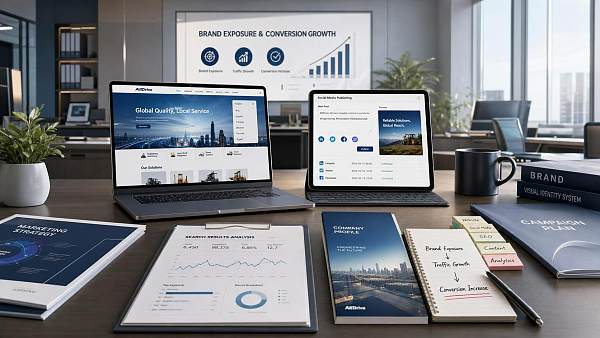
When it comes to overseas social media operations and brand exposure, many teams used to look at total followers first, followed by engagement levels. However, judging from platform changes and customer acquisition results over the past two years, this approach is gradually becoming ineffective. An account may appear active without generating inquiries, and content may attract traffic without necessarily building trust.
A more obvious signal is that brand exposure is shifting from simply “being seen” to “being understood, searched for, and verified.” Social media is no longer just a communication window, but a key touchpoint in the entire journey involving website visits, search behavior, advertising conversions, and subsequent transactions.
This is why overseas social media operations and brand exposure cannot be evaluated based only on surface-level data. What truly deserves attention is whether social media content directs users to the independent website, increases branded searches, shortens the decision-making cycle, and helps audiences in different markets form a stable understanding of the company.
Why Is This Change Becoming More Noticeable?
Changes in platform traffic logic are the first reason. In the past, many brands relied on a single platform to accumulate followers. Today, recommendation mechanisms place greater emphasis on content relevance and the quality of time spent. A large follower base still has value, but it is no longer the decisive factor in brand exposure effectiveness.
The second reason comes from user behavior. After encountering a brand, overseas users typically do not convert immediately. Instead, they continue searching for the official website, case studies, reviews, industry content, and localized information. In other words, social media is only the entry point, while the website and search results are where trust is amplified.
Another practical factor cannot be overlooked. Platform preferences vary more significantly across regions, and content is consumed at a faster pace. Relying solely on standardized materials for overseas social media operations and brand exposure makes it increasingly difficult to address markets such as North America, Europe, Southeast Asia, and the Middle East at the same time.
- Platforms place greater emphasis on authentic interactions, completion rates, and the quality of shares, rather than rewarding only large accounts.
- Users are more accustomed to verifying brands across platforms, and social media exposure is evaluated together with the official website experience.
- As advertising costs continue to rise, the return on investment from simply pursuing follower growth has declined significantly.
- With the widespread adoption of AI search and recommendation technologies, the degree to which content is structured has begun to affect brand visibility.
What New Signals Are Buyers Starting to Focus On?
From an operational perspective, the evaluation criteria for overseas social media operations and brand exposure have become more refined. Many companies are beginning to place “high-quality visits generated by content” ahead of “follower growth,” because this directly affects subsequent lead generation and sales opportunities.
Another change is the growing importance of brand consistency. If the content communicated on social media, the capabilities presented on the official website, and the brand information shown in search results are disconnected, users will quickly leave. The core of brand exposure is shifting from visibility and reach toward a closed loop of brand understanding.
This shows that overseas social media operations and brand exposure can no longer be viewed in isolation. They need to work in coordination with website development, SEO, advertising, and content assets in order to truly turn exposure into growth.
The Impact Extends Beyond Communication
Many teams understand social media operations as content publishing, but the impact has long extended to later stages. If social media content cannot lead users to the website, brand exposure will remain superficial. If the website lacks a multilingual structure and search-friendly capabilities, exposure will also be difficult to consolidate.
For B2B inquiry-driven businesses, overseas social media operations and brand exposure function more like a trust-building system. Users first learn about the company through social media, then visit the official website to verify its case studies, production capacity, qualifications, and delivery capabilities before finally leaving their contact information. If any step in the process is disconnected, front-end traffic will have difficulty becoming a valuable opportunity.
For cross-border independent websites, the role of social media exposure is more focused on compound growth. On the one hand, it helps reach new customers; on the other, it also influences search performance, the accumulation of remarketing audiences, and the distribution of short-video content. Traffic channels are no longer separate; instead, they reinforce one another.
From Websites to Social Media, True Effectiveness Comes from Integrated Coordination
This is why integrated website and marketing services are receiving increasing attention. When social media is handled alone, a common problem is that content exists but the follow-up conversion path is insufficient. When only the website is developed, the site may also lack a sustainable source of exposure after launch. When the two are disconnected, both brand reach and conversion efficiency suffer.
Based on long-term experience serving overseas markets, platforms with coordinated capabilities in website development, SEO, advertising, and social media are more likely to turn overseas social media operations and brand exposure into a sustainable initiative rather than a one-time communication campaign. The reason is simple: data can be connected, content can be reused, and paid and organic traffic can more easily work together.
Digital service platforms such as Yiyingbao, driven by AI and big data, are better suited to the current stage not simply because they offer a wide range of tools, but because they can place intelligent website development, multilingual content, SEO optimization, advertising, and social media operations within the same growth framework. With this approach to overseas social media operations and brand exposure, the basis for evaluation is more complete and execution is more efficient.
For Future Evaluation, Start by Tracking These Metrics
If you plan to evaluate the effectiveness of overseas social media operations and brand exposure, it is recommended to divide the metrics into three levels: visibility, understanding, and action. This is closer to actual business outcomes and helps prevent misleading conclusions based on data from a single platform.
- Visibility: content reach, repeat reach rate, and coverage of key markets.
- Understanding: time spent on the official website, branded search volume, and depth of visits to case study pages.
- Action: form submissions, direct-message inquiries, and advertising remarketing conversion rates.
- Accumulation: whether content can be indexed by search engines and whether it appears in AI search results.
Compared with simply pursuing follower growth, these metrics better reflect whether brand exposure has truly entered the business chain. Especially in multi-region operations, analyzing content feedback and on-site behavior by market is more valuable than aggregating everything into a single total figure.
The Next Priority Is Not to Be Louder, but to Be More Verifiable
For some time to come, overseas social media operations and brand exposure will continue to develop in two directions. One is more vertical content, emphasizing industry understanding and scenario-based communication. The other is a more complete customer journey, requiring every stage—from social media reach to website engagement, and then to search and advertising re-engagement—to be tracked and optimized.
What is truly worth doing is not putting all resources into follower growth, but first clarifying the entry points through which audiences understand the brand in different overseas markets, checking whether the official website can effectively receive traffic from social media, and then assessing whether SEO, advertising, and social media are coordinated around the same set of content themes.
When overseas social media operations and brand exposure move from superficial popularity toward verifiable growth, brand building becomes more stable. The next step can begin with three actions: rebuilding the metrics framework, connecting website and social media data, and conducting layered content tests by priority market. The result will not be more attractive numbers, but evaluation criteria that are closer to real growth.
Related Articles


Related Products
 EasyCamp SaaS Smart Website Marketing SystemE-Yingbao SaaS Smart Website Marketing System: AI-powered, zero-code website building. Rapidly launch multilingual independent e-commerce sites in just 10 minutes. Global server acceleration and AI-driven SEO optimization empower businesses to efficiently connect with global markets. The seamless integration of technology and user-friendly operation makes building e-commerce sites incredibly simple.
 AI+SEM Intelligent Advertising Marketing SystemAI+SEM drives intelligent ad creation, empowering full-funnel precision advertising marketing. The system automatically generates weekly/monthly reports, AI recommends keywords and target countries, monitors core metrics in real-time with intelligent alerts, and enables one-click high-conversion ad solutions to help quickly acquire customers and improve ROI.
 AI+SEO Dual Engine Optimization ServiceEasyWin AI+SEO Dual Engine Optimization System leverages AI-powered keyword mining, content generation, and comprehensive technical optimization to help foreign trade enterprises acquire high-quality organic traffic, significantly improving search rankings and conversion rates.
 AI+SNS Social Media Marketing SystemYingbao AI+SNS Social Media Marketing System - Precision social capture for the social media era. Supports one-click content synchronization across major platforms like Facebook and LinkedIn. AI intelligently rewrites posts for enhanced relevance. 24/7 AI customer service and user profiling analysis empower businesses to efficiently expand into global markets.
 AI+SEO营销解决方案易营宝AI+SEO营销解决方案,通过AI批量写作、智能生成TDK、精准关键词扩词等功能,全面优化网站SEO效果,提升流量与转化率。助力企业构建高效智能网站新生态。
 AI+SEM Advertising Marketing SolutionsAI+SEM Advertising Marketing Solution leverages AI technology to deeply empower SEM ad campaigns. It automatically generates weekly/monthly reports using AI, presenting account data across multiple dimensions for comprehensive insights into campaign performance and trends. The system precisely recommends keywords and target countries, intelligently generates high-conversion ad copy, and enables one-click activation of efficient campaign plans to help businesses rapidly acquire customers. Simultaneously, it monitors core metrics in real time, intelligently identifies abnormal fluctuations, and issues timely alerts to ensure stable, high-return advertising results.
 Domain Name ServicesEasyWin provides professional domain name services, including intelligent queries, one-stop registration, brand protection, and full lifecycle management, helping businesses build a digital brand image.
 EasyOperate B2C Cross-Border E-Commerce Platform & Independent WebsiteEasyStore B2C Cross-border E-commerce Independent Store is an intelligent website building and cross-border e-commerce integrated solution independently developed by EasyStore Information Technology (Beijing) Co., Ltd. The system is specially designed for small and medium-sized as well as large export enterprises, integrating 'website building, operation, marketing, advertising, and conversion' into one, helping enterprises quickly establish cross-border e-commerce independent stores to achieve brand globalization and global sales growth.
The platform supports multiple languages, multiple currencies, and multi-channel marketing, with built-in AI intelligent translation and SEO optimization systems, suitable for mainstream markets such as Southeast Asia, Europe and America, Latin America, and the Middle East, assisting Chinese manufacturing enterprises in efficiently deploying international e-commerce strategies. SSL证书易营宝提供专业SSL安全证书服务,包括单域名和泛域名证书,确保网站数据传输加密、身份验证和完整性保护,助力企业建立安全可信的在线业务环境。









