









- What Does a Global Traffic Ecosystem Service Provider Do? What Are the Differences from a Single Advertising AgencyJul 16, 2026View details
- What should you focus on in the latest enterprise SaaS report? From renewal rates and delivery costs to overseas growth opportunitiesJul 12, 2026View details
- What signals are worth paying attention to in a cross-border marketing trend report? B2B companies should look at these 6 signalsJul 11, 2026View details
- How to Read a Cross-Border Marketing Trends Report? Five Key Dimensions for Evaluating Channel OpportunitiesJul 11, 2026View details
- Which channel has the highest ROI in the global traffic ecosystem? Comparative analysis of search, social media, and advertisingJul 10, 2026View details
- What multilingual website services are available in Sanya? Which model is more suitable for local businesses going global?Jul 08, 2026View details
How to build a small-language website? Key points for URL structure, font rendering, and RTL adaptation when launching Arabic/Spanish/German three versions simultaneously
How to build a small-language website? First, clarify three things that are “not equal to”
How to build a small-language website? Many companies simply understand multilingual website building as “translation + duplication”, only to find after launch that Arabic page text overlaps, German long words wrap chaotically, and Spanish SEO indexing reaches less than one-third of the English version. Behind this lies a systematic lack in three major technical areas: URL structure, font rendering, and RTL adaptation. During its service to over 100,000 global expansion enterprises, the Yiyingbao AI website building system found that launching Arabic, Spanish, and German versions simultaneously is not something solved by merely turning on a language switch, but requires redefining the site logic from the architectural level.
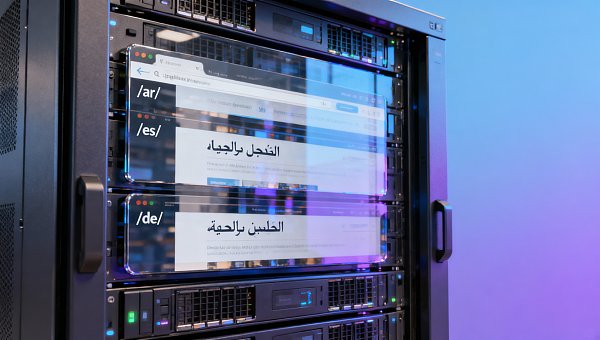
Simply put, “supporting multiple languages” does not equal “being adapted for small languages”, “being able to display text” does not equal “being readable and convertible”, and “having three sub-sites” certainly does not equal “forming localized traffic entry points”. A truly multilingual website must allow search engines, user devices, and content operations to simultaneously “recognize it, read it smoothly, and use it naturally”.
How should the URL structure be set? Don’t let Google think you are building a mirror site
A common misconception is applying a subdomain to each language version (ar.example.com/es.example.com/de.example.com), or using parameters entirely (example.com?lang=ar). The former is easily judged as multiple independent sites, while the latter causes crawler confusion, invalid Canonical tags, and diluted page authority.
A more reliable approach is to use a subdirectory structure and strictly configure hreflang tags. For example:
example.com/ar/(Arabic)
example.com/es/(Spanish)
example.com/de/(German)
Embed bidirectional hreflang declarations in the head of each page to clearly define language and regional attribution. The Yiyingbao cloud intelligent website building system enables this structure by default and automatically injects dynamic hreflang to avoid manual omissions.
Why does font rendering always run into problems? Arabic ligatures and German compound words are the key
Arabic relies on OpenType features to achieve ligatures (such as لَمْ يَكُنْ). If the frontend does not declare font-feature-settings or does not load web fonts that support Arabic Script (such as Tajawal, Cairo), the text will break into isolated characters; German, meanwhile, faces the issue of long compound words (such as Arbeitsunfähigkeitsbescheinigung) failing to wrap properly and overflowing their containers.
The solution needs to be handled in layers: at the foundation level, choose font families in Google Fonts already marked with support for “Arabic” and “Latin Extended”; at the CSS level, enable hyphens:auto and text-rendering:optimizeLegibility; for Arabic, additionally enable font-variant-ligatures: common-ligatures. The Yiyingbao system has a built-in multilingual font strategy engine that can automatically match the optimal rendering rules by language.
RTL adaptation is not just “right-aligning text”, but a reconstruction of the entire interaction logic
Arabic is an RTL (right-to-left) language, but adaptation goes far beyond direction:rtl. Navigation icon positions, form input cursor direction, progress bar direction, and even image carousel order all need mirrored reversal. More subtly, margin-left in CSS should map to margin-inline-start under RTL, otherwise responsive layouts will become misaligned.
In actual deployment, it is recommended to use CSS Logical Properties (such as using inset-inline-start instead of left), together with dual declarations of the lang attribute and dir attribute on the HTML root element. When generating Arabic templates, the Yiyingbao AI website building system automatically injects an RTL-specific style package and provides compatibility wrapping for third-party components (such as maps and form validation).
Low content publishing efficiency? Multilingual social media coordination is the real breakthrough point
After the Arabic official website goes live, if you still rely on manually translating and posting item by item to LinkedIn or Instagram, content timeliness and contextual accuracy will inevitably be compromised. At this point, the technical infrastructure needs to extend to the operations side.
The AI+SNS social media omnichannel intelligent marketing system launched by Yiyingbao is designed for exactly this purpose: it supports one-click generation of multilingual posts from official website product pages and blog articles that match the tone of each platform—not direct translation, but reconstructed expression based on semantic understanding through NLP models. For example, German posts will emphasize technical parameters and compliance certifications, while Arabic posts will focus more on religious and cultural adaptation as well as trust endorsements for local payment methods.
Before launching a multilingual website, be sure to verify these 5 technical indicators
What should you do next? Shift from “being able to launch” to “being able to grow”
Completing the technical deployment of Arabic, Spanish, and German versions is only the starting point. What truly determines the value of a small-language website is the subsequent rhythm of localized content updates, the depth of GEO generative engine optimization, and the cross-validation capability between social media and SEO traffic.
It is recommended to prioritize three actions: first, use Google Search Console to filter “high impressions, low clicks” keywords for each language version, and optimize titles and descriptions accordingly; second, connect the multilingual content of the official website to the AI+SNS social media omnichannel intelligent marketing system to establish a closed loop of content—social media—inquiries; third, set up a monthly localization health checklist covering three core metrics: loading speed (LCP), text readability (CLS), and interaction delay (INP).
How to build a small-language website? The answer does not lie in translation accuracy, but in technical foresight and operational coordination. When URL structure, font rendering, and RTL adaptation become default capabilities, companies can truly turn multilingual websites into stable support points for global customer acquisition.
Related Articles

Related Products
 EasyCamp SaaS Smart Website Marketing SystemE-Yingbao SaaS Smart Website Marketing System: AI-powered, zero-code website building. Rapidly launch multilingual independent e-commerce sites in just 10 minutes. Global server acceleration and AI-driven SEO optimization empower businesses to efficiently connect with global markets. The seamless integration of technology and user-friendly operation makes building e-commerce sites incredibly simple.
 AI+SEM Intelligent Advertising Marketing SystemAI+SEM drives intelligent ad creation, empowering full-funnel precision advertising marketing. The system automatically generates weekly/monthly reports, AI recommends keywords and target countries, monitors core metrics in real-time with intelligent alerts, and enables one-click high-conversion ad solutions to help quickly acquire customers and improve ROI.
 AI+SEO Dual Engine Optimization ServiceEasyWin AI+SEO Dual Engine Optimization System leverages AI-powered keyword mining, content generation, and comprehensive technical optimization to help foreign trade enterprises acquire high-quality organic traffic, significantly improving search rankings and conversion rates.
 AI+SNS Social Media Marketing SystemYingbao AI+SNS Social Media Marketing System - Precision social capture for the social media era. Supports one-click content synchronization across major platforms like Facebook and LinkedIn. AI intelligently rewrites posts for enhanced relevance. 24/7 AI customer service and user profiling analysis empower businesses to efficiently expand into global markets.
 AI+SEO营销解决方案易营宝AI+SEO营销解决方案,通过AI批量写作、智能生成TDK、精准关键词扩词等功能,全面优化网站SEO效果,提升流量与转化率。助力企业构建高效智能网站新生态。
 AI+SEM Advertising Marketing SolutionsAI+SEM Advertising Marketing Solution leverages AI technology to deeply empower SEM ad campaigns. It automatically generates weekly/monthly reports using AI, presenting account data across multiple dimensions for comprehensive insights into campaign performance and trends. The system precisely recommends keywords and target countries, intelligently generates high-conversion ad copy, and enables one-click activation of efficient campaign plans to help businesses rapidly acquire customers. Simultaneously, it monitors core metrics in real time, intelligently identifies abnormal fluctuations, and issues timely alerts to ensure stable, high-return advertising results.
 Domain Name ServicesEasyWin provides professional domain name services, including intelligent queries, one-stop registration, brand protection, and full lifecycle management, helping businesses build a digital brand image.
 EasyOperate B2C Cross-Border E-Commerce Platform & Independent WebsiteEasyStore B2C Cross-border E-commerce Independent Store is an intelligent website building and cross-border e-commerce integrated solution independently developed by EasyStore Information Technology (Beijing) Co., Ltd. The system is specially designed for small and medium-sized as well as large export enterprises, integrating 'website building, operation, marketing, advertising, and conversion' into one, helping enterprises quickly establish cross-border e-commerce independent stores to achieve brand globalization and global sales growth.
The platform supports multiple languages, multiple currencies, and multi-channel marketing, with built-in AI intelligent translation and SEO optimization systems, suitable for mainstream markets such as Southeast Asia, Europe and America, Latin America, and the Middle East, assisting Chinese manufacturing enterprises in efficiently deploying international e-commerce strategies. SSL证书易营宝提供专业SSL安全证书服务,包括单域名和泛域名证书,确保网站数据传输加密、身份验证和完整性保护,助力企业建立安全可信的在线业务环境。









