









- Cross-Border Marketing Trend Research: Why More and More Companies Are Starting to Deploy AI Search and GEO OptimizationJun 30, 2026View details
- Cross-Border Marketing Trend Research: How Independent Sites, AI Content, and Short-Video Customer Acquisition Are ChangingJun 30, 2026View details
- How Can a Brand Updates Page Be Made More SEO-Friendly? Analysis of Update Frequency, Content Structure, and Internal Linking StrategyJun 28, 2026View details
- What stages does the cross-border services ecosystem include? How do website building, promotion, payment, and compliance work togetherJun 22, 2026View details
- How will email marketing costs change in 2026Jun 22, 2026View details
- The China-US tariff arrangement has reached a preliminary consensus, and the trade association will be establishedJun 15, 2026View details
How to choose Arabic website development: key evaluation criteria from RTL layout to local server deployment
How to choose Arabic website development: first check whether it is truly adapted
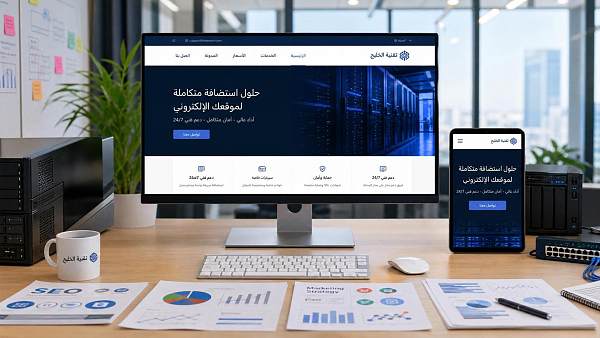
When considering how to choose Arabic website development, many teams first compare prices, delivery timelines, and the number of pages. Once the project enters execution, however, problems often arise from deeper adaptation capabilities.
For example, whether pages support right-to-left display, whether forms, buttons, navigation, and carousels are mirrored as a whole, and whether fonts are clear and readable will all directly affect user trust.
For foreign trade companies and globalizing brands, choosing Arabic website development is not just about building a website that can go live. It is about selecting a set of digital infrastructure that can support long-term customer acquisition.
Judging from recent changes in the Middle East market, users are becoming increasingly sensitive to localized language experiences. If a page looks “like a translated version”, conversions are usually significantly reduced.
This also means that the core of choosing Arabic website development is not who offers the lowest quote, but who can truly connect experience, deployment, indexing, and marketing.
Four key judgments that determine the later cost of the project
When evaluating options, it is recommended to upgrade the question from “can it be built” to “can it be used stably, promoted continuously, and converted effectively after completion”. Focus on four aspects when making the judgment.
1. Whether RTL layout is supported at the system level
Many service providers say they support Arabic, but they are only translating the text. To truly determine how to choose Arabic website development, you need to see whether the system natively supports RTL layout.
Details to check include whether the navigation position, image-text order, input box alignment, pagination direction, icon orientation, mobile menu, and checkout process are adapted in sync.
- Whether the overall page layout can switch between left and right with one click
- Whether the component library supports Arabic font rendering
- Whether display is consistent across multiple devices
- Whether it is easy to maintain during backend editing
2. Whether multilingual SEO can be configured independently
When choosing Arabic website development, you cannot look only at the front-end pages. Whether search engines can correctly identify language versions also determines later traffic costs.
A qualified website should at least support independent configuration of titles, descriptions, URL rules, sitemaps, and language tags for pages in different languages.
If the system only automatically copies the Chinese structure and then translates it mechanically, it can easily lead to indexing confusion, keyword misalignment, and competition between landing pages.
3. Whether local server deployment is available
The Middle East market has relatively high requirements for access speed and stability. When choosing Arabic website development, you also need to judge whether the service provider supports local server deployment or regional node deployment.
This is related to page loading speed, advertising landing page performance, form submission success rates, and data compliance requirements in some regions.
In actual business scenarios, the closer the server is to the target customers, the more stable the first-screen experience usually is, and the smoother advertising traffic and organic traffic can be received.
4. Whether follow-up marketing capabilities are integrated
Many projects produce no results after launch not because the website is not attractive enough, but because website development and promotion are purchased separately, making it impossible to coordinate data, content, advertising, and optimization.
Therefore, when choosing Arabic website development, it is best to directly examine whether the service provider has capabilities in SEO, advertising, social media operations, and conversion optimization.
Comparison of common solutions: the gap is often not in the number of pages
The most misleading factors during selection are often “more pages”, “flashier templates”, and “lower prices”. What truly creates the gap is usually the depth of delivery and the room for subsequent operations.
If a company’s goal is only short-term display, a basic solution may be enough. But once inquiries, advertising, search traffic, and long-term growth are involved, the gap will expand rapidly.
How to judge whether a service provider has practical Middle East market experience
When choosing Arabic website development, the final judgment still needs to return to the service provider itself. Looking at the number of cases is not enough. You also need to see whether the methodology is mature and whether delivery can be replicated.
A more reliable way to judge is to directly ask the following questions.
- Whether they have built Arabic independent websites and can show real page details
- Whether they have Middle East server or regional deployment solutions
- Whether they support structured configuration for multilingual SEO
- Whether they can handle Google promotion, social media marketing, and content operations
- Whether they have a follow-up data analysis and continuous optimization mechanism
These questions may seem basic, but in practice they can easily filter out suppliers that only know how to make pages and do not understand overseas growth.
A clearer signal is that mature teams usually do not only discuss design effects. They also discuss traffic entry points, lead conversion, regional access performance, and the rhythm of later operations.
Why an integrated solution is more suitable for long-term investment
When it comes to choosing Arabic website development, the value of an integrated solution is mainly reflected in three areas: faster launch, smoother collaboration, and more sustainable growth.
Taking 易营宝 as an example, the company has been deeply engaged in global digital marketing since 2013 and has built a complete service chain around intelligent website development, SEO optimization, advertising, and social media operations.
Its self-developed cloud intelligent website development system, cross-border mall system, and AI+SEO/GEO optimization system can advance website construction and subsequent customer acquisition within the same framework.
For companies targeting the Middle East, North Africa, and broader overseas markets, the advantages of this model are very direct: it reduces the collaboration cost of working with multiple suppliers and also lowers trial-and-error losses.
Especially in Arabic projects, language adaptation, content planning, advertising traffic reception, and SEO structure are inherently connected. Splitting them apart often results in the lowest efficiency.
When conducting implementation evaluation, it is recommended to score according to this checklist
If you want to turn the question of how to choose Arabic website development into a real procurement decision, you can build a simple but effective scoring table.
- Completeness of RTL layout, accounting for 25%
- Level of multilingual SEO support, accounting for 20%
- Local server deployment capability, accounting for 20%
- Marketing collaboration capability, accounting for 20%
- Delivery efficiency and after-sales mechanism, accounting for 15%
Using this method to evaluate solutions is usually closer to real value than simply comparing total prices. This is because the hidden costs of low-price projects often appear intensively during later maintenance and promotion stages.
Ultimately, choosing Arabic website development depends on whether it is truly adapted around the target market, whether it can support later customer acquisition, and whether it is worth long-term investment.
When you put RTL layout, multilingual SEO, local server deployment, and marketing integration into the same evaluation table, the selection direction usually becomes much clearer, and later execution is more stable.
Related Articles
 What Should You Pay Attention to When Building a German-Language Website for Germany? Language Localization, Privacy Compliance, and Conversion Details
 How to choose Arabic website development: key evaluation criteria from RTL layout to local server deployment
 EU EPR Requirements Extended to B2B Independent Websites
Related Products
 EasyCamp SaaS Smart Website Marketing SystemE-Yingbao SaaS Smart Website Marketing System: AI-powered, zero-code website building. Rapidly launch multilingual independent e-commerce sites in just 10 minutes. Global server acceleration and AI-driven SEO optimization empower businesses to efficiently connect with global markets. The seamless integration of technology and user-friendly operation makes building e-commerce sites incredibly simple.
 AI+SEM Intelligent Advertising Marketing SystemAI+SEM drives intelligent ad creation, empowering full-funnel precision advertising marketing. The system automatically generates weekly/monthly reports, AI recommends keywords and target countries, monitors core metrics in real-time with intelligent alerts, and enables one-click high-conversion ad solutions to help quickly acquire customers and improve ROI.
 AI+SEO Dual Engine Optimization ServiceEasyWin AI+SEO Dual Engine Optimization System leverages AI-powered keyword mining, content generation, and comprehensive technical optimization to help foreign trade enterprises acquire high-quality organic traffic, significantly improving search rankings and conversion rates.
 AI+SNS Social Media Marketing SystemYingbao AI+SNS Social Media Marketing System - Precision social capture for the social media era. Supports one-click content synchronization across major platforms like Facebook and LinkedIn. AI intelligently rewrites posts for enhanced relevance. 24/7 AI customer service and user profiling analysis empower businesses to efficiently expand into global markets.
 AI+SEO营销解决方案易营宝AI+SEO营销解决方案,通过AI批量写作、智能生成TDK、精准关键词扩词等功能,全面优化网站SEO效果,提升流量与转化率。助力企业构建高效智能网站新生态。
 AI+SEM Advertising Marketing SolutionsAI+SEM Advertising Marketing Solution leverages AI technology to deeply empower SEM ad campaigns. It automatically generates weekly/monthly reports using AI, presenting account data across multiple dimensions for comprehensive insights into campaign performance and trends. The system precisely recommends keywords and target countries, intelligently generates high-conversion ad copy, and enables one-click activation of efficient campaign plans to help businesses rapidly acquire customers. Simultaneously, it monitors core metrics in real time, intelligently identifies abnormal fluctuations, and issues timely alerts to ensure stable, high-return advertising results.
 Domain Name ServicesEasyWin provides professional domain name services, including intelligent queries, one-stop registration, brand protection, and full lifecycle management, helping businesses build a digital brand image.
 EasyOperate B2C Cross-Border E-Commerce Platform & Independent WebsiteEasyStore B2C Cross-border E-commerce Independent Store is an intelligent website building and cross-border e-commerce integrated solution independently developed by EasyStore Information Technology (Beijing) Co., Ltd. The system is specially designed for small and medium-sized as well as large export enterprises, integrating 'website building, operation, marketing, advertising, and conversion' into one, helping enterprises quickly establish cross-border e-commerce independent stores to achieve brand globalization and global sales growth.
The platform supports multiple languages, multiple currencies, and multi-channel marketing, with built-in AI intelligent translation and SEO optimization systems, suitable for mainstream markets such as Southeast Asia, Europe and America, Latin America, and the Middle East, assisting Chinese manufacturing enterprises in efficiently deploying international e-commerce strategies. SSL证书易营宝提供专业SSL安全证书服务,包括单域名和泛域名证书,确保网站数据传输加密、身份验证和完整性保护,助力企业建立安全可信的在线业务环境。









