









- What Does a Global Traffic Ecosystem Service Provider Do? What Are the Differences from a Single Advertising AgencyJul 16, 2026View details
- What should you focus on in the latest enterprise SaaS report? From renewal rates and delivery costs to overseas growth opportunitiesJul 12, 2026View details
- What signals are worth paying attention to in a cross-border marketing trend report? B2B companies should look at these 6 signalsJul 11, 2026View details
- How to Read a Cross-Border Marketing Trends Report? Five Key Dimensions for Evaluating Channel OpportunitiesJul 11, 2026View details
- Which channel has the highest ROI in the global traffic ecosystem? Comparative analysis of search, social media, and advertisingJul 10, 2026View details
- What multilingual website services are available in Sanya? Which model is more suitable for local businesses going global?Jul 08, 2026View details
Should a B2B foreign trade website include a multilingual switcher?
Should a B2B export website design include a multilingual language-switching button? The answer is not simply that more languages are better. It depends on whether the target markets, user journeys, and SEO strategy are aligned. Only by choosing the right multilingual solution can inquiries and conversions be genuinely improved.
For manufacturing exporters, brands expanding overseas, and cross-border service providers, multilingual functionality is not merely a front-end feature that affects whether a website “looks good.” It is a core design element that affects indexing, bounce rate, inquiry quality, and subsequent sales efficiency. When building an export website, many companies habitually add language buttons first and only later consider whether the translated content is complete, whether the page structure is suitable, and whether each market has been optimized independently. As a result, the website may appear international, while actual conversions remain unsatisfactory.
Especially within an integrated website and marketing service model, a language-switching button is not merely a user interface element. It also affects URL structure, keyword layout, Google indexing strategy, consistency between advertising and landing pages, and content comprehensibility in AI search scenarios. For B2B companies, determining “whether switching is needed” before deciding “how to switch” is usually more important than blindly launching multiple languages.
A multilingual language-switching button is not a standard feature—start by examining the company’s target-market structure
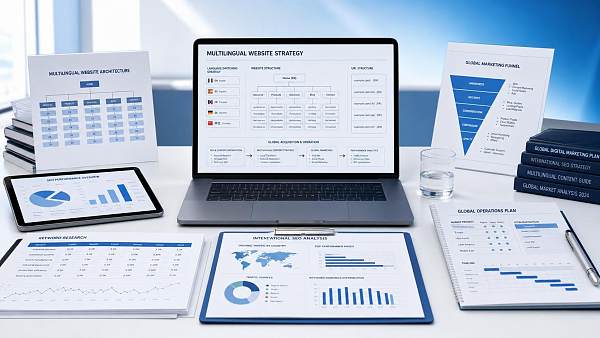
Should a B2B export website design include a multilingual language-switching button? The first step is not to ask the designer, but to examine the market structure. If more than 80% of a company’s inquiries come from English-speaking markets and the sales team primarily follows up in English, it is often more effective to make the English site complete, professional, and indexable than to launch five languages at the same time.
Conversely, if a company clearly serves more than three regions, such as English-speaking markets, Russian-speaking regions, and Spanish-speaking regions, and has stable advertising or organic traffic goals for each market, providing a multilingual switching entrance is practically meaningful. Such websites serve buyers with different native languages, and language adaptation directly affects time on site, form submission rates, and page trust.
4 core dimensions for deciding whether to add a button
- Are there more than 2 major target-market languages, with ongoing customer-acquisition needs for each language?
- Does the website plan to conduct multi-region SEO rather than only achieve global coverage in English?
- Does the sales and customer-service team have the ability to handle the corresponding languages, with response times ideally controlled within 24 hours?
- Can product materials, case studies, FAQs, forms, and policy pages all be localized simultaneously, rather than translating only the homepage?
Typical scenarios suitable for adding a multilingual switching button
The first category is region-focused companies, such as suppliers specializing in the Middle East, Latin America, or Eastern Europe. The second is industrial-product companies with long product decision chains, where purchasing, technical, and management personnel may each prefer pages in different languages. The third is companies that combine advertising with organic traffic and need users to follow a consistent language path from the homepage and product pages to the inquiry page.
Situations in which a button may not be necessary
If a company has a limited website-building budget, can support only 30 to 50 pages in the first phase, and lacks sufficient translation resources, launching 6 to 8 languages at once will usually create a large amount of thin content. Search engines may identify high page duplication, low information density, and weak update frequency. Such websites will not only struggle to improve rankings but may also dilute the authority of the main site.
The table below can help companies more quickly determine whether a B2B export website design should include a multilingual language-switching button and which strategy should be adopted.
The core conclusion is clear: a multilingual button is not more professional simply because there are more languages. It should serve a clear market strategy. For most B2B companies, limiting the first phase to 2 to 3 high-value languages is more likely to generate valid inquiries than rolling out 7 languages with incomplete content.
Multilingual buttons directly affect SEO, indexing, and user journeys
When many companies discuss whether a B2B export website design should include a multilingual language-switching button, they focus only on whether it is convenient for users to switch pages while overlooking structural SEO issues. In reality, once language versions go live, they affect at least four areas: URL rules, page uniqueness, keyword localization, and search-engine recognition efficiency.
Adding the button with the wrong structure creates even bigger problems
Common mistakes include using the same URL for different languages, switching text only through scripts, failing to set independent page titles and descriptions, and providing only machine-translated versions of product pages. These practices make it difficult for search engines to determine the page topic. In serious cases, they can lead to language-confused indexing: users enter a Spanish page from Google but see an English title or Chinese buttons.
For B2B industry websites, it is recommended that each priority language have an independent URL structure, such as /en/, /es/, and /ru/. If the target country is clearly defined, regional versions can be further differentiated. This is more conducive to keyword grouping, page-authority allocation, and subsequent advertising landing-page expansion.
From an SEO perspective, at least 3 basic conditions should be met
- Each language version has an independent page and does not use simple pop-up translation.
- There are no fewer than 10 to 20 core pages, avoiding a situation in which only the homepage and Contact Us page are translated.
- Titles, descriptions, product specifications, industry applications, and form prompts are all localized rather than translating only the body text.
The user journey also determines whether the button is effective
If a user enters a page from a Google search for a product keyword, the ideal situation is usually not to ask the user to switch languages manually, but to direct the user straight to the corresponding language page. In other words, a multilingual button is more of an auxiliary entrance than the primary solution. What truly affects conversion is whether the search result, landing page, product description, and inquiry form can maintain the same language across all four touchpoints.
This is even more important in advertising scenarios. For example, when Google Ads or Facebook ads generate traffic, if the ad copy is in Spanish but the landing page defaults to English, the language-switching button will still increase the risk of bouncing. If users cannot understand the above-the-fold information within the first 3 to 5 seconds, they may leave immediately.
How should an export website choose a multilingual solution more prudently?
In actual projects, a multilingual website is not limited to the approach of simply “adding a button.” A more reasonable method is to select a solution based on customer-acquisition goals, budget cycles, content capabilities, and subsequent promotional methods. It can generally be divided into 3 categories: single-language specialization, bilingual expansion, and independent multilingual operations.
Adaptation logic for 3 common solutions
If a company is at the initial stage of expanding overseas, it is recommended to start with an English main site. The project cycle is usually 2 to 4 weeks, focusing first on product presentation, inquiry forms, basic SEO, and the mobile experience. If a company already has stable contact with customers in Europe, Latin America, or Russian-speaking regions, 1 to 2 additional languages can be added in the second phase. Only companies with ongoing content-update and market-advertising capabilities are suitable for more than 3 language versions.
The costs, maintenance requirements, and marketing value of different solutions are not the same. The comparison below is more suitable for companies making purchasing decisions.
For most small and medium-sized B2B export companies, the second solution is often the most balanced. It demonstrates an international presence without creating excessive maintenance pressure due to an overly broad content scope. In particular, when the capacity for adding new content is below 8 to 10 articles per month, independent multilingual operations can easily become difficult to manage.
The position and format of a multilingual button also require careful consideration
It is recommended to follow 3 design principles
- Clear positioning: It is usually placed at the upper right of the header navigation or at the top of the mobile menu, avoiding locations that are too deeply buried.
- Accurate naming: It is recommended to use language names, such as English and Español, rather than using only national flag icons.
- Stable switching: After switching, users should remain on the corresponding language version of the current page instead of always being redirected to the homepage.
These details directly affect the user experience. For websites containing more than 50 product pages, if switching languages always returns users to the homepage, they may need to repeat navigation 2 to 3 times to find the original product, resulting in significant conversion losses.
Common pitfalls to avoid when implementing the process from website development to promotion
Whether a B2B export website design should include a multilingual language-switching button is ultimately not a graphic-design issue but a systematic project. If website development, content, SEO, advertising, social media, and AI search visibility are not planned consistently, the multilingual function can easily become a mere decoration.
Pitfall 1: Translating only the homepage while leaving key conversion pages untranslated
Many companies make the homepage and About Us page multilingual, while product details, application scenarios, certification information, FAQs, and inquiry forms remain in English or even Chinese. This causes users to lose informational support during the latter stages of decision-making. A B2B purchasing process usually requires 3 to 5 types of pages to work together to build confidence; the homepage alone is far from sufficient.
Pitfall 2: Relying on machine translation without verifying industry terminology
Industrial-product, equipment, and materials websites need to pay particular attention to this issue. A translation error in a parameter unit, process term, or certification description can affect professional judgment. It is recommended that product titles, specification tables, industry applications, and form fields undergo at least manual review, with accuracy prioritized for the first 20 high-value pages.
Pitfall 3: Having multilingual versions without corresponding marketing activities
If a website launches Russian and Spanish versions but has no corresponding keyword layout, advertising, backlink building, or social-media traffic acquisition, these pages may remain without traffic for a long time. Multilingual pages are not an accumulation of assets; they are marketing entrances. Each additional language means adding a complete content-operations and customer-acquisition path.
An implementation process more suitable for B2B companies
- First confirm 1 to 3 priority regional markets and define language priorities.
- Organize 20 to 50 core pages and determine which must be localized.
- Build an independent URL structure and handle page titles, descriptions, and form languages simultaneously.
- After launch, use SEO, advertising, or social media to acquire traffic by language and observe performance data over 90 days.
- Based on bounce rate, time on site, inquiry volume, and sales feedback, decide whether to add more languages.
For companies seeking to balance website-building efficiency with global promotional results, an integrated service is a more reliable approach. An AI-driven enterprise SaaS platform such as 易营宝 can connect intelligent website building, multilingual website development, Google SEO optimization, advertising, and GEO generative engine optimization, reducing the trial-and-error costs caused by disconnected processes. It is particularly suitable for B2B companies that need to acquire overseas customers continuously.
Whether to add a multilingual language-switching button to a B2B export website is not about “following the trend,” but about whether there is a market, content, promotion, and follow-up capability. If a company currently has only one primary overseas market, it is more cost-effective to develop a single-language site in depth. If it has already established 2 to 3 priority regional markets and is prepared to conduct long-term SEO, advertising, and localized conversion activities, multilingual switching is a necessary configuration.
For export companies, a truly effective multilingual website should be indexable, understandable, convertible, and sustainable to operate. Relying on its self-developed cloud intelligent website-building system, AI+SEO/GEO optimization system, and full-chain overseas marketing capabilities, 易营宝 can help companies create a unified solution covering language planning, website development, and promotional implementation. If you are evaluating whether a B2B export website design should include a multilingual language-switching button, or would like to obtain a website and marketing solution better suited to your target market, please contact us now for customized advice and an implementation roadmap.
Related Articles
Related Products
 EasyCamp SaaS Smart Website Marketing SystemE-Yingbao SaaS Smart Website Marketing System: AI-powered, zero-code website building. Rapidly launch multilingual independent e-commerce sites in just 10 minutes. Global server acceleration and AI-driven SEO optimization empower businesses to efficiently connect with global markets. The seamless integration of technology and user-friendly operation makes building e-commerce sites incredibly simple.
 AI+SEM Intelligent Advertising Marketing SystemAI+SEM drives intelligent ad creation, empowering full-funnel precision advertising marketing. The system automatically generates weekly/monthly reports, AI recommends keywords and target countries, monitors core metrics in real-time with intelligent alerts, and enables one-click high-conversion ad solutions to help quickly acquire customers and improve ROI.
 AI+SEO Dual Engine Optimization ServiceEasyWin AI+SEO Dual Engine Optimization System leverages AI-powered keyword mining, content generation, and comprehensive technical optimization to help foreign trade enterprises acquire high-quality organic traffic, significantly improving search rankings and conversion rates.
 AI+SNS Social Media Marketing SystemYingbao AI+SNS Social Media Marketing System - Precision social capture for the social media era. Supports one-click content synchronization across major platforms like Facebook and LinkedIn. AI intelligently rewrites posts for enhanced relevance. 24/7 AI customer service and user profiling analysis empower businesses to efficiently expand into global markets.
 AI+SEO营销解决方案易营宝AI+SEO营销解决方案,通过AI批量写作、智能生成TDK、精准关键词扩词等功能,全面优化网站SEO效果,提升流量与转化率。助力企业构建高效智能网站新生态。
 AI+SEM Advertising Marketing SolutionsAI+SEM Advertising Marketing Solution leverages AI technology to deeply empower SEM ad campaigns. It automatically generates weekly/monthly reports using AI, presenting account data across multiple dimensions for comprehensive insights into campaign performance and trends. The system precisely recommends keywords and target countries, intelligently generates high-conversion ad copy, and enables one-click activation of efficient campaign plans to help businesses rapidly acquire customers. Simultaneously, it monitors core metrics in real time, intelligently identifies abnormal fluctuations, and issues timely alerts to ensure stable, high-return advertising results.
 Domain Name ServicesEasyWin provides professional domain name services, including intelligent queries, one-stop registration, brand protection, and full lifecycle management, helping businesses build a digital brand image.
 EasyOperate B2C Cross-Border E-Commerce Platform & Independent WebsiteEasyStore B2C Cross-border E-commerce Independent Store is an intelligent website building and cross-border e-commerce integrated solution independently developed by EasyStore Information Technology (Beijing) Co., Ltd. The system is specially designed for small and medium-sized as well as large export enterprises, integrating 'website building, operation, marketing, advertising, and conversion' into one, helping enterprises quickly establish cross-border e-commerce independent stores to achieve brand globalization and global sales growth.
The platform supports multiple languages, multiple currencies, and multi-channel marketing, with built-in AI intelligent translation and SEO optimization systems, suitable for mainstream markets such as Southeast Asia, Europe and America, Latin America, and the Middle East, assisting Chinese manufacturing enterprises in efficiently deploying international e-commerce strategies. SSL证书易营宝提供专业SSL安全证书服务,包括单域名和泛域名证书,确保网站数据传输加密、身份验证和完整性保护,助力企业建立安全可信的在线业务环境。









