









- What Does a Global Traffic Ecosystem Service Provider Do? What Are the Differences from a Single Advertising AgencyJul 16, 2026View details
- What should you focus on in the latest enterprise SaaS report? From renewal rates and delivery costs to overseas growth opportunitiesJul 12, 2026View details
- What signals are worth paying attention to in a cross-border marketing trend report? B2B companies should look at these 6 signalsJul 11, 2026View details
- How to Read a Cross-Border Marketing Trends Report? Five Key Dimensions for Evaluating Channel OpportunitiesJul 11, 2026View details
- Which channel has the highest ROI in the global traffic ecosystem? Comparative analysis of search, social media, and advertisingJul 10, 2026View details
- What multilingual website services are available in Sanya? Which model is more suitable for local businesses going global?Jul 08, 2026View details
With a limited Google Ads budget, should you start with Search or Shopping?
With a limited Google Ads budget, should you start with Search or Shopping campaigns? This is not a simple either-or decision. It should be determined based on product characteristics, the conversion path, and the speed of data accumulation. Choosing the right campaign sequence allows a limited budget to generate inquiries and orders more quickly.
For foreign trade enterprises, manufacturing plants, cross-border sellers, and brands expanding overseas, a limited budget is often not the biggest problem. What truly affects return on ad spend is whether the campaign sequence is correct, whether the landing page can effectively receive and convert traffic, and whether data transmission is complete. If the website, product feed, and advertising account are not coordinated, even a daily spend of only RMB 300 to RMB 1,000 may be quickly exhausted within 7 days without generating valid leads.
In the practice of integrated website and marketing services, Search ads and Shopping ads do not replace each other; instead, they serve different customer acquisition stages. Search ads are more suitable for inquiry-driven businesses with clear intent and longer decision cycles, while Shopping ads are more suitable for e-commerce conversion scenarios with standardized products and relatively transparent pricing. When the budget is limited, getting the first step right is more important than blindly increasing the budget later.
With a limited budget, first determine whether you are selling a “need” or a “product”
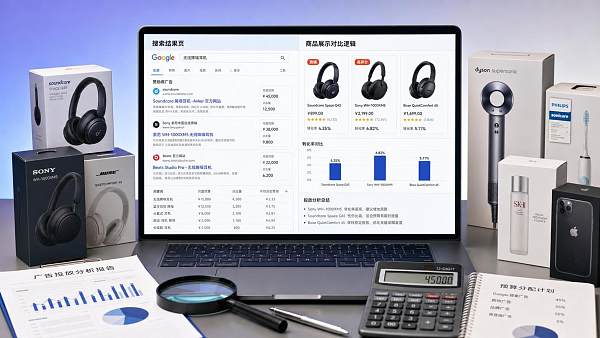
When discussing whether to start with Search or Shopping with a limited Google Ads budget, many companies tend to look at cost per click first. In fact, they should first examine the logic behind the transaction. If customers need to consult about specifications, MOQ, lead times, certifications, or customization capabilities before purchasing, the business is essentially selling a solution, and Search ads generally have higher priority. If customers directly compare styles, prices, reviews, and shipping costs, Shopping ads can often generate orders more quickly.
What scenarios are Search ads suitable for?
Search ads are more suitable for B2B inquiries, equipment customization, industrial components, raw materials, and business services. These users search for keywords such as “supplier,” “manufacturer,” “OEM,” and “bulk order.” The conversion path usually involves 1 click, 2 to 3 visits, and an inquiry submitted within 7 to 30 days. When the budget is not high, starting with Search ads to validate core keywords can help identify high-intent markets more quickly.
3 advantages of Search ads
- Strong controllability: Start with 5 to 20 core keywords and gradually expand to avoid overly dispersed traffic at the beginning.
- Suitable for long decision cycles: Ideal for project-based orders requiring sample communication, quotation confirmation, and technical discussions.
- Convenient landing page testing: Within 7 to 14 days, you can make an initial assessment of whether the page content, form settings, and conversion path are reasonable.
What scenarios are Shopping ads suitable for?
Shopping ads are more suitable for B2C cross-border stores or products involving simple purchase decisions, with clear SKUs, complete images, transparent prices, and standardized logistics. Users can see the image, title, price, and promotional information directly in the search results and usually complete an order within 1 to 3 clicks. If the product price is between $20 and $200 and complex pre-sales communication is not required, Shopping ads generally offer faster data accumulation.
To make it easier to determine whether to start with Search or Shopping with a limited Google Ads budget, the table below can be used as an initial screening reference.
If your business is closer to the left side, starting with Search is generally more stable when the budget is limited. If it is closer to the right side, Shopping ads are more likely to show click-through and conversion signals within the first 10 days. However, the website foundation must be qualified; otherwise, even if the right ad type is selected, conversion will still be hindered by the landing page.
With a limited budget, website conversion capacity matters more than the ad format alone
When discussing whether to start with Search or Shopping with a limited Google Ads budget, many companies overlook a more important question: Does the website have the foundation to be promoted, indexed, and converted? If the page takes more than 3 seconds to load, the mobile form is too lengthy, and product details lack lead times, specifications, FAQs, and trust elements, even highly targeted traffic will be lost.
Key points for Search ad landing pages
For Search ads, the landing page should focus on 1 core keyword. It is not recommended that one page serve more than 5 completely different product needs at the same time. For B2B websites, it is recommended that the first screen explain the product category, supply capabilities, application scenarios, and primary call-to-action within 5 seconds. Keeping form fields to 4 to 6 items can significantly reduce the bounce rate.
4 page elements to complete first
- Use a clear title and subtitle to explain what you sell and what problems you can solve.
- Include decision-making information such as application scenarios, specification ranges, and delivery cycles.
- Add forms, online chat, WhatsApp, or email buttons to reduce conversion barriers.
- Provide information about factory capabilities, service processes, and frequently asked questions to increase inquiry credibility.
Key points for Shopping ad websites
For Shopping ads, product data quality is the most important factor. Titles are generally recommended to be kept between 70 and 150 characters. The main image should clearly highlight the subject, and the price, currency, inventory, shipping policy, and return and exchange information must be consistent. If the Feed information is inconsistent with the landing page, system learning efficiency will decline, and low-budget accounts are more likely to receive clicks without generating orders.
The table below can be used to check whether the website and advertising are ready for a low-budget launch.
For companies with limited budgets, advertising is only the entry point for traffic. What truly determines returns is the coordination efficiency of website development, tracking, content, and campaign management. This is why more and more companies are choosing integrated website and marketing services: optimizing individual elements alone often cannot solve overall conversion problems.
Practical strategies for low-budget accounts: validate on a small scale first, then expand gradually
If you are still wondering whether to start with Search or Shopping with a limited Google Ads budget, you can use the “small-budget validation method.” Do not launch across multiple countries, product lines, and bidding methods simultaneously from the beginning. Instead, focus first on 1 market, 1 product category, and 1 core conversion goal. This makes it easier to see the actual results within the first 14 days rather than being misled by fragmented data.
Recommended launch pace for B2B companies
For foreign trade factories, machinery and equipment companies, industrial parts suppliers, and business service providers, it is recommended to start with Search ads. Select around 10 high-intent keywords in the first round and divide them into 3 dimensions: product terms, application terms, and procurement terms. The budget can initially be concentrated on a single country or English-speaking market. Run the campaign for 7 days to observe search term quality, evaluate form submissions and inquiry quality after 14 days, and then decide whether to expand keywords or add Display remarketing.
Common mistakes in low-budget B2B advertising
- Keywords are too broad: Purchasing only broad industry terms results in a large number of irrelevant clicks.
- All products share one landing page: The page cannot match different procurement needs.
- Looking only at cost per click: Failing to consider the cost of valid inquiries and sales follow-up results.
Recommended launch pace for B2C cross-border stores
For independent websites with complete SKUs and a mature payment process, it is recommended to start with Shopping ads. First select 20 to 50 featured SKUs and ensure that the product Feed structure is consistent and that pricing and promotional information are synchronized. Check impressions and click-through rate during the first 3 days, add-to-cart rate after 7 days, and the first batch of converted SKUs after 14 days. Then shift the budget toward categories with high click-through rates and strong conversions.
How should a very limited budget be allocated more reasonably?
In practice, if the daily budget is insufficient to support continuous learning for both Search and Shopping campaigns, it is recommended to allocate 70% to 80% of the budget to the primary campaign type and the remaining 20% to 30% for testing or remarketing. This ensures sufficient data accumulation in the main channel while retaining room for optimization, preventing the account from remaining in a state of “doing everything but going deep into nothing.”
Integrated solutions are the key to improving return on ad spend with a limited budget
A limited budget does not mean there are no opportunities. The key is to shorten the trial-and-error cycle through a systematic approach. For companies expanding overseas, ad selection is only one step. More importantly, smart website development, data tracking, page content, multilingual adaptation, and campaign strategy must form a closed loop. Especially in markets such as North America, Europe, and Southeast Asia, users in different regions have different concerns regarding page messaging, delivery information, and trust elements.
Why are more companies choosing integrated website and marketing services?
Compared with coordinating separately with a website development company, an advertising team, and a content team, integrated services can complete page launch, conversion tracking implementation, ad setup, and initial optimization more quickly within 2 to 4 weeks. This reduces communication losses and keeps keywords, products, pages, and conversion goals consistent from the first day, making it more suitable for companies with limited budgets that want to obtain valid results as soon as possible.
Which companies should consider this first?
- Companies expanding overseas with newly built independent websites that have not yet established stable organic traffic.
- Factories or brands that have already invested in advertising but face high inquiry costs and unstable orders.
- Cross-border teams planning to develop Google Ads, SEO, and multilingual websites simultaneously.
Yingyibao has focused on global digital marketing and AI-driven growth services for more than 10 years. Centered on smart website development, Google SEO optimization, Google Ads management, social media marketing, and GEO generative engine optimization, it has built a complete process from website development to customer acquisition and conversion improvement. For companies deciding whether to start with Search or Shopping with a limited Google Ads budget, it is more appropriate to first identify the right starting solution through account diagnosis, website evaluation, and market-fit analysis, and then gradually increase investment.
If your products are highly customized and have long inquiry cycles, you should generally start with Search ads. If your products are highly standardized, your SKUs are complete, and your website has a mature transaction process, Shopping ads can often scale more quickly. The truly efficient approach is not to insist on a single channel, but to first take the step most likely to produce results within the available budget and then use data to guide further expansion.
If you would like to obtain more suitable campaign sequencing and independent website optimization recommendations based on your industry, target market, and current website conditions, please contact us now for a customized solution and learn more about integrated website development and marketing solutions designed for overseas growth.
Related Articles
Related Products
 EasyCamp SaaS Smart Website Marketing SystemE-Yingbao SaaS Smart Website Marketing System: AI-powered, zero-code website building. Rapidly launch multilingual independent e-commerce sites in just 10 minutes. Global server acceleration and AI-driven SEO optimization empower businesses to efficiently connect with global markets. The seamless integration of technology and user-friendly operation makes building e-commerce sites incredibly simple.
 AI+SEM Intelligent Advertising Marketing SystemAI+SEM drives intelligent ad creation, empowering full-funnel precision advertising marketing. The system automatically generates weekly/monthly reports, AI recommends keywords and target countries, monitors core metrics in real-time with intelligent alerts, and enables one-click high-conversion ad solutions to help quickly acquire customers and improve ROI.
 AI+SEO Dual Engine Optimization ServiceEasyWin AI+SEO Dual Engine Optimization System leverages AI-powered keyword mining, content generation, and comprehensive technical optimization to help foreign trade enterprises acquire high-quality organic traffic, significantly improving search rankings and conversion rates.
 AI+SNS Social Media Marketing SystemYingbao AI+SNS Social Media Marketing System - Precision social capture for the social media era. Supports one-click content synchronization across major platforms like Facebook and LinkedIn. AI intelligently rewrites posts for enhanced relevance. 24/7 AI customer service and user profiling analysis empower businesses to efficiently expand into global markets.
 AI+SEO营销解决方案易营宝AI+SEO营销解决方案,通过AI批量写作、智能生成TDK、精准关键词扩词等功能,全面优化网站SEO效果,提升流量与转化率。助力企业构建高效智能网站新生态。
 AI+SEM Advertising Marketing SolutionsAI+SEM Advertising Marketing Solution leverages AI technology to deeply empower SEM ad campaigns. It automatically generates weekly/monthly reports using AI, presenting account data across multiple dimensions for comprehensive insights into campaign performance and trends. The system precisely recommends keywords and target countries, intelligently generates high-conversion ad copy, and enables one-click activation of efficient campaign plans to help businesses rapidly acquire customers. Simultaneously, it monitors core metrics in real time, intelligently identifies abnormal fluctuations, and issues timely alerts to ensure stable, high-return advertising results.
 Domain Name ServicesEasyWin provides professional domain name services, including intelligent queries, one-stop registration, brand protection, and full lifecycle management, helping businesses build a digital brand image.
 EasyOperate B2C Cross-Border E-Commerce Platform & Independent WebsiteEasyStore B2C Cross-border E-commerce Independent Store is an intelligent website building and cross-border e-commerce integrated solution independently developed by EasyStore Information Technology (Beijing) Co., Ltd. The system is specially designed for small and medium-sized as well as large export enterprises, integrating 'website building, operation, marketing, advertising, and conversion' into one, helping enterprises quickly establish cross-border e-commerce independent stores to achieve brand globalization and global sales growth.
The platform supports multiple languages, multiple currencies, and multi-channel marketing, with built-in AI intelligent translation and SEO optimization systems, suitable for mainstream markets such as Southeast Asia, Europe and America, Latin America, and the Middle East, assisting Chinese manufacturing enterprises in efficiently deploying international e-commerce strategies. SSL证书易营宝提供专业SSL安全证书服务,包括单域名和泛域名证书,确保网站数据传输加密、身份验证和完整性保护,助力企业建立安全可信的在线业务环境。









