









- What Does a Global Traffic Ecosystem Service Provider Do? What Are the Differences from a Single Advertising AgencyJul 16, 2026View details
- What should you focus on in the latest enterprise SaaS report? From renewal rates and delivery costs to overseas growth opportunitiesJul 12, 2026View details
- What signals are worth paying attention to in a cross-border marketing trend report? B2B companies should look at these 6 signalsJul 11, 2026View details
- How to Read a Cross-Border Marketing Trends Report? Five Key Dimensions for Evaluating Channel OpportunitiesJul 11, 2026View details
- Which channel has the highest ROI in the global traffic ecosystem? Comparative analysis of search, social media, and advertisingJul 10, 2026View details
- What multilingual website services are available in Sanya? Which model is more suitable for local businesses going global?Jul 08, 2026View details
Should SSL and WAF be deployed together for website security?
Do SSL and WAF need to be deployed together for website security? If you are building a corporate website or marketing website, this is not an optional question, but a basic configuration related to data encryption, attack protection, and conversion trust.
Why can't a corporate website install only SSL without WAF?
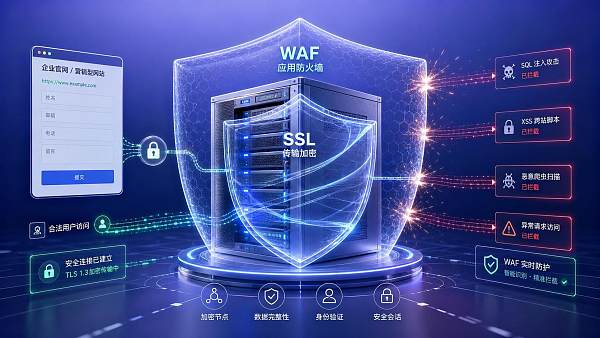
Many companies deploy an SSL certificate first when building a website because the security lock icon in the browser's address bar can directly increase visitor trust and help search engines identify the site's basic security capabilities. However, assuming that website security is complete as a result often creates subsequent risks.
SSL addresses transmission encryption. Its primary function is to prevent data from being eavesdropped on, tampered with, or impersonated between users and servers. WAF is responsible for identifying and blocking malicious access requests, such as common injection attacks, malicious crawlers, brute-force attacks, and abnormal traffic surges. They protect different layers and cannot replace each other.
For integrated website and marketing services, security issues affect not only server stability but also landing-page conversion for advertising campaigns, SEO indexing stability, the quality of form inquiries, and overseas customers' first impression of the brand. Therefore, do SSL and WAF need to be deployed together for website security? In most cases, the answer is that they are worth planning simultaneously.
- If a website has forms, inquiry functions, login, payment, or file-upload features, SSL alone still cannot prevent application-layer attacks.
- If a website is responsible for SEO traffic acquisition and advertising campaigns, abnormal traffic and malicious requests can slow page responses and affect user experience and conversions.
- If a company targets overseas markets, access from multiple regions and cross-border traffic are more complex, so security strategies need to balance accessibility and protection strength.
What problems do SSL and WAF address respectively? Understand their boundaries before making a decision
Before answering the question of whether SSL and WAF need to be deployed together for website security, it is easier to determine whether the investment is necessary by examining the two capabilities separately. The following table is suitable for companies to use as a quick reference when purchasing website-building, hosting, and security services.
From an operational perspective, SSL is more like an “encrypted channel,” while WAF is more like a “front-door access control.” One protects data while it is in transit, and the other protects requests at the entry point. Combining the two better meets a company's dual requirements for stable customer acquisition and brand trust.
Which website scenarios are more suitable for deploying SSL and WAF simultaneously?
Not all websites face the same risks. However, as long as a website carries marketing objectives, customer data, or overseas promotion tasks, the question of whether SSL and WAF need to be deployed together for website security is usually no longer about “whether,” but about “when and how.”
High-priority scenarios
- B2B international trade websites: They often have inquiry forms, product details, and multiple language pages, making them vulnerable to spam submissions and malicious scraping.
- Cross-border independent websites and online stores: Registration, login, payment, or order processes are involved, creating higher requirements for data encryption and attack blocking.
- Advertising landing pages: Traffic peaks are obvious during campaigns. Malicious traffic generation or attacks can directly increase customer acquisition costs.
- Global brand websites: They need to balance global access speed, trustworthy presentation, and long-term indexing stability. Security configuration cannot be merely superficial.
Medium- and long-term operation scenarios
If a company is already engaged in Google SEO, overseas social media traffic acquisition, and advertising campaigns, website security configuration should serve growth objectives rather than be added as a remedy after a failure. Page tampering, slow website performance, and spammed lead forms can all affect search crawling, ad reviews, and sales follow-up efficiency.
What should you focus on when purchasing? Don't compare only certificate prices and firewall fees
Many purchasing decisions fail not because the budget is too low, but because attention is focused only on individual prices. For corporate websites and marketing sites, the factors that really need to be compared include deployment methods, compatibility, false-positive blocking rates, management complexity, and ongoing maintenance response.
The following selection table is suitable for companies to conduct a unified evaluation during the initial website-building or redesign stage, helping avoid repeated purchases, migrations, and adjustments later.
If a company does not have a dedicated technical team, it is advisable to prioritize a service provider that can coordinate the delivery of website building, security, SEO, and overseas marketing. This not only reduces communication between different interfaces, but also prevents conflicts among certificates, CDN, firewalls, servers, and page performance.
What issues do companies most often overlook when deploying SSL and WAF?
Misconception 1: Having HTTPS means the website is secure
HTTPS only indicates that the connection is encrypted. It does not mean that the site has no program vulnerabilities, nor does it mean that malicious requests cannot enter the backend. Many compromised websites also use SSL, which is exactly where many companies misjudge the situation.
Misconception 2: Everything will be fine once WAF is enabled
WAF requires optimization based on business rules. For example, multilingual websites, file uploads, complex forms, and access policies for specific countries all require whitelist, rate-limit, and path-rule settings. Otherwise, false positives may occur and affect normal inquiries.
Misconception 3: Security and marketing are two separate systems
In reality, security is closely related to conversions. Inaccessible pages, certificate errors, a surge in spam leads, and frequent backend anomalies can directly damage advertising performance, SEO crawling stability, and sales follow-up efficiency. The core of integrated website and marketing services is to make security configuration serve customer acquisition results.
- Before deployment, confirm whether HTTPS redirection is enabled across the entire site to avoid indexing issues and abnormal browser warnings caused by mixed old and new links.
- Check whether forms, shopping carts, and login interfaces are included in the key monitoring scope of WAF rules.
- Set up backups, log retention, abnormal alerts, and permission levels to prevent security issues from escalating.
From website building to promotion, how can you create a security solution that better suits your company?
For international trade companies, manufacturing factories, cross-border sellers, and global brands, a more practical approach is not to purchase scattered tools separately, but to plan SSL, WAF, page performance, SEO structure, and subsequent promotion requirements together during the website-building stage.
Yiyingbao has long provided services for multilingual websites, B2B international trade marketing websites, B2C cross-border online stores, and overseas promotion scenarios. Its advantage lies not in selling security products individually, but in connecting website security, accessibility, indexability, and conversion paths through its cloud-based intelligent website-building system, AI+SEO/GEO optimization system, and marketing campaign capabilities.
- Plan HTTPS, certificate renewal, access redirection, and basic protection strategies simultaneously during website development to reduce rework after launch.
- Based on overseas market access characteristics, configure more suitable access controls by considering regional traffic, language versions, and promotion channels.
- Integrate security capabilities into SEO and advertising coordination to prevent abnormal pages, speed issues, or failed forms from affecting customer acquisition.
- Based on the company's budget, provide tiered solutions ranging from basic corporate websites to highly interactive online stores, rather than adding configurations indiscriminately.
FAQ: Do SSL and WAF need to be deployed together for website security? 4 questions frequently asked by companies
1. Does a small business website also need both to be deployed?
If it is only a minimal presentation page without forms or backend interaction, SSL should be deployed at a minimum. However, as long as there are online inquiries, advertising campaigns, SEO optimization, or backend management entrances, it is advisable to add WAF as early as possible to prevent a small website from becoming an attack target due to weak protection.
2. When the budget is limited, which one should be deployed first?
The usual basic order is to ensure that SSL is enabled across the entire site first, and then add WAF based on the website's functions and traffic. However, if the website has already started running advertising campaigns or serving overseas customers, it is best not to remain in the “SSL only” state for a long time, as this exposes risks at the front-end business entrance.
3. Will deploying WAF affect normal user access?
It generally will not if configured properly. The key is rule optimization. Multilingual websites, file-upload pages, inquiry forms, and payment pages should be tested carefully. Choosing a team familiar with integrated website and marketing services makes it easier to balance protection strength and conversion experience.
4. Are the security priorities the same for international trade websites and cross-border online stores?
Not entirely. International trade websites focus more on form security, content accessibility, and search stability, while cross-border online stores also need to focus on login, orders, payment interfaces, and high-concurrency access. Both are advised to deploy SSL and WAF, but their strategic priorities differ.
Why choose us: Put website security and overseas customer acquisition into one solution
If you are evaluating whether SSL and WAF need to be deployed together for website security, you may wish to take the question one step further: does your website also need to support multilingual development, Google SEO, advertising landing-page speed, overseas access stability, and lead conversion efficiency? This is precisely the type of integrated scenario in which Yiyingbao excels.
Yiyingbao can assist you in evaluating the necessity, functional boundaries, and implementation sequence of SSL and WAF for corporate websites, international trade marketing sites, independent websites, and cross-border online stores. Based on the site structure, target markets, and promotion plans, we can also provide solution recommendations that better fit your business.
- Consultation topics include certificate and protection solution selection, security planning during website development, overseas node access strategies, and key protection areas for forms and backends.
- You can also discuss the delivery timeline for multilingual websites, SEO-friendly structures, the balance between security and speed, and stability requirements for advertising landing pages.
- If you already have an existing website, we can also assess whether a redesign or migration is needed, whether the current HTTPS configuration is compliant, and whether WAF has false positives or missing rules.
For companies that plan to conduct overseas promotion over the long term, SSL and WAF are not duplicate investments, but the underlying safeguards for website trust, stable customer acquisition, and sustained growth. The earlier they are planned together, the lower the subsequent operating costs usually are and the more controllable the risks become.
Related Articles

Related Products
 EasyCamp SaaS Smart Website Marketing SystemE-Yingbao SaaS Smart Website Marketing System: AI-powered, zero-code website building. Rapidly launch multilingual independent e-commerce sites in just 10 minutes. Global server acceleration and AI-driven SEO optimization empower businesses to efficiently connect with global markets. The seamless integration of technology and user-friendly operation makes building e-commerce sites incredibly simple.
 AI+SEM Intelligent Advertising Marketing SystemAI+SEM drives intelligent ad creation, empowering full-funnel precision advertising marketing. The system automatically generates weekly/monthly reports, AI recommends keywords and target countries, monitors core metrics in real-time with intelligent alerts, and enables one-click high-conversion ad solutions to help quickly acquire customers and improve ROI.
 AI+SEO Dual Engine Optimization ServiceEasyWin AI+SEO Dual Engine Optimization System leverages AI-powered keyword mining, content generation, and comprehensive technical optimization to help foreign trade enterprises acquire high-quality organic traffic, significantly improving search rankings and conversion rates.
 AI+SNS Social Media Marketing SystemYingbao AI+SNS Social Media Marketing System - Precision social capture for the social media era. Supports one-click content synchronization across major platforms like Facebook and LinkedIn. AI intelligently rewrites posts for enhanced relevance. 24/7 AI customer service and user profiling analysis empower businesses to efficiently expand into global markets.
 AI+SEO营销解决方案易营宝AI+SEO营销解决方案,通过AI批量写作、智能生成TDK、精准关键词扩词等功能,全面优化网站SEO效果,提升流量与转化率。助力企业构建高效智能网站新生态。
 AI+SEM Advertising Marketing SolutionsAI+SEM Advertising Marketing Solution leverages AI technology to deeply empower SEM ad campaigns. It automatically generates weekly/monthly reports using AI, presenting account data across multiple dimensions for comprehensive insights into campaign performance and trends. The system precisely recommends keywords and target countries, intelligently generates high-conversion ad copy, and enables one-click activation of efficient campaign plans to help businesses rapidly acquire customers. Simultaneously, it monitors core metrics in real time, intelligently identifies abnormal fluctuations, and issues timely alerts to ensure stable, high-return advertising results.
 Domain Name ServicesEasyWin provides professional domain name services, including intelligent queries, one-stop registration, brand protection, and full lifecycle management, helping businesses build a digital brand image.
 EasyOperate B2C Cross-Border E-Commerce Platform & Independent WebsiteEasyStore B2C Cross-border E-commerce Independent Store is an intelligent website building and cross-border e-commerce integrated solution independently developed by EasyStore Information Technology (Beijing) Co., Ltd. The system is specially designed for small and medium-sized as well as large export enterprises, integrating 'website building, operation, marketing, advertising, and conversion' into one, helping enterprises quickly establish cross-border e-commerce independent stores to achieve brand globalization and global sales growth.
The platform supports multiple languages, multiple currencies, and multi-channel marketing, with built-in AI intelligent translation and SEO optimization systems, suitable for mainstream markets such as Southeast Asia, Europe and America, Latin America, and the Middle East, assisting Chinese manufacturing enterprises in efficiently deploying international e-commerce strategies. SSL证书易营宝提供专业SSL安全证书服务,包括单域名和泛域名证书,确保网站数据传输加密、身份验证和完整性保护,助力企业建立安全可信的在线业务环境。









