









- What Does a Global Traffic Ecosystem Service Provider Do? What Are the Differences from a Single Advertising AgencyJul 16, 2026View details
- What should you focus on in the latest enterprise SaaS report? From renewal rates and delivery costs to overseas growth opportunitiesJul 12, 2026View details
- What signals are worth paying attention to in a cross-border marketing trend report? B2B companies should look at these 6 signalsJul 11, 2026View details
- How to Read a Cross-Border Marketing Trends Report? Five Key Dimensions for Evaluating Channel OpportunitiesJul 11, 2026View details
- Which channel has the highest ROI in the global traffic ecosystem? Comparative analysis of search, social media, and advertisingJul 10, 2026View details
- What multilingual website services are available in Sanya? Which model is more suitable for local businesses going global?Jul 08, 2026View details
What Localization Details Should Be Considered in B2B Export Website Design?
What localization details should be considered in B2B international trade website design? Every detail, from language and visual preferences to trust signals and inquiry paths, affects overseas customer conversion. Only with proper localization can a website truly generate leads and drive growth.
For international trade companies, manufacturing factories, and brands expanding overseas, a website is no longer merely an online business card. It is a core platform for capturing search traffic, building trust, and driving inquiries. Many companies invest in website development but still face problems such as high bounce rates, short visit durations, and low inquiry conversion rates. The root cause is often not the technology itself, but insufficient attention to localization details.
In particular, users in different markets, including North America, Europe, the Middle East, Southeast Asia, and Japan and South Korea, have significantly different expectations regarding language, page structure, evidence presentation, and contact preferences. If a website continues to use a single Chinese-oriented approach to translation and layout, it may be indexed within 7 to 15 days after launch, but it will still be difficult to generate stable inquiries within the following 30 to 90 days.
As a digital service platform with many years of experience in overseas marketing and intelligent website development, 易营宝 has long served multilingual websites, B2B marketing websites, Google SEO, and advertising campaigns. Based on practical project experience, this article analyzes the localization details that should be considered in B2B international trade website design from four perspectives: content, visual presentation, trust building, and conversion paths.
I. Language and Content Localization: Help Customers Understand First, Then Encourage Them to Inquire
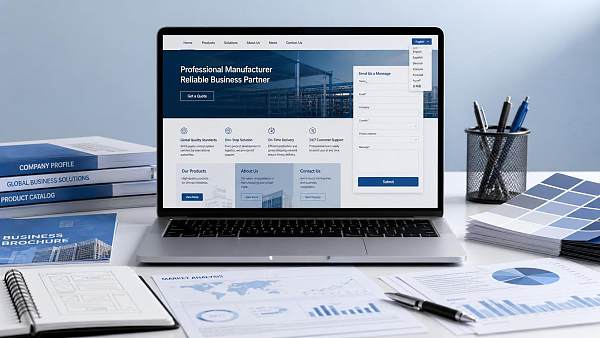
Many companies understand localization simply as “translating Chinese into English.” However, effective B2B international trade website design should include at least three levels of localization: language accuracy, alignment with local expression habits, and complete purchasing information. For purchasing managers, technical decision-makers, and distributors, whether they can find the key information within 30 seconds directly determines whether they continue browsing or leave.
1. Copy Should Not Merely Be Translated; It Should Match Business Communication in the Target Market
A common issue with English websites is that the grammar is correct, but the content reads like machine translation. Expressions such as “our factory has strong capabilities” and “welcome to send us drawings for customization,” which are common in Chinese, do not sound natural in European and American markets. More effective copy should focus on purchasing information such as delivery capabilities, application scenarios, quality control, minimum order quantity, and lead time.
Each core product page should cover at least six items: product specifications, application industries, available options, lead time, quality inspection methods, and inquiry calls to action. In B2B manufacturing, buyers often check the MOQ range, a sample lead time of 3 to 7 days, a mass production lead time of 15 to 35 days, and whether OEM or ODM services are supported.
3 Practical Priorities for Content Writing
- Avoid literal, sentence-by-sentence translation. Prioritize expressions and industry terminology commonly used by local buyers.
- Shift product introductions from “Who we are” to “What customers can gain.”
- Set one primary conversion goal for each page and avoid placing 4 to 5 unrelated actions together.
2. Multilingual Versions Should Not Only Change the Text; They Should Also Adjust the Structure
Users in different markets browse websites in very different ways. European and American customers prefer clear modular structures, Japanese and South Korean users pay more attention to details and standards, while Middle Eastern customers place greater emphasis on trust displays and local contact information. If a multilingual website only provides a language switcher without adjusting the navigation hierarchy, CTA copy, and form fields, conversion performance will usually suffer.
Take inquiry forms as an example. European and American websites generally work well with 5 to 7 fields, such as name, email, company, inquiry details, country, quantity, and attachment. Too many fields can significantly reduce submission rates. On mobile pages, above-the-fold copy should preferably be limited to no more than 2 screens, with key specifications placed first so that customers do not need to scroll more than 5 times before finding the core information.
The following table can help companies quickly identify the key differences in content localization across different markets.
As the table shows, the first localization detail to consider in B2B international trade website design is whether the content is expressed in a way that matches local purchasing logic. Language is not superficial translation; it is the restructuring of information around the purchasing decision-making process. This is especially critical for conversion after SEO indexing.
II. Visual and Interaction Localization: Design Should Build Trust Rather Than Simply Add More Elements
In an integrated website and marketing services context, design is not merely an aesthetic issue but also a conversion issue. Many international trade websites fill their homepages with videos, animations, and large banner images without creating a clear reading path. B2B customers usually evaluate suppliers quickly within 1 to 3 minutes, so visual design must focus on being easy to understand, compare, and contact.
1. Visual Preferences Vary Significantly by Region
European and American markets generally prefer clean pages with ample white space and clearly defined modules. Japanese and South Korean markets have higher requirements for layout order, detailed explanations, and consistency between images and text. Latin American and Middle Eastern markets are relatively more receptive to color, but still require strong trust elements. Forcing a single template to cover more than 8 regional markets often weakens click-through and inquiry performance.
In actual website development, it is recommended to limit the homepage to 6 to 8 main modules and avoid displaying more than 3 consecutive sections with repeated selling points after the above-the-fold area. Product detail pages are recommended to follow the order of “application scenarios—specifications—advantages—delivery capabilities—FAQ—inquiry entry,” which better matches purchasing habits than simply presenting company information.
2. Mobile Experience Is Often Overlooked, Yet It Directly Affects Conversion from Advertising and Organic Traffic
When Google SEO, Google Ads, and social media traffic acquisition are used together, mobile visits often account for 40% to 70% of total traffic. If a page takes more than 3 to 5 seconds to load, buttons are too small, or forms are difficult to complete, users may close the page immediately. For an international trade independent website, the mobile version is not an auxiliary version but one of the core conversion entry points.
Therefore, the localization details to consider in B2B international trade website design also include mobile interaction optimization: clear button sizes, fixed floating contact information, fewer form steps, simplified file uploads, and one-click access to telephone and email. Mobile instant communication paths are particularly important in Southeast Asian and Middle Eastern markets.
4-Point Page Interaction Checklist
- Does the above-the-fold area communicate the industry, products, and target customers within 5 seconds?
- Is the navigation limited to no more than 6 to 8 items to avoid excessive depth?
- Does the inquiry button appear at least once in the visible area of every screen?
- Can the mobile form be completed and submitted within 1 minute?
III. Localization of Trust Signals: Customers Do Not Check the Price First; They First Decide Whether You Are Reliable
For overseas buyers encountering a company for the first time, the website’s primary task is not to close a deal immediately but to establish initial trust. In B2B scenarios especially, purchasing often involves an internal decision-making chain of 2 to 5 people, including purchasing, technical, finance, and management personnel. The completeness of the supporting materials on the website directly affects subsequent email response rates and sample communication efficiency.
1. Trust Elements Should Be Specific and Avoid Empty Slogans
Statements such as “quality first,” “serving customers worldwide,” and “rich experience” are not sufficiently persuasive. More effective trust content includes factory or team photos, service processes, supported trade terms, delivery ranges, after-sales response times, service regions, and answers to frequently asked questions. If the company has certifications, test reports, patents, or trade show information, these should also be displayed accurately, clearly, and verifiably.
For example, a website can state “Emails are answered within 24 hours on business days,” “Sample confirmation usually takes 3 to 7 days,” “FOB and CIF trade terms are supported,” and “English materials and after-sales instructions are available.” Such information can reduce buyers’ uncertainty more effectively than vague promotional claims.
2. Contact Details and Company Information Should Match the Evaluation Habits of Overseas Visitors
Many websites hide contact details at the bottom of the page or provide only a general email address, which weakens credibility. It is recommended to provide at least three contact channels: email, forms, and instant messaging tools. For key markets, regional contact options can also be configured. For example, customers in North America commonly use email and forms, while customers in the Middle East and Southeast Asia rely more on WhatsApp or quick chat tools.
The following table summarizes common trust modules on B2B international trade websites and recommended ways to display them.
For companies providing integrated website and marketing services, trust modules should also work together with subsequent promotion. For example, in multilingual website development, SEO optimization, advertising campaigns, and AI search visibility enhancement, 易营宝 plans the brand introduction page, service pages, case study logic, and conversion paths together to avoid the common problem of having a website that can be viewed but does not convert.
IV. Inquiry Path Localization: Make It Easier for Customers to Submit Their Needs Rather Than Discouraging Them with the Process
The answer to what localization details should be considered in B2B international trade website design must ultimately be reflected in inquiry design. No matter how good the visual presentation and content are, if visitors cannot be smoothly guided to take an inquiry action, the value of the traffic cannot be realized. The common problem with international trade websites is often not a lack of traffic, but a lack of a clear path for receiving and converting that traffic.
1. Different Pages Should Have Different Conversion Actions
The homepage is suitable for “Learn More” and “Contact Us”; product pages are suitable for “Get a Quote” and “Request a Catalog”; solution pages are suitable for “Get a Custom Solution”; and blog pages are suitable for “Inquire About Related Services” or “View Related Products.” If every page only includes one “Contact Us” button, it often fails to match purchasing intent at different stages.
Companies are advised to design at least three types of forms: a basic inquiry form, a quotation request form, and a project customization form. The number of fields can be controlled at around 5, 7, and 6 respectively, ensuring sufficient information without increasing the submission burden. For high-value services, a demo booking or one-on-one consultation option can also be added.
2. Website Development and Marketing Should Be Planned Together to Avoid Rework Later
Localization is not the final step before launch; it should be incorporated into the planning process from the beginning of website development. A relatively complete international trade marketing website project can usually be divided into four stages: market research, content planning, page development, and promotion integration testing. If SEO structure, multilingual logic, and advertising landing pages are considered only after the website is completed, rework costs will increase significantly.
Following 易营宝’s integrated service approach, AI-powered website development, multilingual website construction, Google SEO, advertising campaigns, and GEO optimization should be coordinated within the same process. This not only helps pages become indexable more quickly but also allows subsequent search, advertising, and social media traffic to enter the same conversion loop.
Implementation Steps for International Trade Companies
- First identify 1 to 3 priority markets instead of trying to cover every region at once.
- Define the language, page style, and contact preferences for each priority market.
- Organize product terms, application terms, and purchasing-related questions, and plan the site structure.
- Configure SEO pages, advertising landing pages, and inquiry tracking mechanisms at the same time.
- Continue optimizing after launch at the 30-day, 60-day, and 90-day milestones.
If a company is evaluating the localization details to consider in B2B international trade website design, the key issue is not whether the pages “look attractive,” but whether the website truly matches the reading habits, decision-making process, and inquiry methods of the target market. If any one of the four areas—language, visual presentation, trust, and conversion—has a weakness, overall lead-generation efficiency may be affected.
With its AI-powered intelligent website development system, multilingual website capabilities, and experience coordinating SEO and advertising, 易营宝 provides overseas website and marketing solutions better aligned with market needs for international trade companies, manufacturing factories, cross-border sellers, and brands expanding overseas. If you want to build a B2B international trade website that can be promoted, indexed, and converted, please contact us now to obtain a customized solution and learn more about localization recommendations suitable for your target market.
Related Articles
Related Products
 EasyCamp SaaS Smart Website Marketing SystemE-Yingbao SaaS Smart Website Marketing System: AI-powered, zero-code website building. Rapidly launch multilingual independent e-commerce sites in just 10 minutes. Global server acceleration and AI-driven SEO optimization empower businesses to efficiently connect with global markets. The seamless integration of technology and user-friendly operation makes building e-commerce sites incredibly simple.
 AI+SEM Intelligent Advertising Marketing SystemAI+SEM drives intelligent ad creation, empowering full-funnel precision advertising marketing. The system automatically generates weekly/monthly reports, AI recommends keywords and target countries, monitors core metrics in real-time with intelligent alerts, and enables one-click high-conversion ad solutions to help quickly acquire customers and improve ROI.
 AI+SEO Dual Engine Optimization ServiceEasyWin AI+SEO Dual Engine Optimization System leverages AI-powered keyword mining, content generation, and comprehensive technical optimization to help foreign trade enterprises acquire high-quality organic traffic, significantly improving search rankings and conversion rates.
 AI+SNS Social Media Marketing SystemYingbao AI+SNS Social Media Marketing System - Precision social capture for the social media era. Supports one-click content synchronization across major platforms like Facebook and LinkedIn. AI intelligently rewrites posts for enhanced relevance. 24/7 AI customer service and user profiling analysis empower businesses to efficiently expand into global markets.
 AI+SEO营销解决方案易营宝AI+SEO营销解决方案,通过AI批量写作、智能生成TDK、精准关键词扩词等功能,全面优化网站SEO效果,提升流量与转化率。助力企业构建高效智能网站新生态。
 AI+SEM Advertising Marketing SolutionsAI+SEM Advertising Marketing Solution leverages AI technology to deeply empower SEM ad campaigns. It automatically generates weekly/monthly reports using AI, presenting account data across multiple dimensions for comprehensive insights into campaign performance and trends. The system precisely recommends keywords and target countries, intelligently generates high-conversion ad copy, and enables one-click activation of efficient campaign plans to help businesses rapidly acquire customers. Simultaneously, it monitors core metrics in real time, intelligently identifies abnormal fluctuations, and issues timely alerts to ensure stable, high-return advertising results.
 Domain Name ServicesEasyWin provides professional domain name services, including intelligent queries, one-stop registration, brand protection, and full lifecycle management, helping businesses build a digital brand image.
 EasyOperate B2C Cross-Border E-Commerce Platform & Independent WebsiteEasyStore B2C Cross-border E-commerce Independent Store is an intelligent website building and cross-border e-commerce integrated solution independently developed by EasyStore Information Technology (Beijing) Co., Ltd. The system is specially designed for small and medium-sized as well as large export enterprises, integrating 'website building, operation, marketing, advertising, and conversion' into one, helping enterprises quickly establish cross-border e-commerce independent stores to achieve brand globalization and global sales growth.
The platform supports multiple languages, multiple currencies, and multi-channel marketing, with built-in AI intelligent translation and SEO optimization systems, suitable for mainstream markets such as Southeast Asia, Europe and America, Latin America, and the Middle East, assisting Chinese manufacturing enterprises in efficiently deploying international e-commerce strategies. SSL证书易营宝提供专业SSL安全证书服务,包括单域名和泛域名证书,确保网站数据传输加密、身份验证和完整性保护,助力企业建立安全可信的在线业务环境。









