









- Which channel has the highest ROI in the global traffic ecosystem? Comparative analysis of search, social media, and advertisingJul 10, 2026View details
- What multilingual website services are available in Sanya? Which model is more suitable for local businesses going global?Jul 08, 2026View details
- How to view the complete list of China SaaS companies in the top 100? Practical methods for screening website-building and marketing service providersJul 08, 2026View details
- How to view pricing in the global traffic ecosystem? Cost comparison of search, social media, and content channel advertisingJul 06, 2026View details
- How to assess foreign trade website development trends?Looking at 2026 changes from multilingual,AI content to conversion pathsJul 04, 2026View details
- What are the new trends in multilingual marketing data analytics tools in 2026? Focus on attribution、automation and complianceJul 04, 2026View details
How much difference is there between AI-generated website translation and human translation? A comparison of SEO, conversion rates, and terminology accuracy.
How much difference is there between AI website translation and human translation? For business evaluators, the difference lies not only in cost, but also in SEO performance, conversion rate, and terminology accuracy. Choosing the wrong solution can directly impact overseas customer acquisition and brand trust.
In the integrated website and marketing service scenario, translation is no longer just language conversion, but a crucial link affecting website indexing, multilingual ranking, ad landing page performance, and inquiry quality. Especially for foreign trade enterprises, manufacturing plants, and cross-border brands, a multilingual page often has to simultaneously handle three tasks: display, search, and conversion.
Therefore, when comparing prices, business evaluators should not only look at the cost per keyword or the speed of listing, but also assess whether the content can be understood by search engines, whether it can be understood and trusted by overseas customers, and whether it can accurately express product parameters and industry terminology. A truly reasonable solution is usually not to choose either AI or human alone, but rather to combine and configure the content according to page type and marketing objectives.
Let's look at the core differences: AI translation and human translation affect more than just cost.
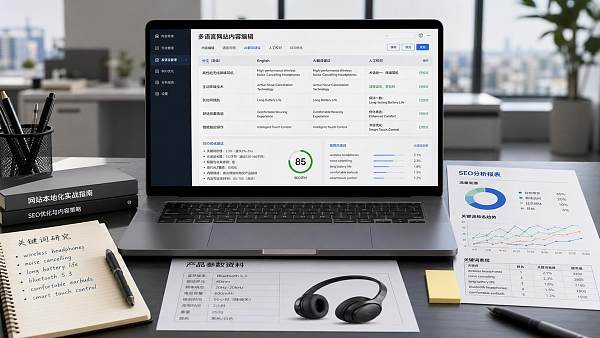
The most common pitfall in business assessment is treating translation projects as one-off text processing tasks. In reality, multilingual websites typically cover four or more types of pages, including the homepage, product pages, case study pages, blog pages, and landing pages. Different pages have different requirements for speed, accuracy, and conversion rates.
AI translation excels in scale and efficiency.
If a company needs to launch 5 languages, 200 pages, and over 100,000 words at once, AI translation has a clear speed advantage. Under normal circumstances, basic pages can complete the first round of translation in 1-3 days, making it suitable for quickly building multilingual websites, synchronizing new product catalogs, or processing large batches of SKU pages.
For sections with relatively standardized information structures, such as logistics instructions, after-sales policies, company introductions, and basic FAQs, AI translation can significantly reduce labor costs and help websites complete their first round of global deployment within 2-4 weeks.
The value of human translation lies in context and business judgment.
However, when a webpage is tasked with SEO customer acquisition and inquiry conversion, the value of human translation becomes significantly amplified. This is because search term selection, title expression, CTA tone, industry terminology, and purchasing preferences often cannot be resolved through literal translation.
For example, in B2B manufacturing product pages, terms like "load capacity," "tolerance standards," "customization process," and "delivery time capability" may lead to inaccurate search traffic or even cause buyers to misjudge supply capacity if the translation only matches the words verbatim without incorporating commonly used expressions in the target market.
To facilitate business evaluation, a comparison is made below using dimensions more suitable for procurement decisions.
On the surface, the most obvious difference between AI website translation and human translation is time and unit price; however, from a business perspective, the real difference often lies in backend metrics, such as page indexing rate, keyword ranking, average dwell time, inquiry form completion rate, and repeat customers' perception of the brand's professionalism.
From an SEO perspective, the main difference lies in "being searchable" versus "how accurate the search results are."
Multilingual websites are not simply about translating Chinese content into foreign languages. For search engines like Google, the presence of localized titles, clear hierarchy, semantically relevant keywords, and an indexable structure determines the potential for organic traffic over the next 6-12 months.
Common SEO weaknesses of AI translation
- The title and body text use too much similarity in wording, and there is a lack of variations of search scenario terms.
- Product pages are often translated literally, ignoring commonly used purchasing keywords in the target market.
- Meta descriptions, button text, and URL aliases lack localization.
- Multilingual pages are prone to repetitive semantics, which can affect the independent ranking of different languages.
For example, the Chinese phrase "custom metal parts supplier" might require differentiating between terms like "manufacturer," "supplier," "custom parts," and "OEM machining" depending on the search habits in different countries. A simple literal translation might make the page "readable," but not necessarily "searchable."
Human translation is more suitable for high-value SEO pages
For the five high-authority page categories—homepage, core product pages, industry solution pages, case study pages, and blog topic pages—it is recommended to at least perform manual editing or localization rewriting. This is because these pages typically account for over 80% of brand search exposure and core inquiry conversions.
Page types that are recommended to be processed manually should be prioritized.
- Homepage and brand introduction page: Influence first impressions and build trust.
- Core product page: Includes technical parameters, application scenarios, and industry terminology.
- Solution page: Needs to be strongly aligned with buyer pain points.
- Advertising landing page: It needs to take into account the conversion behavior after clicking.
- Blog topic pages: Impact on long-tail traffic coverage.
Platform service providers like Yiyingbao, which combine intelligent website building, SEO optimization, advertising, and multilingual website construction, offer value because translation is no longer performed in isolation, but is integrated into a unified plan within the "page construction - indexing optimization - traffic acquisition - inquiry conversion" chain.
In terms of conversion rates, the difference often lies in whether buyers are willing to leave their contact information.
Business evaluators often ask: How much difference is there between AI website translation and human translation? If the page is just displaying information, will the difference be less significant? The answer is that the difference is relatively limited for display pages, but once it enters the stages of advertising, SEO customer acquisition, and inquiry collection, the conversion difference will become significantly larger.
Transformation is not just about grammatical correctness, but also about the trust and expression of ideas.
Overseas buyers can quickly determine a company's professionalism within 15-60 seconds. At this point, what influences the judgment is not just whether there are any typos, but also whether the selling points are clearly presented in order, whether delivery time, MOQ, certification scope, customization support, and after-sales response time are all key information.
AI translation often translates sentences correctly, but it may not be able to handle the question of "what to say first to maximize lead generation." Human translation or marketing-oriented localization pays more attention to information ordering, such as first stating the application industry, then the prototyping cycle of 3-7 days, then the mass production cycle of 15-30 days, and finally guiding the submission of drawings or requirements.
If your goal is to make the website a sales channel, rather than just an electronic catalog, then it is recommended to examine the language scheme together with the page conversion task during the evaluation.
This type of tiered strategy is generally more efficient than "purely manual" or "purely AI-driven" approaches. For companies with limited budgets but seeking results, focusing on developing the 20% of high-value pages in depth and accelerating the development of the 80% of basic pages is often a more realistic return on investment model.
Why does terminology accuracy directly impact brand trust and inquiry quality?
In manufacturing, equipment, materials, electronics, medical peripherals, and industrial components, terminology errors are not minor issues. A single mistranslation of a unit of measurement, material, standard, or process name can lead to anything from repeated confirmations from clients to discrepancies in sample requests, misunderstandings in pricing, and even the loss of business partnerships.
Common Risks of AI Translation
- Similar terms are used interchangeably, such as inconsistent expressions of specifications, models, and series names.
- The direct translation of Chinese structures increases the comprehension costs for overseas procurement personnel.
- The technical parameters have incorrect unit placement, such as mm, inch, and tolerance being mixed up.
- Inconsistent translation of industry standard names affects the sense of professionalism.
How to reduce terminology risks to a controllable level?
A more prudent approach is to establish a glossary, a page priority system, and an approval process before the project begins. The glossary should ideally contain at least 50-200 high-frequency terms, covering product names, materials, processes, certifications, parameter units, and sales action terms.
Recommended 3-step review mechanism
- AI-powered first page rendering: Completes basic output of all pages.
- Industry proofreading: The terminology and parameters are checked by people who understand the product.
- Marketing adjustments: Optimize headlines, CTAs, SEO wording, and lead generation paths.
This is why more and more companies are choosing integrated website building and marketing services with AI+SEO/GEO optimization capabilities, rather than distributing translation, website building, optimization, and advertising among four different teams. The more fragmented the process, the more easily terminology and page expression become distorted.
How to select business evaluators: It's not about choosing one or the other, but about establishing actionable procurement standards.
If you are comparing suppliers, it's not recommended to just ask "how much per thousand words". A more effective approach is to break down the project into five dimensions: page value, number of languages, delivery cycle, SEO goals, and terminology risks, and then determine the ratio of AI to human resources.
4 key evaluation indicators
- Page hierarchy capability: Can it distinguish between homepage, product page, blog page, and landing page?
- Localization capabilities: Whether to translate only the text, or to process the title, description, buttons, and URL simultaneously.
- Marketing synergy capability: Whether it can be linked with SEO, advertising, and social media traffic generation.
- Subsequent maintenance capabilities: Whether newly added pages can be updated within 7 days, and whether multilingual support can be sustainably expanded.
Implementation solutions suitable for most enterprises
For companies planning to enter multiple markets such as North America, Europe, and Southeast Asia, a common feasible model is to first create a prototype website in one main language, and then expand to 2-5 auxiliary languages; focus on processing 20-50 high-value pages in the first batch, and optimize the remaining content in stages after batch translation using AI.
If a service provider can also offer intelligent website building, multilingual deployment, SEO structure optimization, ad landing page creation, and data tracking, then business evaluation is no longer a single-point purchase, but rather an assessment of the stability and scalability of the entire overseas customer acquisition chain. For companies looking to reduce trial-and-error costs, this integrated solution makes it easier to achieve unified delivery and subsequent review.
Returning to the initial question, how much difference is there between AI website translation and human translation? The answer isn't about "which completely replaces the other," but rather how to combine them for different pages, markets, and conversion goals. AI is suitable for amplifying efficiency, while humans are responsible for ensuring professionalism, search relevance, and effective sales communication. This approach is more suited to the realities of overseas marketing.
For businesses requiring multilingual websites, SEO growth, advertising, and overseas customer acquisition in tandem, integrated website and marketing service platforms like EasyPro are more suitable for inclusion in their evaluation list. Through intelligent website building, AI translation, localization optimization, and collaborative promotion, businesses can launch faster and more easily convert traffic into inquiries. If you are evaluating a multilingual website solution, it is recommended to obtain a customized plan as soon as possible and further consult on page translation strategies, SEO configuration, and conversion optimization details.
Related Articles
 GCC Digital Trade Partner Certification, Precondition for Independent Site Dual Verification and Listing
 SEAEC unified API gateway enabled, ASEAN six-country independent site payments and tax interface entered into hard constraints
 How to plan multilingual B2C cross-border e-commerce store development? Key points for products, payment, and localized user experience

Related Products
 EasyCamp SaaS Smart Website Marketing SystemE-Yingbao SaaS Smart Website Marketing System: AI-powered, zero-code website building. Rapidly launch multilingual independent e-commerce sites in just 10 minutes. Global server acceleration and AI-driven SEO optimization empower businesses to efficiently connect with global markets. The seamless integration of technology and user-friendly operation makes building e-commerce sites incredibly simple.
 AI+SEM Intelligent Advertising Marketing SystemAI+SEM drives intelligent ad creation, empowering full-funnel precision advertising marketing. The system automatically generates weekly/monthly reports, AI recommends keywords and target countries, monitors core metrics in real-time with intelligent alerts, and enables one-click high-conversion ad solutions to help quickly acquire customers and improve ROI.
 AI+SEO Dual Engine Optimization ServiceEasyWin AI+SEO Dual Engine Optimization System leverages AI-powered keyword mining, content generation, and comprehensive technical optimization to help foreign trade enterprises acquire high-quality organic traffic, significantly improving search rankings and conversion rates.
 AI+SNS Social Media Marketing SystemYingbao AI+SNS Social Media Marketing System - Precision social capture for the social media era. Supports one-click content synchronization across major platforms like Facebook and LinkedIn. AI intelligently rewrites posts for enhanced relevance. 24/7 AI customer service and user profiling analysis empower businesses to efficiently expand into global markets.
 AI+SEO营销解决方案易营宝AI+SEO营销解决方案,通过AI批量写作、智能生成TDK、精准关键词扩词等功能,全面优化网站SEO效果,提升流量与转化率。助力企业构建高效智能网站新生态。
 AI+SEM Advertising Marketing SolutionsAI+SEM Advertising Marketing Solution leverages AI technology to deeply empower SEM ad campaigns. It automatically generates weekly/monthly reports using AI, presenting account data across multiple dimensions for comprehensive insights into campaign performance and trends. The system precisely recommends keywords and target countries, intelligently generates high-conversion ad copy, and enables one-click activation of efficient campaign plans to help businesses rapidly acquire customers. Simultaneously, it monitors core metrics in real time, intelligently identifies abnormal fluctuations, and issues timely alerts to ensure stable, high-return advertising results.
 Domain Name ServicesEasyWin provides professional domain name services, including intelligent queries, one-stop registration, brand protection, and full lifecycle management, helping businesses build a digital brand image.
 EasyOperate B2C Cross-Border E-Commerce Platform & Independent WebsiteEasyStore B2C Cross-border E-commerce Independent Store is an intelligent website building and cross-border e-commerce integrated solution independently developed by EasyStore Information Technology (Beijing) Co., Ltd. The system is specially designed for small and medium-sized as well as large export enterprises, integrating 'website building, operation, marketing, advertising, and conversion' into one, helping enterprises quickly establish cross-border e-commerce independent stores to achieve brand globalization and global sales growth.
The platform supports multiple languages, multiple currencies, and multi-channel marketing, with built-in AI intelligent translation and SEO optimization systems, suitable for mainstream markets such as Southeast Asia, Europe and America, Latin America, and the Middle East, assisting Chinese manufacturing enterprises in efficiently deploying international e-commerce strategies. SSL证书易营宝提供专业SSL安全证书服务,包括单域名和泛域名证书,确保网站数据传输加密、身份验证和完整性保护,助力企业建立安全可信的在线业务环境。









