









- Which channel has the highest ROI in the global traffic ecosystem? Comparative analysis of search, social media, and advertisingJul 10, 2026View details
- What multilingual website services are available in Sanya? Which model is more suitable for local businesses going global?Jul 08, 2026View details
- How to view the complete list of China SaaS companies in the top 100? Practical methods for screening website-building and marketing service providersJul 08, 2026View details
- How to view pricing in the global traffic ecosystem? Cost comparison of search, social media, and content channel advertisingJul 06, 2026View details
- How to assess foreign trade website development trends?Looking at 2026 changes from multilingual,AI content to conversion pathsJul 04, 2026View details
- What are the new trends in multilingual marketing data analytics tools in 2026? Focus on attribution、automation and complianceJul 04, 2026View details
How to plan multilingual B2C cross-border e-commerce store development? Key points for products, payment, and localized user experience
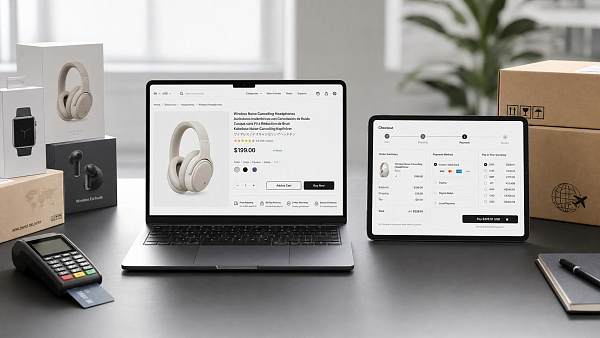
When building a multilingual B2C cross-border ecommerce store, the first issue to solve is growth efficiency
How to plan a multilingual B2C cross-border ecommerce store is seemingly a translation issue, but in fact it is a conversion system issue.
Whether users can understand the products, feel confident paying, and complete an order quickly will directly affect conversion results.
For brand companies going global, multilingual B2C cross-border ecommerce store development is not about creating multiple page versions, but about building a unified operating framework suitable for different markets.
If the initial planning is not in place, common problems will appear quickly.
- Product information may be translated accurately, but the selling points do not match local habits.
- The site supports multiple currencies, but does not match local high-frequency payment methods.
- Pages can be opened, but the shipping, taxes, and return/exchange policies are unclear.
- After the multilingual versions go live, SEO indexing and operational maintenance become more and more difficult.
Therefore, the core of multilingual B2C cross-border ecommerce store development is not the number of languages, but whether language, transactions, and experience work in sync.
Define the market first, then the language; do not make it too big at the start
When many companies build multilingual B2C cross-border ecommerce stores, they tend to list a long string of languages first, only to launch quickly and operate slowly.
A more stable approach is to segment by target market first.
- Core conversion market: prioritize complete local adaptation.
- Testing growth market: first build the main pages and core product pages.
- Potential reserve market: first retain the content structure and technical interface.
The benefit of doing this is that the budget can be invested in markets with better returns, rather than being spread evenly.
In actual business, language selection usually needs to be considered together with traffic sources.
- For sites relying on Google SEO, local search terms and indexing structure must be considered.
- For sites relying on ad placement, landing pages and ad copy consistency must be considered.
- For sites relying on social media conversion, mobile browsing and instant purchase experience must be considered.
This also means that multilingual B2C cross-border ecommerce store development should start from market priority, not from translation workload.
How the product system is built determines whether the multilingual store can convert
Product pages are the part of multilingual B2C cross-border ecommerce store development that is most easily underestimated.
Many websites directly translate Chinese materials into foreign languages; the information is complete, but it may not necessarily sell.
Product information should be managed in three layers
The first layer is standard information, such as specifications, materials, dimensions, functions, certifications, and packaging.
The second layer is marketing information, such as selling point headlines, usage scenarios, comparative advantages, and reasons to buy.
The third layer is transaction information, such as inventory, price, shipping time, customs duty prompts, and after-sales policies.
All three layers need to support multiple languages, but the handling methods cannot be the same.
- Standard information emphasizes accuracy and consistency, and is suitable for structured management.
- Marketing information emphasizes local expression and needs to be rewritten according to market habits.
- Transaction information emphasizes clarity and transparency to reduce pre-order concerns.
Product presentation should follow local decision-making logic
User priorities differ from market to market.
Some regions value price and delivery time, while others pay more attention to quality certification and return/exchange guarantees.
Therefore, multilingual B2C cross-border ecommerce store development cannot simply involve changing the language; the information order on product pages must also be adjusted.
For example, core selling points, reviews, delivery time, tax explanations, and payment security badges should often be displayed first.
Payment and settlement adaptation is a key step in order conversion
When multilingual B2C cross-border ecommerce store development reaches this stage, the part that truly affects orders is usually the payment process.
A user adding an item to the cart does not mean they are willing to complete payment.
Local payment methods must match the market
If a cross-border ecommerce store only offers international credit cards and a single payment channel, the abandonment rate is usually relatively high.
A more mature plan usually considers the following capabilities at the same time.
- Multi-currency display and local settlement capability.
- Combined payment options such as credit cards, digital wallets, and installment payments.
- Taxes, shipping fees, and discount amounts clearly displayed in real time on the checkout page.
- High-risk order identification and risk control review mechanisms.
Looking at recent changes, buy now pay later, wallet payments, and mobile quick-pay methods have already become standard options in many markets.
If these capabilities are not planned in sync during multilingual B2C cross-border ecommerce store development, even with a good front-end experience, users can easily get stuck at the final step.
The checkout process should be as short as possible, but the information must be complete
The checkout page is not a display page; the simpler it is, the better, but key explanations cannot be omitted.
It is recommended to ensure at least four things.
- Price, taxes, and shipping breakdown are clear.
- Order notifications after successful payment can be delivered in the local language.
- Delivery times and return policies are visible before checkout.
- The mobile input steps are minimal, with strong auto-fill capability.
The local experience is not just translation, but also trust building
Many companies understand multilingual B2C cross-border ecommerce store development as simply adding language switching to the page.
But what truly affects repeat purchases is whether users feel that this store is “prepared for them.”
Several localization details that are easy to overlook
- Date, time, size, unit, and address formats conform to local habits.
- The customer service entry point, FAQ, and after-sales explanations can be found quickly.
- Review content, logistics explanations, and delivery commitments are closer to real shopping scenarios.
- Site loading speed, mobile adaptation, and redirect logic are stable enough.
A more obvious signal is that overseas users are paying more and more attention to transparency.
Who ships, how long delivery takes, whether returns/exchanges are available, and how taxes are calculated—all of these must be explained clearly on the front end.
For multilingual B2C cross-border ecommerce store development, trust is not a slogan, but the result of continuous accumulation through page details.
Technology and operations must be designed together, so maintenance will not become more and more burdensome later
The thing multilingual ecommerce stores fear most is fast front-end launch and increasingly chaotic back-end maintenance.
Therefore, multilingual B2C cross-border ecommerce store development should determine the technical structure and operating process from the beginning.
These modules should be checked with priority
If a company hopes to achieve long-term overseas independent site growth, this kind of integrated design becomes even more important.
Integrated services like Yiyingbao, covering intelligent website building, cross-border ecommerce stores, SEO optimization, ad placement, and social media operations, are more suitable for companies that need to balance website-building efficiency and promotional conversion.
For multilingual B2C cross-border ecommerce store development, these four steps can be used during implementation
If you want the plan to truly go live, it is recommended to proceed in a clear implementation sequence.
- First determine the target market, language priority, and core traffic channels.
- Then sort out the product content structure, page templates, and localization rules.
- Synchronously complete payment, logistics, taxes, and after-sales process configuration.
- Finally, combine SEO, advertising, and social media data to continuously optimize conversion.
At the end of the day, multilingual B2C cross-border ecommerce store development is not a one-off project, but a coordinated engineering effort across the website, marketing, and transaction capabilities.
When product expressions are closer to the market, payment paths are smoother, and the local experience is more complete, the store truly has the foundation for stable growth.
When a company puts multilingual planning in place during the website-building stage, subsequent promotional efficiency, indexing performance, and order conversion are usually more controllable.
Related Articles
 GCC Digital Trade Partner Certification, Precondition for Independent Site Dual Verification and Listing
 SEAEC unified API gateway enabled, ASEAN six-country independent site payments and tax interface entered into hard constraints
 How to plan multilingual B2C cross-border e-commerce store development? Key points for products, payment, and localized user experience


Related Products
 EasyCamp SaaS Smart Website Marketing SystemE-Yingbao SaaS Smart Website Marketing System: AI-powered, zero-code website building. Rapidly launch multilingual independent e-commerce sites in just 10 minutes. Global server acceleration and AI-driven SEO optimization empower businesses to efficiently connect with global markets. The seamless integration of technology and user-friendly operation makes building e-commerce sites incredibly simple.
 AI+SEM Intelligent Advertising Marketing SystemAI+SEM drives intelligent ad creation, empowering full-funnel precision advertising marketing. The system automatically generates weekly/monthly reports, AI recommends keywords and target countries, monitors core metrics in real-time with intelligent alerts, and enables one-click high-conversion ad solutions to help quickly acquire customers and improve ROI.
 AI+SEO Dual Engine Optimization ServiceEasyWin AI+SEO Dual Engine Optimization System leverages AI-powered keyword mining, content generation, and comprehensive technical optimization to help foreign trade enterprises acquire high-quality organic traffic, significantly improving search rankings and conversion rates.
 AI+SNS Social Media Marketing SystemYingbao AI+SNS Social Media Marketing System - Precision social capture for the social media era. Supports one-click content synchronization across major platforms like Facebook and LinkedIn. AI intelligently rewrites posts for enhanced relevance. 24/7 AI customer service and user profiling analysis empower businesses to efficiently expand into global markets.
 AI+SEO营销解决方案易营宝AI+SEO营销解决方案,通过AI批量写作、智能生成TDK、精准关键词扩词等功能,全面优化网站SEO效果,提升流量与转化率。助力企业构建高效智能网站新生态。
 AI+SEM Advertising Marketing SolutionsAI+SEM Advertising Marketing Solution leverages AI technology to deeply empower SEM ad campaigns. It automatically generates weekly/monthly reports using AI, presenting account data across multiple dimensions for comprehensive insights into campaign performance and trends. The system precisely recommends keywords and target countries, intelligently generates high-conversion ad copy, and enables one-click activation of efficient campaign plans to help businesses rapidly acquire customers. Simultaneously, it monitors core metrics in real time, intelligently identifies abnormal fluctuations, and issues timely alerts to ensure stable, high-return advertising results.
 Domain Name ServicesEasyWin provides professional domain name services, including intelligent queries, one-stop registration, brand protection, and full lifecycle management, helping businesses build a digital brand image.
 EasyOperate B2C Cross-Border E-Commerce Platform & Independent WebsiteEasyStore B2C Cross-border E-commerce Independent Store is an intelligent website building and cross-border e-commerce integrated solution independently developed by EasyStore Information Technology (Beijing) Co., Ltd. The system is specially designed for small and medium-sized as well as large export enterprises, integrating 'website building, operation, marketing, advertising, and conversion' into one, helping enterprises quickly establish cross-border e-commerce independent stores to achieve brand globalization and global sales growth.
The platform supports multiple languages, multiple currencies, and multi-channel marketing, with built-in AI intelligent translation and SEO optimization systems, suitable for mainstream markets such as Southeast Asia, Europe and America, Latin America, and the Middle East, assisting Chinese manufacturing enterprises in efficiently deploying international e-commerce strategies. SSL证书易营宝提供专业SSL安全证书服务,包括单域名和泛域名证书,确保网站数据传输加密、身份验证和完整性保护,助力企业建立安全可信的在线业务环境。









