









- What stages does the cross-border services ecosystem include? How do website building, promotion, payment, and compliance work togetherJun 22, 2026View details
- How will email marketing costs change in 2026Jun 22, 2026View details
- The China-US tariff arrangement has reached a preliminary consensus, and the trade association will be establishedJun 15, 2026View details
- Should overseas brand marketing start with ads or contentJun 21, 2026View details
- What determines B2C cross-border e-commerce website development costs? A breakdown of features, interfaces, and deployment methodsJun 17, 2026View details
- China-Morocco zero-tariff access, a breakthrough in the cost of Moroccan goods exports to ChinaJun 11, 2026View details
How to Build a Chemicals Industry Foreign Trade Website? Product Classification, Compliance Descriptions, and Inquiry Path Design
How to build a chemical industry foreign trade website: first check whether the product matches the transaction path
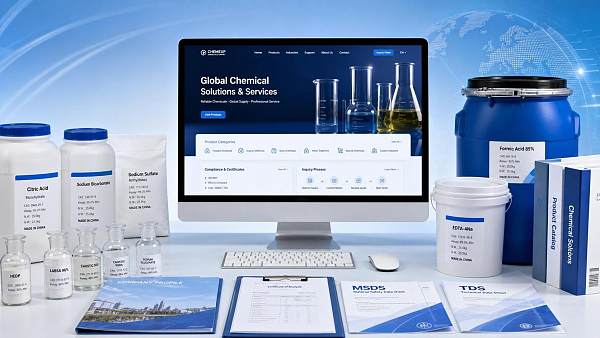
When it comes to how to build a chemical industry foreign trade website, the difficulty usually is not the homepage visuals, but whether the information architecture is close to real transactions. Chemical products have many model numbers, diverse uses, and large differences in compliance requirements. If the website only emphasizes corporate strength, it often struggles to balance search engine indexing, customer judgment, and subsequent inquiry conversion.
In practical applications, a chemical foreign trade website does not face a single access scenario. Some users first look at product performance, some first confirm transportation and certification, and some enter a page through a search for a specific subcategory. Precisely because the entry points differ, product categories, compliance explanations, and inquiry paths cannot be handled in the same way as a general manufacturing website.
For website + marketing service integrated projects, the more common approach is to first build a content base suitable for promotion, and then determine how SEO, ad placement, and multilingual pages should take on traffic. For a platform like Yiyingbao that centers on intelligent website building, SEO optimization, ad placement, and AI search visibility enhancement, the value lies in considering website-building logic and customer-acquisition logic within the same framework.
In actual development, the page focus of different chemical product categories is not the same
When building a chemical industry foreign trade website, the first step is to break down the product type. Basic chemicals, fine chemicals, intermediates, additives, and raw material solvents can all be placed in the same product center at first glance, but the granularity of information on the page is not the same. The former depends more on specifications, packaging, and supply capacity, while the latter usually places greater emphasis on application scenarios, stability, and technical data.
If the website presents all products using a unified template, the usual result is insufficient parameters, imprecise search terms, and difficulty for customers to quickly determine whether there is a match. The truly effective approach is to classify by the three layers of “product series + application industry + key attributes,” rather than listing only by name.
A more index-friendly classification method usually includes three lines
- Classify by chemical properties to help settle core product terms and model-number terms.
- Classify by application industry to cover long-tail searches such as coatings, plastics, rubber, and daily chemicals.
- Classify by supply and delivery conditions to highlight packaging, purity, storage, and minimum order quantity.
Only after doing this well can the question of how to build a chemical industry foreign trade website truly shift from “making a website” to “building a product system that is promotable, judgeable, and convertible.”
Whether customers stay or not often depends on whether the compliance explanation hits the mark
Chemical product trading naturally comes with barriers. Many visitors will not submit an inquiry immediately, but will first verify the document information. If this stage does not clearly explain SDS, COA, REACH, RoHS, GHS labels, transportation methods, and storage conditions, it is still hard to build trust no matter how complete the page is.
It should be noted that compliance explanations are not just about uploading a few attachments. Different markets focus on different points: Europe pays more attention to laws and environmental protection requirements, while the Middle East and Southeast Asia often care more about delivery stability and packaging methods. On the page design side, “public information” and “information provided after inquiry” should be displayed in layers, so that key judgment basis is not missing and the materials are not turned into a download wall.
This structure also has another advantage: it is convenient for subsequent ad landing pages and multilingual versions to be reused, without having to redo the logic every time.
The inquiry path is not better when shorter; it is about reducing invalid back-and-forth
When many people discuss how to build a chemical industry foreign trade website, they assume that the more obvious the inquiry button, the more effective it is. That is not always the case. Chemical product inquiries usually come with clear conditions. If the form is too simple, what comes in is often low-quality leads; if the form is too long, it will cause the initial intent to be lost.
A more stable design is to set different entry points based on page depth. The product list page keeps lightweight inquiries, the product detail page adds fields such as specifications, target use, estimated quantity, and target market, and the material download or sample request page then supplements more complete information. In this way, the conversion rate is preserved, and follow-up tracking efficiency can also be improved.
The most easily overlooked links in the inquiry path
- Not distinguishing between sample requests, price inquiries, and customization needs.
- The form is not linked to a specific product page, making sales follow-up difficult.
- Button placement on mobile devices is unstable, leading to obvious interruptions in access.
- There is no automatic reply or next-step explanation after submission, causing leads to cool off easily.
If you then integrate Yiyingbao’s AI website-building and marketing system and connect SEO entry pages, ad landing pages, and inquiry data, you can later determine which keywords bring high-value inquiries, rather than looking only at traffic volume.
Under high-frequency promotion scenarios, the content organization method also needs to be adjusted
How to build a chemical industry foreign trade website also depends on where the traffic mainly comes from. If it relies on Google SEO for the long term, the website needs a content matrix that lays out product terms, application terms, question terms, and regional terms; if ad placement is the main focus, then product pages should be split into more focused landing pages to reduce information interference.
A more common misunderstanding is treating the official website as the only page. In fact, the brand official website is responsible for trust building, product topic pages are responsible for search intake, ad pages are responsible for conversion actions, and multilingual pages are responsible for improving regional adaptation. They are not duplicate builds, but extensions of the same content structure in different customer acquisition scenarios.
When refining content, you can also borrow the structural thinking of other management-oriented content, such as the way complex information is presented in layers, which is similar to the logic in topics like how to optimize HR management in the era of digital economy. The focus is on making information easier to understand and act on.
Check these misconceptions before launch; it is often more cost-effective than revising later
Many chemical websites go live and then remain ineffective for a long time, not because the industry is hard, but because the early judgment was biased. The most common issues are only looking at product parameters and not the usage environment; only writing the company introduction and not the delivery conditions; only making an English version and not handling regional search differences; only setting one inquiry entry and not distinguishing intent stages.
There is also another situation: putting similar products on the same page in the hope of saving maintenance costs. While this may save effort in the short term, it will weaken SEO indexing in the long run and also make it difficult for customers to compare. For websites that need to continuously acquire overseas traffic, sufficiently clear information breakdown is usually more important than page count.
- First confirm the main product line, then determine the in-site categories and content depth.
- First sort out the target market regulations, then decide which materials should be displayed publicly.
- First distinguish inquiry types, then design form fields and automatic replies.
- First clarify customer acquisition channels, then arrange the proportion of the official website, topic pages, and landing pages.
The truly workable approach is to put website building, promotion, and conversion into the same judgment framework
Back to the original question, how to build a chemical industry foreign trade website is not primarily about how many pages to make, but whether the website can handle real needs in different scenarios. Product categories need to support search and filtering, compliance explanations need to support trust building, and the inquiry path needs to support efficient communication; none of these three can be missing.
If you are preparing to launch or optimize a project, the more practical sequence is to first sort out the main products, target regions, and common inquiry questions, and then evaluate whether the classification hierarchy, material structure, and conversion entry points are consistent. Once these basic judgments are made clear, whether it is SEO optimization, ad placement, or multilingual expansion, it will be easier to achieve stable growth.
Related Articles


Related Products
 EasyCamp SaaS Smart Website Marketing SystemE-Yingbao SaaS Smart Website Marketing System: AI-powered, zero-code website building. Rapidly launch multilingual independent e-commerce sites in just 10 minutes. Global server acceleration and AI-driven SEO optimization empower businesses to efficiently connect with global markets. The seamless integration of technology and user-friendly operation makes building e-commerce sites incredibly simple.
 AI+SEM Intelligent Advertising Marketing SystemAI+SEM drives intelligent ad creation, empowering full-funnel precision advertising marketing. The system automatically generates weekly/monthly reports, AI recommends keywords and target countries, monitors core metrics in real-time with intelligent alerts, and enables one-click high-conversion ad solutions to help quickly acquire customers and improve ROI.
 AI+SEO Dual Engine Optimization ServiceEasyWin AI+SEO Dual Engine Optimization System leverages AI-powered keyword mining, content generation, and comprehensive technical optimization to help foreign trade enterprises acquire high-quality organic traffic, significantly improving search rankings and conversion rates.
 AI+SNS Social Media Marketing SystemYingbao AI+SNS Social Media Marketing System - Precision social capture for the social media era. Supports one-click content synchronization across major platforms like Facebook and LinkedIn. AI intelligently rewrites posts for enhanced relevance. 24/7 AI customer service and user profiling analysis empower businesses to efficiently expand into global markets.
 AI+SEO营销解决方案易营宝AI+SEO营销解决方案,通过AI批量写作、智能生成TDK、精准关键词扩词等功能,全面优化网站SEO效果,提升流量与转化率。助力企业构建高效智能网站新生态。
 AI+SEM Advertising Marketing SolutionsAI+SEM Advertising Marketing Solution leverages AI technology to deeply empower SEM ad campaigns. It automatically generates weekly/monthly reports using AI, presenting account data across multiple dimensions for comprehensive insights into campaign performance and trends. The system precisely recommends keywords and target countries, intelligently generates high-conversion ad copy, and enables one-click activation of efficient campaign plans to help businesses rapidly acquire customers. Simultaneously, it monitors core metrics in real time, intelligently identifies abnormal fluctuations, and issues timely alerts to ensure stable, high-return advertising results.
 Domain Name ServicesEasyWin provides professional domain name services, including intelligent queries, one-stop registration, brand protection, and full lifecycle management, helping businesses build a digital brand image.
 EasyOperate B2C Cross-Border E-Commerce Platform & Independent WebsiteEasyStore B2C Cross-border E-commerce Independent Store is an intelligent website building and cross-border e-commerce integrated solution independently developed by EasyStore Information Technology (Beijing) Co., Ltd. The system is specially designed for small and medium-sized as well as large export enterprises, integrating 'website building, operation, marketing, advertising, and conversion' into one, helping enterprises quickly establish cross-border e-commerce independent stores to achieve brand globalization and global sales growth.
The platform supports multiple languages, multiple currencies, and multi-channel marketing, with built-in AI intelligent translation and SEO optimization systems, suitable for mainstream markets such as Southeast Asia, Europe and America, Latin America, and the Middle East, assisting Chinese manufacturing enterprises in efficiently deploying international e-commerce strategies. SSL证书易营宝提供专业SSL安全证书服务,包括单域名和泛域名证书,确保网站数据传输加密、身份验证和完整性保护,助力企业建立安全可信的在线业务环境。









