









- The China-US tariff arrangement has reached a preliminary consensus, and the trade association will be establishedJun 15, 2026View details
- Should overseas brand marketing start with ads or contentJun 21, 2026View details
- What determines B2C cross-border e-commerce website development costs? A breakdown of features, interfaces, and deployment methodsJun 17, 2026View details
- China-Morocco zero-tariff access, a breakthrough in the cost of Moroccan goods exports to ChinaJun 11, 2026View details
- What signal should be released for the suspension of exports to JapanJun 10, 2026View details
- China's May LNG imports rebounded, with increased volumes from Russia and Canada filling the Middle East supply gapJun 10, 2026View details
How Is the Cost of Building a B2C Cross-Border E-Commerce Store Calculated
How to Calculate the Cost of Building a B2C Cross-Border E-Commerce Store
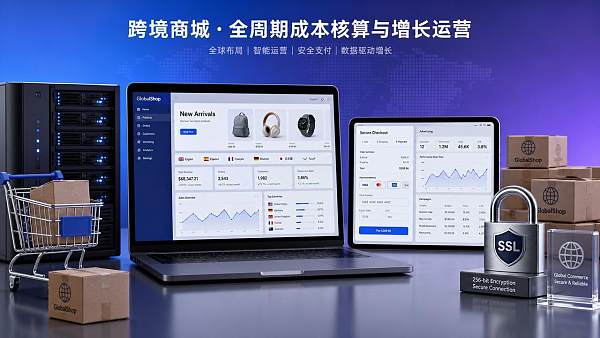
How to calculate the cost of building a B2C cross-border e-commerce store is not simply about looking at a single quotation. What truly affects approval decisions is whether one-time investment, ongoing expenses, and future growth potential are aligned.
Many companies only focus on the development fee at the beginning, but later find that transaction fees, plugin renewal fees, multilingual maintenance, marketing budgets, and operations and maintenance costs keep pushing up the total investment. This also means that calculating the cost of a B2C cross-border e-commerce store must be done from a full life-cycle perspective.
If the goal is long-term overseas sales, the budget model should cover at least three stages: initial website build, launch and ramp-up, and stable operation. This makes it easier to judge whether a project is merely “cheap to launch” or truly “sustainable.”
First, clarify: What components make up the cost of a B2C cross-border e-commerce store
In actual business operations, the costs of a B2C cross-border e-commerce store are usually divided into five major categories. Only by breaking them down can the budget be accurate.
- Website system costs: SaaS subscription fees, or custom development fees.
- Basic setup costs: domain name, server, SSL certificate, CDN.
- Transaction-related costs: payment channels, exchange rate losses, risk control services.
- Operational support costs: multilingual content, customer service tools, email systems.
- Customer acquisition and promotion costs: SEO, ad placement, social media traffic generation, and content production.
The most easily underestimated part is often not the homepage design, nor the store backend, but ongoing operations. Especially when targeting multiple countries, language, tax, payment, and logistics rules all bring additional costs.
The first type of cost: The website model determines the starting budget
When calculating the cost of a B2C cross-border e-commerce store, first determine whether you are choosing a templated SaaS solution or deeply customized development. The budgeting logic for these two approaches is completely different.
SaaS model
The SaaS model requires relatively low upfront investment and is suitable for businesses that want to launch quickly and validate the market first. The cost structure is clearer, usually billed annually, and function upgrades and security maintenance are also more stable.
Custom development model
Custom development is more suitable for complex business scenarios, such as multi-warehouse, multi-currency, membership tiers, and regional pricing systems. However, the initial development, testing, and subsequent version upgrades all cost more, and the project timeline is longer.
If the approval priority is cash flow control, SaaS is usually easier to pass. If the core requirement is deep adaptation to business processes, then secondary development and maintenance costs must be included together.
The second type of cost: The “hidden expenses” that are easily overlooked
For many B2C cross-border e-commerce projects, budget overruns are not caused by the main contract, but by the small costs that keep increasing after launch. This is the part that needs to be estimated in advance.
- Payment processing fees: Rates vary by region, and refunds may also generate losses.
- Plugins and integrations: Marketing pop-ups, membership points, and tax calculation tools are often charged separately.
- Content localization: not just translation, but also cultural adaptation and page adjustments.
- Compliance costs: privacy policies, cookie management, and tax statements all need to be handled.
- Operations and maintenance response: vulnerability fixes, data backups, and performance optimization cannot be absent.
From recent changes, overseas markets have stricter requirements for site experience and compliance. A solution that looks inexpensive may end up costing more to fix later if these supporting elements are missing.
The third type of cost: Promotion budget must be considered together with website build budget
A B2C cross-border e-commerce store does not generate orders just because it is finished. Without traffic, the store is only a cost center. Therefore, website build cost calculations must be linked with customer acquisition budgets.
Common investments include Google SEO, Google Ads, Facebook Ads, short-form video content, and email marketing systems. Different channels vary greatly in cost, but they share one thing in common: early-stage testing costs are necessary.
At this point, whether the site has a good indexing structure, page loading speed, mobile experience, and conversion path directly affects promotion efficiency. The more heavily you invest in promotion, the more important it becomes to pay attention to the underlying quality of the website.
Take a website-and-marketing-integrated platform like YiYingBao as an example. Its advantage is not only building a B2C cross-border e-commerce store, but also coordinating AI smart website building, SEO optimization, ad placement, and overseas social media operations to reduce redundant investment caused by system fragmentation.
A chart to help you understand the budget structure of a B2C cross-border e-commerce store
When reviewing, focus on these three judgment dimensions
First, check whether the investment can be phased. A good B2C cross-border e-commerce solution does not cram all functions into a single upfront build; instead, it launches the core transaction path first and then iterates based on data.
Second, check whether the costs are traceable. Each expense should be classified as system, operations, promotion, or maintenance, and tied to output metrics; otherwise, later reviews will be very passive.
Third, check whether the solution has a growth synergy. If website build, SEO, ads, and social media are purchased separately, it may seem flexible, but in practice it is very easy to create data silos and duplicate payments.
Many companies, when advancing overseas projects, also pay attention to organizational and management upgrades. Content like Enterprise Management Research under the Background of Digital Transformation is more suitable as internal research and judgment material, helping project evaluation go beyond a single purchasing layer.
How to control the overall cost of a B2C cross-border e-commerce store more reasonably
If you want a more stable budget, it is recommended to control it from the source rather than patching holes after the project goes live. The following points are more actionable.
- First clarify the target market to avoid launching with too many languages and regions at the beginning.
- Prioritize standardizing functions to reduce unnecessary deep customization in the early stage.
- Finalize payment, logistics, and tax solutions in advance to avoid rework.
- Plan website build and marketing together to improve traffic conversion efficiency.
- Review input and output by quarter, and adjust channel structure in time.
For enterprises that want to build a long-term independent brand site, a B2C cross-border e-commerce store is not just a technical project, but a sales channel construction project. The key to judging whether the cost is reasonable is not low price, but whether it can form an order loop faster.
Conclusion: When calculating the cost of a B2C cross-border e-commerce store, the key is a full life-cycle perspective
Returning to the original question, how should the cost of building a B2C cross-border e-commerce store be calculated? The answer is actually very clear: you cannot only look at the development quotation; you must include system, payment, operations, promotion, and maintenance all in the same budget sheet.
A more stable approach is to choose a service solution that understands both website building and overseas marketing, so that website construction and subsequent customer acquisition are linked. This not only makes total cost easier to control, but also makes the return path clearer.
If you are currently evaluating a B2C cross-border e-commerce project, you may want to break it down into three items first: “build cost, hidden cost, and growth cost.” Once the budget is clearly broken down, approval decisions are usually faster and more accurate.
Related Articles


Related Products
 EasyCamp SaaS Smart Website Marketing SystemE-Yingbao SaaS Smart Website Marketing System: AI-powered, zero-code website building. Rapidly launch multilingual independent e-commerce sites in just 10 minutes. Global server acceleration and AI-driven SEO optimization empower businesses to efficiently connect with global markets. The seamless integration of technology and user-friendly operation makes building e-commerce sites incredibly simple.
 AI+SEM Intelligent Advertising Marketing SystemAI+SEM drives intelligent ad creation, empowering full-funnel precision advertising marketing. The system automatically generates weekly/monthly reports, AI recommends keywords and target countries, monitors core metrics in real-time with intelligent alerts, and enables one-click high-conversion ad solutions to help quickly acquire customers and improve ROI.
 AI+SEO Dual Engine Optimization ServiceEasyWin AI+SEO Dual Engine Optimization System leverages AI-powered keyword mining, content generation, and comprehensive technical optimization to help foreign trade enterprises acquire high-quality organic traffic, significantly improving search rankings and conversion rates.
 AI+SNS Social Media Marketing SystemYingbao AI+SNS Social Media Marketing System - Precision social capture for the social media era. Supports one-click content synchronization across major platforms like Facebook and LinkedIn. AI intelligently rewrites posts for enhanced relevance. 24/7 AI customer service and user profiling analysis empower businesses to efficiently expand into global markets.
 AI+SEO营销解决方案易营宝AI+SEO营销解决方案,通过AI批量写作、智能生成TDK、精准关键词扩词等功能,全面优化网站SEO效果,提升流量与转化率。助力企业构建高效智能网站新生态。
 AI+SEM Advertising Marketing SolutionsAI+SEM Advertising Marketing Solution leverages AI technology to deeply empower SEM ad campaigns. It automatically generates weekly/monthly reports using AI, presenting account data across multiple dimensions for comprehensive insights into campaign performance and trends. The system precisely recommends keywords and target countries, intelligently generates high-conversion ad copy, and enables one-click activation of efficient campaign plans to help businesses rapidly acquire customers. Simultaneously, it monitors core metrics in real time, intelligently identifies abnormal fluctuations, and issues timely alerts to ensure stable, high-return advertising results.
 Domain Name ServicesEasyWin provides professional domain name services, including intelligent queries, one-stop registration, brand protection, and full lifecycle management, helping businesses build a digital brand image.
 EasyOperate B2C Cross-Border E-Commerce Platform & Independent WebsiteEasyStore B2C Cross-border E-commerce Independent Store is an intelligent website building and cross-border e-commerce integrated solution independently developed by EasyStore Information Technology (Beijing) Co., Ltd. The system is specially designed for small and medium-sized as well as large export enterprises, integrating 'website building, operation, marketing, advertising, and conversion' into one, helping enterprises quickly establish cross-border e-commerce independent stores to achieve brand globalization and global sales growth.
The platform supports multiple languages, multiple currencies, and multi-channel marketing, with built-in AI intelligent translation and SEO optimization systems, suitable for mainstream markets such as Southeast Asia, Europe and America, Latin America, and the Middle East, assisting Chinese manufacturing enterprises in efficiently deploying international e-commerce strategies. SSL证书易营宝提供专业SSL安全证书服务,包括单域名和泛域名证书,确保网站数据传输加密、身份验证和完整性保护,助力企业建立安全可信的在线业务环境。









