









- The China-US tariff arrangement has reached a preliminary consensus, and the trade association will be establishedJun 15, 2026View details
- What determines B2C cross-border e-commerce website development costs? A breakdown of features, interfaces, and deployment methodsJun 17, 2026View details
- China-Morocco zero-tariff access, a breakthrough in the cost of Moroccan goods exports to ChinaJun 11, 2026View details
- What signal should be released for the suspension of exports to JapanJun 10, 2026View details
- China's May LNG imports rebounded, with increased volumes from Russia and Canada filling the Middle East supply gapJun 10, 2026View details
- Will GEO change its SEO strategy?Jun 04, 2026View details
India soybean exports tax shock hits overseas procurement rhythm
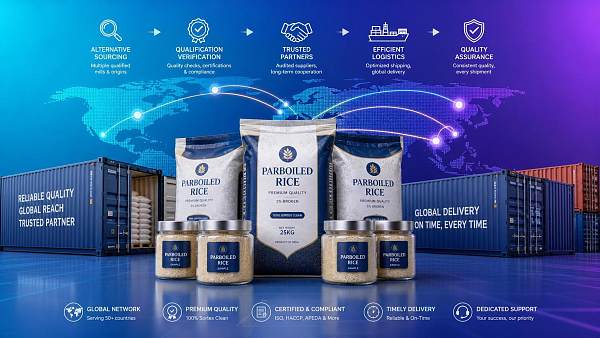
On June 20, 2026, India imposed an urgent 20% export tariff on steamed rice. This trade rule change, combined with the previous broken-rice ban and the high tariff on white rice, has created a cumulative effect that has directly affected expectations for international rice supply and purchasing rhythms. For importers in Southeast Asia, West Africa and other regions that rely on external sourcing, as well as processing and export enterprises in China that take on replacement orders domestically, the current focus is no longer simply price fluctuations, but whether inquiry responsiveness, qualification display, online factory inspection and delivery handoff can keep pace with the new trade rhythm.
Tariff adjustments have triggered an immediate response from the supply side
Confirmed information shows that the Indian government urgently imposed a 20% export tariff on steamed rice on June 20. Before this, the broken-rice ban and the high tariff on white rice were already in place, and this adjustment is a further tightening on top of the existing restrictions.
According to the provided summary, affected by multiple overlapping restrictions, India’s rice export volume is expected to decline by 35%, and international rice prices will rise accordingly. At the same time, as the world’s third-largest rice exporter, China, along with processing enterprises in Guangdong, Anhui and other regions, has already received urgent inquiries from importers in Southeast Asia and West Africa.
Another confirmed situation is that many related processing enterprises have yet to establish independent English websites and online factory inspection channels, so in the process of overseas buyers quickly screening alternative suppliers, there has been a problem of inquiry leakage.
The procurement and delivery chain is being reordered
Import procurement is first faced with a reassessment of substitutes
From the perspective of the business chain, importers in Southeast Asia and Africa are the first to be affected, because changes in export tariffs will directly alter existing procurement costs and supply stability. For such buyers, in the short term they need to reassess the availability of substitute capacity, and at the same time pay attention to supplier qualifications, delivery capability, the completeness of English-language materials, and whether remote audits are feasible.
From an analytical perspective, this stage of change is not only a price adjustment, but also a change in the preconditions of the procurement process: if a supplier cannot provide clear English information, basic documents, or online factory inspection support in a timely manner, it may be excluded at the inquiry stage.
China’s processing and export enterprises are facing a test of responsiveness
For processing and export enterprises in China, the impact is mainly reflected in customer intake, qualification display, and delivery handoff. Confirmed facts show that enterprises in Guangdong, Anhui and other regions have received urgent inquiries, but many enterprises have been unable to effectively capture such temporary release demand due to the lack of independent English websites and online factory inspection channels.
From an industry perspective, this means that whether replacement capacity is visible is becoming as important as actual capacity. What enterprises need to focus on is not only quotation, but also whether they can quickly submit verifiable company information, production and quality materials to overseas customers, as well as the basic documents required to meet remote due diligence.
Supply-chain service links need to keep up with document and rhythm changes
For supply-chain service enterprises surrounding export operations, the impact is more reflected in collaborative efficiency. Trade rule changes often compress the procurement decision-making window, causing customers to pay more attention to whether document preparation, delivery schedules, and risk statements are clear.
Observing the situation, under the current information, enterprises need to pay more attention to materials preparation related to order intake, communication language capabilities, and delivery commitment boundaries, rather than simply understanding short-term inquiries as already forming stable orders.
After inquiries increase, what short boards should the operations side fill first
First fill the information entry points that can be directly verified by overseas buyers
Based on the information provided, the most direct short board at present is the insufficient English independent website and online factory inspection channels. For enterprises that take on replacement orders, this directly relates to whether overseas buyers can complete initial screening and compliance review in a short time. If basic materials cannot be displayed online, even enterprises with processing capability may be unable to enter subsequent price comparison or factory inspection processes.
Prepare documents, inspection and quality materials before the inquiry stage
From an analytical point of view, when international rice prices rise and the purchasing window tightens simultaneously, buyers usually place more emphasis on the efficiency of material acquisition. Enterprises should focus on organizing document materials, inspection reports, quality traceability files, and basic technical descriptions that can be used for external communication. However, in the absence of specific execution details in the input information, this is more suitable to be understood as a pre-positioned preparation suggestion rather than already standardized execution requirements.
Pay attention to whether delivery commitments match actual capacity
As inquiries increase rapidly, delivery cycles and supply stability will become important bases for buyers to judge alternative suppliers. From an observational perspective, enterprises need to handle quotations and delivery commitments cautiously, avoiding delivery arrangements that exceed actual capacity when there is insufficient confirmation.
Continuously track subsequent execution channels and market feedback
At present, what is clear is the tariff change and the immediate market response, but whether subsequent purchasing standards, customer audit requirements, and document checklists will change still needs to be continuously observed in combination with actual market execution. For export enterprises, tracking key points in customer inquiries and actual transaction terms may be more critical than merely focusing on price fluctuations.
This looks more like a signal of execution than a simple market fluctuation
From an observational perspective, this piece of information is more suitable to be understood as a signal that changes in trade rules are being transmitted to the execution level of the supply chain. The core is not only the rise in India’s steamed-rice export costs, but also the fact that after existing trade restrictions are stacked, international buyers begin to search for alternative sources more quickly, and whether those alternative sources can be identified in time depends on whether the enterprise has externally facing capabilities that are verifiable, remotely communicable, and able to respond quickly.
From an analytical perspective, the fact that Chinese-related enterprises have received urgent inquiries indicates that market demand for substitutes has been released; however, most enterprises have yet to establish independent English websites and online factory inspection channels, which also suggests that such demand will not automatically turn into orders. Whether it will subsequently form sustained order intake still needs to be observed in light of the buyer’s actual screening criteria and execution feedback.
What is the more realistic industry takeaway
Taken together, the industry significance of this event lies in the fact that the sudden tightening of trade rules is shifting supply-chain competition from purely capacity and price to a comparison of information transparency, response speed, and basic compliance display capabilities. For importers, the focus is on reassessing substitute sources; for China’s export-related enterprises, the focus is on whether potential substitute capacity can be converted into verifiable commercial intake capacity.
At present, a more appropriate interpretation of this piece of information is that it reflects market reassessment and execution pressure triggered by an already landed tariff change, rather than a conclusion that can directly predict the long-term landscape. The subsequent impact still needs to be continuously observed in combination with procurement execution, delivery feedback, and changes in regulatory channels.
Basis of this article and direction for subsequent verification
This article was generated based on the user-provided news title, event time, and summary, and the verified scope of facts is limited to the input content itself. Such events usually still require cross-verification with official announcements, information released by regulatory bodies, customs or trade authorities, industry association information, standard organization documents, and reports from authoritative media.
It should be noted that the input did not provide specific official source links. Therefore, relevant policy details, execution channels, changes in purchasing documents, industry feedback, and actual enterprise uptake conditions still need continuous verification and follow-up observation.
Related Articles


Related Products
 EasyCamp SaaS Smart Website Marketing SystemE-Yingbao SaaS Smart Website Marketing System: AI-powered, zero-code website building. Rapidly launch multilingual independent e-commerce sites in just 10 minutes. Global server acceleration and AI-driven SEO optimization empower businesses to efficiently connect with global markets. The seamless integration of technology and user-friendly operation makes building e-commerce sites incredibly simple.
 AI+SEM Intelligent Advertising Marketing SystemAI+SEM drives intelligent ad creation, empowering full-funnel precision advertising marketing. The system automatically generates weekly/monthly reports, AI recommends keywords and target countries, monitors core metrics in real-time with intelligent alerts, and enables one-click high-conversion ad solutions to help quickly acquire customers and improve ROI.
 AI+SEO Dual Engine Optimization ServiceEasyWin AI+SEO Dual Engine Optimization System leverages AI-powered keyword mining, content generation, and comprehensive technical optimization to help foreign trade enterprises acquire high-quality organic traffic, significantly improving search rankings and conversion rates.
 AI+SNS Social Media Marketing SystemYingbao AI+SNS Social Media Marketing System - Precision social capture for the social media era. Supports one-click content synchronization across major platforms like Facebook and LinkedIn. AI intelligently rewrites posts for enhanced relevance. 24/7 AI customer service and user profiling analysis empower businesses to efficiently expand into global markets.
 AI+SEO营销解决方案易营宝AI+SEO营销解决方案,通过AI批量写作、智能生成TDK、精准关键词扩词等功能,全面优化网站SEO效果,提升流量与转化率。助力企业构建高效智能网站新生态。
 AI+SEM Advertising Marketing SolutionsAI+SEM Advertising Marketing Solution leverages AI technology to deeply empower SEM ad campaigns. It automatically generates weekly/monthly reports using AI, presenting account data across multiple dimensions for comprehensive insights into campaign performance and trends. The system precisely recommends keywords and target countries, intelligently generates high-conversion ad copy, and enables one-click activation of efficient campaign plans to help businesses rapidly acquire customers. Simultaneously, it monitors core metrics in real time, intelligently identifies abnormal fluctuations, and issues timely alerts to ensure stable, high-return advertising results.
 Domain Name ServicesEasyWin provides professional domain name services, including intelligent queries, one-stop registration, brand protection, and full lifecycle management, helping businesses build a digital brand image.
 EasyOperate B2C Cross-Border E-Commerce Platform & Independent WebsiteEasyStore B2C Cross-border E-commerce Independent Store is an intelligent website building and cross-border e-commerce integrated solution independently developed by EasyStore Information Technology (Beijing) Co., Ltd. The system is specially designed for small and medium-sized as well as large export enterprises, integrating 'website building, operation, marketing, advertising, and conversion' into one, helping enterprises quickly establish cross-border e-commerce independent stores to achieve brand globalization and global sales growth.
The platform supports multiple languages, multiple currencies, and multi-channel marketing, with built-in AI intelligent translation and SEO optimization systems, suitable for mainstream markets such as Southeast Asia, Europe and America, Latin America, and the Middle East, assisting Chinese manufacturing enterprises in efficiently deploying international e-commerce strategies. SSL证书易营宝提供专业SSL安全证书服务,包括单域名和泛域名证书,确保网站数据传输加密、身份验证和完整性保护,助力企业建立安全可信的在线业务环境。









