









- The China-US tariff arrangement has reached a preliminary consensus, and the trade association will be establishedJun 15, 2026View details
- What determines B2C cross-border e-commerce website development costs? A breakdown of features, interfaces, and deployment methodsJun 17, 2026View details
- China-Morocco zero-tariff access, a breakthrough in the cost of Moroccan goods exports to ChinaJun 11, 2026View details
- What signal should be released for the suspension of exports to JapanJun 10, 2026View details
- China's May LNG imports rebounded, with increased volumes from Russia and Canada filling the Middle East supply gapJun 10, 2026View details
- Will GEO change its SEO strategy?Jun 04, 2026View details
How to do Google keyword placement? Detailed explanation of the allocation strategy for category pages, product pages, and blog pages
Don't rush to stack keywords first; Google keyword layout should first look at what task the page needs to handle
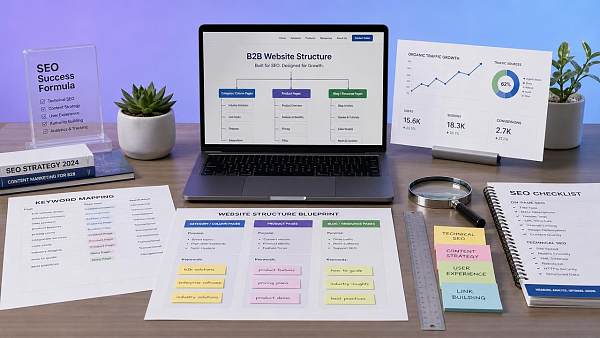
If Google keyword layout is done well, traffic growth is usually more stable and conversion is easier. The problem is that many websites pile all high-search-volume terms onto the homepage, while category pages, product pages, and blog pages end up competing for the same terms, causing slow indexing and unstable rankings.
In practical applications, different pages serve different search intents. Category pages are better suited to carrying topic-level needs, product pages should solve specific transactional questions, and blog pages are responsible for explaining questions, covering long-tail terms, and building topical relevance. This is also why Google keyword layout cannot be handled with one template for everything.
For overseas customer acquisition websites, especially multilingual official websites, B2B marketing websites, and cross-border independent sites, the page structure often directly affects the efficiency of subsequent SEO expansion. When YiYingBao combines intelligent website building, SEO optimization, and AI content systems, it usually first breaks down the keyword library according to page responsibilities rather than looking only at the search volume of individual keywords.
Category pages are more like topic entry points; the key is not how many words there are, but whether the word groups form a system
Category pages are commonly found on product category pages, solution pages, and industry application pages. Their task is not to close the final deal, but to let Google understand what this section is talking about and organize the related content. Therefore, when Google keyword layout reaches category pages, the core is not to stuff them with keywords, but to establish a clear topical boundary.
A more common approach is to first determine one main keyword, then build out with synonyms, application terms, and regional modifiers in layers. For example, when facing foreign trade website building services, a category page can expand around topics such as “Google SEO optimization”, “multilingual website development”, and “B2B foreign trade marketing website”, but do not mix words with clearly different intents such as “quotation”, “case study”, and “tutorial” on the same page.
- Main keywords are responsible for defining the page topic and are usually placed in the title, opening paragraph, and core modules.
- Synonyms are responsible for expanding relevance and are suitable for use in subheadings and explanatory paragraphs.
- Application scenario terms are responsible for covering segmented searches, such as industry, region, and language version.
- Decision terms should not be overused, otherwise the category page will overlap semantically with the product page.
If this layer is done right, the product pages and blog pages behind it will more easily receive internal link support. If the category page itself has a confusing topic, the entire site's Google keyword layout will have a problem with dispersed resources.
Keyword allocation for product pages should revolve around real purchase-intent actions before conversion
The most common mistake on product pages is copying the main keywords from category pages. Although this seems to strengthen Google keyword layout, it actually creates competition within the site. Product pages are better suited to carrying words that are “more specific and closer to conversion”, such as model terms, service combination terms, price-related terms, delivery cycle terms, and regional terms.
If the page corresponds to services such as website building, SEO, or advertising, the product page content cannot just describe functions. It needs to clearly state the scope of delivery, target audience, launch cycle, content support, data tracking, and other information. Because by the time the searcher reaches this stage, the focus has shifted from “what is this” to “whether it is suitable for the current business”.
Some websites also stuff unrelated content into product pages, such as policy explanations or cross-industry materials. Content like the application and optimization of management accounting in business unit financial management, if it appears in a knowledge category or topic content section, can serve as an information-architecture extension case; but if it is directly forced into a core service page, it often weakens the page's thematic focus.
Blog pages are not for padding word count, but for carrying long-tail needs and early-stage search judgment
Many websites treat blogs as content warehouses, resulting in a large number of articles but very little effective traffic. The reason is usually not insufficient publishing, but that Google keyword layout has not clearly designed the relationship between blog pages and business pages.
Blog pages are best suited to covering three types of terms: first, question terms, such as “how to do Google keyword layout”; second, comparison terms, such as “how to allocate keywords between category pages and product pages”; and third, scenario terms, such as “how to plan a multilingual website SEO keyword library”. These terms may not convert immediately, but they can continuously send topical authority to more core pages.
If the website provides services across multiple markets such as North America, Europe, and Southeast Asia, blog pages can also take on the task of localized expression. For example, when discussing Google keyword layout, North American sites place more emphasis on clear commercial intent, while Japanese and Korean markets pay more attention to page structure and local expression accuracy. Blog content that explains these differences is more valuable than simply stacking words.
Why keyword allocation logic changes in different scenarios
When building a B2B lead generation site, the decision cycle is long, so Google keyword layout usually needs category pages and blog pages to establish trust first, and then send traffic to solution pages or inquiry pages. Here, the coordination of professional terms, industry terms, and question-explanation terms is more important.
When building a B2C independent site, the conversion path is shorter, so the importance of product pages and collection pages increases significantly. Keyword allocation will be closer to category terms, purchase terms, review terms, and comparison terms, while blog pages take on more of the role of guiding purchases and nurturing content.
If it is a multilingual official website, you also need to consider whether different language versions share the same root-word logic. You cannot have the Chinese site dividing by business, while the English site divides by information; otherwise the internal structure will become unbalanced, and even with fine-grained Google keyword layout, it will be difficult to maintain consistency later.
- For inquiry-type websites, prioritize ensuring that category page topics are complete.
- For e-commerce websites, prioritize ensuring clear category and product page hierarchy.
- For multilingual websites, prioritize unifying keyword mapping and page template logic.
- For landing pages, prioritize avoiding term competition with natural search core pages.
What is most easily overlooked in implementation is not keyword selection, but pages competing with each other
Many websites seem to have a large keyword library, but the real problem is concentrated internal consumption. If category pages, product pages, and blog pages all optimize the same core keyword at the same time, Google will have a hard time judging which page is more worthy of ranking. The final result is usually repeated rankings, scattered indexing, and even old pages suppressing new pages.
Another common misconception is to look only at search volume and not at the conversion path. High-volume terms are not necessarily suitable for product pages, and low-volume long-tail terms are not necessarily less valuable. Especially in overseas marketing scenarios, what really brings inquiries are often those phrases that are clear, specific in demand, and moderately competitive.
There is also a situation where content updates are disconnected from the site structure. For example, a new industry category is opened, but the blog internal links and product page anchor text are not adjusted in sync. In this way, even if articles continue to be added, Google keyword layout will still be difficult to form a stable topic cluster. Content like the application and optimization of management accounting in business unit financial management needs to be placed in an appropriate information layer even more, to avoid damaging the relevance of the main business line.
The truly actionable method is to first build an allocation table, then iterate by page
To implement Google keyword layout, a more stable approach is to first create a page allocation table. Map core terms, secondary terms, and long-tail terms respectively to category pages, product pages, and blog pages, and then mark each page's goal, internal link direction, and update frequency. This way, when expanding the site later, duplicate page creation is less likely.
If the website is already online, you can start with three actions: check whether duplicate pages exist; confirm whether the category pages can summarize the topic; and sort out whether the blog pages are carrying effective traffic. For websites targeting international markets, also further check whether different language and regional pages maintain the same allocation logic.
Google keyword layout is not a one-time task, but a process that accompanies continuous adjustments to website building, content, advertising, and conversion. Clarifying page responsibilities and then adjusting the keyword library based on real search scenarios will make it easier for indexing, rankings, and inquiry efficiency to improve in sync.
Related Articles
 Google Search Console Launches AI Content Health Panel
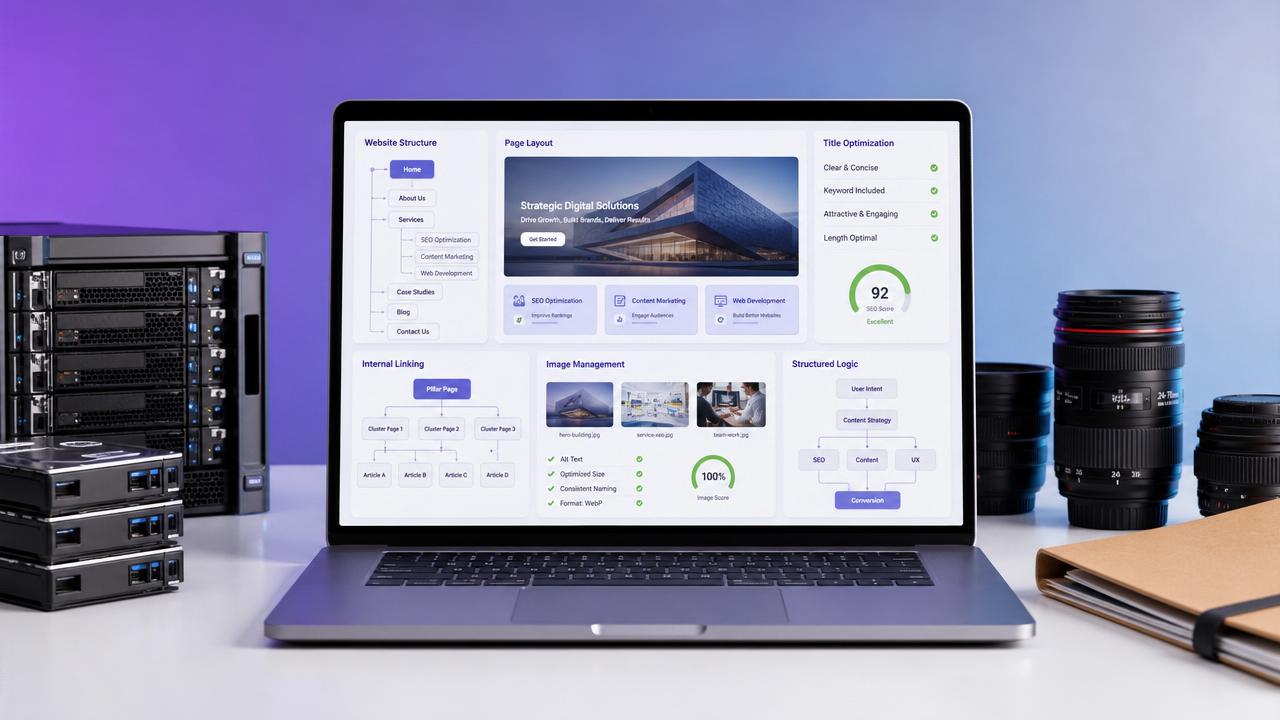
 How to make page SEO settings more standardized? Analysis of title, internal links, images, and structured data key points
 How to make Google indexing optimization more effective? From crawling and indexing to page quality, conduct a step-by-step review


Related Products
 EasyCamp SaaS Smart Website Marketing SystemE-Yingbao SaaS Smart Website Marketing System: AI-powered, zero-code website building. Rapidly launch multilingual independent e-commerce sites in just 10 minutes. Global server acceleration and AI-driven SEO optimization empower businesses to efficiently connect with global markets. The seamless integration of technology and user-friendly operation makes building e-commerce sites incredibly simple.
 AI+SEM Intelligent Advertising Marketing SystemAI+SEM drives intelligent ad creation, empowering full-funnel precision advertising marketing. The system automatically generates weekly/monthly reports, AI recommends keywords and target countries, monitors core metrics in real-time with intelligent alerts, and enables one-click high-conversion ad solutions to help quickly acquire customers and improve ROI.
 AI+SEO Dual Engine Optimization ServiceEasyWin AI+SEO Dual Engine Optimization System leverages AI-powered keyword mining, content generation, and comprehensive technical optimization to help foreign trade enterprises acquire high-quality organic traffic, significantly improving search rankings and conversion rates.
 AI+SNS Social Media Marketing SystemYingbao AI+SNS Social Media Marketing System - Precision social capture for the social media era. Supports one-click content synchronization across major platforms like Facebook and LinkedIn. AI intelligently rewrites posts for enhanced relevance. 24/7 AI customer service and user profiling analysis empower businesses to efficiently expand into global markets.
 AI+SEO营销解决方案易营宝AI+SEO营销解决方案,通过AI批量写作、智能生成TDK、精准关键词扩词等功能,全面优化网站SEO效果,提升流量与转化率。助力企业构建高效智能网站新生态。
 AI+SEM Advertising Marketing SolutionsAI+SEM Advertising Marketing Solution leverages AI technology to deeply empower SEM ad campaigns. It automatically generates weekly/monthly reports using AI, presenting account data across multiple dimensions for comprehensive insights into campaign performance and trends. The system precisely recommends keywords and target countries, intelligently generates high-conversion ad copy, and enables one-click activation of efficient campaign plans to help businesses rapidly acquire customers. Simultaneously, it monitors core metrics in real time, intelligently identifies abnormal fluctuations, and issues timely alerts to ensure stable, high-return advertising results.
 Domain Name ServicesEasyWin provides professional domain name services, including intelligent queries, one-stop registration, brand protection, and full lifecycle management, helping businesses build a digital brand image.
 EasyOperate B2C Cross-Border E-Commerce Platform & Independent WebsiteEasyStore B2C Cross-border E-commerce Independent Store is an intelligent website building and cross-border e-commerce integrated solution independently developed by EasyStore Information Technology (Beijing) Co., Ltd. The system is specially designed for small and medium-sized as well as large export enterprises, integrating 'website building, operation, marketing, advertising, and conversion' into one, helping enterprises quickly establish cross-border e-commerce independent stores to achieve brand globalization and global sales growth.
The platform supports multiple languages, multiple currencies, and multi-channel marketing, with built-in AI intelligent translation and SEO optimization systems, suitable for mainstream markets such as Southeast Asia, Europe and America, Latin America, and the Middle East, assisting Chinese manufacturing enterprises in efficiently deploying international e-commerce strategies. SSL证书易营宝提供专业SSL安全证书服务,包括单域名和泛域名证书,确保网站数据传输加密、身份验证和完整性保护,助力企业建立安全可信的在线业务环境。









