









- The China-US tariff arrangement has reached a preliminary consensus, and the trade association will be establishedJun 15, 2026View details
- What determines B2C cross-border e-commerce website development costs? A breakdown of features, interfaces, and deployment methodsJun 17, 2026View details
- China-Morocco zero-tariff access, a breakthrough in the cost of Moroccan goods exports to ChinaJun 11, 2026View details
- What signal should be released for the suspension of exports to JapanJun 10, 2026View details
- China's May LNG imports rebounded, with increased volumes from Russia and Canada filling the Middle East supply gapJun 10, 2026View details
- Will GEO change its SEO strategy?Jun 04, 2026View details
- What types of businesses are end-to-end solutions suitable for?Jun 03, 2026View details
- 2026 Global Growth Channel TrendsJun 02, 2026View details
Why can’t Google organic traffic grow long-term? First check these 5 types of content and technical issues
Why is Google's organic traffic consistently low? First, check if there are underlying issues.
If your Google organic traffic is consistently low, it's usually not because a particular keyword isn't ranking well.
More commonly, content, indexing, structure, speed, and conversion path are all unbalanced.
What appears to be a traffic issue may actually be due to unstable site quality signals.
In reality, many websites don't lack content, but rather they lack the SEO foundation for sustainable growth.
This article addresses five frequently asked questions to help you quickly pinpoint the bottlenecks in your Google organic traffic growth.
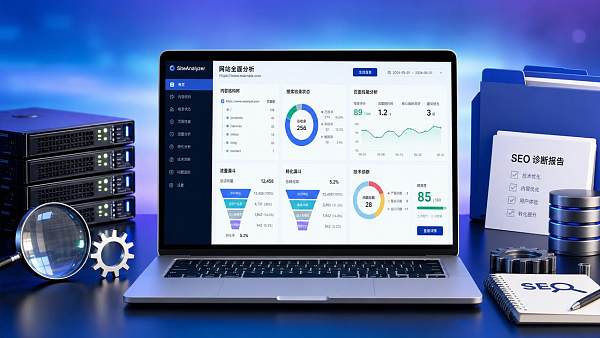
If the order of investigation is correct, it is usually easier to determine whether the problem lies in the content strategy or the technical aspects.
1. There are many content topics, but none form a closed loop of search intent.
Many websites publish articles frequently, but their organic traffic from Google remains stagnant.
The reason is often not a lack of quantity, but rather that the content does not match the search intent.
Users want to see solutions, but the page only introduces the company.
Users are comparing products, but the page remains at a level of general science popularization.
This misalignment will affect rankings, clicks, and dwell time simultaneously.
Three key signals to be investigated
- The core page title covers the keywords but doesn't answer the real question.
- There are many sections, but the themes are scattered and lack a primary and secondary structure.
- The competition between articles leads to keyword depletion.
The solution is clear: first, reorganize the content according to the search intent.
Separate the planning of cognitive, comparative, and decision-making content.
Then, create special pages and supporting pages around the core business to form a theme cluster.
This makes it easier for Google's organic traffic to enter a stable growth phase.
Second, the crawling and indexing success rates are low, and the page is not even in competition.
Many people focus on rankings first, but they should actually look at whether the page has been effectively crawled and indexed.
Even the best content won't get organic traffic from Google if a page isn't indexed.
Common technical issues
- Robots restrictions are incorrect; important directories are blocked.
- The canonical pointers are confusing, and the main page signal is scattered.
- Sitemap updates are delayed, and new pages are not submitted in a timely manner.
- Pagination, filter pages, and parameter pages create a lot of repetitive content.
- The JavaScript rendering is too heavy, and the complete text cannot be retrieved after fetching.
This type of problem has a distinct characteristic: the indexing curve fluctuates greatly, and high-quality pages are not indexed.
If Google organic traffic suddenly stops recently, checking the index coverage report is often more efficient.
In actual business operations, the value of content can only be properly recognized after the technological foundation is stable.
One of the advantages of service systems like YiYingBao, which cover AI website building, SEO optimization, advertising, and multilingual marketing, is that they take into account both website indexability and subsequent promotion, rather than launching the website first and then reworking it.
Third, unclear page structure leads to decreased efficiency in weight transfer and comprehension.
Another frequent reason why Google's organic traffic is low is that while the page structure looks complete, it is actually not easy to understand.
Search engines do more than just crawl text; they also determine the topic hierarchy and the relationships between information.
Pay close attention to these items.
- Does a page have only one clear theme?
- Should H tags be organized hierarchically, rather than just for styling purposes?
- Internal links should point to relevant pages, rather than being randomly piled up.
- Can breadcrumbs, category pages, and topic pages create context?
The problem with many websites is that article pages exist in isolation, and product pages also lack supporting content.
Even if some keywords rank, it's difficult for Google's organic traffic to achieve a significant scale effect.
A more prudent approach is to establish a structure of "core page + topic page + case study page + Q&A page".
Among them, the case study page can naturally absorb traffic during the decision-making stage.
For example, in industry content, appropriately interspersing vertical topics such as discussions on the optimization strategies of power companies' capital management based on cash flow forecasting is more likely to be accepted than a blunt promotion, and it is also more conducive to the semantic extension of the page.
IV. Inadequate technical performance leads to a continuous dilution of ranking opportunities.
The steady growth of Google's organic traffic is inseparable from its basic performance.
Even the best content will be diminished if the page is slow, has many redirects, or provides a poor mobile experience.
Priority inspection items
- Is the first screen of the core page loading too slowly?
- Are the images, scripts, and third-party code too heavy?
- Are mobile buttons, forms, and navigation easy to use?
- Are there too many 404, 302 and chained jumps?
- Does the multi-language version have a hreflang configuration error?
These issues won't immediately reduce Google's organic traffic to zero, but they will continue to erode growth efficiency.
Especially for multilingual websites, if regional versions conflict with each other, the target market can easily be mismatched.
For foreign trade, cross-border e-commerce platforms, and websites that help brands go global, these kinds of losses are often hidden, but the cost is not small.
Therefore, technical evaluation should not only focus on whether it can be launched, but also on whether it can support the long-term growth of Google's organic traffic.
5. Traffic is available, but conversion signals are too weak, making the system's judgment insufficient.
There is another situation that is more easily overlooked.
The page has already gained some exposure, but organic traffic from Google is slow to increase.
At this point, what you need to look at is not just the ranking, but the performance after clicking.
Several typical signals
- The title has some exposure, but the click-through rate has remained consistently low.
- Enter the page and leave quickly, with a short stay.
- There is an access point for inquiries on the page, but the path is very convoluted.
- Content can generate traffic, but it cannot facilitate commercial activities.
This means that the site is not fully expressing the value of its traffic.
The growth of Google's organic traffic is not only driven by indexing and ranking, but also influenced by user feedback signals.
Therefore, the landing page should answer questions and also drive the next step.
For example, clearly showcasing solutions, case studies, delivery capabilities, and contact information.
If your business covers website building, SEO, advertising, and overseas social media, you should design the entry point as a continuous path, rather than multiple isolated buttons.
Finally, let's conduct a comprehensive check-up, from content to technology.
If Google's organic traffic is consistently low, it's usually not due to a single, isolated failure.
The more realistic situation is that multiple small problems piled up, ultimately slowing down overall growth.
It is recommended to first check each item according to five dimensions: content intent, indexing status, page structure, technical performance, and conversion rate.
When investigating, prioritize identifying the pages and directories most affected, rather than spreading your efforts evenly.
If you want to get things off the ground faster, you can also leverage platforms that offer AI-powered website building, SEO optimization, multilingual deployment, and global marketing collaboration capabilities to reduce technical rework and trial-and-error in growth.
When a website truly becomes crawlable, understandable, and convertible, Google's organic traffic will move from short-term fluctuations to long-term accumulation.
Related Articles



Related Products
 EasyCamp SaaS Smart Website Marketing SystemE-Yingbao SaaS Smart Website Marketing System: AI-powered, zero-code website building. Rapidly launch multilingual independent e-commerce sites in just 10 minutes. Global server acceleration and AI-driven SEO optimization empower businesses to efficiently connect with global markets. The seamless integration of technology and user-friendly operation makes building e-commerce sites incredibly simple.
 AI+SEM Intelligent Advertising Marketing SystemAI+SEM drives intelligent ad creation, empowering full-funnel precision advertising marketing. The system automatically generates weekly/monthly reports, AI recommends keywords and target countries, monitors core metrics in real-time with intelligent alerts, and enables one-click high-conversion ad solutions to help quickly acquire customers and improve ROI.
 AI+SEO Dual Engine Optimization ServiceEasyWin AI+SEO Dual Engine Optimization System leverages AI-powered keyword mining, content generation, and comprehensive technical optimization to help foreign trade enterprises acquire high-quality organic traffic, significantly improving search rankings and conversion rates.
 AI+SNS Social Media Marketing SystemYingbao AI+SNS Social Media Marketing System - Precision social capture for the social media era. Supports one-click content synchronization across major platforms like Facebook and LinkedIn. AI intelligently rewrites posts for enhanced relevance. 24/7 AI customer service and user profiling analysis empower businesses to efficiently expand into global markets.
 AI+SEO营销解决方案易营宝AI+SEO营销解决方案,通过AI批量写作、智能生成TDK、精准关键词扩词等功能,全面优化网站SEO效果,提升流量与转化率。助力企业构建高效智能网站新生态。
 AI+SEM Advertising Marketing SolutionsAI+SEM Advertising Marketing Solution leverages AI technology to deeply empower SEM ad campaigns. It automatically generates weekly/monthly reports using AI, presenting account data across multiple dimensions for comprehensive insights into campaign performance and trends. The system precisely recommends keywords and target countries, intelligently generates high-conversion ad copy, and enables one-click activation of efficient campaign plans to help businesses rapidly acquire customers. Simultaneously, it monitors core metrics in real time, intelligently identifies abnormal fluctuations, and issues timely alerts to ensure stable, high-return advertising results.
 Domain Name ServicesEasyWin provides professional domain name services, including intelligent queries, one-stop registration, brand protection, and full lifecycle management, helping businesses build a digital brand image.
 EasyOperate B2C Cross-Border E-Commerce Platform & Independent WebsiteEasyStore B2C Cross-border E-commerce Independent Store is an intelligent website building and cross-border e-commerce integrated solution independently developed by EasyStore Information Technology (Beijing) Co., Ltd. The system is specially designed for small and medium-sized as well as large export enterprises, integrating 'website building, operation, marketing, advertising, and conversion' into one, helping enterprises quickly establish cross-border e-commerce independent stores to achieve brand globalization and global sales growth.
The platform supports multiple languages, multiple currencies, and multi-channel marketing, with built-in AI intelligent translation and SEO optimization systems, suitable for mainstream markets such as Southeast Asia, Europe and America, Latin America, and the Middle East, assisting Chinese manufacturing enterprises in efficiently deploying international e-commerce strategies. SSL证书易营宝提供专业SSL安全证书服务,包括单域名和泛域名证书,确保网站数据传输加密、身份验证和完整性保护,助力企业建立安全可信的在线业务环境。









