









- Can Zhejiang foreign trade independent websites still be developed today? Look at changes in traffic and lead generationJul 28, 2026View details
- What New Signals Are Emerging in Enterprise Services SaaS Marketing ReportsJul 27, 2026View details
- What Does a Global Traffic Ecosystem Service Provider Do? What Are the Differences from a Single Advertising AgencyJul 16, 2026View details
- What should you focus on in the latest enterprise SaaS report? From renewal rates and delivery costs to overseas growth opportunitiesJul 12, 2026View details
- What signals are worth paying attention to in a cross-border marketing trend report? B2B companies should look at these 6 signalsJul 11, 2026View details
- How to Read a Cross-Border Marketing Trends Report? Five Key Dimensions for Evaluating Channel OpportunitiesJul 11, 2026View details
How to Achieve More Stable Google SEO for B2B Lead Generation
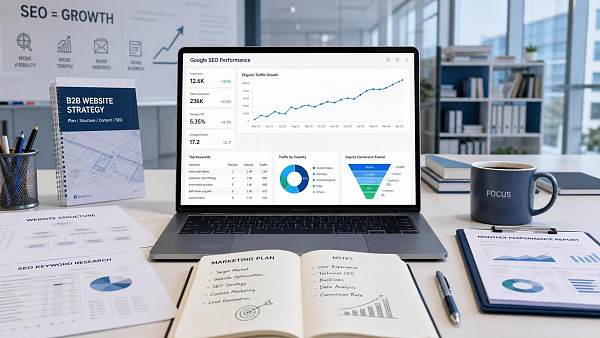
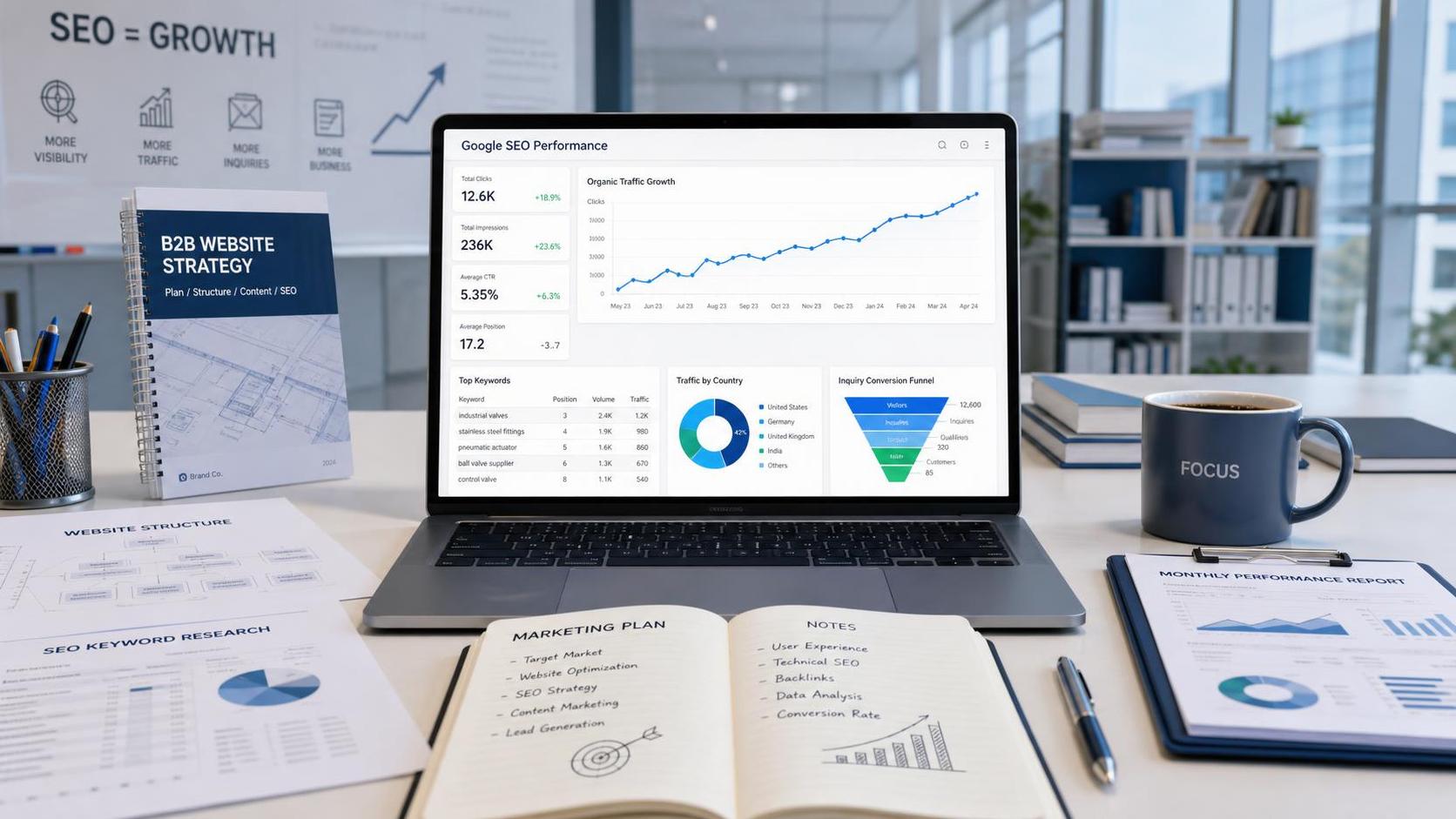
How to Make Google SEO for More Stable B2B Inquiry Acquisition
Google SEO for B2B inquiry acquisition: how can it be made more stable? The key lies not in any single technique, but in whether the website foundation, content strategy, lead handling, and ongoing optimization are properly connected. Many teams see no results after working for six months—not because Google is unsuitable for B2B, but because the website has merely been “launched” without being truly built around lead-generation logic. For operators, when assessing whether an SEO plan is reliable, do not look at promises first. Check whether these aspects can withstand scrutiny.
The checklist below can be used to review your existing foreign trade website, manufacturing website, or global brand website. It can also serve as a reference when selecting a website development and marketing service plan. It is not written for people who simply “want to learn about SEO,” but for those who genuinely want to generate inquiries.
Start with the Website Foundation: An Unstable Website Makes Stable Inquiries Difficult
Many B2B companies immediately ask how to optimize keywords. In practice, they should first check whether the website is suitable for indexing and conversion. Stable SEO depends on a website structure that search engines can understand and that enables overseas buyers to quickly determine whether you are worth contacting.
- Keep the page hierarchy clear. Product categories, application scenarios, solutions, and industry pages should be clearly distinguished. Do not place all content under the top-level navigation.
- URLs should be stable and readable. Avoid excessive parameter pages, duplicate pages, and arbitrary URL changes. During a B2B website redesign, these issues are most likely to directly interrupt historical indexing.
- Do not simply launch a multilingual website with machine translation. Language versions should have clear correspondence, and page content should follow the expression habits of the target market. Purchasing search methods differ significantly across North America, Europe, and Southeast Asia.
- Do not overlook the mobile experience. B2B customers may not complete an inquiry on a mobile phone, but they often take an initial look before deciding whether to return to a computer for further research.
- Basic technical elements should be verifiable: titles, descriptions, canonical tags, sitemaps, redirection logic, 404 pages, page loading speed, and server stability.
If these foundations are not properly established, the results may fluctuate no matter how much content you publish or how many backlinks you build later. For companies using outdated template websites, assembled websites, or purely showcase-oriented corporate websites, the most common problem is not a lack of traffic, but that traffic quickly leaves after arriving.
Do Not Focus Only on Broad Keywords; Inquiry-Oriented SEO Should Follow Purchase Intent
When doing Google SEO for B2B inquiry acquisition, the two biggest extremes are pursuing only broad industry keywords, which have high difficulty and long cycles, or targeting only keywords that no one searches for, which may generate many indexed pages but no inquiries. A more practical approach is to divide keywords into several levels: “product terms, application terms, problem terms, location terms, and decision-making terms.”
For example, manufacturing and industrial product customers may not search directly for a brand. They are more likely to search for product models, materials, processes, applicable industries, certification requirements, and purchasing conditions. A common misconception in foreign trade operations is to write articles entirely about industry knowledge while having too few pages capable of addressing purchase intent. The result is plenty of content but very few business opportunities.
To determine whether a keyword is worth targeting, ask three questions first: Is there a purchasing action behind this keyword? Can the corresponding page answer the buyer’s key concerns? Can visitors who arrive through this keyword naturally proceed to submit an inquiry? If two of these questions cannot be answered, do not rush to invest.
Page Content Should Resemble a Salesperson Serving a Customer, Not a Pile of Materials
Many corporate websites share a common problem: they explain a great deal about “who we are” but fail to answer what customers really care about—“Can you solve my problem?” A B2B SEO page is not better simply because it is longer; the information must be presented in the right order.
A product page that can genuinely generate inquiries should normally make at least the following information clear: product applications, key specifications, optional parameters, applicable industries, delivery methods, common purchasing questions, and contact actions. If certifications, testing, lead times, customization capabilities, or minimum order quantities are involved, they must be written based on the company’s actual information. Where details are uncertain, it is better to use cautious wording than to make them up. When certifications and compliance information are involved, clearly indicate the applicable scope and, where necessary, mark it as 【待核实】.
In terms of content structure, it is recommended to connect “product pages,” “application scenario pages,” “industry solution pages,” and “FAQ pages.” This offers two benefits: search engines can more easily understand the depth of the topic, and users can more easily move from general awareness to a specific inquiry.
Do Not Look Only at Rankings; First Check Whether There Is a Conversion Entry Point
For Google SEO focused on B2B inquiry acquisition, the final thing to examine is not a keyword screenshot but inquiry quality. Many websites have decent rankings but generate no leads. The reasons are often straightforward: contact entrances are difficult to find, forms are too complicated, pages lack trust-building information, or the inquiry action is unclear.
- Every type of core page should have a clear contact action. Do not place only a generic form at the bottom of the page.
- Do not include too many form fields. For an initial inquiry, collecting a name, email address, and description of requirements is usually sufficient. Other information can be added during subsequent sales follow-up.
- Contact information should be complete, including email, telephone, instant messaging channels, or regional service information, as these can enhance credibility.
- Trust-building information should be specific. Factory photos, service markets, delivery processes, common export regions, and team response mechanisms are more useful than vague claims of “professional service.”
Here is a practical rule of thumb: if a website has stable organic traffic every month but very few form submissions, check the conversion path first instead of immediately questioning the keyword strategy. In many cases, the problem lies in how the page handles visitors, not in exposure.
You Can Build Backlinks and Off-Site Exposure, but Do Not Treat Them as the Main Course
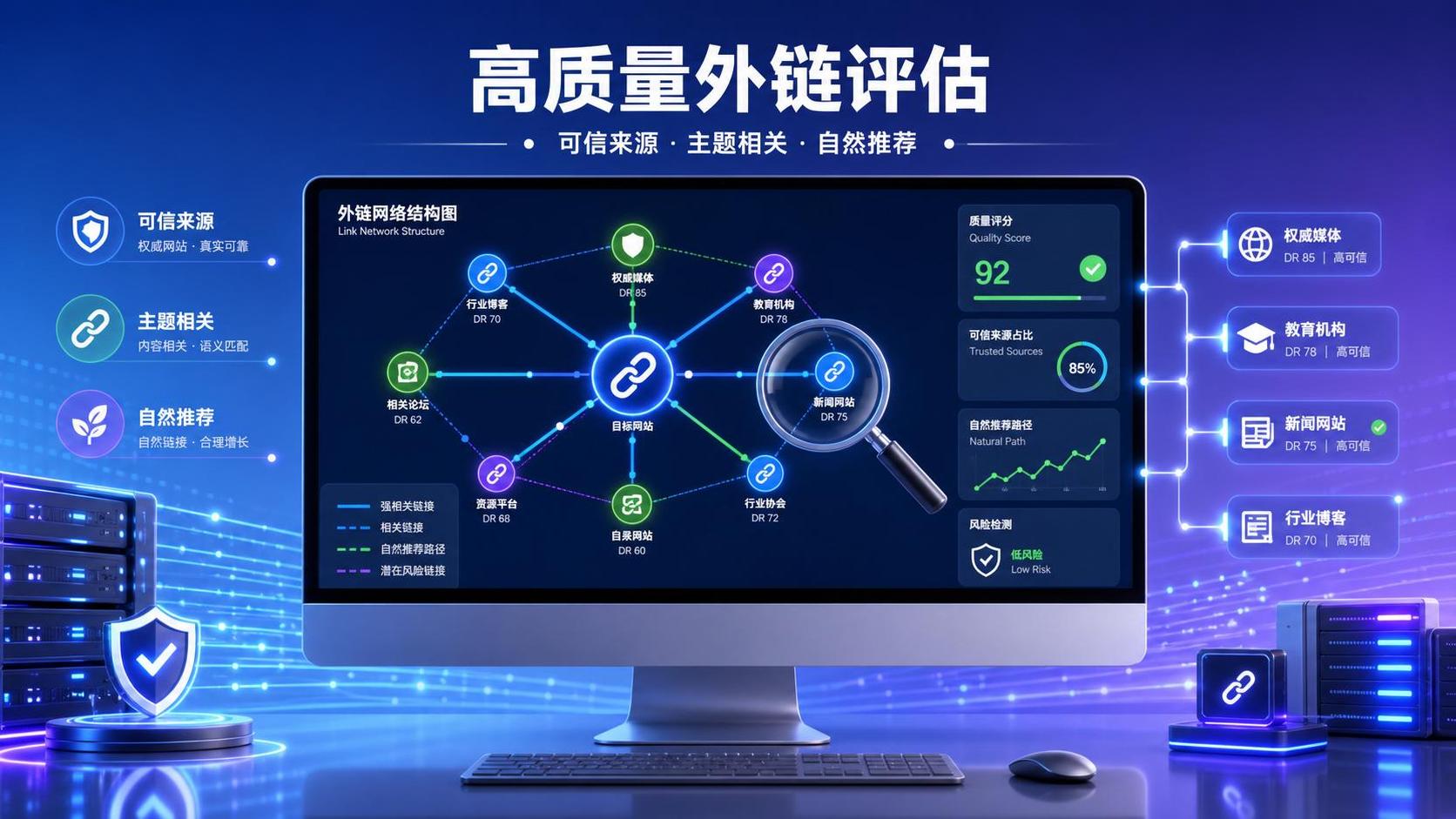
External links do help Google SEO, but in B2B projects, the elements that usually determine inquiry stability are still on-site content and page lead handling. If backlinks are disconnected from the business topic or their source quality is unclear, they may appear to create fluctuations in the short term, but they are difficult to sustain over the long term.
A more practical approach is to create natural exposure around the business, such as through industry directories, partner pages, media coverage, citations in technical articles, and content distribution in regional markets. The premise remains the same: the information must be authentic. In particular, when mentioning company qualifications, project experience, or market coverage, it must be consistent with publicly available information. Do not expand on content when details are uncertain.
Different Markets Require Different Page Strategies
A purchasing page targeting North America may differ significantly from one targeting the Middle East, Japan and South Korea, or Latin America. These differences are reflected not only in translation, but also in information order, search expressions, and preferred contact methods.
For example, some markets place greater emphasis on technical details and compliance explanations, while others care more about lead times, service responsiveness, and the convenience of multilingual communication. When creating a multilingual website, do not simply translate Chinese pages directly and publish them in bulk. Although this may mean the site “has content,” it may not be persuasive to the target market. When regional regulations or industry access requirements are involved, it is recommended to verify them separately against local requirements to avoid misleading users. If such information lacks sufficient supporting evidence, the 【待核实】 mark may be retained.
Stability Does Not Come from One-Time Optimization, but from a Data Feedback Loop
Many teams treat SEO as a project to complete before launch and then leave it unattended, making stability difficult to achieve. Effective Google SEO for B2B inquiry acquisition always relies on continuous data reviews. Which pages are beginning to gain exposure? Which keywords receive clicks but convert poorly? Which countries are seeing traffic growth without generating inquiries? Which product pages have high bounce rates? These questions should be reviewed regularly.
If a company also needs to run Google Ads, social media lead generation, or AI search visibility optimization, it is best to build the website as a “unified asset” from the outset rather than allowing each channel to operate independently. The value of an integrated website and marketing service solution such as 易营宝 lies here: website development, SEO, advertising, social media, and subsequent data optimization are not disconnected. Launching a page is not the end, but the starting point of an ongoing lead-generation process. For foreign trade companies, manufacturing plants, and cross-border brands in particular, this integrated approach makes it easier to reduce repeated website revisions, duplicated advertising, and data gaps.
In actual implementation, operators are advised to regularly monitor at least the following types of data: indexing changes, rankings of core pages, countries generating organic traffic, form submission volume, the proportion of qualified inquiries, page dwell time, and bounce rates. Do not look only at one total traffic figure; it has limited value for B2B assessment.
The Final Judgment from This Checklist
If your current Google SEO for B2B inquiry acquisition has a clear website structure, keywords centered on purchase intent, pages capable of supporting decision-making, a smooth conversion path, and continuous data reviews, it will most likely become increasingly stable. Conversely, if you only publish articles, revise titles, and monitor ranking screenshots, you may see short-term improvement, but the portion that actually turns into overseas inquiries will often be very limited.
The most practical approach at the operational level is to review your existing website against the checklist above, identify the three issues that most affect indexing, conversion, and ongoing optimization, and address them first. B2B SEO is not better because it is more elaborate. Every step should point toward one outcome: helping the right people find you and encouraging them to submit an inquiry.
Related Articles

Related Products
 EasyCamp SaaS Smart Website Marketing SystemE-Yingbao SaaS Smart Website Marketing System: AI-powered, zero-code website building. Rapidly launch multilingual independent e-commerce sites in just 10 minutes. Global server acceleration and AI-driven SEO optimization empower businesses to efficiently connect with global markets. The seamless integration of technology and user-friendly operation makes building e-commerce sites incredibly simple.
 AI+SEM Intelligent Advertising Marketing SystemAI+SEM drives intelligent ad creation, empowering full-funnel precision advertising marketing. The system automatically generates weekly/monthly reports, AI recommends keywords and target countries, monitors core metrics in real-time with intelligent alerts, and enables one-click high-conversion ad solutions to help quickly acquire customers and improve ROI.
 AI+SEO Dual Engine Optimization ServiceEasyWin AI+SEO Dual Engine Optimization System leverages AI-powered keyword mining, content generation, and comprehensive technical optimization to help foreign trade enterprises acquire high-quality organic traffic, significantly improving search rankings and conversion rates.
 AI+SNS Social Media Marketing SystemYingbao AI+SNS Social Media Marketing System - Precision social capture for the social media era. Supports one-click content synchronization across major platforms like Facebook and LinkedIn. AI intelligently rewrites posts for enhanced relevance. 24/7 AI customer service and user profiling analysis empower businesses to efficiently expand into global markets.
 AI+SEO营销解决方案易营宝AI+SEO营销解决方案,通过AI批量写作、智能生成TDK、精准关键词扩词等功能,全面优化网站SEO效果,提升流量与转化率。助力企业构建高效智能网站新生态。
 AI+SEM Advertising Marketing SolutionsAI+SEM Advertising Marketing Solution leverages AI technology to deeply empower SEM ad campaigns. It automatically generates weekly/monthly reports using AI, presenting account data across multiple dimensions for comprehensive insights into campaign performance and trends. The system precisely recommends keywords and target countries, intelligently generates high-conversion ad copy, and enables one-click activation of efficient campaign plans to help businesses rapidly acquire customers. Simultaneously, it monitors core metrics in real time, intelligently identifies abnormal fluctuations, and issues timely alerts to ensure stable, high-return advertising results.
 Domain Name ServicesEasyWin provides professional domain name services, including intelligent queries, one-stop registration, brand protection, and full lifecycle management, helping businesses build a digital brand image.
 EasyOperate B2C Cross-Border E-Commerce Platform & Independent WebsiteEasyStore B2C Cross-border E-commerce Independent Store is an intelligent website building and cross-border e-commerce integrated solution independently developed by EasyStore Information Technology (Beijing) Co., Ltd. The system is specially designed for small and medium-sized as well as large export enterprises, integrating 'website building, operation, marketing, advertising, and conversion' into one, helping enterprises quickly establish cross-border e-commerce independent stores to achieve brand globalization and global sales growth.
The platform supports multiple languages, multiple currencies, and multi-channel marketing, with built-in AI intelligent translation and SEO optimization systems, suitable for mainstream markets such as Southeast Asia, Europe and America, Latin America, and the Middle East, assisting Chinese manufacturing enterprises in efficiently deploying international e-commerce strategies. SSL证书易营宝提供专业SSL安全证书服务,包括单域名和泛域名证书,确保网站数据传输加密、身份验证和完整性保护,助力企业建立安全可信的在线业务环境。









