









- What stages does the cross-border services ecosystem include? How do website building, promotion, payment, and compliance work togetherJun 22, 2026View details
- How will email marketing costs change in 2026Jun 22, 2026View details
- The China-US tariff arrangement has reached a preliminary consensus, and the trade association will be establishedJun 15, 2026View details
- Should overseas brand marketing start with ads or contentJun 21, 2026View details
- What determines B2C cross-border e-commerce website development costs? A breakdown of features, interfaces, and deployment methodsJun 17, 2026View details
- China-Morocco zero-tariff access, a breakthrough in the cost of Moroccan goods exports to ChinaJun 11, 2026View details
What signals does AI search indexing look at? What adjustments are needed to website content and structure
The logic for AI search indexing has already shifted from “whether there are keywords on the page” to “whether the website can be understood, verified, and cited.” For businesses that rely on overseas independent sites to acquire customers, this is not merely a content issue, but a coordinated issue involving content, structure, data, and the marketing funnel.
Especially in an integrated website and marketing services scenario, the search entry point is becoming more three-dimensional. Search engines, generative Q&A, and industry knowledge aggregation pages all extract trustworthy information from the website. Whoever can more clearly express the business entity, solution, and scenario value can more easily improve AI search indexing and subsequent conversion efficiency.
AI search indexing is redefining website value
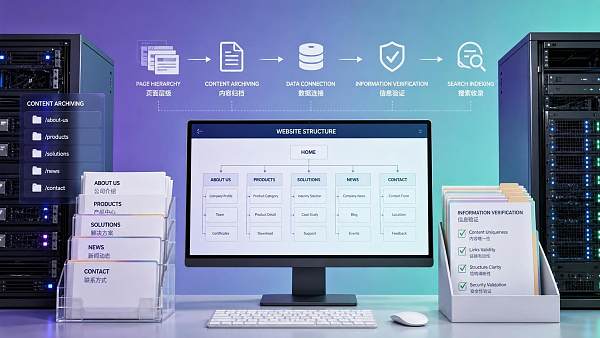
Traditional SEO places greater emphasis on matching, while AI search indexing places greater emphasis on understanding. A page must not only answer “what does this term mean,” but also “who is this company, what problem does it solve, where does the evidence come from, and is the content internally consistent?”
In other words, a website is no longer just an information container, but an enterprise knowledge expression system. Page titles, category relationships, structured data, brand information, case materials, and product descriptions all jointly form signals that can be indexed.
For foreign trade companies, manufacturing factories, cross-border malls, and brand overseas websites, this change is especially significant. Because overseas traffic comes not only from organic search, but also from snippets in Q&A, comparison recommendations, and multi-round search results, the quality of AI search indexing directly affects first-round visibility.
Which signals does the system focus on?
From a practical judgment perspective, AI search indexing usually does not focus on just one field, but evaluates multiple dimensions comprehensively.
Content credibility
Whether the content has a clear source, whether it is consistent with brand positioning, and whether there is duplicate stitching will all affect indexing quality. Websites with a lot of vague descriptions and very little factual evidence are often difficult to be cited steadily.
Structural clarity
Messy category layers, cross-cutting page themes, and a single page carrying too many intentions will all reduce the system’s understanding efficiency. AI search indexing tends to favor pages with a single theme, clear paths, and complete context.
Entity relevance
Whether the company name, product line, service capabilities, target market, and industry terminology can form a stable association is a key judgment point. If a website can clearly express “who provides what, and for whom solves what problems,” it is easier to enter the AI search indexing pipeline.
Technical extractability
If a page relies on a lot of script rendering, loads main content slowly, or has navigation, breadcrumbs, or internal links that are not readable, even good content may be weakened. The precondition for indexing is always accessibility, parsability, and classificability.
Website content needs changes beyond copywriting
Many website problems are not caused by insufficient content, but by content organization that is not suitable for AI search indexing. When the same topic is scattered across news, product pages, case pages, and landing pages without a unified expression, the system will find it difficult to determine authority.
A more effective approach is to reorganize content around the business entity. For example, independently establish stable pages for company capabilities, industry solutions, product functions, customer scenarios, and service regions, and then build a knowledge network through internal links.
At the content layer, at least three types of problems should be avoided: first, severe synonym duplication; second, inconsistency between titles and body text; third, pages that only have promotional channels and no verifiable information. The requirement of AI search indexing for “whether it can be paraphrased” is often higher than “whether it is written in a lively way.”
In actual content development, the combination of industry insight pages, solution pages, and case pages has greater value. For example, when discussing topics such as green transformation and supply chain upgrading, appropriately associating an ESG-enabled implementation path analysis of how enterprises can develop new quality productive forces with such themed content is more likely to form contextual signals than simply stacking trending keywords.
Structural adjustments determine understanding efficiency
If content determines “what is said,” then structure determines “how the system understands it.” AI search indexing places great importance on relationships between pages, rather than just single-page performance.
- Keep navigation layers stable and avoid repeatedly renaming the same topic.
- Keep core pages with clear titles, summaries, and breadcrumbs.
- Establish upstream and downstream relationships between pages on the same topic rather than random cross-linking.
- Keep terminology consistent across multilingual websites to reduce semantic breaks caused by translation deviations.
- Product pages, solution pages, and blog pages should each play a clear role.
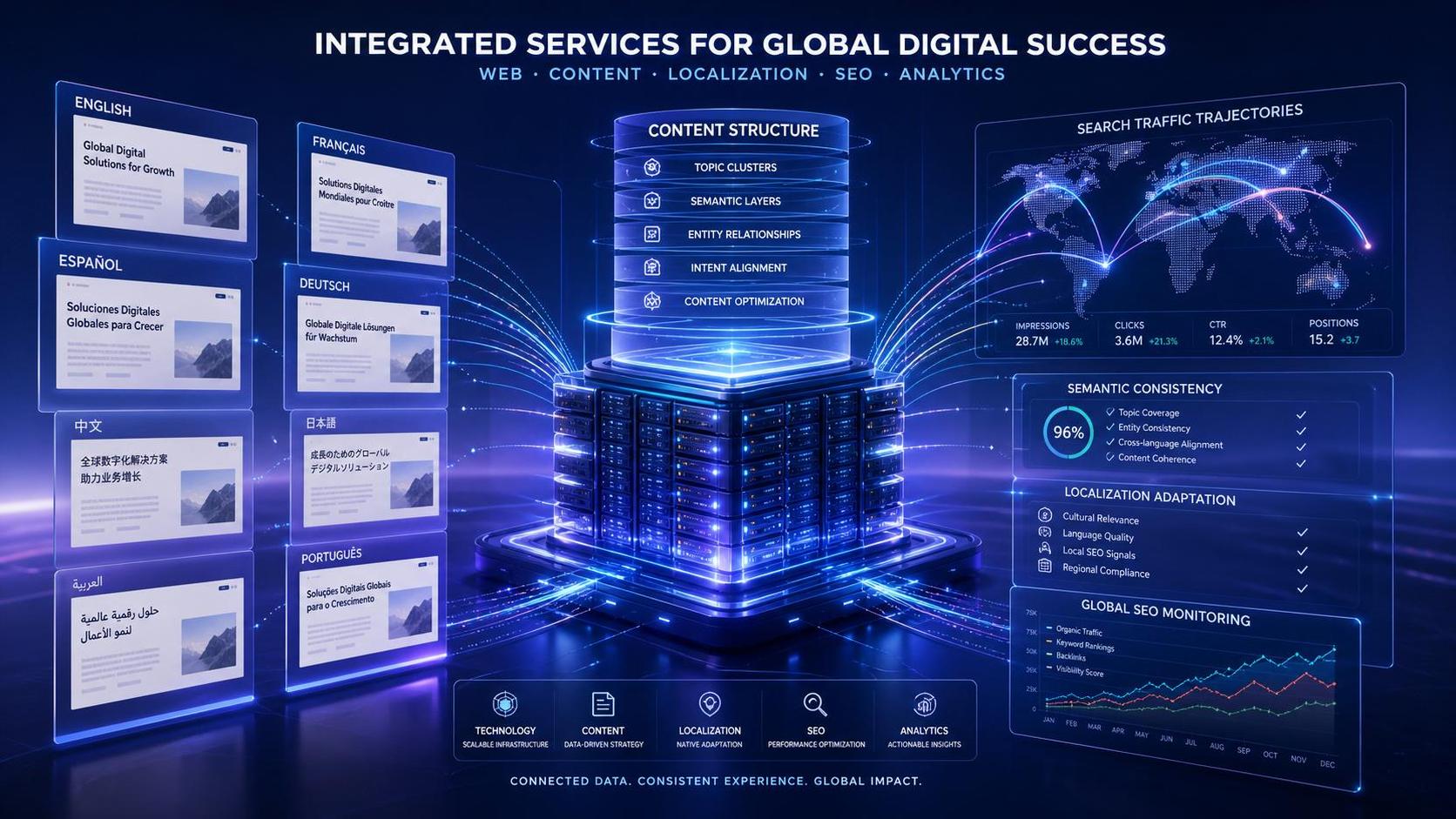
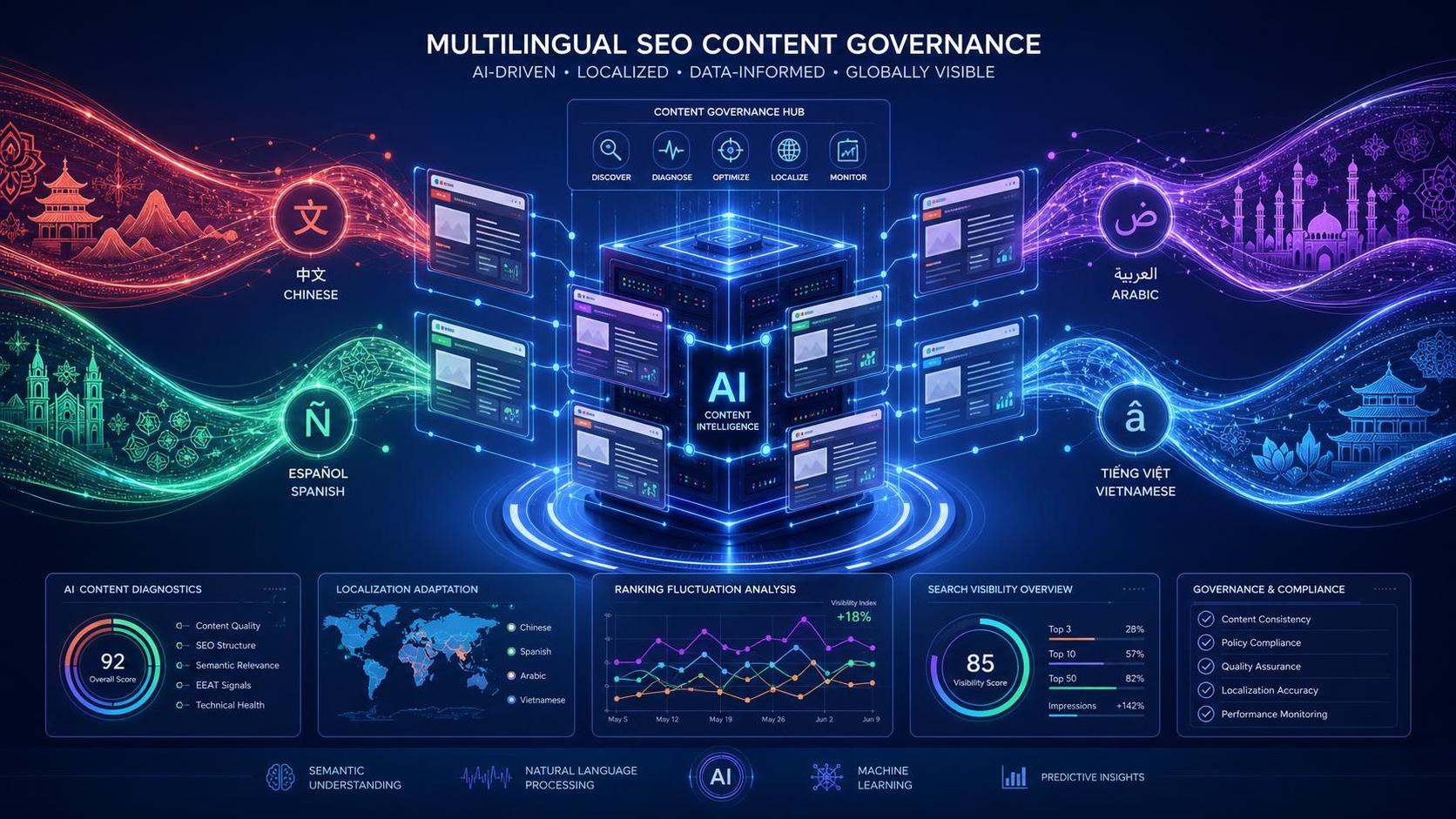
For overseas business websites, this step is especially critical. Long-term services for multilingual official websites, B2B foreign trade marketing websites, and cross-border malls all center on enabling the site architecture to support not only presentation, but also search and conversion collaboration. If page structure is naturally conducive to extraction and semantic classification, subsequent SEO, ad landing pages, and AI search distribution will be smoother.
From a business scenario perspective, which pages are most worth prioritizing?
Not all pages require equal investment. In most cases, the pages that affect AI search indexing efficiency are often only a small number of key pages.
Brand and company information pages
These pages determine the website’s main trustworthiness. The company profile, establishment date, main business direction, service regions, and technical capabilities should all be complete and consistent from beginning to end.
Solution pages
Solution pages are more likely to carry long-tail search and Q&A citations. Compared with a single product listing, organizing content around “industry problem — implementation approach — delivery outcome” is more favorable to AI search indexing.
Case and knowledge content pages
Cases can provide factual support, while knowledge content can supplement semantic coverage. Together, the two can help the system determine that the website not only understands the business, but also has practical evidence.
For example, for a website aiming at global growth, if intelligent website building, Google SEO optimization, advertising, social media operations, and GEO optimization can all be expressed within the same business framework, it is easier to form a sustainable AI search indexing advantage rather than relying on a single short-term viral piece.
A few details worth checking most during evaluation
When evaluating a website, the focus can shift from “is there content” to “does the content form effective signals.” The following details are often more meaningful as reference than simply looking at the number of indexed pages.
- Can core pages be reached within three clicks?
- Is the same business terminology kept consistent across different pages?
- Does the page contain clear author, institution, or entity information?
- Are structured data, sitemap, and standardized links configured?
- Does content updating reflect business evolution rather than merely changing dates?
- Can conclusions be supported with cases, white papers, or themed pages?
If the website also carries brand awareness and lead conversion tasks, then the forms, download entry points, and consultation paths on the page also need to align with the content theme. Traffic brought by AI search indexing will not automatically become conversions; only when structure and intent match can traffic have business value.
The next step is more suitable to start from the overall chain
AI search indexing is not a single-point optimization project; it is more like a comprehensive rebuild of the website knowledge system. It requires enterprises to re-sort page responsibilities, content evidence, entity relationships, and technical foundations, upgrading the “website that can be displayed” into a “website that can be understood, cited, and converted.”
From the current stage, conducting content audits, structural reviews, and key page prioritization first is usually more effective than blindly chasing new algorithms. If the website is also responsible for overseas promotion tasks, it can further combine the synergy of website building, SEO, advertising, and GEO to form a unified evaluation and avoid each being optimized separately and fragmented from one another.
When a website already has basic traffic but has never formed stable citations and high-quality inquiries, it is worth revisiting the logic of AI search indexing. The clearer the judgment criteria, the easier it is for subsequent adjustments to land on pages and links that truly generate results.
Related Articles

Related Products
 EasyCamp SaaS Smart Website Marketing SystemE-Yingbao SaaS Smart Website Marketing System: AI-powered, zero-code website building. Rapidly launch multilingual independent e-commerce sites in just 10 minutes. Global server acceleration and AI-driven SEO optimization empower businesses to efficiently connect with global markets. The seamless integration of technology and user-friendly operation makes building e-commerce sites incredibly simple.
 AI+SEM Intelligent Advertising Marketing SystemAI+SEM drives intelligent ad creation, empowering full-funnel precision advertising marketing. The system automatically generates weekly/monthly reports, AI recommends keywords and target countries, monitors core metrics in real-time with intelligent alerts, and enables one-click high-conversion ad solutions to help quickly acquire customers and improve ROI.
 AI+SEO Dual Engine Optimization ServiceEasyWin AI+SEO Dual Engine Optimization System leverages AI-powered keyword mining, content generation, and comprehensive technical optimization to help foreign trade enterprises acquire high-quality organic traffic, significantly improving search rankings and conversion rates.
 AI+SNS Social Media Marketing SystemYingbao AI+SNS Social Media Marketing System - Precision social capture for the social media era. Supports one-click content synchronization across major platforms like Facebook and LinkedIn. AI intelligently rewrites posts for enhanced relevance. 24/7 AI customer service and user profiling analysis empower businesses to efficiently expand into global markets.
 AI+SEO营销解决方案易营宝AI+SEO营销解决方案,通过AI批量写作、智能生成TDK、精准关键词扩词等功能,全面优化网站SEO效果,提升流量与转化率。助力企业构建高效智能网站新生态。
 AI+SEM Advertising Marketing SolutionsAI+SEM Advertising Marketing Solution leverages AI technology to deeply empower SEM ad campaigns. It automatically generates weekly/monthly reports using AI, presenting account data across multiple dimensions for comprehensive insights into campaign performance and trends. The system precisely recommends keywords and target countries, intelligently generates high-conversion ad copy, and enables one-click activation of efficient campaign plans to help businesses rapidly acquire customers. Simultaneously, it monitors core metrics in real time, intelligently identifies abnormal fluctuations, and issues timely alerts to ensure stable, high-return advertising results.
 Domain Name ServicesEasyWin provides professional domain name services, including intelligent queries, one-stop registration, brand protection, and full lifecycle management, helping businesses build a digital brand image.
 EasyOperate B2C Cross-Border E-Commerce Platform & Independent WebsiteEasyStore B2C Cross-border E-commerce Independent Store is an intelligent website building and cross-border e-commerce integrated solution independently developed by EasyStore Information Technology (Beijing) Co., Ltd. The system is specially designed for small and medium-sized as well as large export enterprises, integrating 'website building, operation, marketing, advertising, and conversion' into one, helping enterprises quickly establish cross-border e-commerce independent stores to achieve brand globalization and global sales growth.
The platform supports multiple languages, multiple currencies, and multi-channel marketing, with built-in AI intelligent translation and SEO optimization systems, suitable for mainstream markets such as Southeast Asia, Europe and America, Latin America, and the Middle East, assisting Chinese manufacturing enterprises in efficiently deploying international e-commerce strategies. SSL证书易营宝提供专业SSL安全证书服务,包括单域名和泛域名证书,确保网站数据传输加密、身份验证和完整性保护,助力企业建立安全可信的在线业务环境。









