









- The China-US tariff arrangement has reached a preliminary consensus, and the trade association will be establishedJun 15, 2026View details
- What determines B2C cross-border e-commerce website development costs? A breakdown of features, interfaces, and deployment methodsJun 17, 2026View details
- China-Morocco zero-tariff access, a breakthrough in the cost of Moroccan goods exports to ChinaJun 11, 2026View details
- What signal should be released for the suspension of exports to JapanJun 10, 2026View details
- China's May LNG imports rebounded, with increased volumes from Russia and Canada filling the Middle East supply gapJun 10, 2026View details
- Will GEO change its SEO strategy?Jun 04, 2026View details
Google ACH Panel, Multilingual SEO Faces New Evaluation
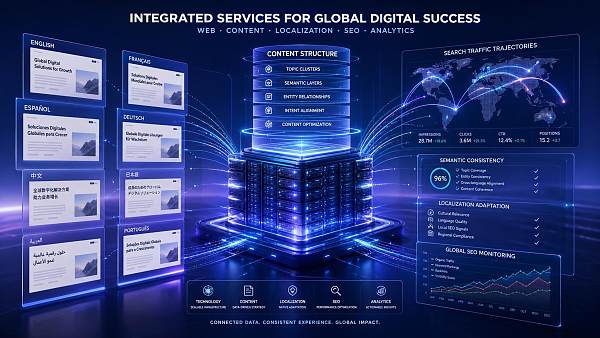
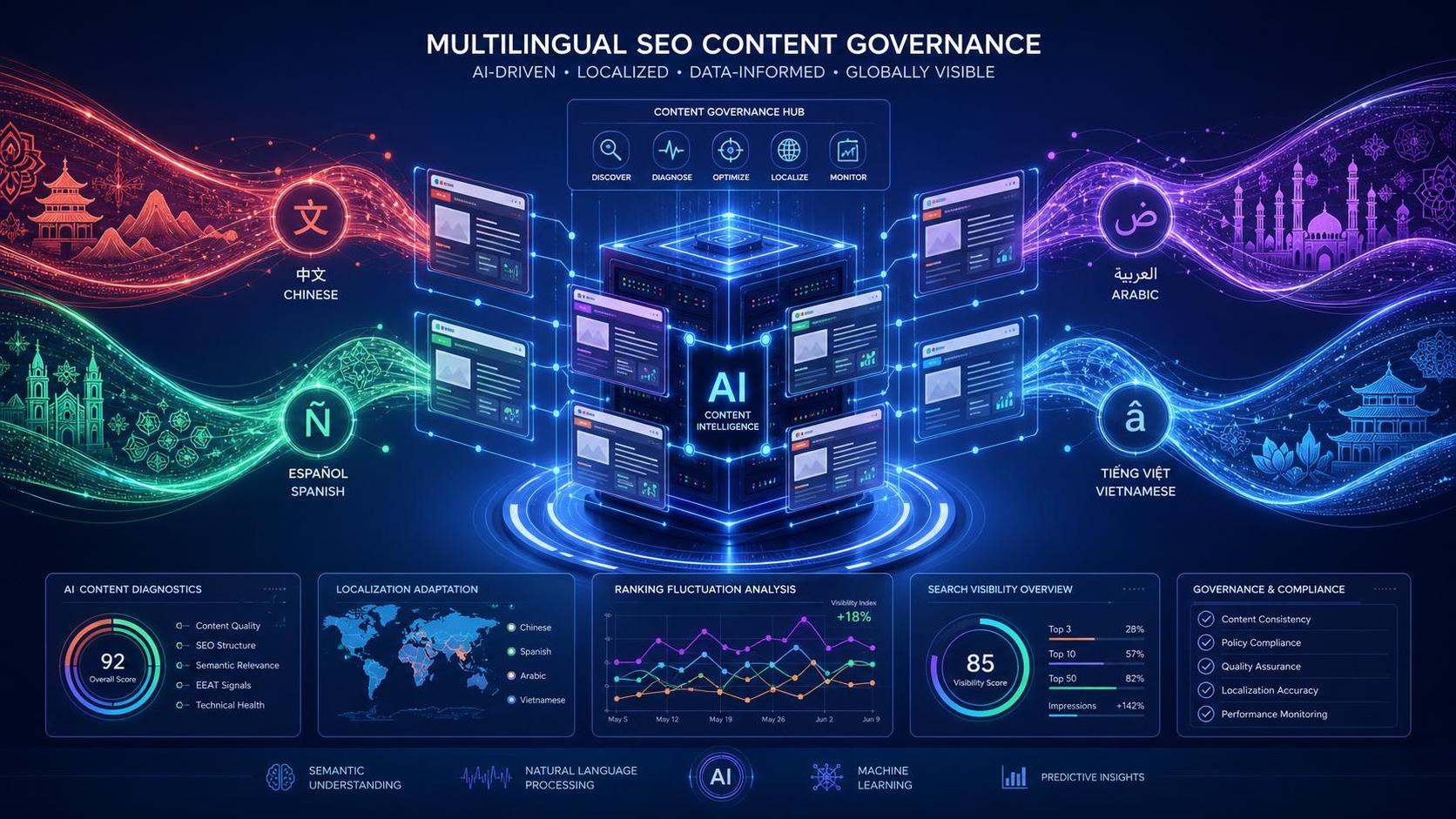
On June 15, 2026, Google rolled out the Search Console “AI Content Health” diagnostic panel to site owners worldwide, moving the quality assessment of AI content on multilingual websites further upstream into site operations. For businesses relying on organic traffic from non-English markets, cross-border teams, content service providers, and local market operations staff, what matters here is not just the launch of a new tool, but that Google is beginning to incorporate semantic consistency, cultural adaptation, and local search intent matching into a visible diagnostic framework, while establishing a more direct link with long-term search visibility.
Confirmed information released by the ACH panel
According to known information, on June 15, 2026, Google officially opened the new Search Console feature “AI Content Health” (ACH) diagnostic panel to site owners worldwide. This panel can identify semantic consistency, cultural adaptability, and local search intent alignment for AI-generated content on multilingual websites. At the same time, the confirmed rule signals also include: websites with lower ACH scores will see the natural search ranking weight of their non-English language versions gradually reduced.
From a factual perspective, this feature is not a broad discussion of AI content in general, but directly focuses on the quality performance of AI-generated content on multilingual websites, especially whether different language versions truly conform to local users’ understanding habits and search needs.
The impact on multilingual traffic chains is becoming visible
Enterprise websites targeting overseas lead generation need to re-examine content production
From an industry perspective, enterprise websites that directly target overseas customers for lead generation may be among the first to feel the change. The reason is that these websites usually rely on multilingual pages to capture search traffic; once non-English pages lose ranking weight due to lower ACH scores, the impact will first show up in organic traffic acquisition, inquiry entry points, and visibility of key market pages. What is more worth noting now is whether the practice of enterprises relying on mass-generated multilingual pages in the past will expose shortcomings in semantic consistency and local intent matching.
The delivery standards for content services and localization services may tighten
For service providers offering SEO content, translation, localization rewriting, or AI content production services, the impact will mainly be reflected in delivery standards. Looking ahead, clients may no longer focus only on page volume, launch speed, or keyword coverage; they will place greater emphasis on the accuracy of content expression, the degree of cultural adaptation, and whether it is aligned with local search scenarios in different language environments. This means that the service process needs to be closer to real search intent, rather than staying at the level of direct translation or template-based generation.
Channel and operations teams will face more direct visibility pressure
For teams responsible for channel traffic, site operations, and regional market promotion, the impact will be felt in page management, content review, and market priority decisions. In particular, enterprises with multiple non-English websites or multiple language directories need to pay attention to which language pages may become low-ACH areas, and whether these pages are concentrated in key product categories, key markets, or core conversion paths.
Practical issues enterprises should focus on now
First distinguish between “the tool went live” and “the effect has materialized”
Analysis suggests that the ACH panel being made available means the assessment dimension is now clearly visible, but the pace and scope of the impact on different websites still need to be judged in combination with subsequent actual performance. When assessing risk, enterprises should separate “Google has provided a diagnostic tool” from “traffic has already changed substantively” to avoid overreacting simply because of the tool name.
Prioritize non-English key pages for review
A more practical approach is to first review the non-English pages that bear lead generation and conversion responsibilities, including key market language versions, core product pages, solution pages, and FAQ pages. Because the confirmed impact targets the natural search ranking weight of non-English language versions, enterprises need to invest limited resources first in the most critical language versions and page types, rather than treating all content equally.
Pay attention to whether AI-generated content is “linguistically smooth but not locally valid”
From an operational perspective, the most concerning issue in ACH identification items is content that appears linguistically smooth on the surface but does not hold up in local culture or search intent. Such issues are often not exposed in basic grammar checks, yet they may directly affect diagnostic results. For content teams and external vendor managers, subsequent reviews should focus more on “would local users search this way, understand it this way, and judge it this way,” rather than simply “has this paragraph been translated.”
Continue to watch for further refinement in official statements
At present, ACH is clearly linked to ranking weight for non-English language versions, but more details on scoring thresholds, adjustment pace, and finer application boundaries have not yet been provided in the input information. Therefore, at the execution level, enterprises should leave room for contingency plans and continue to watch whether Google will issue clearer explanations on diagnostic logic, scope of application, or operational guidance.
This looks more like an upstream signal for long-term quality
Editorial observation: based on the current information, this article is better understood as Google making its governance approach to multilingual AI content more upstream and transparent, rather than as an announcement of a fully implemented, clearly bounded result. The core signal it conveys is that the visibility of non-English markets is no longer just a matter of whether content covers keywords, but is beginning to be evaluated more explicitly in terms of semantic consistency, cultural adaptability, and local search intent in a comprehensive review.
At the same time, it should be noted that what has been confirmed at this stage is the launch of the diagnostic panel and the gradual ranking downshift for low-scoring sites; the depth, speed, and reversibility of the impact on different types of websites still remain within the scope that requires continued observation. Therefore, what the industry most needs to do at this stage is establish monitoring and review mechanisms, rather than rushing to draw conclusions.
The significance for the industry is shifting from tools to operations
Taken as a whole, this update is not merely Search Console adding a new panel; it further turns the quality issue of multilingual AI content into a long-term SEO visibility issue. For enterprises dependent on international market traffic, it reminds operations, content, localization, and lead generation teams that page quality must be judged collaboratively under the same standards.
The more appropriate way to understand this information right now is to view it as a long-term search quality signal: the direction is already clear, but the specific impact still needs to be refined through subsequent rules and continuously observed through site performance. For enterprises, the earlier key language versions and key page content adaptation risks are identified, the greater the room for later adjustments.
Source basis of this article and direction for follow-up verification
This article was generated based on the title, event time, and event summary provided by the user. The confirmed factual scope is limited to: on June 15, 2026, Google opened the Search Console “AI Content Health” diagnostic panel to site owners worldwide; this feature can identify semantic consistency, cultural adaptability, and local search intent alignment in AI-generated content on multilingual websites; low-scoring sites will gradually see the natural search ranking weight of non-English language versions reduced.
Such information still needs to be continuously verified in combination with official announcements, public corporate statements, authoritative media reports, and related industry information. Since no specific official source link was provided in the input, this article cannot supplement a corresponding link. Follow-up attention should still be paid to whether Google will publish more detailed rule explanations, applicable boundaries, and operational guidance.
Related Articles

Related Products
 EasyCamp SaaS Smart Website Marketing SystemE-Yingbao SaaS Smart Website Marketing System: AI-powered, zero-code website building. Rapidly launch multilingual independent e-commerce sites in just 10 minutes. Global server acceleration and AI-driven SEO optimization empower businesses to efficiently connect with global markets. The seamless integration of technology and user-friendly operation makes building e-commerce sites incredibly simple.
 AI+SEM Intelligent Advertising Marketing SystemAI+SEM drives intelligent ad creation, empowering full-funnel precision advertising marketing. The system automatically generates weekly/monthly reports, AI recommends keywords and target countries, monitors core metrics in real-time with intelligent alerts, and enables one-click high-conversion ad solutions to help quickly acquire customers and improve ROI.
 AI+SEO Dual Engine Optimization ServiceEasyWin AI+SEO Dual Engine Optimization System leverages AI-powered keyword mining, content generation, and comprehensive technical optimization to help foreign trade enterprises acquire high-quality organic traffic, significantly improving search rankings and conversion rates.
 AI+SNS Social Media Marketing SystemYingbao AI+SNS Social Media Marketing System - Precision social capture for the social media era. Supports one-click content synchronization across major platforms like Facebook and LinkedIn. AI intelligently rewrites posts for enhanced relevance. 24/7 AI customer service and user profiling analysis empower businesses to efficiently expand into global markets.
 AI+SEO营销解决方案易营宝AI+SEO营销解决方案,通过AI批量写作、智能生成TDK、精准关键词扩词等功能,全面优化网站SEO效果,提升流量与转化率。助力企业构建高效智能网站新生态。
 AI+SEM Advertising Marketing SolutionsAI+SEM Advertising Marketing Solution leverages AI technology to deeply empower SEM ad campaigns. It automatically generates weekly/monthly reports using AI, presenting account data across multiple dimensions for comprehensive insights into campaign performance and trends. The system precisely recommends keywords and target countries, intelligently generates high-conversion ad copy, and enables one-click activation of efficient campaign plans to help businesses rapidly acquire customers. Simultaneously, it monitors core metrics in real time, intelligently identifies abnormal fluctuations, and issues timely alerts to ensure stable, high-return advertising results.
 Domain Name ServicesEasyWin provides professional domain name services, including intelligent queries, one-stop registration, brand protection, and full lifecycle management, helping businesses build a digital brand image.
 EasyOperate B2C Cross-Border E-Commerce Platform & Independent WebsiteEasyStore B2C Cross-border E-commerce Independent Store is an intelligent website building and cross-border e-commerce integrated solution independently developed by EasyStore Information Technology (Beijing) Co., Ltd. The system is specially designed for small and medium-sized as well as large export enterprises, integrating 'website building, operation, marketing, advertising, and conversion' into one, helping enterprises quickly establish cross-border e-commerce independent stores to achieve brand globalization and global sales growth.
The platform supports multiple languages, multiple currencies, and multi-channel marketing, with built-in AI intelligent translation and SEO optimization systems, suitable for mainstream markets such as Southeast Asia, Europe and America, Latin America, and the Middle East, assisting Chinese manufacturing enterprises in efficiently deploying international e-commerce strategies. SSL证书易营宝提供专业SSL安全证书服务,包括单域名和泛域名证书,确保网站数据传输加密、身份验证和完整性保护,助力企业建立安全可信的在线业务环境。









