









- The China-US tariff arrangement has reached a preliminary consensus, and the trade association will be establishedJun 15, 2026View details
- China-Morocco zero-tariff access, a breakthrough in the cost of Moroccan goods exports to ChinaJun 11, 2026View details
- What signal should be released for the suspension of exports to JapanJun 10, 2026View details
- China's May LNG imports rebounded, with increased volumes from Russia and Canada filling the Middle East supply gapJun 10, 2026View details
- Will GEO change its SEO strategy?Jun 04, 2026View details
- What types of businesses are end-to-end solutions suitable for?Jun 03, 2026View details
What to do if your landing page has a low conversion rate? 7 elements to check one by one
What Should You Do If Your Landing Page Conversion Rate Is Low? Check the 7 Page Elements One by One
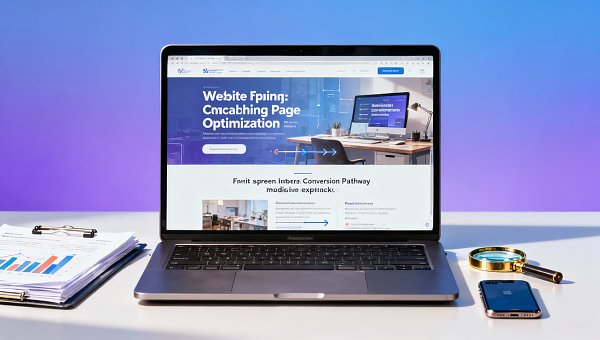
A low landing page conversion rate is often not caused by insufficient traffic, but by problems with key page elements. This article will review 7 core page elements one by one to help operators quickly identify the root cause and improve inquiry and conversion efficiency.
When many teams see a drop in data, their first reaction is to increase the budget. But in real business, what truly drags down landing page performance is often the page content, structure, and trust design.
If users do not understand it, are not interested, do not trust it, and take no action after clicking in, even the most precise targeting will still be difficult to convert. Rather than blindly scaling up ad spend, it is better to first break down and review the page step by step.
1. Is the above-the-fold message clear enough within 3 seconds
The above-the-fold area determines whether users will keep reading. When a landing page opens, users usually only scan the headline, subheadline, main visual, and button first.
If the top section does not quickly answer “who you are, what problem you solve, and why I should keep reading”, the bounce rate will usually be very high.
When reviewing, focus on three questions: Is the value proposition clear, is the target audience specific, and is the action direct enough. In particular, the landing page headline should not just be a brand slogan; it should communicate the result.
- Does the headline directly match the campaign promise
- Does the subheadline add the use case or advantage
- Does the button clearly state the next step
For example, “Contact Us Now for a Solution” is usually more effective than “Learn More”, because the action is more specific and the expectation is clearer.
2. Are the ad promise and page content aligned
For many low-converting landing pages, the problem is not that the page is poorly made, but that the “pre-click expectation” and the “post-click content” are disconnected. Users click in expecting to see pricing, but the result page keeps talking about the brand story, so they naturally leave.
At this stage, review whether the ad copy, keywords, and page copy are on the same wavelength. Search ads, information flow ads, and social media ads all have different requirements for page matching.
If you are advertising “multilingual website development”, “foreign trade inquiry website building”, or “Google Ads management”, the landing page should prioritize these specific needs instead of broadly introducing the company’s business.
In recent years, user sensitivity to message matching has increased. The more precise the page alignment, the more stable the conversion rate usually is.
3. Are there too many selling points, making the focus unclear
Many landing pages have a common problem: they try to say everything. Features, pricing, services, cases, and strengths are all stacked together, and as a result users cannot grasp the key point.
A more effective approach is to design the information flow around one core conversion goal. State the result first, then the evidence, and finally the action.
If the page goal is to obtain inquiries, do not let users hesitate between “download materials, join a group, watch a video, claim an offer, or contact support”.
In a website-plus-marketing-services integrated scenario, landing pages are often better suited to highlighting a single type of value, such as lead generation efficiency, website-building speed, or overseas promotion synergy, rather than trying to cover everything.
Platforms like 易营宝, which are AI-driven website-building and overseas marketing platforms, usually integrate smart website building, SEO optimization, ad placement, and social media marketing into one growth path. If the page can clearly explain this “from setup to conversion” logic, users will understand the value more easily.
4. Are trust elements missing
Whether users are willing to submit a form often depends on trust. This is especially true for businesses with higher order values and longer decision cycles, where trust elements are often more important than creative copy.
Common trust content includes customer cases, service data, industry credentials, media coverage, real reviews, cooperation process, and after-sales support. Without these, a landing page can easily feel “too much like an ad”.
A more obvious signal is that many pages only say “professional team”, “rich experience”, and “remarkable results”, but provide no supporting evidence. Such expression is hard to support conversion.
- Show real customer industries and project results
- Add service years and coverage regions
- Explain the onboarding process to reduce decision uncertainty
If it is a content-based page, you can also insert related materials as extended reading, for exampleA Discussion on Optimization Strategies for Human Resource Management in the New Erasuch structurally clear topic content is very suitable as a reference format for “methodology display”.
5. Are the forms and conversion actions set too aggressively
Another common reason for low landing page conversion is that the form barrier is too high. Before users have built enough trust, asking for too much information will naturally lead to abandonment.
First check the number of fields. Usually, name, contact information, and requirement description are enough. Information such as industry, budget, job title, and company size can be supplemented later during follow-up communication.
Then review the button copy. Compared with “Submit”, users are more willing to click on action-oriented expressions such as “Get a Proposal”, “Book a Demo”, or “Claim Diagnostic Results”.
This also means that a landing page is not just a display page; it is also a conversion process node. The lighter the action and the clearer the feedback, the smoother the lead capture usually is.
6. Is the page load speed and mobile experience slowing things down
Many teams focus on copy and design but ignore the basic experience. In fact, if a landing page loads even 2 or 3 seconds slower, the conversion loss can be very obvious.
Especially on mobile devices, where the screen is smaller and the network environment is more complex, any lag, misalignment, hard-to-tap button, or form obstruction will directly affect submission rates.
You can check in the following order:
- Is the hero image too large
- Are the buttons clearly tappable on mobile
- Does the form require frequent zooming in and out
- Is key page information interrupted by pop-ups
If the company is also doing overseas promotion, then the website system, server deployment, and multilingual loading capability will all affect landing page performance. Only when the technical foundation is stable can marketing actions more easily amplify results.
7. Is there ongoing testing, rather than a one-time final version
Many landing pages remain unchanged for a long time after launch, which itself is a problem. Page conversion is not something you “finish” once and stop; it requires continuous testing and iteration.
You can prioritize testing the elements with the greatest impact, such as the hero headline, primary button, form length, case study order, and quotation expression. Changing only one core variable at a time makes it easier to see the result.
If the landing page serves businesses such as foreign trade lead generation, cross-border malls, or brand globalization, it is recommended to evaluate the page together with ad placement, SEO, and social media traffic. Because conversion issues often do not come from the page alone.
At this point, platforms with integrated website building, SEO, advertising, and social media capabilities have a clearer advantage. They can optimize traffic acquisition, page handling, and online lead conversion within the same growth logic.
First review the page, then decide whether to increase the budget
A low landing page conversion rate is not necessarily caused by poor traffic, and it is not necessarily because there is no market demand. More often, the deviation comes from the above-the-fold message, information matching, selling point order, trust design, form barrier, loading experience, and testing mechanism.
Review these 7 elements one by one, and you can usually find the key point affecting conversion. Fix the page first, then scale up the traffic. This is often more effective than simply increasing the budget.
If you are building or upgrading a landing page, you can also refer to a more systematic content organization approach, such asA Discussion on Optimization Strategies for Human Resource Management in the New Erathis kind of structured topic presentation makes complex information much clearer.
A truly high-converting landing page is not one with more content, but one where every screen pushes the user one step forward. That is the core worth capturing in page optimization.
Related Articles

Related Products
 EasyCamp SaaS Smart Website Marketing SystemE-Yingbao SaaS Smart Website Marketing System: AI-powered, zero-code website building. Rapidly launch multilingual independent e-commerce sites in just 10 minutes. Global server acceleration and AI-driven SEO optimization empower businesses to efficiently connect with global markets. The seamless integration of technology and user-friendly operation makes building e-commerce sites incredibly simple.
 AI+SEM Intelligent Advertising Marketing SystemAI+SEM drives intelligent ad creation, empowering full-funnel precision advertising marketing. The system automatically generates weekly/monthly reports, AI recommends keywords and target countries, monitors core metrics in real-time with intelligent alerts, and enables one-click high-conversion ad solutions to help quickly acquire customers and improve ROI.
 AI+SEO Dual Engine Optimization ServiceEasyWin AI+SEO Dual Engine Optimization System leverages AI-powered keyword mining, content generation, and comprehensive technical optimization to help foreign trade enterprises acquire high-quality organic traffic, significantly improving search rankings and conversion rates.
 AI+SNS Social Media Marketing SystemYingbao AI+SNS Social Media Marketing System - Precision social capture for the social media era. Supports one-click content synchronization across major platforms like Facebook and LinkedIn. AI intelligently rewrites posts for enhanced relevance. 24/7 AI customer service and user profiling analysis empower businesses to efficiently expand into global markets.
 AI+SEO营销解决方案易营宝AI+SEO营销解决方案,通过AI批量写作、智能生成TDK、精准关键词扩词等功能,全面优化网站SEO效果,提升流量与转化率。助力企业构建高效智能网站新生态。
 AI+SEM Advertising Marketing SolutionsAI+SEM Advertising Marketing Solution leverages AI technology to deeply empower SEM ad campaigns. It automatically generates weekly/monthly reports using AI, presenting account data across multiple dimensions for comprehensive insights into campaign performance and trends. The system precisely recommends keywords and target countries, intelligently generates high-conversion ad copy, and enables one-click activation of efficient campaign plans to help businesses rapidly acquire customers. Simultaneously, it monitors core metrics in real time, intelligently identifies abnormal fluctuations, and issues timely alerts to ensure stable, high-return advertising results.
 Domain Name ServicesEasyWin provides professional domain name services, including intelligent queries, one-stop registration, brand protection, and full lifecycle management, helping businesses build a digital brand image.
 EasyOperate B2C Cross-Border E-Commerce Platform & Independent WebsiteEasyStore B2C Cross-border E-commerce Independent Store is an intelligent website building and cross-border e-commerce integrated solution independently developed by EasyStore Information Technology (Beijing) Co., Ltd. The system is specially designed for small and medium-sized as well as large export enterprises, integrating 'website building, operation, marketing, advertising, and conversion' into one, helping enterprises quickly establish cross-border e-commerce independent stores to achieve brand globalization and global sales growth.
The platform supports multiple languages, multiple currencies, and multi-channel marketing, with built-in AI intelligent translation and SEO optimization systems, suitable for mainstream markets such as Southeast Asia, Europe and America, Latin America, and the Middle East, assisting Chinese manufacturing enterprises in efficiently deploying international e-commerce strategies. SSL证书易营宝提供专业SSL安全证书服务,包括单域名和泛域名证书,确保网站数据传输加密、身份验证和完整性保护,助力企业建立安全可信的在线业务环境。









