









- The China-US tariff arrangement has reached a preliminary consensus, and the trade association will be establishedJun 15, 2026View details
- China-Morocco zero-tariff access, a breakthrough in the cost of Moroccan goods exports to ChinaJun 11, 2026View details
- What signal should be released for the suspension of exports to JapanJun 10, 2026View details
- China's May LNG imports rebounded, with increased volumes from Russia and Canada filling the Middle East supply gapJun 10, 2026View details
- Will GEO change its SEO strategy?Jun 04, 2026View details
- What types of businesses are end-to-end solutions suitable for?Jun 03, 2026View details
FTC Requires AI Advertising Disclosure for Non-Human Creatives
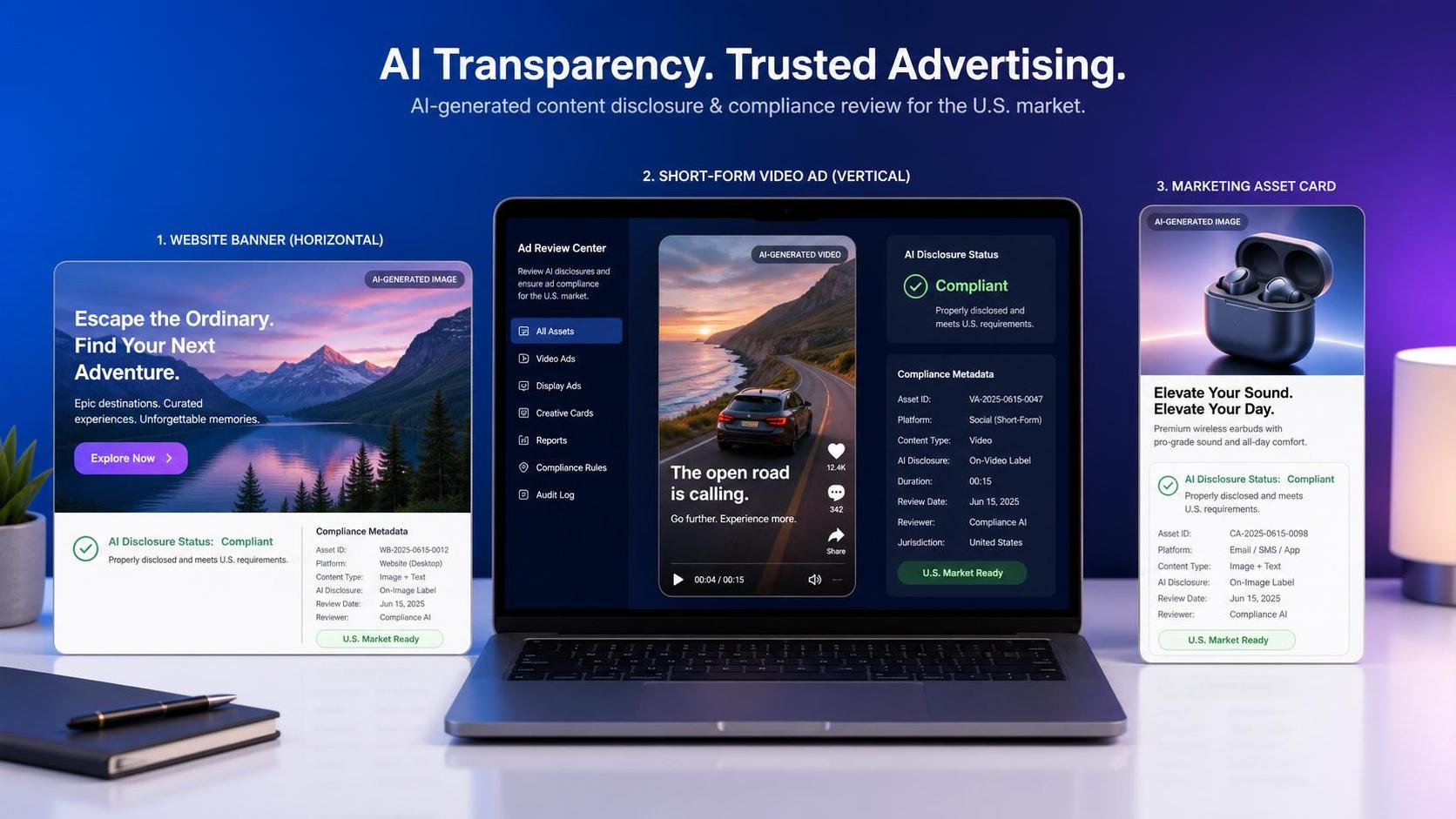
On June 14, 2026, the U.S. Federal Trade Commission (FTC) updated its enforcement guidance for advertising in the United States, further moving the disclosure requirements for AI-generated content to the forefront of ad compliance. For companies that place Facebook, Google ad landing pages, short-form video ad creatives, and independent-site banner copy for the U.S. market, this change is noteworthy not only because of the added labeling requirements, but also because ad production, placement review, cross-border marketing delivery, and brand trust management may all be directly affected.

What does this enforcement guidance confirm
Confirmed information shows that the FTC issued its latest enforcement guidance on June 14, 2026, requiring all AI-generated ads placed in the United States to clearly disclose that “this content was generated by artificial intelligence.” Applicable scenarios include Facebook and Google ad landing pages, short-form video ad creatives, and independent-site banner copy.
At the same time, violators may face fines of up to $100,000 per case. In addition to the penalty risk, related violations may also affect ad account review and further impact brand trust.
The impact on the cross-border marketing chain is moving upstream
First affected are businesses targeting the U.S. market
From an industry perspective, export companies, independent-site operators, and cross-border sellers that directly target the U.S. market for promotion will be the first to feel the impact of this regulatory change. The reason is that whether an ad is AI-generated and whether it has been clearly disclosed is no longer just a content production issue, but a compliance checkpoint before placement. The business stages affected are mainly concentrated in ad copy generation, creative upload review, landing page publishing, and daily account operations management.
What these companies need to pay attention to now is not expanding the interpretation of the rules, but incorporating “whether the content is AI-generated and whether it has been clearly disclosed” into the internal pre-launch review process for ads, so as to reduce the risk of subsequent fines, blocked account review, and damaged brand communication.
Supply chains providing creatives and managed-operations services also need to adjust in sync
From an observational perspective, service providers that create short-form video creatives, banner copy, ad page production, or managed-operations services for brands may also bear more direct delivery pressure due to the rule change. Once a client places ads targeting the U.S. market, whether the delivered materials include compliant disclosure will affect whether the client can launch smoothly and the status of the account thereafter.
This means service providers need to pay more attention to disclosure arrangements in deliverables, source material explanations, and client confirmation processes. For teams that use AI tools to mass-produce advertising content, the key point in future delivery is not only efficiency, but also whether they can leave clear, executable disclosure positions and review records for clients.
Procurement and brand management processes will also be tightened
For procurement teams, brand teams, and internal teams responsible for market compliance review, this change may push them to reassess and redefine cooperation requirements with external marketing vendors. In the procurement of ad creatives, page outsourcing, and short-form video production, the past focus was more on content performance and delivery speed, but going forward, AI-generated content identification and disclosure responsibility classification will need to be added.
In analysis, the impact is not limited to ad launch operations themselves; it also includes supplier screening, service requirement confirmation, acceptance criteria setting, and subsequent dispute tracing. Especially in cross-border business, although ad content is produced by an external team, the ultimate risk may still flow back to the brand account and brand trust level.
What real-world changes should companies focus on now
First clarify which contents fall within the disclosure scope
What is more worth attention at present is that companies should first sort out their own ad assets targeting the U.S. market, especially landing page copy, short-form video ad creatives, and independent-site banner copy, to determine which content is AI-generated and which content requires an additional clear disclosure statement. Because the input information does not provide a more detailed technical path, the current stage is more suitable for understanding it as a content inventory and risk classification exercise, rather than assuming that all execution details are already fully clear.
Bring disclosure requirements into pre-launch review
For teams that have already established ad placement workflows, the practical change is that review checkpoints need to move forward. Companies can focus on legal, compliance, operations, or brand review before ad launch to avoid making changes after materials have already been deployed in bulk. What needs to be noted here is that the input information only confirms that “must be clearly disclosed,” and does not provide a more specific display format, so the relevant execution path still requires ongoing attention.
Recheck supplier delivery and acceptance standards
If enterprise ad content is completed by an external production team, managed-operations company, or content service provider, then contract requirements, delivery checklists, and acceptance standards may need to be adjusted accordingly. From an analytical perspective, what needs more attention going forward is whether the supplier clearly states the use of AI, whether the delivered content reserves compliant disclosure space, and how responsibility is connected when review issues arise.
The ripple effect on account review and brand trust
In addition to the risk of a single-case fine, the input information also clearly states that ad account review and brand trust will be affected. Therefore, companies should not treat this change as a simple text-labeling issue; they should view it as part of placement stability and external brand expression. For teams that continuously operate in the U.S. market, this impact is closer to a compliance cost change at the daily operations level.
From the execution signal, this looks more like a preemptive marketing compliance measure
From an observational perspective, this piece of information is better understood as a clear execution signal for advertising activities in the U.S. market: whether AI-generated content is disclosed is shifting from a debatable expression issue to a compliance issue that can be pursued for liability. What is noteworthy is not whether all marketing rules have changed, but that the regulatory focus has already landed specifically on practical deployment scenarios such as ad creatives, landing pages, and in-site display copy.
From a rational perspective, this information is currently better understood as an execution direction that already carries real constraints, while still having some details that require continued observation. Companies should neither underestimate its impact on account review and brand trust, nor overextend conclusions beyond what is already known.
Basis of this article and direction for follow-up verification
This article was generated based on the user-provided news title, event time, and event summary, and the factual scope has been confirmed to be limited to the relevant input content. For such events, it is usually still necessary to combine information released by regulatory agencies, official announcements, platform review rules, industry association information, and reporting by authoritative media for ongoing verification.
Because the input did not provide a specific official source link, the original document and the complete description still need to be checked later. What is worth continuing to observe next includes whether policy details become clearer, whether platform execution paths change, whether new clauses are added to enterprise tender documents or supplier requirements, and how industry implementation feedback evolves.
Related Articles


Related Products
 EasyCamp SaaS Smart Website Marketing SystemE-Yingbao SaaS Smart Website Marketing System: AI-powered, zero-code website building. Rapidly launch multilingual independent e-commerce sites in just 10 minutes. Global server acceleration and AI-driven SEO optimization empower businesses to efficiently connect with global markets. The seamless integration of technology and user-friendly operation makes building e-commerce sites incredibly simple.
 AI+SEM Intelligent Advertising Marketing SystemAI+SEM drives intelligent ad creation, empowering full-funnel precision advertising marketing. The system automatically generates weekly/monthly reports, AI recommends keywords and target countries, monitors core metrics in real-time with intelligent alerts, and enables one-click high-conversion ad solutions to help quickly acquire customers and improve ROI.
 AI+SEO Dual Engine Optimization ServiceEasyWin AI+SEO Dual Engine Optimization System leverages AI-powered keyword mining, content generation, and comprehensive technical optimization to help foreign trade enterprises acquire high-quality organic traffic, significantly improving search rankings and conversion rates.
 AI+SNS Social Media Marketing SystemYingbao AI+SNS Social Media Marketing System - Precision social capture for the social media era. Supports one-click content synchronization across major platforms like Facebook and LinkedIn. AI intelligently rewrites posts for enhanced relevance. 24/7 AI customer service and user profiling analysis empower businesses to efficiently expand into global markets.
 AI+SEO营销解决方案易营宝AI+SEO营销解决方案,通过AI批量写作、智能生成TDK、精准关键词扩词等功能,全面优化网站SEO效果,提升流量与转化率。助力企业构建高效智能网站新生态。
 AI+SEM Advertising Marketing SolutionsAI+SEM Advertising Marketing Solution leverages AI technology to deeply empower SEM ad campaigns. It automatically generates weekly/monthly reports using AI, presenting account data across multiple dimensions for comprehensive insights into campaign performance and trends. The system precisely recommends keywords and target countries, intelligently generates high-conversion ad copy, and enables one-click activation of efficient campaign plans to help businesses rapidly acquire customers. Simultaneously, it monitors core metrics in real time, intelligently identifies abnormal fluctuations, and issues timely alerts to ensure stable, high-return advertising results.
 Domain Name ServicesEasyWin provides professional domain name services, including intelligent queries, one-stop registration, brand protection, and full lifecycle management, helping businesses build a digital brand image.
 EasyOperate B2C Cross-Border E-Commerce Platform & Independent WebsiteEasyStore B2C Cross-border E-commerce Independent Store is an intelligent website building and cross-border e-commerce integrated solution independently developed by EasyStore Information Technology (Beijing) Co., Ltd. The system is specially designed for small and medium-sized as well as large export enterprises, integrating 'website building, operation, marketing, advertising, and conversion' into one, helping enterprises quickly establish cross-border e-commerce independent stores to achieve brand globalization and global sales growth.
The platform supports multiple languages, multiple currencies, and multi-channel marketing, with built-in AI intelligent translation and SEO optimization systems, suitable for mainstream markets such as Southeast Asia, Europe and America, Latin America, and the Middle East, assisting Chinese manufacturing enterprises in efficiently deploying international e-commerce strategies. SSL证书易营宝提供专业SSL安全证书服务,包括单域名和泛域名证书,确保网站数据传输加密、身份验证和完整性保护,助力企业建立安全可信的在线业务环境。









