









- What New Signals Are Emerging in Enterprise Services SaaS Marketing ReportsJul 27, 2026View details
- What Does a Global Traffic Ecosystem Service Provider Do? What Are the Differences from a Single Advertising AgencyJul 16, 2026View details
- What should you focus on in the latest enterprise SaaS report? From renewal rates and delivery costs to overseas growth opportunitiesJul 12, 2026View details
- What signals are worth paying attention to in a cross-border marketing trend report? B2B companies should look at these 6 signalsJul 11, 2026View details
- How to Read a Cross-Border Marketing Trends Report? Five Key Dimensions for Evaluating Channel OpportunitiesJul 11, 2026View details
- Which channel has the highest ROI in the global traffic ecosystem? Comparative analysis of search, social media, and advertisingJul 10, 2026View details
What areas can be optimized to improve advertising CTR in the German market?
In highly competitive overseas promotion, mastering ways to improve advertising CTR in the German market is key to increasing click-through rates and reducing customer acquisition costs. This article breaks down actionable optimization ideas across creatives, keywords, audiences, landing pages, and other areas.
For foreign trade companies, manufacturing plants, cross-border sellers, and brands expanding overseas, the German market cannot be successfully addressed through simple “translation-based advertising.” German users place greater importance on information accuracy, delivery reliability, price transparency, and privacy compliance. Whether users click an ad often depends on whether the details appear professional.
In an integrated website and marketing services scenario, CTR affects not only the scale of advertising traffic, but also account quality, cost per click, and subsequent conversion efficiency. To continuously improve advertising performance, ad creatives, keyword strategies, audience matching, and landing page experience must be optimized collaboratively across the same conversion path.
Start with the Ad Front End: 4 Key Areas for Improving Click-Through Rates in the German Market
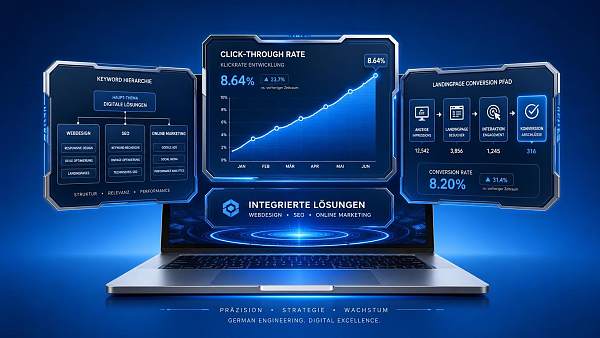
When advertising in Germany, many companies see their CTR remain in the 1%—2% range for a long time. The core issue is usually not an insufficient budget, but inadequate alignment of the front-end information. To truly master ways to improve advertising CTR in the German market, the user’s search intent, the advertising promise, and the page messaging must first be brought into alignment.
Ad Creative: First Solve the Question of “Why Should Users Click?”
German users are sensitive to exaggerated copy. Expressions such as “the best” and “absolutely leading” are often less effective at building trust than specific information such as “7—15-day delivery,” “German-language inquiries supported,” and “CE-related documents provided.” Ad copy should highlight concrete information rather than empty slogans.
It is recommended that headlines contain 2—3 layers of information, such as “German Website Development + Google Advertising Management,” “B2B Manufacturing Lead Generation Solutions in Germany,” and “Integrated Multilingual Website and Advertising Landing Pages.” This improves readability and helps search engines and users quickly understand the service content.
Creative Optimization Recommendations
- Prepare at least 3—5 headlines and 2 descriptions for each ad group, and conduct continuous testing for more than 7 days.
- It is recommended to prioritize selling points in the following order: “local-language support—delivery capabilities—industry experience—conversion path.”
- Use website interfaces, service processes, and industry scenarios for images or display materials whenever possible, rather than generic business images.
Keyword Strategy: Capture High-Intent Terms First, Then Expand to Related Terms
Among the methods for improving advertising CTR in the German market, keyword selection determines whether an ad appears in front of “the right people.” A common mistake among B2B companies is to bid only on broad terms such as website, marketing, and SEO. These terms have high search volumes, but their commercial intent is dispersed, so CTR is often low.
A more effective approach is to prioritize combinations of “service terms + regional terms + scenario terms,” such as “Google advertising optimization in Germany,” “German-language website development,” and “German promotion of B2B foreign trade websites.” During the first 2—4 weeks, these long-tail keywords generally make it easier to achieve higher click-through rates and clearer inquiry quality.
The following table can be used to organize the performance trends and application scenarios of different keyword types in German-market advertising, helping companies divide their account structure.
If the budget is limited, it is recommended to allocate 60%—70% of the budget first to high-intent service terms and scenario-based long-tail terms, while reserving 20%—30% for testing broad industry terms. This structure is more conducive to gradually identifying German users’ search preferences while controlling costs.
Audience and Geography: Avoid Broad, Undifferentiated Targeting Across Germany
User behavior differs significantly across German states and urban areas. For industrial, equipment, and foreign trade service businesses, it is not advisable to launch nationwide targeting from the outset. It is recommended to test 2—5 key regions first and then gradually expand.
Audience filtering should not focus only on basic age groups. Companies should also consider equipment purchasing cycles, job characteristics, visiting hours, and remarketing data to build at least 3 audience segments, such as new search audiences, visitors who did not convert, and audiences who submitted a form and need to be reached again.
Ad Extensions: Small Modules Can Also Increase Click-Through Rates
In Google Ads, sitelinks, callouts, phone numbers, forms, and price information are not optional extras. For B2B service companies, complete ad extensions can often increase CTR by 0.3%—1.2%. Although this improvement may seem small, it is extremely important for long-term advertising.
For an integrated website and marketing services solution, for example, sitelinks such as “AI-Powered Website Development,” “Multilingual Website Development,” “Google SEO Optimization,” and “Managed Advertising in Germany” can be added. This allows users to understand the scope of services before clicking and reduces invalid clicks.
Start with the Conversion Path: Collaborative Optimization of Landing Pages, Data Feedback, and Localization
Many teams focus only on the advertising dashboard while overlooking the quality of the post-click experience. In fact, methods for improving advertising CTR in the German market do not occur only on the advertising side. The landing page experience also affects ad ratings, user engagement, and subsequent click performance.
Landing Page Consistency: Let Users Confirm Within 3 Seconds That They “Clicked the Right Place”
If the ad promotes “German-language website development,” but the landing page first displays Chinese case studies or a generic company introduction, trust will be directly weakened. German users typically determine within 3—5 seconds whether a page is relevant. Therefore, the first screen must complete 3 tasks: explain the service, demonstrate capabilities, and provide an action entry point.
The first screen should include German-language or German-oriented messaging, core service modules, and contact information or a form button. The page does not need to be made excessively long, but it should cover at least 4 types of information: service content, applicable industries, delivery process, and frequently asked questions. For B2B businesses, limiting forms to 4—6 fields is generally more conducive to conversion.
Landing Page Checklist for High-CTR Ads
- Is the headline consistent with the advertising keywords?
- Does the page highlight experience in the German market, local-language capabilities, or European business?
- Is the loading time kept within 3 seconds whenever possible?
- Are there clear consultation entry points, WhatsApp, or email contact paths?
- Does the page present verifiable processes, capability boundaries, and service details?
Data Feedback: Without Feedback, There Is No Optimization
CTR optimization should not focus only on the click-through rate itself. It should also examine whether clicks lead to meaningful engagement, form submissions, and inquiries. It is recommended to connect at least 3 layers of data: ad clicks, page behavior, and conversion submissions. Only then can companies distinguish between “high clicks with low conversion” and “low clicks with high value.”
For integrated marketing service providers, the advertising account, independent website system, form system, and basic analytics tools should preferably be deployed in a unified manner. This makes it possible to continuously review keyword, creative, and page performance over 7-day, 14-day, and 30-day periods, providing a clear basis for the next round of advertising in Germany.
The following table can be used to establish execution priorities for German advertising CTR optimization, helping companies allocate resources to the most productive points.
From an execution-efficiency perspective, ad creatives and keywords usually produce results faster and are suitable for short-cycle iteration. Landing page optimization may take slightly longer, but its improvement in overall customer acquisition costs is more stable. Only by coordinating both can companies achieve sustainable methods for improving advertising CTR in the German market.
Localized Messaging: It Is Not Translation, but a Restructuring of the Persuasive Logic
Users in the German market generally place greater emphasis on rigorous expression. Rather than “helping you expand overseas quickly,” they are more concerned with questions such as “How long is the delivery cycle?”, “Are multilingual sites supported?”, “Can SEO and advertising work together?”, and “How will ongoing maintenance be handled?” Therefore, copy should shift from promotional messaging to decision-oriented messaging.
For example, a platform such as Yiyingbao that integrates website and marketing services offers more than standalone website development or advertising services. It can connect AI-powered website development, multilingual pages, Google SEO, advertising, and data analysis. For the German market, this full-path collaboration can often improve click and conversion efficiency more effectively than individual services.
Common Mistakes in Advertising in Germany and More Reliable Execution Recommendations
When applying methods for improving advertising CTR in the German market, the most common problem is not an inability to advertise, but an incorrect optimization sequence. Expanding first and fixing pages later, or purchasing traffic first and reviewing data later, can leave an account in a state of “acceptable clicks but unstable inquiries.”
Mistake 1: Looking Only at CTR and Ignoring Click Quality
If an ad group achieves a CTR of 4% but has an average visit duration of less than 20 seconds and almost no form submissions, those clicks do not represent real value. It is recommended to monitor page engagement time, bounce rate, form conversion, and repeat visits simultaneously, and to evaluate advertising performance using at least 4 dimensions.
Mistake 2: Ignoring the Mobile Experience
Although German B2B users often conduct in-depth reading in work situations, their initial searches and screening do not necessarily take place on computers. If the mobile first screen is cluttered, buttons are unclear, or loading takes more than 4 seconds, the traffic generated by improved CTR will also have difficulty becoming effective leads.
Mistake 3: Separating Website Development, SEO, and Advertising
Customer acquisition efficiency in the German market increasingly depends on building the site foundation and advertising strategy in parallel. A website that can be indexed, promoted, and converted can help stabilize ad quality. Search data, advertising keyword sets, and user behavior can in turn guide SEO pages and content planning. This is also the practical value of an integrated service model.
A More Reliable Execution Path
- Phase 1: Spend 2—3 weeks completing keyword segmentation, creative testing, and the launch of core pages.
- Phase 2: Spend 2 weeks observing regional, audience, and device performance and removing ineffective terms.
- Phase 3: Around day 30, review CTR, conversion rate, and lead quality to determine the direction of expansion.
For companies planning to develop the European market over the long term, methods for improving advertising CTR in the German market should not be understood as a one-time advertising tactic. Instead, they should be incorporated into a long-term system covering website development, advertising operations, SEO optimization, and multilingual content planning. Only when the front end attracts clicks, the back end supports conversions, and the data layer provides continuous feedback can customer acquisition costs be gradually reduced and lead quality steadily improved.
Relying on its AI-powered website development, multilingual website development, Google advertising, SEO optimization, and data-driven operations capabilities, Yiyingbao can provide foreign trade companies, manufacturing brands, and cross-border teams with integrated growth solutions better suited to the German market. If you would like to systematically develop a German advertising strategy, optimize ad click-through rates, and improve independent website conversion efficiency, please contact us now for a customized solution and to learn more about our solutions.
Related Articles
Related Products
 EasyCamp SaaS Smart Website Marketing SystemE-Yingbao SaaS Smart Website Marketing System: AI-powered, zero-code website building. Rapidly launch multilingual independent e-commerce sites in just 10 minutes. Global server acceleration and AI-driven SEO optimization empower businesses to efficiently connect with global markets. The seamless integration of technology and user-friendly operation makes building e-commerce sites incredibly simple.
 AI+SEM Intelligent Advertising Marketing SystemAI+SEM drives intelligent ad creation, empowering full-funnel precision advertising marketing. The system automatically generates weekly/monthly reports, AI recommends keywords and target countries, monitors core metrics in real-time with intelligent alerts, and enables one-click high-conversion ad solutions to help quickly acquire customers and improve ROI.
 AI+SEO Dual Engine Optimization ServiceEasyWin AI+SEO Dual Engine Optimization System leverages AI-powered keyword mining, content generation, and comprehensive technical optimization to help foreign trade enterprises acquire high-quality organic traffic, significantly improving search rankings and conversion rates.
 AI+SNS Social Media Marketing SystemYingbao AI+SNS Social Media Marketing System - Precision social capture for the social media era. Supports one-click content synchronization across major platforms like Facebook and LinkedIn. AI intelligently rewrites posts for enhanced relevance. 24/7 AI customer service and user profiling analysis empower businesses to efficiently expand into global markets.
 AI+SEO营销解决方案易营宝AI+SEO营销解决方案,通过AI批量写作、智能生成TDK、精准关键词扩词等功能,全面优化网站SEO效果,提升流量与转化率。助力企业构建高效智能网站新生态。
 AI+SEM Advertising Marketing SolutionsAI+SEM Advertising Marketing Solution leverages AI technology to deeply empower SEM ad campaigns. It automatically generates weekly/monthly reports using AI, presenting account data across multiple dimensions for comprehensive insights into campaign performance and trends. The system precisely recommends keywords and target countries, intelligently generates high-conversion ad copy, and enables one-click activation of efficient campaign plans to help businesses rapidly acquire customers. Simultaneously, it monitors core metrics in real time, intelligently identifies abnormal fluctuations, and issues timely alerts to ensure stable, high-return advertising results.
 Domain Name ServicesEasyWin provides professional domain name services, including intelligent queries, one-stop registration, brand protection, and full lifecycle management, helping businesses build a digital brand image.
 EasyOperate B2C Cross-Border E-Commerce Platform & Independent WebsiteEasyStore B2C Cross-border E-commerce Independent Store is an intelligent website building and cross-border e-commerce integrated solution independently developed by EasyStore Information Technology (Beijing) Co., Ltd. The system is specially designed for small and medium-sized as well as large export enterprises, integrating 'website building, operation, marketing, advertising, and conversion' into one, helping enterprises quickly establish cross-border e-commerce independent stores to achieve brand globalization and global sales growth.
The platform supports multiple languages, multiple currencies, and multi-channel marketing, with built-in AI intelligent translation and SEO optimization systems, suitable for mainstream markets such as Southeast Asia, Europe and America, Latin America, and the Middle East, assisting Chinese manufacturing enterprises in efficiently deploying international e-commerce strategies. SSL证书易营宝提供专业SSL安全证书服务,包括单域名和泛域名证书,确保网站数据传输加密、身份验证和完整性保护,助力企业建立安全可信的在线业务环境。









