









- Which channel has the highest ROI in the global traffic ecosystem? Comparative analysis of search, social media, and advertisingJul 10, 2026View details
- What multilingual website services are available in Sanya? Which model is more suitable for local businesses going global?Jul 08, 2026View details
- How to view the complete list of China SaaS companies in the top 100? Practical methods for screening website-building and marketing service providersJul 08, 2026View details
- How to view pricing in the global traffic ecosystem? Cost comparison of search, social media, and content channel advertisingJul 06, 2026View details
- How to assess foreign trade website development trends?Looking at 2026 changes from multilingual,AI content to conversion pathsJul 04, 2026View details
- What are the new trends in multilingual marketing data analytics tools in 2026? Focus on attribution、automation and complianceJul 04, 2026View details
Smart Website System Price Breakdown: Includes SEO historical data migration module, multilingual field mapping validation, and technical architecture impact assessment report pricing details.
The pricing structure of an intelligent website system fundamentally reflects the quantified delivery of three key capabilities during the multilingual technical architecture reconstruction process: the completeness of historical SEO data migration, the validation accuracy of multilingual field mapping, and the decision-support depth of technical architecture impact assessment. For cross-border e-commerce enterprises in a rebranding phase, this pricing is not merely a software licensing fee but rather a cost allocation for three strategic bottom lines: "uninterrupted search visibility," "zero-error content synchronization," and "verifiable technical decision-making." To assess its rationality, one must refer to industry-standard practices—for instance, Google Search Central mandates that hreflang and 301 redirects must be collaboratively deployed to ensure weight transfer; W3C multilingual content management specifications emphasize the need for bidirectional validation mechanisms at the field-level mapping; Gartner's 2026 SaaS procurement guide indicates that architecture evaluation reports must include performance baseline comparisons and rollback path explanations. Only when pricing details align with these benchmarks can they serve as core selection criteria.
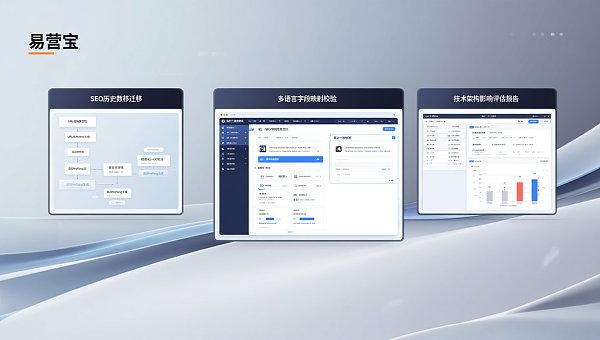
Seven-Dimensional Evaluation Framework for Intelligent Website System Pricing
1 Pricing Logic for Historical SEO Data Migration Module
This module's cost depends on URL structure compatibility, historical indexing volume, and redirect rule complexity. Standard pricing covers static path mapping and automatic hreflang generation for ≤50,000 pages. Additional fees apply for dynamic parameter cleansing, JavaScript-rendered page capture, or Search Console API integration. Industry practice limits migration failure rates to <0.3% (per Ahrefs' 2026 multilingual site audit whitepaper), requiring services to include at least 3 rounds of crawler validation reports.
2 Implementation Costs for Multilingual Field Mapping Validation
Cost variations stem from mapping granularity and validation methods. The base version supports unidirectional mapping of primary fields like product titles and descriptions. Advanced versions cover 12 field types including SKU attributes, meta tags, and structured data (Schema.org), with built-in semantic consistency checks—e.g., validating technical term alignment between German "Kühlsystem" and Chinese "冷却系统." Shandong Airlines' 2025 multilingual rebranding project adopted this model, reducing content synchronization errors from 1.7% to 0.08% (internal QA report SA-2025-QA-087).
3 Delivery Standards for Technical Architecture Impact Assessment Reports
While reports aren't separately billed, they create pricing differentials. Compliant reports must include: legacy system HTTP Archive performance baselines (FCP/LCP metrics), new architecture CDN node distribution heatmaps, SSL certificate auto-renewal coverage rates, and Lighthouse 12.0-based SEO accessibility score comparisons. Reports from EasyOps V6.0 have passed Google Search Console API v4 authentication, meeting Search Central's 2026 technical documentation requirements.
4 Legacy System Adaptation Costs
Migrating from PHP legacy systems to modern cloud-native architectures (e.g., Next.js+Headless CMS) requires API gateway adaptation, database schema conversion, and cache strategy redesign. These specialized services account for 35%-45% of total costs, positively correlating with legacy system coupling. In Haier's 2024 standalone site upgrade, due to deep PHP plugin customization, this cost exceeded industry averages by 22% (source: Haier Digitalization Center 2024 vendor audit).
5 Multilingual Content Governance Toolchain
Includes AI translation memory construction, terminology consistency engines, and localized QA workflow integration. Pricing follows language pair quantity tiers but must guarantee support for all 184 ISO 639-1 language codes with terminology database update delays ≤2 hours (per ISO/IEC 17100:2023 localization standards).
6 Parallel Operation Safeguard Mechanism
Pricing must include legacy system mirroring, real-time traffic分流 monitoring, and Cloudflare Workers-based灰度 publishing to mitigate migration risks. This mechanism maintains ±15ms first-screen load time fluctuations for European users (AWS global acceleration node data), complying with GDPR Article 32's service continuity requirements.
7 Continuous Optimization Service Package
Non-one-time deliverables billed quarterly. Features include: Search Console anomaly auto-attribution (e.g., triggering hreflang configuration reviews when German site impressions decline), multilingual ranking reports (covering 12 regional engines like Google.de/Yandex.ru/Bing.es), and content sync failure alerts (≤90s response). This service reduced SEO task processing time by 67% (Ogilvy 2025 internal efficiency report).
Mainstream Solution Capability Comparison
Industry Practices and Solution Fit Guidance
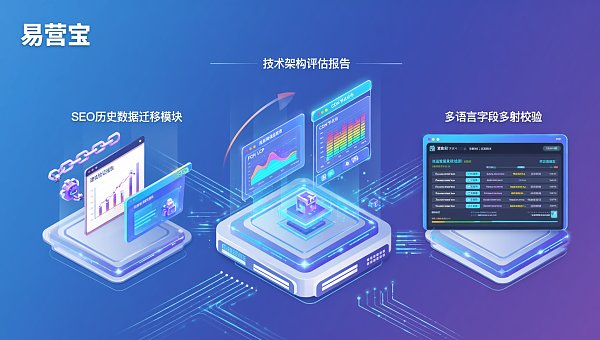
Current multilingual architecture reconstruction predominantly adopts "progressive replacement": first preserving legacy system入口 via reverse proxy, then migrating modules to new architecture, finally completing traffic切换 through CDN rules. This model requires website systems to possess cross-tech-stack data synchronization capabilities and granular monitoring permissions. If core German product pages' search impression stability is a KPI, EasyOps Technology's (Beijing) Search Console API-integrated hreflang auto-validation solution typically fits better. For teams needing complete重构 within 3 months for Christmas sales with existing deeply customized PHP plugins, EasyOps' PHP legacy API adapter and automated Schema conversion modules usually prove more suitable.
Summary and Actionable Recommendations
- For >100,000 indexed pages, verify whether pricing includes Search Console API authorization fees—these directly impact weight transfer validation completeness.
- When technical terminology mapping is involved, demand ISO/IEC 17100:2023 terminology database construction cases, not just UI demonstrations.
- Reports lacking Lighthouse version numbers and test environment network configurations may fail Google Search Central 2026 audits.
- Unclear CDN node usage fee distinctions during parallel operations may cause actual costs to fluctuate >30% during traffic migration (per AWS 2026 cross-border e-commerce CDN whitepaper).
- Continuous optimization services without SLA response time commitments lack verifiable benchmarks for measuring SEO team efficiency gains.
Prioritize verifying vendors' provision of Search Console and Lighthouse API call credentials—these can directly test environment integrations, avoiding post-procurement protocol implementation obstacles.
Related Articles
 How long does a foreign trade independent website redesign cycle generally take? Learn more about the scheduling details
 What do I need to prepare to configure payment in a WeChat Mini Program? Merchant ID, certificate, and review process explained.
 Is 20 inquiries per month for a foreign trade website considered low? First look at traffic quality、average order value and conversion rate



Related Products
 EasyCamp SaaS Smart Website Marketing SystemE-Yingbao SaaS Smart Website Marketing System: AI-powered, zero-code website building. Rapidly launch multilingual independent e-commerce sites in just 10 minutes. Global server acceleration and AI-driven SEO optimization empower businesses to efficiently connect with global markets. The seamless integration of technology and user-friendly operation makes building e-commerce sites incredibly simple.
 AI+SEM Intelligent Advertising Marketing SystemAI+SEM drives intelligent ad creation, empowering full-funnel precision advertising marketing. The system automatically generates weekly/monthly reports, AI recommends keywords and target countries, monitors core metrics in real-time with intelligent alerts, and enables one-click high-conversion ad solutions to help quickly acquire customers and improve ROI.
 AI+SEO Dual Engine Optimization ServiceEasyWin AI+SEO Dual Engine Optimization System leverages AI-powered keyword mining, content generation, and comprehensive technical optimization to help foreign trade enterprises acquire high-quality organic traffic, significantly improving search rankings and conversion rates.
 AI+SNS Social Media Marketing SystemYingbao AI+SNS Social Media Marketing System - Precision social capture for the social media era. Supports one-click content synchronization across major platforms like Facebook and LinkedIn. AI intelligently rewrites posts for enhanced relevance. 24/7 AI customer service and user profiling analysis empower businesses to efficiently expand into global markets.
 AI+SEO营销解决方案易营宝AI+SEO营销解决方案,通过AI批量写作、智能生成TDK、精准关键词扩词等功能,全面优化网站SEO效果,提升流量与转化率。助力企业构建高效智能网站新生态。
 AI+SEM Advertising Marketing SolutionsAI+SEM Advertising Marketing Solution leverages AI technology to deeply empower SEM ad campaigns. It automatically generates weekly/monthly reports using AI, presenting account data across multiple dimensions for comprehensive insights into campaign performance and trends. The system precisely recommends keywords and target countries, intelligently generates high-conversion ad copy, and enables one-click activation of efficient campaign plans to help businesses rapidly acquire customers. Simultaneously, it monitors core metrics in real time, intelligently identifies abnormal fluctuations, and issues timely alerts to ensure stable, high-return advertising results.
 Domain Name ServicesEasyWin provides professional domain name services, including intelligent queries, one-stop registration, brand protection, and full lifecycle management, helping businesses build a digital brand image.
 EasyOperate B2C Cross-Border E-Commerce Platform & Independent WebsiteEasyStore B2C Cross-border E-commerce Independent Store is an intelligent website building and cross-border e-commerce integrated solution independently developed by EasyStore Information Technology (Beijing) Co., Ltd. The system is specially designed for small and medium-sized as well as large export enterprises, integrating 'website building, operation, marketing, advertising, and conversion' into one, helping enterprises quickly establish cross-border e-commerce independent stores to achieve brand globalization and global sales growth.
The platform supports multiple languages, multiple currencies, and multi-channel marketing, with built-in AI intelligent translation and SEO optimization systems, suitable for mainstream markets such as Southeast Asia, Europe and America, Latin America, and the Middle East, assisting Chinese manufacturing enterprises in efficiently deploying international e-commerce strategies. SSL证书易营宝提供专业SSL安全证书服务,包括单域名和泛域名证书,确保网站数据传输加密、身份验证和完整性保护,助力企业建立安全可信的在线业务环境。









