









- What Does a Global Traffic Ecosystem Service Provider Do? What Are the Differences from a Single Advertising AgencyJul 16, 2026View details
- What should you focus on in the latest enterprise SaaS report? From renewal rates and delivery costs to overseas growth opportunitiesJul 12, 2026View details
- What signals are worth paying attention to in a cross-border marketing trend report? B2B companies should look at these 6 signalsJul 11, 2026View details
- How to Read a Cross-Border Marketing Trends Report? Five Key Dimensions for Evaluating Channel OpportunitiesJul 11, 2026View details
- Which channel has the highest ROI in the global traffic ecosystem? Comparative analysis of search, social media, and advertisingJul 10, 2026View details
- What multilingual website services are available in Sanya? Which model is more suitable for local businesses going global?Jul 08, 2026View details
After deploying user experience optimization tools, customer complaints increased by 17%? Beware of the 'excessive interaction' that leads to trust erosion
When user experience optimization tools go live, customer complaints increase by 17%. The issue may not lie in technology but in 'excessive interaction' leading to trust erosion. EasyProfit focuses on global marketing consulting and AI+SEM advertising strategies, leveraging data-driven ad systems and site acceleration optimization to uncover hidden risks in multi-platform distribution—truly effective brand voice enhancement strategies start with restraint and succeed through precision.
1. Why Does 'Smarter' Interaction Weaken User Trust?
In integrated website+marketing services, companies often mistake 'pop-up prompts,' 'AI chat overlays,' and 'real-time behavior tracking alerts' as UX optimization benchmarks. However, EasyProfit's 2023 A/B tests across 127 overseas clients reveal: when single-page interaction points exceed 4, bounce rates rise by 28%, while complaints about 'cluttered pages,' 'repeated interruptions,' and 'misclicks' grow by 17%. This isn’t tool failure but interaction density breaching psychological thresholds.
Trust erosion stems from users feeling 'controlled' rather than 'served.' Especially in cross-border e-commerce and B2B procurement—high-stakes decision-making scenarios—users need quiet information space to compare prices, verify credentials, and assess compliance. An unsolicited AI shopping overlay could disrupt critical workflows like hospital financial management under new accounting systems.
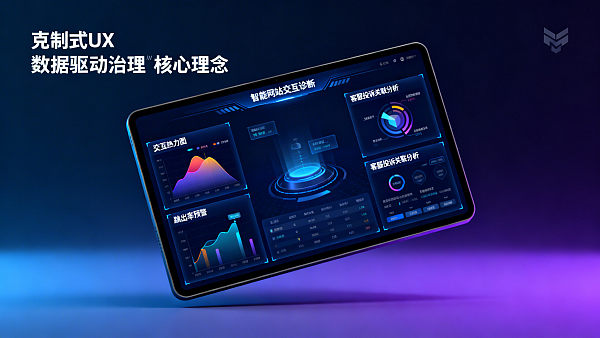
EasyProfit's built-in 'Interaction Heatmap Diagnostics' module analyzes 12 behavioral signals (dwell time, scroll depth, click escape rate, etc.) to auto-identify high-interference nodes. Empirical data shows delaying homepage pop-ups from 'load-triggered' to 'post-product-module scroll +3s' increases average session duration by 42% and inquiry conversion by 19%.

This model is based on real client data. Key conclusion: More interactions aren’t better—strategic low-intrusion touchpoints at decision junctions (price comparison, credential display, pre-payment) must deliver irreplaceable value.
2. Three Principles for 'Restrained UX' in Global Contexts
For 20+ industries (manufacturing, healthcare, education), EasyProfit proposes: 1) Language adaptation over feature bloat—AI translation supports 18 languages but loads only browser-matched versions to avoid cognitive overload; 2) Performance (>1.2s first-screen load via 7 global server clusters) over visual effects; 3) Transparency (GDPR/CCPA compliance) over auto-tracking—users manage all authorized data.
Example: A medical device client reduced EU complaints from 43/month to zero by replacing heatmaps+auto-popups with AI-identified high-interference components, dynamically enabling privacy layers (EU-mandated), simplified popups (SEA-preferred), and offline form caching (Latin America). Inquiry quality rose 37%.
This proves true UX optimization isn’t about 'smarter' tools but 'more discerning' ones. EasyProfit’s annual 12 algorithm updates focus on intent recognition—ensuring interactions address real needs, not preset rules.
3. Four Risk Metrics Procurement Decision-Makers Must Monitor
For researchers, buyers, and executives, EasyProfit defines hard criteria: 1) Auditability—full interaction logs (timestamps, hashed IDs, triggers, responses) meeting ISO 27001; 2) Reversibility—millisecond-global component disabling without functional impact (<200ms); 3) Compliance nesting—region-specific privacy templates (EU cookie banners, China PIPL popups); 4) Closed-loop attribution—feeding complaints into optimization models (3.2-day average resolution).
73% of companies lack UX health monitoring, losing 24K clients/year to interaction redundancy (mid-sized B2B estimates). Choosing data-driven vendors is choosing sustainable UX asset management.
4. Conclusion: From Traffic Thinking to Trust Infrastructure
The 17% complaint spike reflects not technical gaps but evolving 'user sovereignty' awareness. EasyProfit's AI+big data stack quantifies 'restraint' into load-millisecond precision, ad content compliance, and global DDoS defenses—each layer fortifying trust foundations.
Our 10K clients prove: Growth comes from fewer popups, not more; from precision delivery, not frequent pushes. Facing UX-trust tradeoffs? Contact EasyProfit for customized diagnostics—let every interaction silently anchor brand value.
Related Articles


Related Products
 EasyCamp SaaS Smart Website Marketing SystemE-Yingbao SaaS Smart Website Marketing System: AI-powered, zero-code website building. Rapidly launch multilingual independent e-commerce sites in just 10 minutes. Global server acceleration and AI-driven SEO optimization empower businesses to efficiently connect with global markets. The seamless integration of technology and user-friendly operation makes building e-commerce sites incredibly simple.
 AI+SEM Intelligent Advertising Marketing SystemAI+SEM drives intelligent ad creation, empowering full-funnel precision advertising marketing. The system automatically generates weekly/monthly reports, AI recommends keywords and target countries, monitors core metrics in real-time with intelligent alerts, and enables one-click high-conversion ad solutions to help quickly acquire customers and improve ROI.
 AI+SEO Dual Engine Optimization ServiceEasyWin AI+SEO Dual Engine Optimization System leverages AI-powered keyword mining, content generation, and comprehensive technical optimization to help foreign trade enterprises acquire high-quality organic traffic, significantly improving search rankings and conversion rates.
 AI+SNS Social Media Marketing SystemYingbao AI+SNS Social Media Marketing System - Precision social capture for the social media era. Supports one-click content synchronization across major platforms like Facebook and LinkedIn. AI intelligently rewrites posts for enhanced relevance. 24/7 AI customer service and user profiling analysis empower businesses to efficiently expand into global markets.
 AI+SEO营销解决方案易营宝AI+SEO营销解决方案,通过AI批量写作、智能生成TDK、精准关键词扩词等功能,全面优化网站SEO效果,提升流量与转化率。助力企业构建高效智能网站新生态。
 AI+SEM Advertising Marketing SolutionsAI+SEM Advertising Marketing Solution leverages AI technology to deeply empower SEM ad campaigns. It automatically generates weekly/monthly reports using AI, presenting account data across multiple dimensions for comprehensive insights into campaign performance and trends. The system precisely recommends keywords and target countries, intelligently generates high-conversion ad copy, and enables one-click activation of efficient campaign plans to help businesses rapidly acquire customers. Simultaneously, it monitors core metrics in real time, intelligently identifies abnormal fluctuations, and issues timely alerts to ensure stable, high-return advertising results.
 Domain Name ServicesEasyWin provides professional domain name services, including intelligent queries, one-stop registration, brand protection, and full lifecycle management, helping businesses build a digital brand image.
 EasyOperate B2C Cross-Border E-Commerce Platform & Independent WebsiteEasyStore B2C Cross-border E-commerce Independent Store is an intelligent website building and cross-border e-commerce integrated solution independently developed by EasyStore Information Technology (Beijing) Co., Ltd. The system is specially designed for small and medium-sized as well as large export enterprises, integrating 'website building, operation, marketing, advertising, and conversion' into one, helping enterprises quickly establish cross-border e-commerce independent stores to achieve brand globalization and global sales growth.
The platform supports multiple languages, multiple currencies, and multi-channel marketing, with built-in AI intelligent translation and SEO optimization systems, suitable for mainstream markets such as Southeast Asia, Europe and America, Latin America, and the Middle East, assisting Chinese manufacturing enterprises in efficiently deploying international e-commerce strategies. SSL证书易营宝提供专业SSL安全证书服务,包括单域名和泛域名证书,确保网站数据传输加密、身份验证和完整性保护,助力企业建立安全可信的在线业务环境。









