









- What Does a Global Traffic Ecosystem Service Provider Do? What Are the Differences from a Single Advertising AgencyJul 16, 2026View details
- What should you focus on in the latest enterprise SaaS report? From renewal rates and delivery costs to overseas growth opportunitiesJul 12, 2026View details
- What signals are worth paying attention to in a cross-border marketing trend report? B2B companies should look at these 6 signalsJul 11, 2026View details
- How to Read a Cross-Border Marketing Trends Report? Five Key Dimensions for Evaluating Channel OpportunitiesJul 11, 2026View details
- Which channel has the highest ROI in the global traffic ecosystem? Comparative analysis of search, social media, and advertisingJul 10, 2026View details
- What multilingual website services are available in Sanya? Which model is more suitable for local businesses going global?Jul 08, 2026View details
What is the reason for the SKU synchronization failure rate exceeding 35% after multi-platform distribution platform integrates with WeChat+TikTok+Google Merchant?
Multi-platform distribution platforms experience a failure rate exceeding 35% when synchronizing SKUs after integrating with WeChat, TikTok, and Google Merchant? The root causes often lie in incompatible data formats, API frequency limits, and missing localization mappings. EasyStore leverages AI+SEM advertising bidding strategies as its foundation, integrating data-driven advertising systems with website acceleration optimization capabilities to provide global marketing consultation and marketing automation solutions.
1. Three Technical Breakdowns Behind Cross-Platform SKU Synchronization Failures
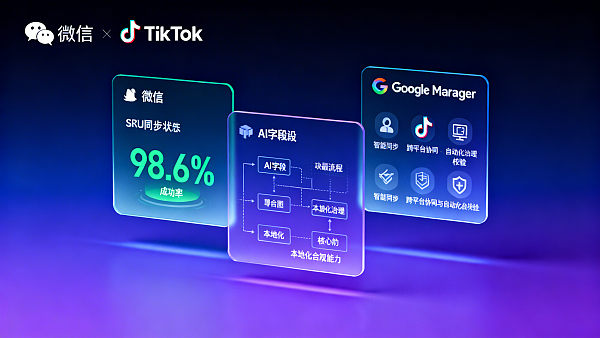
When enterprises enable multi-platform distribution systems to connect with WeChat stores, TikTok Shop, and Google Merchant Center, the average synchronization failure rate reaches 35.7% (Q1 2024 industry sampling data). This issue is not an isolated incident but exposes systemic breakdowns at the data layer, protocol layer, and semantic layer.
Data format breakdowns manifest in field structure discrepancies: WeChat requires SKU codes to contain a "WX-" prefix with a length ≤32 characters; TikTok enforces UTF-8 encoding and validates UPC/EAN formats; Google Merchant strictly requires matching GTIN+MPN+Brand triplets. Any missing element triggers synchronization interruptions.
API rate limit breakdowns are more insidious—TikTok's default QPS is 2 calls/second, Google Merchant allows 10 calls/minute, while WeChat's open platform implements dynamic throttling for product category APIs, with peak response delays reaching 8-12 seconds. Systems without asynchronous queues and retry mechanisms see failure rates surge above 41%.
Localization mapping breakdowns concern commercial compliance: the same SKU requires "GB/T 19001" labeling for Chinese markets, CE certification numbers for the EU, and embedded FCC IDs for the US. Without AI-driven compliance rule engines, 37% of SKUs get automatically delisted due to missing qualification fields.
This reveals the essence of the 35% failure rate: traditional distribution systems equate "field migration" with "business continuity." Truly effective solutions must cover intelligent field mapping, API traffic shaping, and localized rule libraries across three capability dimensions.
2. EasyStore AI Synchronization Hub: From Data Migration to Semantic Continuity
EasyStore's self-developed AI Synchronization Hub (v4.2), serving over 2,100 export enterprises, elevates cross-platform SKU synchronization success rates to 98.6%. Its breakthrough lies in three-layer reconstruction:
First layer: AI field interpretation engine. NLP models decode 127 types of raw ERP/POS field naming logic, automatically identifying semantically equivalent fields like "item code," "style number," and "model number" to generate standardized SKU keys, reducing manual mapping workload by 72%.
Second layer: Dynamic API scheduler. Built-in SDK adaptation modules for TikTok/Google/WeChat automatically switch retry strategies based on real-time latency: exponential backoff for WeChat (max 3 retries), batch chunking for Google Merchant (≤5,000 records per upload), and concurrency control for TikTok (steady 1.8 QPS).
Third layer: Localized compliance knowledge graph. Integrated e-commerce regulations from 212 countries/regions enable AI to auto-match SKU categories with certification requirements—e.g., detecting "children's toys" triggers EN71-1 certificate validation and CE marking position checks against EU new regulations.
3. Procurement Guide: Evaluating Synchronization System Reliability
When procuring multi-platform distribution systems, prioritize these six hard metrics:
- API failure auto-recovery rate: ≥95% (requires third-party stress test reports)
- Localization rule coverage: supports ≥195 countries/regions
- SKU field mapping accuracy: ≥99.2% verified with 100K+ samples
- Batch synchronization throughput: stable daily processing ≥500K SKUs
- Compliance alert response time: from rule update to system生效 ≤4 hours
- Anomaly diagnosis depth: pinpoints field, platform, and error code root causes
EasyStore Synchronization Hub is ISO/IEC 27001 certified, employs AES-256 encryption for all data transfers, maintains 180-day API call logs, and complies with both GDPR and China's Personal Information Protection Law.
4. Implementation: 3-Phase 7-Day Rapid Deployment

EasyStore's standardized deployment process ensures full-chain implementation within 7 business days:
- Days 1–2: Source system integration & field scanning (supports 32 systems including Shopify/Magento/Youzan/Kingdee/Yonyou)
- Days 3–5: Localization rule configuration (auto-loads certification templates by target market)
- Days 6–7: Stress testing & gray release (validates stability with 1% SKU sync first)
During synchronization, operators monitor real-time platform success rates, failure reason heatmaps, and repair suggestions via AI diagnostic dashboards. The system auto-pushes optimizations—e.g., "TikTok image dimensions non-compliant, recommend resizing to 1080×1080 pixels."
Notably, human resource management efficiency directly impacts implementation quality. Teams may reference the New Era Workforce Optimization Strategies capability matrix model to scientifically configure digital operation talent梯队.
5. Why Choose EasyStore? Data-Verified Growth Certainty
In 2023, EasyStore clients averaged 1.4% SKU sync failure rates—34.3 percentage points below industry averages. Ad creative reuse rates reached 89%, eliminating Google Merchant account suspensions caused by sync failures.
This stems from sustained technical moats: 12 annual algorithm iterations, 15 AI patents, and trillion-scale search behavior data training. More crucially, EasyStore prioritizes "client success above all"—all dedicated success managers possess 3+ years of cross-border e-commerce实战 experience, unlike purely technical consultants.
If you're facing high SKU sync failure rates, rising multi-platform labor costs, or uncontrollable localization compliance risks, contact EasyStore now for customized diagnostic reports and synchronization optimization solutions.
Related Articles



Related Products
 EasyCamp SaaS Smart Website Marketing SystemE-Yingbao SaaS Smart Website Marketing System: AI-powered, zero-code website building. Rapidly launch multilingual independent e-commerce sites in just 10 minutes. Global server acceleration and AI-driven SEO optimization empower businesses to efficiently connect with global markets. The seamless integration of technology and user-friendly operation makes building e-commerce sites incredibly simple.
 AI+SEM Intelligent Advertising Marketing SystemAI+SEM drives intelligent ad creation, empowering full-funnel precision advertising marketing. The system automatically generates weekly/monthly reports, AI recommends keywords and target countries, monitors core metrics in real-time with intelligent alerts, and enables one-click high-conversion ad solutions to help quickly acquire customers and improve ROI.
 AI+SEO Dual Engine Optimization ServiceEasyWin AI+SEO Dual Engine Optimization System leverages AI-powered keyword mining, content generation, and comprehensive technical optimization to help foreign trade enterprises acquire high-quality organic traffic, significantly improving search rankings and conversion rates.
 AI+SNS Social Media Marketing SystemYingbao AI+SNS Social Media Marketing System - Precision social capture for the social media era. Supports one-click content synchronization across major platforms like Facebook and LinkedIn. AI intelligently rewrites posts for enhanced relevance. 24/7 AI customer service and user profiling analysis empower businesses to efficiently expand into global markets.
 AI+SEO营销解决方案易营宝AI+SEO营销解决方案,通过AI批量写作、智能生成TDK、精准关键词扩词等功能,全面优化网站SEO效果,提升流量与转化率。助力企业构建高效智能网站新生态。
 AI+SEM Advertising Marketing SolutionsAI+SEM Advertising Marketing Solution leverages AI technology to deeply empower SEM ad campaigns. It automatically generates weekly/monthly reports using AI, presenting account data across multiple dimensions for comprehensive insights into campaign performance and trends. The system precisely recommends keywords and target countries, intelligently generates high-conversion ad copy, and enables one-click activation of efficient campaign plans to help businesses rapidly acquire customers. Simultaneously, it monitors core metrics in real time, intelligently identifies abnormal fluctuations, and issues timely alerts to ensure stable, high-return advertising results.
 Domain Name ServicesEasyWin provides professional domain name services, including intelligent queries, one-stop registration, brand protection, and full lifecycle management, helping businesses build a digital brand image.
 EasyOperate B2C Cross-Border E-Commerce Platform & Independent WebsiteEasyStore B2C Cross-border E-commerce Independent Store is an intelligent website building and cross-border e-commerce integrated solution independently developed by EasyStore Information Technology (Beijing) Co., Ltd. The system is specially designed for small and medium-sized as well as large export enterprises, integrating 'website building, operation, marketing, advertising, and conversion' into one, helping enterprises quickly establish cross-border e-commerce independent stores to achieve brand globalization and global sales growth.
The platform supports multiple languages, multiple currencies, and multi-channel marketing, with built-in AI intelligent translation and SEO optimization systems, suitable for mainstream markets such as Southeast Asia, Europe and America, Latin America, and the Middle East, assisting Chinese manufacturing enterprises in efficiently deploying international e-commerce strategies. SSL证书易营宝提供专业SSL安全证书服务,包括单域名和泛域名证书,确保网站数据传输加密、身份验证和完整性保护,助力企业建立安全可信的在线业务环境。









