









- What Does a Global Traffic Ecosystem Service Provider Do? What Are the Differences from a Single Advertising AgencyJul 16, 2026View details
- What should you focus on in the latest enterprise SaaS report? From renewal rates and delivery costs to overseas growth opportunitiesJul 12, 2026View details
- What signals are worth paying attention to in a cross-border marketing trend report? B2B companies should look at these 6 signalsJul 11, 2026View details
- How to Read a Cross-Border Marketing Trends Report? Five Key Dimensions for Evaluating Channel OpportunitiesJul 11, 2026View details
- Which channel has the highest ROI in the global traffic ecosystem? Comparative analysis of search, social media, and advertisingJul 10, 2026View details
- What multilingual website services are available in Sanya? Which model is more suitable for local businesses going global?Jul 08, 2026View details
- How to view the complete list of China SaaS companies in the top 100? Practical methods for screening website-building and marketing service providersJul 08, 2026View details
- How to view pricing in the global traffic ecosystem? Cost comparison of search, social media, and content channel advertisingJul 06, 2026View details
What Are the Consequences of Not Optimizing a Website for Mobile Devices?
What happens if mobile responsiveness is not implemented? At best, the page layout may become disordered and the bounce rate may increase; at worst, traffic may be lost, conversions may decline, and search rankings may even be affected. For businesses that rely on their official website for lead generation, failing to optimize for mobile means actively missing out on customers.
Why do many businesses overlook the real cost of ignoring mobile responsiveness
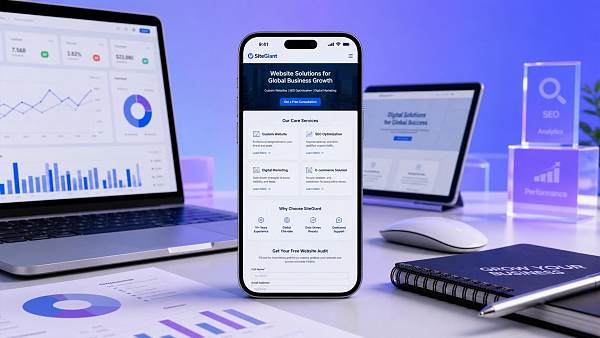
When building a website, many businesses focus more on the homepage visuals, product uploads, and launch speed, while underestimating the changing share of mobile traffic. Today, whether users are searching for suppliers, reviewing product specifications, or filling out an inquiry form, their first touchpoint often comes from a mobile device.
If a business is still asking, “What happens if mobile responsiveness is not implemented?”, the answer is no longer merely an issue of user experience, but whether the entire lead-generation journey is complete. Display errors, difficult-to-use buttons, and hard-to-complete forms can directly affect inquiries, orders, and brand trust.
- After search traffic enters the website, users will usually leave within a few seconds if the above-the-fold information is cluttered.
- If traffic generated by advertising cannot be browsed smoothly, the click budget will be quickly consumed.
- After traffic from social media and short videos reaches a landing page, an unclear conversion path will cause the conversion rate to drop significantly.
For foreign trade companies, manufacturing factories, cross-border sellers, and brands expanding overseas, an official website is not merely a showcase page but a marketing asset. Failing to optimize for mobile essentially weakens this asset’s ability to generate leads continuously.
What consequences can a lack of mobile responsiveness bring? Start with a comparison of the key impacts
To understand more clearly what happens if mobile responsiveness is not implemented, the following analysis breaks down the issue from four perspectives: traffic, user experience, conversion, and brand impact. This comparison is especially useful for businesses evaluating an official website redesign, an overseas independent website, or the optimization of landing pages used to receive marketing traffic.
As this table shows, the consequences of a lack of mobile responsiveness are not isolated problems. They can affect the overall performance of search, advertising, social media, and the brand website. If a business views its website and marketing separately, it will often underestimate the resulting losses.
Which scenarios are most likely to lose customers because of poor mobile responsiveness
Foreign trade websites focused on inquiries
Overseas buyers often use their phones for initial screening. If a product page loads slowly, specification tables are difficult to read, or contact information is hidden too deeply, they may leave directly and turn to a competitor’s website. For B2B companies in particular, the first impression often determines whether communication will continue.
Advertising landing pages and campaign pages
Most traffic generated by Google advertising, Facebook advertising, and short-video promotions will first reach a mobile page. If the hero image is too heavy, the form contains too many fields, or the button placement is inconvenient, even highly targeted campaigns will struggle to generate effective conversions.
Cross-border stores and brand-owned websites
Product details, variant selection, adding items to the cart, and the payment process must all remain smooth on a small screen. Poor mobile responsiveness will directly magnify problems such as shopping-cart abandonment, interrupted payments, and declining repeat purchases.
- If a multilingual website is difficult to switch between languages on mobile, the browsing experience in different markets will be affected.
- If certificates, case studies, and production-line content from a manufacturing company are displayed chaotically on mobile, its professional image will be weakened.
- If the mobile visual experience of a brand expanding overseas is disconnected from the desktop experience, brand consistency and trust-building will be affected.
From search to conversion, where exactly does poor mobile responsiveness create obstacles
If we continue asking what happens if mobile responsiveness is not implemented, it is best not to focus on just one page, but to examine the complete journey. The problem is usually not that there is “no traffic,” but that “traffic arrives and cannot be properly received.”
- Search stage: The page title is seen, but the mobile page loads slowly, so users leave before entering deeper pages.
- Browsing stage: The navigation hierarchy is crowded, product categories are difficult to find, and users cannot quickly locate the information they need.
- Trust stage: The layout of case studies, qualifications, FAQs, and contact information is unclear, causing users to question the company’s authenticity.
- Conversion stage: An overly long inquiry form, an invalid call button, or an obstructed chat entry point causes lead submissions to fail.
- Return-visit stage: The experience remains poor when users open the site again after bookmarking it, and the brand impression continues to weaken.
This is why website development should not focus only on whether a site has “gone live,” but also on whether it can be promoted, indexed, and converted. In an integrated website and marketing service scenario, mobile responsiveness directly determines advertising returns and the efficiency of accumulating organic traffic.
What should businesses focus on when redesigning or building a new website
When purchasing website development services, many businesses compare only prices and the number of pages, while overlooking mobile responsiveness, marketing traffic-receiving capabilities, and the efficiency of subsequent optimization. The following table is suitable for supplier evaluation and requirements confirmation.
A truly worthwhile solution is not merely to build the website, but to enable it to continuously receive search traffic, advertising clicks, and social media visits in a mobile environment, ultimately generating inquiries or orders.
Why should website and marketing be solved through an integrated approach rather than handled separately
Many businesses repeatedly encounter mobile-related problems because website development, optimization, advertising, and content updates are handled by different teams without unified standards. As a result, the design may look good, but once promotion begins, issues with responsiveness, speed, indexing, and conversion become exposed all at once.
易营宝 has long served foreign trade companies, manufacturing factories, cross-border e-commerce sellers, and brands expanding overseas. Its core advantage lies in handling intelligent website development, SEO optimization, advertising, overseas social media operations, and improved AI search visibility within the same growth framework, rather than addressing each problem in isolation.
- The self-developed cloud intelligent website-building system can meet the mobile responsiveness requirements of multilingual websites, B2B marketing websites, and B2C cross-border stores.
- The AI+SEO/GEO optimization system helps coordinate the optimization of page structure, content layout, and search entry points.
- The advertising marketing system works in tandem with landing page strategies to reduce budget waste caused by poor page performance after users arrive.
For businesses seeking to cover North America, Europe, Southeast Asia, Japan and South Korea, the Middle East, Russian-speaking regions, Latin America, and Africa, this integrated capability is particularly important because end-user habits, access environments, and content preferences differ across markets.
Common misconceptions: being able to open a site on a phone does not mean mobile responsiveness is complete
Misconception 1: If the page displays, it is qualified
Many pages can be opened on a phone, but their content hierarchy is disorganized, buttons are too crowded, and the above-the-fold information lacks focus. Such pages are technically “visible,” but commercially “unusable.”
Misconception 2: It is enough to optimize only the homepage
Actual conversions often occur on product detail pages, case study pages, landing pages, and contact pages. A homepage that looks normal does not mean that the mobile experience across the entire site meets the standard. Problems on deeper pages can also result in traffic loss.
Misconception 3: Optimize later when advertising is launched
If traffic is purchased before the basic website experience is stable, a business will feel the pressure of “clicks but no inquiries” even sooner. Organizing the landing pages and conversion paths first, and then increasing traffic volume, usually makes overall costs more controllable.
FAQ: What happens if mobile responsiveness is not implemented? Key questions businesses often ask
Will poor mobile responsiveness definitely affect search rankings?
It may not cause a sharp decline immediately, but a poor mobile experience usually affects page crawling and comprehension, engagement performance, and user satisfaction. In the long term, organic visibility and ranking stability may both be hindered, especially for competitive industry and inquiry-related keywords.
Does an old website need to be completely rebuilt, or is partial optimization enough?
That depends on the existing architecture. If only certain modules display incorrectly, key pages can be corrected first. If the navigation, templates, forms, and multilingual logic all have problems, a systematic upgrade is generally recommended to avoid repeated rework.
Which pages should be optimized first when the budget is limited?
It is recommended to prioritize the homepage, core product pages, advertising landing pages, contact pages, and inquiry form pages. These pages have the most direct impact on receiving traffic and submitting leads, making them the most worthwhile areas for initial investment when the budget is limited.
What should receive special attention when optimizing the mobile experience of a multilingual site?
Pay particular attention to differences in text length across languages, line wrapping in button copy, how navigation expands, the display of regional contact details, and access speeds in different markets. If a multilingual site is designed for only one language, layout misalignment is more likely to occur on mobile devices.
Why choose us
If you are evaluating what happens if mobile responsiveness is not implemented, it usually indicates that actual problems have already appeared in traffic reception, inquiry conversion, or overseas promotion. What is needed at this point is not isolated repair, but an executable solution that takes website development, promotion, and conversion into account.
易营宝 can provide comprehensive support for corporate websites, foreign trade marketing websites, cross-border stores, and advertising landing pages, covering current-state diagnosis, mobile structure organization, multilingual page optimization, SEO, and coordination between advertising and social media. Whether you are more focused on organic traffic, advertising conversions, or AI search visibility, configurations can be tailored to your business stage.
- You can consult us on whether your existing website needs to be rebuilt or whether key pages should be optimized first.
- You can discuss the optimization priorities and delivery schedule for multilingual websites, B2B inquiry sites, and B2C stores.
- You can confirm improvement directions for advertising landing pages, SEO pages, and mobile inquiry forms.
- You can discuss website development plans, promotional support, and phased quotation recommendations according to your budget.
If your company is preparing to upgrade its official website, expand into overseas markets, or improve mobile conversion efficiency, you can now have an in-depth discussion around page responsiveness, solution selection, delivery schedules, and promotional coordination, so that your website can truly become a growth gateway that can be promoted, indexed, and converted.
Related Articles
Related Products
 EasyCamp SaaS Smart Website Marketing SystemE-Yingbao SaaS Smart Website Marketing System: AI-powered, zero-code website building. Rapidly launch multilingual independent e-commerce sites in just 10 minutes. Global server acceleration and AI-driven SEO optimization empower businesses to efficiently connect with global markets. The seamless integration of technology and user-friendly operation makes building e-commerce sites incredibly simple.
 AI+SEM Intelligent Advertising Marketing SystemAI+SEM drives intelligent ad creation, empowering full-funnel precision advertising marketing. The system automatically generates weekly/monthly reports, AI recommends keywords and target countries, monitors core metrics in real-time with intelligent alerts, and enables one-click high-conversion ad solutions to help quickly acquire customers and improve ROI.
 AI+SEO Dual Engine Optimization ServiceEasyWin AI+SEO Dual Engine Optimization System leverages AI-powered keyword mining, content generation, and comprehensive technical optimization to help foreign trade enterprises acquire high-quality organic traffic, significantly improving search rankings and conversion rates.
 AI+SNS Social Media Marketing SystemYingbao AI+SNS Social Media Marketing System - Precision social capture for the social media era. Supports one-click content synchronization across major platforms like Facebook and LinkedIn. AI intelligently rewrites posts for enhanced relevance. 24/7 AI customer service and user profiling analysis empower businesses to efficiently expand into global markets.
 AI+SEO营销解决方案易营宝AI+SEO营销解决方案,通过AI批量写作、智能生成TDK、精准关键词扩词等功能,全面优化网站SEO效果,提升流量与转化率。助力企业构建高效智能网站新生态。
 AI+SEM Advertising Marketing SolutionsAI+SEM Advertising Marketing Solution leverages AI technology to deeply empower SEM ad campaigns. It automatically generates weekly/monthly reports using AI, presenting account data across multiple dimensions for comprehensive insights into campaign performance and trends. The system precisely recommends keywords and target countries, intelligently generates high-conversion ad copy, and enables one-click activation of efficient campaign plans to help businesses rapidly acquire customers. Simultaneously, it monitors core metrics in real time, intelligently identifies abnormal fluctuations, and issues timely alerts to ensure stable, high-return advertising results.
 Domain Name ServicesEasyWin provides professional domain name services, including intelligent queries, one-stop registration, brand protection, and full lifecycle management, helping businesses build a digital brand image.
 EasyOperate B2C Cross-Border E-Commerce Platform & Independent WebsiteEasyStore B2C Cross-border E-commerce Independent Store is an intelligent website building and cross-border e-commerce integrated solution independently developed by EasyStore Information Technology (Beijing) Co., Ltd. The system is specially designed for small and medium-sized as well as large export enterprises, integrating 'website building, operation, marketing, advertising, and conversion' into one, helping enterprises quickly establish cross-border e-commerce independent stores to achieve brand globalization and global sales growth.
The platform supports multiple languages, multiple currencies, and multi-channel marketing, with built-in AI intelligent translation and SEO optimization systems, suitable for mainstream markets such as Southeast Asia, Europe and America, Latin America, and the Middle East, assisting Chinese manufacturing enterprises in efficiently deploying international e-commerce strategies. SSL证书易营宝提供专业SSL安全证书服务,包括单域名和泛域名证书,确保网站数据传输加密、身份验证和完整性保护,助力企业建立安全可信的在线业务环境。









