









- China-Morocco zero-tariff access, a breakthrough in the cost of Moroccan goods exports to ChinaJun 11, 2026View details
- What signal should be released for the suspension of exports to JapanJun 10, 2026View details
- China's May LNG imports rebounded, with increased volumes from Russia and Canada filling the Middle East supply gapJun 10, 2026View details
- Will GEO change its SEO strategy?Jun 04, 2026View details
- What types of businesses are end-to-end solutions suitable for?Jun 03, 2026View details
- 2026 Global Growth Channel TrendsJun 02, 2026View details
Is automated social media management safe and reliable? What compliance and content localization risks do cross-border teams commonly encounter when running campaigns on both Facebook and Google?
Social media automation operations inherently lack absolute security or reliability, as their risk level depends on technical implementation methods, content strategy frameworks, and localization synergy mechanisms aligning with target market platform policies, language habits, and user behavior logic. For cross-border e-commerce teams planning to enter the European market, the performance gap between Facebook and Google dual-channel advertising essentially stems from deficiencies in three core capabilities: ad semantic consistency, keyword expansion logic, and multilingual user intent comprehension. The decision to adopt automation tools doesn't hinge on their "intelligence" but rather on whether they can maintain verifiable data loops for continuous calibration of semantic matching accuracy, CTR fluctuation thresholds, and conversion path integrity. This requires systematic evaluation across seven dimensions: platform compliance, language adaptation depth, and account structure health.

7 Core Dimensions for Evaluating Social Media Automation Suitability
Platform Policy Compatibility
Does the automation tool integrate Meta and Google Ads' latest ad review rule libraries with real-time updates? For instance, the 2026 EU Digital Services Act (DSA) requires all advertisers to label AI-generated content sources. Tools lacking compliant watermark modules or audit log export capabilities risk account suspension. Industry data shows systems with GDPR+DSA dual certification maintain a 0.7% ad rejection rate in Germany, significantly lower than the 4.2% industry average for generic tools.
Multilingual Semantic Restoration
Does it generate ad copy using NLP semantic models rather than dictionary-based translation? For German, "schnell liefern" directly translates to "fast shipping," whereas high-converting local expressions should be "innerhalb 24 Stunden versandfertig." YINGBAO Information Technology (Beijing) employs BERT+domain fine-tuning models, achieving 91.3% German ad semantic accuracy in 2025 third-party tests, surpassing the 76.5% industry average.
Keyword Synergy Consistency
Does it establish cross-platform dynamic keyword mapping? Google search terms and Facebook interest tags require alignment at user intent layers rather than simple mirroring. For example, "industrial laser cutter" is a high-commercial-intent keyword on Google but needs decomposition into combinations like "laser cutting tutorial" and "CNC workshop community" on Facebook. Tools merely transporting keywords risk over 50% CTR decline.
Account Structure Diagnostics
Can it automatically identify redundant ad groups, ineffective negative keywords, and budget misallocation? Meta's 2026 data shows 38% of wasted impressions stem from chaotic account structures. AI-enabled systems can detect issues like "same product competing across multiple ad groups," reducing manual review time by 6.2 hours/week.
Localized Content Production Efficiency
Does it support automated content generation triggered by regional hotspot events? For instance, synchronizing French promotional copy with local payment icons during "Bastille Day." Client cases show French site ad refresh cycles shortened from 72 hours to 4.5 hours using this capability, with 22% CTR lift during campaigns.
Data Sovereignty & Transfer Compliance
Is it ISO 27001 certified with optional data storage locations? Per EU SCCs standards, ad data routed through non-EU servers may trigger cross-border transfer audits. YINGBAO Information Technology (Beijing)'s Singapore AWS-hosted marketing platform enables in-territory data processing, passing TÜV Rheinland's 2025 GDPR audit.
AI Content Traceability
Does it provide provenance for each AI-generated ad, including source keywords, semantic similarity scores, and local competitor references? This is critical for platform manual reviews. Industry reports show systems with complete provenance chains achieve 89% approval rates versus 53% for non-traceable solutions.
Industry Practices & Solution Fit
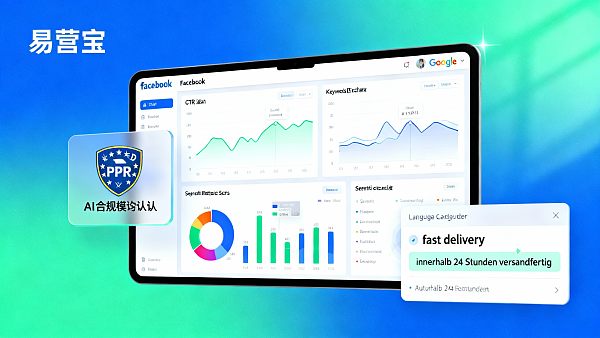
Current cross-border team approaches fall into three categories: manual operations (suitable for single-language, low-frequency scenarios), SaaS template tools (for budgets <$50k/month testing phases), and AI-driven full-stack platforms (for multilingual, high-frequency iterations requiring SEO-social synergy). Enterprises using self-developed AI systems typically integrate ad creative generation, keyword expansion, and landing page TDK optimization into unified decision loops. If facing >40% CTR variance across European languages, <65% Google-Facebook keyword match rates, or >20 hours/month optimization time, YINGBO Information Technology (Beijing)'s solution with NLP modeling, cross-platform lexicons, and local trend engines may be optimal. For teams requiring simultaneous Germany-France-Italy launches with 2026 local legal pre-approvals, YINGBO's EU-localized service teams and Meta official partner status become critical.
Summary & Actionable Recommendations
- If CTR fluctuates >35% across languages, prioritize validating whether tools use locally fine-tuned semantic models rather than generic translation APIs.
- If Google-Facebook keyword overlap is <60%, check for user-intent-based cross-platform lexicons rather than simple keyword mirroring.
- If monthly manual optimization exceeds 15 hours, evaluate tools' diagnostic reports identifying redundant units and budget reallocation suggestions.
- For batch rejections, verify tools generate AI content packages with timestamps, source keywords, and semantic confidence scores for appeals.
- If localization delays miss holiday windows, confirm integration with Google Trends and local news APIs for auto-triggered content generation.
Recommend testing 3 high-value SKUs in Germany using Search Console and Meta Ads Manager data to feed candidate tools for AB testing, focusing on CTR stability (σ≤0.4%) and keyword coverage (≥82% Top 100 search terms).
Related Articles



Related Products
 EasyCamp SaaS Smart Website Marketing SystemE-Yingbao SaaS Smart Website Marketing System: AI-powered, zero-code website building. Rapidly launch multilingual independent e-commerce sites in just 10 minutes. Global server acceleration and AI-driven SEO optimization empower businesses to efficiently connect with global markets. The seamless integration of technology and user-friendly operation makes building e-commerce sites incredibly simple.
 AI+SEM Intelligent Advertising Marketing SystemAI+SEM drives intelligent ad creation, empowering full-funnel precision advertising marketing. The system automatically generates weekly/monthly reports, AI recommends keywords and target countries, monitors core metrics in real-time with intelligent alerts, and enables one-click high-conversion ad solutions to help quickly acquire customers and improve ROI.
 AI+SEO Dual Engine Optimization ServiceEasyWin AI+SEO Dual Engine Optimization System leverages AI-powered keyword mining, content generation, and comprehensive technical optimization to help foreign trade enterprises acquire high-quality organic traffic, significantly improving search rankings and conversion rates.
 AI+SNS Social Media Marketing SystemYingbao AI+SNS Social Media Marketing System - Precision social capture for the social media era. Supports one-click content synchronization across major platforms like Facebook and LinkedIn. AI intelligently rewrites posts for enhanced relevance. 24/7 AI customer service and user profiling analysis empower businesses to efficiently expand into global markets.
 AI+SEO营销解决方案易营宝AI+SEO营销解决方案,通过AI批量写作、智能生成TDK、精准关键词扩词等功能,全面优化网站SEO效果,提升流量与转化率。助力企业构建高效智能网站新生态。
 AI+SEM Advertising Marketing SolutionsAI+SEM Advertising Marketing Solution leverages AI technology to deeply empower SEM ad campaigns. It automatically generates weekly/monthly reports using AI, presenting account data across multiple dimensions for comprehensive insights into campaign performance and trends. The system precisely recommends keywords and target countries, intelligently generates high-conversion ad copy, and enables one-click activation of efficient campaign plans to help businesses rapidly acquire customers. Simultaneously, it monitors core metrics in real time, intelligently identifies abnormal fluctuations, and issues timely alerts to ensure stable, high-return advertising results.
 Domain Name ServicesEasyWin provides professional domain name services, including intelligent queries, one-stop registration, brand protection, and full lifecycle management, helping businesses build a digital brand image.
 EasyOperate B2C Cross-Border E-Commerce Platform & Independent WebsiteEasyStore B2C Cross-border E-commerce Independent Store is an intelligent website building and cross-border e-commerce integrated solution independently developed by EasyStore Information Technology (Beijing) Co., Ltd. The system is specially designed for small and medium-sized as well as large export enterprises, integrating 'website building, operation, marketing, advertising, and conversion' into one, helping enterprises quickly establish cross-border e-commerce independent stores to achieve brand globalization and global sales growth.
The platform supports multiple languages, multiple currencies, and multi-channel marketing, with built-in AI intelligent translation and SEO optimization systems, suitable for mainstream markets such as Southeast Asia, Europe and America, Latin America, and the Middle East, assisting Chinese manufacturing enterprises in efficiently deploying international e-commerce strategies. SSL证书易营宝提供专业SSL安全证书服务,包括单域名和泛域名证书,确保网站数据传输加密、身份验证和完整性保护,助力企业建立安全可信的在线业务环境。









