









- What stages does the cross-border services ecosystem include? How do website building, promotion, payment, and compliance work togetherJun 22, 2026View details
- How will email marketing costs change in 2026Jun 22, 2026View details
- The China-US tariff arrangement has reached a preliminary consensus, and the trade association will be establishedJun 15, 2026View details
- Should overseas brand marketing start with ads or contentJun 21, 2026View details
- What determines B2C cross-border e-commerce website development costs? A breakdown of features, interfaces, and deployment methodsJun 17, 2026View details
- China-Morocco zero-tariff access, a breakthrough in the cost of Moroccan goods exports to ChinaJun 11, 2026View details
- What signal should be released for the suspension of exports to JapanJun 10, 2026View details
- China's May LNG imports rebounded, with increased volumes from Russia and Canada filling the Middle East supply gapJun 10, 2026View details
7 Common Pitfalls in Cross-Border Independent Site Conversion Rate Optimization
Many companies treat launching an independent website as a stage-based victory, only to find after real operations that traffic has increased, but inquiries and orders have not grown accordingly. The problem is often not whether there is a website, but whether the underlying logic of cross-border independent-site conversion rate optimization is understood. It is not simply changing a button color, nor can it be solved by spending a little more on ads. Instead, it is about the overall coordination from traffic matching, page messaging, and trust building to the conversion path.
In website and marketing integration practices, the more common situation is that site development, SEO, advertising, and content are all done separately, and in the end everyone is working hard, but the results cancel each other out. If you want traffic to turn into customers more efficiently, first identify the common misconceptions; this is often more important than blindly increasing the budget.
Why do many independent sites look professional, yet fail to convert from the start?
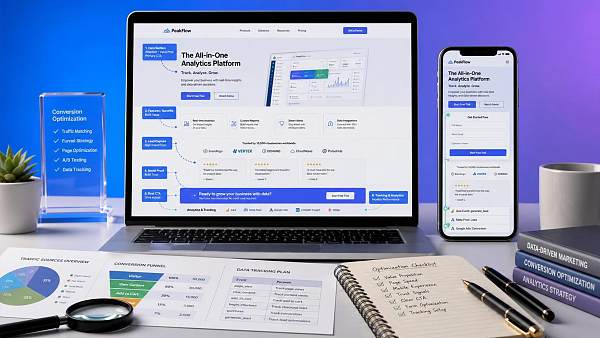
The first misconception is treating “looking good” as “converting well.” Visual design is indeed important, but cross-border independent-site conversion rate optimization focuses more on whether the information is clear, whether the path is smooth, and whether users are willing to continue taking action. If the homepage does not clearly explain what is being sold, who it is for, and why it is worth trusting, even the most refined design will struggle to drive effective conversions.
The second misconception is assuming that all visitors are ready to place an order. In reality, traffic from different sources is at different decision stages. People coming from search are more focused on problem-solving answers, people from ads care more about value propositions, and people from social media often first judge brand credibility. If a page only lists product parameters and does not address real concerns, the bounce rate will be very high.
Platforms like 易营宝, which provide long-term overseas-market services, emphasize the coordination of website development, SEO, advertising, and content because conversion has never been a single-point effort. AI-powered site building, multilingual presentation, localized content, and data tracking—missing any one of these can break the conversion chain.
Is simply chasing traffic volume the misconception behind cross-border independent-site conversion rate optimization?
Yes, and it is one of the most common misunderstandings. Many websites focus on “the more visitors, the better,” while ignoring traffic quality. Visits that do not bring purchase intent may still look impressive in the data, but they do not necessarily turn into customers.
True cross-border independent-site conversion rate optimization starts with whether the keywords are precise, then checks whether the landing page can take over effectively. For example, if a user searching for “supplier custom solutions” lands on a generic product page, it is almost inevitable that they will lose interest. SEO, ad copy, page titles, and form content must all be built around the same need.
The judgment chart below can quickly identify where the traffic problem really lies.
Simply put, traffic is not more valuable just because there is more of it; it becomes more valuable when it is better matched. Only after sending each type of traffic to the most suitable page should you consider scaling up.
If the page content is very complete, why still can’t it generate inquiries?
This is usually an overlap of the third and fourth misconceptions: too much information, but no conversion rhythm; a complete introduction, but no trust closure. Many pages put company introductions, product features, and technical parameters all together, which looks comprehensive, but users cannot actually grasp the key points.
A more effective approach is to arrange content in decision-making order. First answer “what problem can you solve,” then explain “why you are worth trusting,” and finally guide “what to do next.” This sequence fits browsing habits better than simply stacking materials.
- On the homepage, lead with the core selling point instead of expanding all the details right away.
- In the middle section, place real cases, certifications, delivery processes, and service scope.
- At the bottom, set low-friction actions, such as requesting a quote, samples, or a solution.
In practical applications, multilingual pages are especially prone to the problem of “accurate translation, but unconvincing expression.” Cross-border independent-site conversion rate optimization cannot rely only on language switching; it also requires localized rewriting, including unit formats, scenarios, promise styles, and communication habits. Long-term market coverage across North America, Europe, Southeast Asia, and other regions is where 易营宝’s core value lies: combining technical systems with localized expression, rather than directly copying Chinese pages into an overseas environment.
When conversion is poor, should you fix the website first, or SEO and advertising first?
Many people put the two in opposition, which is the fifth misconception. Cross-border independent-site conversion rate optimization is not a single choice between “channel first” or “page first”; it is about identifying the bottleneck first. If the page’s carrying capacity is weak, continuing to add traffic will only amplify waste; if the page foundation is solid but there is no stable traffic, even the best structure is hard to validate.
A more stable way to judge is to look first at three indicators: channel click-through rate, landing page dwell time, and final conversion actions. If the click-through rate is low, the ad message or title is probably off; if dwell time is low, the opening of the page is ineffective; if there is dwell time but no conversion, then forms, pricing explanations, trust elements, and customer service response need to be checked.
Some teams, when planning content, also benchmark against other industry cases, such asFinancial Risks and Countermeasures of State-Owned Enterprises in Mergers and Acquisitions, using its approach to risk identification and decision-path organization. Although the fields are different, the method of “first identify key risks, then design response actions” is equally applicable to website conversion diagnosis.
Will conversion improve significantly if you shorten the form and make the button more eye-catching?
This falls into the sixth misconception: treating local tricks as a complete strategy. Button color, form length, and pop-up timing all matter, but they are more like amplifiers, not the root cause. If the underlying value proposition is unclear, no amount of micro-adjustment can reverse the outcome.
That said, details cannot be ignored either. In the middle and later stages of cross-border independent-site conversion rate optimization, these micro-adjustments often make the difference. It is recommended to first check the following:
- Whether the form fields retain only the necessary information.
- Whether the button copy explains the benefit, rather than simply saying “Submit”.
- Whether mobile loading speed is stable.
- Whether there are multiple entry points, such as WhatsApp, email, and instant chat.
- Whether there is clear feedback and follow-up expectations after submission.
If AI site building and automated marketing systems are used, these actions can be tested more frequently. The value of 易营宝 in intelligent site building, AI advertising systems, and AI+SEO/GEO optimization is reflected in the ability to validate page versions faster, shorten the testing cycle, and avoid merely making the page more complex.
How do you determine whether you have already fallen into the seventh misconception: only looking at results, not data pathways?
If you only focus on inquiry volume, but cannot explain where users came from, which screen they left on, and which pages contributed most, then you are probably already in this misconception. The biggest fear in cross-border independent-site conversion rate optimization is making changes based on gut feeling, because every revision may affect search performance, ad costs, and the conversion path.
A more practical approach is to build a minimal tracking path: source channel, entry page, key clicks, form submissions, and deal feedback. As long as these five nodes can be tracked, many problems become specific.
Once the data becomes clear, the optimization sequence becomes clearer too. First fix pages with high traffic but low conversion, then handle steps with high intent but serious leakage. When necessary, you can also analyzeFinancial Risks and Countermeasures of State-Owned Enterprises in Mergers and Acquisitions in the same way—breaking risks down into several key nodes and then validating them one by one.
After avoiding these 7 misconceptions, where should the next step begin?
If the goal is to make cross-border independent-site conversion rate optimization truly deliver results, it is recommended to start with a small-scope diagnosis rather than a full website overhaul. First sort out traffic sources, then review the page’s carrying capacity accordingly, and finally confirm whether forms, customer service, and follow-up tracking are smooth.
The focus can be placed on three things: first, correcting the mismatch between traffic and pages; second, improving trust and localized expression; third, establishing a trackable data path. The advantage of doing this is that every step shows change, and you will not fall into a cycle of repeated investment without knowing the cause.
For export businesses that need to coordinate websites, SEO, advertising, and social media, an integrated approach is more suitable. Treat the website as a long-term growth asset rather than a short-term display page, and cross-border independent-site conversion rate optimization will be more likely to produce sustained results.
Related Articles
 Are you really hitting the right target with Google FB for truck bed exports?
 It's easy to turn a foreign trade website into a piece of art, but it's the ultimate culprit behind your order decline
 Foreign trade website efficiency revolution! Yiyingbao component upgrade + inquiry optimization, inquiries surge!



Related Products
 EasyCamp SaaS Smart Website Marketing SystemE-Yingbao SaaS Smart Website Marketing System: AI-powered, zero-code website building. Rapidly launch multilingual independent e-commerce sites in just 10 minutes. Global server acceleration and AI-driven SEO optimization empower businesses to efficiently connect with global markets. The seamless integration of technology and user-friendly operation makes building e-commerce sites incredibly simple.
 AI+SEM Intelligent Advertising Marketing SystemAI+SEM drives intelligent ad creation, empowering full-funnel precision advertising marketing. The system automatically generates weekly/monthly reports, AI recommends keywords and target countries, monitors core metrics in real-time with intelligent alerts, and enables one-click high-conversion ad solutions to help quickly acquire customers and improve ROI.
 AI+SEO Dual Engine Optimization ServiceEasyWin AI+SEO Dual Engine Optimization System leverages AI-powered keyword mining, content generation, and comprehensive technical optimization to help foreign trade enterprises acquire high-quality organic traffic, significantly improving search rankings and conversion rates.
 AI+SNS Social Media Marketing SystemYingbao AI+SNS Social Media Marketing System - Precision social capture for the social media era. Supports one-click content synchronization across major platforms like Facebook and LinkedIn. AI intelligently rewrites posts for enhanced relevance. 24/7 AI customer service and user profiling analysis empower businesses to efficiently expand into global markets.
 AI+SEO营销解决方案易营宝AI+SEO营销解决方案,通过AI批量写作、智能生成TDK、精准关键词扩词等功能,全面优化网站SEO效果,提升流量与转化率。助力企业构建高效智能网站新生态。
 AI+SEM Advertising Marketing SolutionsAI+SEM Advertising Marketing Solution leverages AI technology to deeply empower SEM ad campaigns. It automatically generates weekly/monthly reports using AI, presenting account data across multiple dimensions for comprehensive insights into campaign performance and trends. The system precisely recommends keywords and target countries, intelligently generates high-conversion ad copy, and enables one-click activation of efficient campaign plans to help businesses rapidly acquire customers. Simultaneously, it monitors core metrics in real time, intelligently identifies abnormal fluctuations, and issues timely alerts to ensure stable, high-return advertising results.
 Domain Name ServicesEasyWin provides professional domain name services, including intelligent queries, one-stop registration, brand protection, and full lifecycle management, helping businesses build a digital brand image.
 EasyOperate B2C Cross-Border E-Commerce Platform & Independent WebsiteEasyStore B2C Cross-border E-commerce Independent Store is an intelligent website building and cross-border e-commerce integrated solution independently developed by EasyStore Information Technology (Beijing) Co., Ltd. The system is specially designed for small and medium-sized as well as large export enterprises, integrating 'website building, operation, marketing, advertising, and conversion' into one, helping enterprises quickly establish cross-border e-commerce independent stores to achieve brand globalization and global sales growth.
The platform supports multiple languages, multiple currencies, and multi-channel marketing, with built-in AI intelligent translation and SEO optimization systems, suitable for mainstream markets such as Southeast Asia, Europe and America, Latin America, and the Middle East, assisting Chinese manufacturing enterprises in efficiently deploying international e-commerce strategies. SSL证书易营宝提供专业SSL安全证书服务,包括单域名和泛域名证书,确保网站数据传输加密、身份验证和完整性保护,助力企业建立安全可信的在线业务环境。









