









- What stages does the cross-border services ecosystem include? How do website building, promotion, payment, and compliance work togetherJun 22, 2026View details
- How will email marketing costs change in 2026Jun 22, 2026View details
- The China-US tariff arrangement has reached a preliminary consensus, and the trade association will be establishedJun 15, 2026View details
- Should overseas brand marketing start with ads or contentJun 21, 2026View details
- What determines B2C cross-border e-commerce website development costs? A breakdown of features, interfaces, and deployment methodsJun 17, 2026View details
- China-Morocco zero-tariff access, a breakthrough in the cost of Moroccan goods exports to ChinaJun 11, 2026View details
- What signal should be released for the suspension of exports to JapanJun 10, 2026View details
- China's May LNG imports rebounded, with increased volumes from Russia and Canada filling the Middle East supply gapJun 10, 2026View details
Where to start with cross-border independent site conversion rate optimization
Cross-border independent site conversion rate optimization: first check whether the traffic is being captured
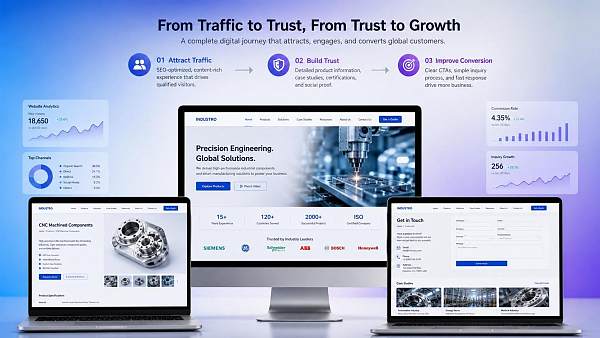
Where should cross-border independent site conversion rate optimization start? Many teams first think of changing the homepage, updating the visuals, or rebuilding the navigation. But what truly affects the result is often not whether it “looks good,” but whether visitors can quickly understand what you offer after they arrive, whether they are willing to trust you, and whether it is easy for them to get in touch.
From real projects, low conversion on independent sites usually does not have complicated causes. It is often due to a mismatch between traffic and the page, insufficient page credibility, or a lead form that is too deep and too long. Even when the front end has been improved a lot, if the back-end data does not improve noticeably, the problem is usually in these three areas.
So, when optimizing the conversion rate of a cross-border independent site, do not start with a full redesign. First prioritize what matters most, and improve the links closest to the final result first. This often saves more budget than a large-scale rebuild and is easier to validate quickly.
Step 1: First check traffic landing, not page style first
Many websites do not have a traffic problem; they have a post-click landing problem. The ad copy promises a customized solution, but the landing page talks about the company vision. Search users want to see product parameters, but the first thing they see on the page is a long brand introduction. This kind of mismatch will directly lower conversion.
In practice, the first thing to do is split the traffic sources. Organic search, ads, social media, and returning customers all have very different needs. Different sources should enter different pages, instead of all being sent to the same homepage.
Prioritize checking these 4 landing points
- Does the title directly respond to the visitor's search intent.
- Does the above-the-fold section clearly explain what you can provide within 5 seconds.
- Does the content match the industry, product category, and usage scenario.
- Does the button clearly point to consultation, quotation, or getting a solution.
If 2 or more of these 4 items fail, do not rush to discuss colors and animations. Because before the user even enters the consideration stage, they have already been lost. Only after solving the “can understand it” problem does cross-border independent site conversion optimization become meaningful.
Step 2: Strengthen page credibility and solve the problem of “not daring to leave an inquiry”
When cross-border customers make judgments online, they are often more cautious than offline. This is especially true in B2B business, where the procurement chain is long, the order value is high, and there are many stakeholders. If page credibility is insufficient, users will not submit an inquiry right away, even if they have a need.
This is also why many companies see clicks and visits after running ads, but still cannot convert. There is traffic, and there is browsing, but customers remain stuck at the final step. A more obvious signal is that dwell time is not short, the form open rate is not low, but the submission rate is still low.
What content should be added first to improve page credibility
- Real factory, team, equipment, and office environment displays.
- Cases, delivery countries, partner brands, and industry experience.
- Certification standards, test reports, delivery terms, and after-sales explanations.
- Complete contact information, with email, phone number, and address clearly visible.
If the website itself also carries overseas lead-generation tasks, then the trust module should be designed more systematically. An integrated solution like B2B Foreign Trade Solutions usually connects multilingual website building, inquiry tracking, ad landing pages, and trust content layout, avoiding a situation where traffic arrives but gets stuck at the page proof stage.
For sites that need to balance speed and experience, page performance also affects trust. For example, slow homepage loading, misaligned mobile layout, or unresponsive form clicks can all make potential customers doubt the company's delivery capability. For overseas visitors, website quality itself is part of the strength.
Step 3: Shorten the inquiry path and do not let customers get stuck at the last step
When cross-border independent site conversion optimization reaches this stage, the next thing to look at is the inquiry path. Many websites do not lack an entry point; they lack a direct one. After viewing the page, customers need to scroll to the bottom, jump to the contact page, and then fill in more than ten fields. The longer this process is, the higher the loss rate.
This is especially true for engineering, manufacturing, and custom-made businesses. Customers may not know all the parameters at the beginning. If the form immediately requires complete specifications, purchase volume, budget, and delivery time, users will often abandon it right away.
More effective inquiry path design
- Place clear buttons on every key page, not just at the bottom.
- Prioritize collecting name, email, and needs, reducing the initial filling cost.
- Support file upload for easy sending of drawings, specifications, and checklists.
- Add instant communication entry points to meet fast consultation needs.
This step may seem simple, but it is often the most effective part of cross-border independent site conversion optimization. Because it directly reduces action cost, allowing people with intent to move from the first step more easily. Let customers leave a lead first, then continue with follow-up communication; this is often more effective than asking everything at once.
Step 4: Use data to prioritize, do not optimize based on gut feeling
The two things that cross-border independent site conversion optimization fears most are, first, a team where everyone has an opinion and whoever speaks loudest gets changed; second, making too many changes at once so that the data changes but you do not know which item actually worked.
A more stable approach is to first establish a simple decision framework. For example, look at bounce rate, above-the-fold dwell time, button click-through rate, form reach rate, and form submission rate, and then decide where to act first. This makes optimization more focused and the review clearer.
It is recommended to watch this small table first
If the site also involves multilingual and multi-region advertising, it is recommended to simultaneously observe performance differences across different country pages. Because conversion issues are not necessarily site-wide issues; often, they are only due to the local expression style of a certain market, form habits, or insufficient localization of trust elements.
Step 5: Turn optimization into a closed loop, do not stop at page revisions
Real effective cross-border independent site conversion optimization does not end after the page is revised. It starts with traffic entry, behavioral tracking, lead collection, sales follow-up, and result review, forming a closed loop. The page is only the front end; the follow-up response also determines the final inquiry quality.
In actual business, if the website speed, content, and forms have all been adjusted, but the sales side does not respond in time, or leads are not classified and managed, the conversion improvement will still be swallowed by the back-end process. This also means that optimization work cannot stay only at the design level.
The reason some mature solutions see results quickly is that they put website building, advertising, SEO, data analysis, and customer follow-up tools into the same system. For example, solutions based on the Google Cloud architecture, support for automatic multilingual switching, and inquiry-conversion-trackable systems are usually more suitable for foreign trade sites that need continuous operation. Capabilities like these are also one of the reasons why B2B Foreign Trade Solutions is often chosen.
From a results-oriented perspective, website performance, tracking capabilities, and back-end operational tools are not add-ons; they are part of conversion efficiency. For example, a Google PageSpeed score above 90+, multilingual translation accuracy of 92.7%, and an average ad click-through rate 40% higher than the industry benchmark all reflect the coordination capability of the entire growth chain.
Conclusion: Improve the three things that affect results most first
Back to the original question, where should cross-border independent site conversion optimization start? The answer is usually not to change the visuals first, but to first check traffic landing, then strengthen page credibility, and finally shorten the inquiry path. Once these three steps are in place, website conversion often shows positive change much faster.
If the current site already has a certain amount of traffic but inquiries still do not pick up, it may be worth conducting a page and path audit first. Review the homepage, product pages, landing pages, and form pages one by one, use data to find problems, and verify results with a small-step fast-run approach. This is more stable and more cost-effective than a one-time major overhaul.
In short, cross-border independent site conversion optimization is not about doing more and more; it is about doing the right thing first, then going deeper. Once the key links are connected and acquisition efficiency and ROI begin to improve, things often start to look different.
Related Articles
 Are you really hitting the right target with Google FB for truck bed exports?
 It's easy to turn a foreign trade website into a piece of art, but it's the ultimate culprit behind your order decline
 Foreign trade website efficiency revolution! Yiyingbao component upgrade + inquiry optimization, inquiries surge!



Related Products
 EasyCamp SaaS Smart Website Marketing SystemE-Yingbao SaaS Smart Website Marketing System: AI-powered, zero-code website building. Rapidly launch multilingual independent e-commerce sites in just 10 minutes. Global server acceleration and AI-driven SEO optimization empower businesses to efficiently connect with global markets. The seamless integration of technology and user-friendly operation makes building e-commerce sites incredibly simple.
 AI+SEM Intelligent Advertising Marketing SystemAI+SEM drives intelligent ad creation, empowering full-funnel precision advertising marketing. The system automatically generates weekly/monthly reports, AI recommends keywords and target countries, monitors core metrics in real-time with intelligent alerts, and enables one-click high-conversion ad solutions to help quickly acquire customers and improve ROI.
 AI+SEO Dual Engine Optimization ServiceEasyWin AI+SEO Dual Engine Optimization System leverages AI-powered keyword mining, content generation, and comprehensive technical optimization to help foreign trade enterprises acquire high-quality organic traffic, significantly improving search rankings and conversion rates.
 AI+SNS Social Media Marketing SystemYingbao AI+SNS Social Media Marketing System - Precision social capture for the social media era. Supports one-click content synchronization across major platforms like Facebook and LinkedIn. AI intelligently rewrites posts for enhanced relevance. 24/7 AI customer service and user profiling analysis empower businesses to efficiently expand into global markets.
 AI+SEO营销解决方案易营宝AI+SEO营销解决方案,通过AI批量写作、智能生成TDK、精准关键词扩词等功能,全面优化网站SEO效果,提升流量与转化率。助力企业构建高效智能网站新生态。
 AI+SEM Advertising Marketing SolutionsAI+SEM Advertising Marketing Solution leverages AI technology to deeply empower SEM ad campaigns. It automatically generates weekly/monthly reports using AI, presenting account data across multiple dimensions for comprehensive insights into campaign performance and trends. The system precisely recommends keywords and target countries, intelligently generates high-conversion ad copy, and enables one-click activation of efficient campaign plans to help businesses rapidly acquire customers. Simultaneously, it monitors core metrics in real time, intelligently identifies abnormal fluctuations, and issues timely alerts to ensure stable, high-return advertising results.
 Domain Name ServicesEasyWin provides professional domain name services, including intelligent queries, one-stop registration, brand protection, and full lifecycle management, helping businesses build a digital brand image.
 EasyOperate B2C Cross-Border E-Commerce Platform & Independent WebsiteEasyStore B2C Cross-border E-commerce Independent Store is an intelligent website building and cross-border e-commerce integrated solution independently developed by EasyStore Information Technology (Beijing) Co., Ltd. The system is specially designed for small and medium-sized as well as large export enterprises, integrating 'website building, operation, marketing, advertising, and conversion' into one, helping enterprises quickly establish cross-border e-commerce independent stores to achieve brand globalization and global sales growth.
The platform supports multiple languages, multiple currencies, and multi-channel marketing, with built-in AI intelligent translation and SEO optimization systems, suitable for mainstream markets such as Southeast Asia, Europe and America, Latin America, and the Middle East, assisting Chinese manufacturing enterprises in efficiently deploying international e-commerce strategies. SSL证书易营宝提供专业SSL安全证书服务,包括单域名和泛域名证书,确保网站数据传输加密、身份验证和完整性保护,助力企业建立安全可信的在线业务环境。









