









- How to Choose the Most Cost-Effective Domain Registration Deals in 2026May 28, 2026View details
- What Growth Challenges Can a Digital Marketing Service Provider SolveMay 28, 2026View details
- Will GEO replace traditional SEOMay 27, 2026View details
- Is SEO Still Necessary in 2026May 27, 2026View details
- Why Shenzhen Global Digital Marketing Services Are Gaining More Attention from Export-Oriented EnterprisesMay 26, 2026View details
- Why International Digital Agencies Place Greater Emphasis on Closed-Loop Data in AdvertisingMay 26, 2026View details
- Which businesses are Guangzhou global digital marketing solutions suitable for?May 26, 2026View details
- Why International Digital Agency Data Analysis Determines Campaign Success or FailureMay 26, 2026View details
Troubleshooting the Reasons for Slow Improvement in Google SEO Rankings
Slow improvement in Google SEO rankings is often not caused by a single issue, but by an imbalance in the coordination of technology, content, and strategy. For integrated website + marketing service projects, stagnant rankings not only affect organic traffic, but also slow down lead conversion, brand exposure, and the efficiency of subsequent advertising campaigns. To achieve steady improvement in Google SEO rankings, the key lies in troubleshooting item by item based on specific scenarios, rather than focusing only on the number of published articles or keyword positions.
1. Why Google SEO ranking improvement is usually the slowest when a website has just gone live or has just been redesigned
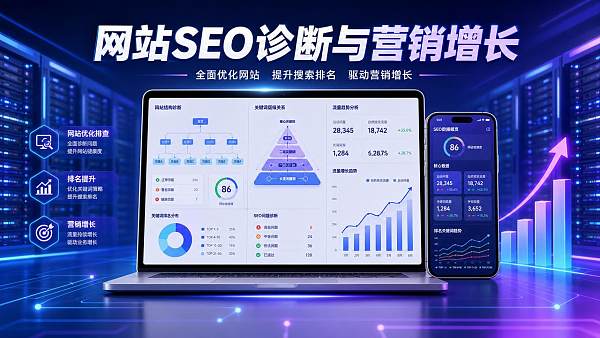
For a new website or a website that has undergone a major redesign, the common issue is not “doing too little,” but insufficient trust from search engines. Google needs to reassess the page structure, topic relationships, crawl paths, and content quality, so there is usually an observation period before Google SEO rankings improve.
If this is accompanied by factors such as a short domain age, a small number of pages, weak internal linking, and a poor backlink foundation, ranking growth will be even slower. This is especially true for service websites, where having too few core pages, too few case studies, and too few scenario pages makes it even more likely that Google SEO ranking improvement will be limited.
Evaluation focus
- Whether a sitemap has been submitted and indexation monitoring has been completed
- Whether there are broken links or redirect errors after the redesign
- Whether only the homepage has content, while category pages and service pages are too thin
- Whether titles, URLs, and page structures are being changed frequently in a short period of time
2. When keyword planning does not match business scenarios, Google SEO ranking improvement will be slowed down
Many websites fail to deliver results over the long term because their keyword strategy is misaligned. For example, they focus only on high-volume keywords, but fail to cover service-intent keywords, local keywords, solution keywords, and question-based keywords. As a result, although the pages target traffic, they do not create real competitive opportunities.
The integrated website + marketing service industry especially requires scenario-based keyword planning. Smart website building, SEO optimization, ad placement, and social media management all face completely different search demands. If multiple services share the same keyword set, Google SEO ranking improvement will naturally become slower.
Typical misconceptions
- Stuffing all core keywords onto the homepage, causing the topic to become fragmented
- Writing only industry news articles while lacking conversion-oriented content
- Service pages are not segmented by scenario, such as foreign trade, education, manufacturing, and cross-border business
- Long-tail keywords do not have dedicated landing pages, making it impossible to match search intent
3. If content is updated continuously but shows no obvious improvement, the page value is mostly not deep enough
More updates do not mean faster Google SEO ranking improvement. If the content remains at the level of generic introductions and lacks actionable recommendations, scenario breakdowns, case information, and structured presentation, search engines will find it difficult to judge the page as highly valuable.
In actual optimization work, service websites should prioritize building pages that “solve problems.” For example, topics such as “ranking drop diagnosis,” “abnormal indexation of independent websites,” and “multilingual website optimization methods” are more likely to drive Google SEO ranking improvement than ordinary industry news.
Some companies also refer to the structural logic of cross-disciplinary materials when planning content. For example, Research on the business-finance integration strategy for full life cycle management of fixed assets in universities, which emphasizes full-process management, offers methodological inspiration: SEO also requires coordination across the entire chain rather than isolated effort at a single point.
High-value content should include
- Clear problem scenarios and applicable conditions
- Step-by-step troubleshooting recommendations
- The corresponding relationship between keywords and page intent
- Case studies, data, tools, or result explanations
4. When the technical foundation is not up to standard, Google SEO ranking improvement is often blocked at indexation and crawling
Technical issues are the most easily underestimated bottleneck. Slow page loading, poor mobile adaptation, duplicate titles, missing canonical tags, and crawling being blocked by mistake will all directly affect Google SEO ranking improvement.
For integrated marketing websites, technical issues also magnify advertising costs. If organic traffic pages provide a poor experience, not only will ranking improvement be slow, but the quality of ad landing pages will also decline, resulting in a double loss.
Common technical troubleshooting checklist
5. Under different business scenarios, the pace of Google SEO ranking improvement is not the same
Even when doing SEO, ranking cycles vary greatly depending on different business goals. If scenario differences are ignored, it is easy to misjudge project progress and even change strategies frequently before the effective period has begun.
Comparison of common scenario differences
6. When backlinks and brand signals are insufficient, Google SEO ranking improvement lacks an accelerator
If the on-site foundation is already in place but Google SEO ranking improvement is still slow, off-site signals should be checked. High-quality backlinks, industry mentions, and growth in branded searches all affect how search engines evaluate a website’s authority.
The focus here is not on building a large number of low-quality backlinks, but on creating verifiable brand content. For example, publishing research-based content, case reviews, industry insights, or building stable citations in partner media usually delivers more lasting results.
Recommended adaptations
- Prioritize acquiring links from relevant industry websites
- Build case studies and knowledge assets around core services
- Increase landing pages for branded search terms
- Keep social media content consistent with the main themes of the official website
7. A common misjudgment: seeing fluctuations in a few keywords and assuming Google SEO ranking improvement has failed
Ranking fluctuations do not mean optimization has failed. Many pages go through a testing period, a reshuffling period, and an intent calibration period. If you make major page changes in a short time just because a few keywords move up and down, you will often interrupt the Google SEO ranking improvement process that was originally taking shape.
Another misjudgment is treating growth in indexation volume as the final result. Indexation is only the beginning. What should really be monitored are target keyword coverage, page click-through rate, dwell quality, and conversion behavior. When necessary, you can also learn from the process-monitoring approach emphasized in works such as Research on the business-finance integration strategy for full life cycle management of fixed assets in universities and manage SEO by breaking it down into phased indicators.
8. If you want to achieve faster Google SEO ranking improvement, how should the next step be implemented
A more efficient approach is to proceed in the order of “technical audit—keyword restructuring—page enhancement—content expansion—backlink building—data review”. This not only reduces ineffective investment, but also makes it easier to identify the core constraint affecting Google SEO ranking improvement.
- First conduct site-wide checks on crawling, indexation, speed, and mobile performance
- Rebuild the keyword map by service type
- Set up dedicated pages for high-value long-tail keywords
- Add case studies, Q&A, solution pages, and regional pages
- Review keyword coverage, click-through rate, and conversion data every month
For websites pursuing long-term growth, Google SEO ranking improvement has never relied on a single tactic, but on the coordinated advancement of the website, content, brand, and marketing. Diagnosing problems within specific scenarios is often more effective than blindly increasing volume, and it is also closer to sustainable growth.
Related Articles



Related Products
 EasyCamp SaaS Smart Website Marketing SystemE-Yingbao SaaS Smart Website Marketing System: AI-powered, zero-code website building. Rapidly launch multilingual independent e-commerce sites in just 10 minutes. Global server acceleration and AI-driven SEO optimization empower businesses to efficiently connect with global markets. The seamless integration of technology and user-friendly operation makes building e-commerce sites incredibly simple.
 AI+SEM Intelligent Advertising Marketing SystemAI+SEM drives intelligent ad creation, empowering full-funnel precision advertising marketing. The system automatically generates weekly/monthly reports, AI recommends keywords and target countries, monitors core metrics in real-time with intelligent alerts, and enables one-click high-conversion ad solutions to help quickly acquire customers and improve ROI.
 AI+SEO Dual Engine Optimization ServiceEasyWin AI+SEO Dual Engine Optimization System leverages AI-powered keyword mining, content generation, and comprehensive technical optimization to help foreign trade enterprises acquire high-quality organic traffic, significantly improving search rankings and conversion rates.
 AI+SNS Social Media Marketing SystemYingbao AI+SNS Social Media Marketing System - Precision social capture for the social media era. Supports one-click content synchronization across major platforms like Facebook and LinkedIn. AI intelligently rewrites posts for enhanced relevance. 24/7 AI customer service and user profiling analysis empower businesses to efficiently expand into global markets.
 AI+SEO营销解决方案易营宝AI+SEO营销解决方案,通过AI批量写作、智能生成TDK、精准关键词扩词等功能,全面优化网站SEO效果,提升流量与转化率。助力企业构建高效智能网站新生态。
 AI+SEM Advertising Marketing SolutionsAI+SEM Advertising Marketing Solution leverages AI technology to deeply empower SEM ad campaigns. It automatically generates weekly/monthly reports using AI, presenting account data across multiple dimensions for comprehensive insights into campaign performance and trends. The system precisely recommends keywords and target countries, intelligently generates high-conversion ad copy, and enables one-click activation of efficient campaign plans to help businesses rapidly acquire customers. Simultaneously, it monitors core metrics in real time, intelligently identifies abnormal fluctuations, and issues timely alerts to ensure stable, high-return advertising results.
 Domain Name ServicesEasyWin provides professional domain name services, including intelligent queries, one-stop registration, brand protection, and full lifecycle management, helping businesses build a digital brand image.
 EasyOperate B2C Cross-Border E-Commerce Platform & Independent WebsiteEasyStore B2C Cross-border E-commerce Independent Store is an intelligent website building and cross-border e-commerce integrated solution independently developed by EasyStore Information Technology (Beijing) Co., Ltd. The system is specially designed for small and medium-sized as well as large export enterprises, integrating 'website building, operation, marketing, advertising, and conversion' into one, helping enterprises quickly establish cross-border e-commerce independent stores to achieve brand globalization and global sales growth.
The platform supports multiple languages, multiple currencies, and multi-channel marketing, with built-in AI intelligent translation and SEO optimization systems, suitable for mainstream markets such as Southeast Asia, Europe and America, Latin America, and the Middle East, assisting Chinese manufacturing enterprises in efficiently deploying international e-commerce strategies. SSL证书易营宝提供专业SSL安全证书服务,包括单域名和泛域名证书,确保网站数据传输加密、身份验证和完整性保护,助力企业建立安全可信的在线业务环境。









