









- What signals are worth paying attention to in a cross-border marketing trend report? B2B companies should look at these 6 signalsJul 11, 2026View details
- How to Read a Cross-Border Marketing Trends Report? Five Key Dimensions for Evaluating Channel OpportunitiesJul 11, 2026View details
- Which channel has the highest ROI in the global traffic ecosystem? Comparative analysis of search, social media, and advertisingJul 10, 2026View details
- What multilingual website services are available in Sanya? Which model is more suitable for local businesses going global?Jul 08, 2026View details
- How to view the complete list of China SaaS companies in the top 100? Practical methods for screening website-building and marketing service providersJul 08, 2026View details
- How to view pricing in the global traffic ecosystem? Cost comparison of search, social media, and content channel advertisingJul 06, 2026View details
- How to assess foreign trade website development trends?Looking at 2026 changes from multilingual,AI content to conversion pathsJul 04, 2026View details
- What are the new trends in multilingual marketing data analytics tools in 2026? Focus on attribution、automation and complianceJul 04, 2026View details
What are the impacts of shortened SSL certificate validity periods
Shorter SSL certificate validity periods are reshaping the foundation of website operations and marketing
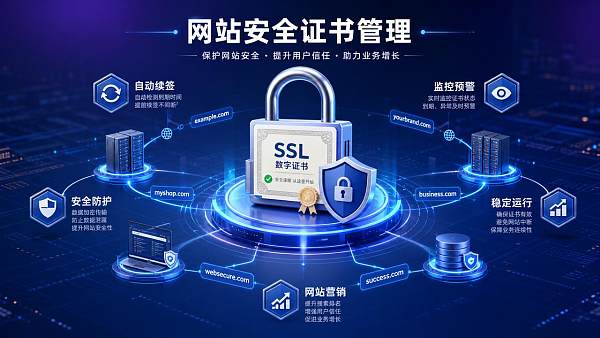
The validity period of SSL certificates continues to shorten, forcing after-sales maintenance personnel to re-examine certificate management, renewal workflows, and website stability. If not addressed in time, this may not only trigger access interruptions, but also affect user trust, search performance, and marketing conversions.
For the website + marketing integrated services industry, SSL certificate validity is no longer just a technical detail, but a core indicator directly related to brand security, lead generation, landing page availability, and global business continuity.
Especially in an environment where intelligent website building, SEO optimization, social media marketing, and advertising placement are advanced in coordination, any single certificate expiration may instantly amplify traffic costs, and may even cause breaks in campaign data and declines in customer trust.
From long-term validity to high-frequency renewals, the signals of industry change are already very clear
In the past, SSL certificates had relatively longer validity periods, and operation and maintenance cycles were also more relaxed. Today, browsers, security standards, and the certificate ecosystem are continuously tightening, and the shortening of SSL certificate validity periods has become a clear trend rather than a short-term adjustment.
This change sends two strong signals. First, website security governance is shifting from “deploy once” to “continuous operations.” Second, the website infrastructure that marketing growth depends on must have automation, monitoring, and early warning capabilities.
For corporate websites, campaign pages, standalone sites, multilingual site clusters, and event landing pages, the shorter the SSL certificate validity period, the higher the risk of manual management, especially in scenarios involving multiple domains, multiple servers, and cross-region deployments.
Why SSL certificate validity periods keep getting shorter
The compression of SSL certificate validity periods is not driven by a single factor, but is the result of the combined effects of security, trust, platform rules, and business models. The following summary makes it easier to judge quickly:
From the trend perspective, the focus of future discussions is no longer whether to adapt to shorter SSL certificate validity periods, but who can earlier incorporate certificate management into standardized operational processes, because whoever does so can reduce interruptions and traffic loss.
After SSL certificate validity periods are shortened, it is not only the technical department that is affected
Many teams mistakenly believe that SSL certificate validity periods only affect server configuration. In fact, they affect search, advertising, conversions, and brand image along the website access chain, making this a typical issue where “infrastructure affects business outcomes.”
Direct impact on website stability
- After a certificate expires, the browser will directly display an insecure warning, and access interruptions will be obvious.
- Interfaces, forms, payment pages, and login pages may malfunction or be blocked.
- If renewal is missed for a multi-domain site cluster, some pages can easily become invalid.
- Manual renewal depends on individual experience, and the risks are higher during holidays and handover periods.
Chain impact on SEO and marketing conversions
- Search engine crawling anomalies may affect page indexing and ranking stability.
- If an ad landing page cannot be opened, the advertising budget will be directly wasted.
- If a social media campaign page shows a security warning, the user bounce rate will rise rapidly.
- If form submission is blocked, the lead generation chain will be interrupted, and sales follow-up efficiency will decline.
In actual projects, the loss caused by a single expired certificate is often not just a few minutes of inaccessibility, but fluctuations in search authority, distorted campaign plans, increased customer doubts, and rising after-sales explanation costs.
Integrated website + marketing services are moving certificate management further upstream
As SSL certificate validity periods shorten, leading service providers no longer treat certificates as one-time deliverables, but instead incorporate them into an integrated system covering website building, SEO, managed operations and maintenance, and data monitoring.
Global digital marketing service providers represented by E-Marketing Easy Information Technology (Beijing) Co., Ltd. are helping enterprises reduce operational fluctuations caused by changes in SSL certificate validity periods through intelligent website building, automated monitoring, renewal reminders, and unified multi-site management.
This approach is consistent with the logic of internal control development. Whether in website asset management or process risk review, it emphasizes early warning, closed-loop management, and clear responsibilities. For relevant research, refer to Research on the Construction of an Internal Control System for Public Institutions Based on Risk Prevention and Control, whose risk identification approach is also instructive for digital asset governance.
What key points enterprises should focus on now
When facing shorter SSL certificate validity periods, what truly matters is not temporary fixes, but establishing a long-term executable management mechanism. The following key points deserve priority review:
- Whether a complete inventory has been established for domains, certificates, servers, and expiration dates.
- Whether automatic renewal capability is in place, along with post-deployment validity verification.
- Whether multi-layer reminders are set, including early warnings at 30 days, 15 days, and 7 days before expiration.
- Whether the official website, event pages, minor-language sites, and subdomains are brought under unified management.
- Whether SSL certificate validity checks are included in SEO inspections and pre-launch campaign checks.
- Whether the person responsible for exception handling, backup plans, and nighttime emergency response workflows are clearly defined.
If an enterprise is advancing multi-channel customer acquisition, the earlier these issues are addressed, the more traffic loss and brand damage caused later by foundational security issues can be avoided.
To respond to changes in SSL certificate validity periods, progress can be made in three stages
If multiple business systems are already running in parallel, certificate checks should also be synchronized for interfaces, content delivery nodes, and third-party integrated services, so as to avoid hidden failures where the main site operates normally but key functions malfunction.
What is more worth doing next is not patching loopholes, but building certificate operations capabilities
Shorter SSL certificate validity periods appear to increase renewal frequency on the surface, but in essence they are driving enterprises to upgrade their website governance methods. In future competition, a stable, secure, and trustworthy website environment will have an increasingly direct impact on marketing efficiency and growth quality.
It is recommended to carry out a full-site certificate inventory as soon as possible, checking whether the official website, campaign pages, subdomains, and advertising landing pages have near-term expiration risks; at the same time, evaluate whether automated renewal, early warning mechanisms, and cross-department collaboration processes are complete.
When SSL certificate validity periods become a normalized management issue, whoever establishes standards, tools, and response mechanisms earlier will be better able to protect these three key growth lines: search performance, advertising conversions, and brand trust.
Related Articles
 What signals are worth paying attention to in a cross-border marketing trend report? B2B companies should look at these 6 signals
 How to Read a Cross-Border Marketing Trends Report? Five Key Dimensions for Evaluating Channel Opportunities
 Which channel has the highest ROI in the global traffic ecosystem? Comparative analysis of search, social media, and advertising



Related Products
 EasyCamp SaaS Smart Website Marketing SystemE-Yingbao SaaS Smart Website Marketing System: AI-powered, zero-code website building. Rapidly launch multilingual independent e-commerce sites in just 10 minutes. Global server acceleration and AI-driven SEO optimization empower businesses to efficiently connect with global markets. The seamless integration of technology and user-friendly operation makes building e-commerce sites incredibly simple.
 AI+SEM Intelligent Advertising Marketing SystemAI+SEM drives intelligent ad creation, empowering full-funnel precision advertising marketing. The system automatically generates weekly/monthly reports, AI recommends keywords and target countries, monitors core metrics in real-time with intelligent alerts, and enables one-click high-conversion ad solutions to help quickly acquire customers and improve ROI.
 AI+SEO Dual Engine Optimization ServiceEasyWin AI+SEO Dual Engine Optimization System leverages AI-powered keyword mining, content generation, and comprehensive technical optimization to help foreign trade enterprises acquire high-quality organic traffic, significantly improving search rankings and conversion rates.
 AI+SNS Social Media Marketing SystemYingbao AI+SNS Social Media Marketing System - Precision social capture for the social media era. Supports one-click content synchronization across major platforms like Facebook and LinkedIn. AI intelligently rewrites posts for enhanced relevance. 24/7 AI customer service and user profiling analysis empower businesses to efficiently expand into global markets.
 AI+SEO营销解决方案易营宝AI+SEO营销解决方案,通过AI批量写作、智能生成TDK、精准关键词扩词等功能,全面优化网站SEO效果,提升流量与转化率。助力企业构建高效智能网站新生态。
 AI+SEM Advertising Marketing SolutionsAI+SEM Advertising Marketing Solution leverages AI technology to deeply empower SEM ad campaigns. It automatically generates weekly/monthly reports using AI, presenting account data across multiple dimensions for comprehensive insights into campaign performance and trends. The system precisely recommends keywords and target countries, intelligently generates high-conversion ad copy, and enables one-click activation of efficient campaign plans to help businesses rapidly acquire customers. Simultaneously, it monitors core metrics in real time, intelligently identifies abnormal fluctuations, and issues timely alerts to ensure stable, high-return advertising results.
 Domain Name ServicesEasyWin provides professional domain name services, including intelligent queries, one-stop registration, brand protection, and full lifecycle management, helping businesses build a digital brand image.
 EasyOperate B2C Cross-Border E-Commerce Platform & Independent WebsiteEasyStore B2C Cross-border E-commerce Independent Store is an intelligent website building and cross-border e-commerce integrated solution independently developed by EasyStore Information Technology (Beijing) Co., Ltd. The system is specially designed for small and medium-sized as well as large export enterprises, integrating 'website building, operation, marketing, advertising, and conversion' into one, helping enterprises quickly establish cross-border e-commerce independent stores to achieve brand globalization and global sales growth.
The platform supports multiple languages, multiple currencies, and multi-channel marketing, with built-in AI intelligent translation and SEO optimization systems, suitable for mainstream markets such as Southeast Asia, Europe and America, Latin America, and the Middle East, assisting Chinese manufacturing enterprises in efficiently deploying international e-commerce strategies. SSL证书易营宝提供专业SSL安全证书服务,包括单域名和泛域名证书,确保网站数据传输加密、身份验证和完整性保护,助力企业建立安全可信的在线业务环境。









