









- What multilingual website services are available in Sanya? Which model is more suitable for local businesses going global?Jul 08, 2026View details
- How to view the complete list of China SaaS companies in the top 100? Practical methods for screening website-building and marketing service providersJul 08, 2026View details
- How to view pricing in the global traffic ecosystem? Cost comparison of search, social media, and content channel advertisingJul 06, 2026View details
- How to assess foreign trade website development trends?Looking at 2026 changes from multilingual,AI content to conversion pathsJul 04, 2026View details
- What are the new trends in multilingual marketing data analytics tools in 2026? Focus on attribution、automation and complianceJul 04, 2026View details
- Is Brand Globalization Marketing Consulting Worth Buying? At What Stage Should Companies Bring It InJul 01, 2026View details
- Cross-Border Marketing Trend Research: Why More and More Companies Are Starting to Deploy AI Search and GEO OptimizationJun 30, 2026View details
- Cross-Border Marketing Trend Research: How Independent Sites, AI Content, and Short-Video Customer Acquisition Are ChangingJun 30, 2026View details
What preparations should be made before an SSL certificate expires?
When an SSL certificate is close to expiration, website stability, search trust, and marketing conversion often come under pressure at the same time. For integrated website + marketing service businesses, the certificate not only affects browser security warnings, but is also related to form submissions, ad landing page access, search engine crawling, and brand reputation. Therefore, before the SSL certificate validity period enters its final stage, it is necessary to inventory assets in advance, confirm domain status, plan the renewal window, and complete testing and rollback plans to avoid business interruption and traffic loss caused by certificate expiration.
The basic meaning and management scope of SSL certificate validity period
The SSL certificate validity period refers to the usable time interval from certificate issuance to expiration. After it expires, the browser will display an insecure connection warning, API requests may fail, and user trust in the website will also decline rapidly.
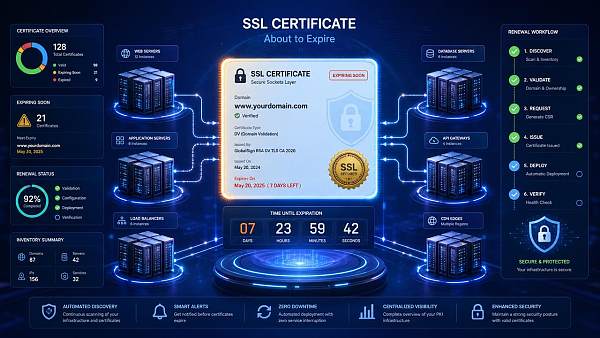
In corporate website operations, the SSL certificate validity period is not just a technical parameter. It is directly related to multiple scenarios such as the official website, campaign pages, member center, payment pages, API services, and subdomain site clusters, and its impact is even greater during marketing promotion periods.
If the SSL certificate validity period is ignored, common consequences include ad pages failing to open, lead forms being unable to submit, search engine access being blocked, the brand official website being marked as a risky page, and abnormal partner API calls.
Therefore, establishing a normalized management mechanism around the SSL certificate validity period has become a foundational action in website security, SEO optimization, and digital marketing operations, rather than a temporary remedial task.
Key areas of focus on SSL certificate validity period in industry scenarios
In integrated website + marketing service scenarios, the reason the SSL certificate validity period receives continuous attention is that both frontend access experience and backend service continuity depend on certificate status. The following signals deserve priority inspection:
- Whether the official website, topic pages, and campaign pages share the same certificate
- Whether there are parallel deployments across multiple clouds, multiple servers, and multiple sites
- Whether domain resolution, CDN, and load balancing are all associated with the certificate at the same time
- Whether the certificate needs to be synchronized to the API gateway or cache layer after renewal
- Whether the SEO crawling entry point will encounter access abnormalities due to certificate expiration
For enterprises that rely on traffic growth, inadequate management of the SSL certificate validity period is not only a security issue, but may also lead to wasted advertising budgets and broken conversion paths.
Key inspection signal checklist
Preparations that need to be completed before the SSL certificate validity period expires
Regarding the SSL certificate validity period, it is recommended to start preparations at least 15 days to 30 days in advance. If multiple sites or cross-regional nodes are involved, the timeline should be moved even further forward.
First, organize the certificate asset inventory
First confirm which domains, subdomains, servers, CDN nodes, and API services are using this certificate. The inventory should include the issuing authority, expiration time, deployment location, person in charge, and replacement sequence.
Second, verify domains and renewal conditions
Check whether the domain is still managed under the current entity, whether DNS resolution is operable, and whether the domain email, verification records, and administrative permissions are complete. This step will directly affect whether the SSL certificate can be renewed smoothly before its validity period expires.
Third, confirm the deployment environment and compatibility requirements
Different servers, containers, gateways, and cloud platforms have different certificate format requirements. It is necessary to confirm in advance whether formats such as PEM and PFX match, and check whether the private key, certificate chain, and automated renewal scripts are functioning properly.
Fourth, define the switch window and rollback plan
Certificate replacement should be scheduled during off-peak hours whenever possible, and a backup of the old certificate configuration should be retained. If the new certificate chain is abnormal, node synchronization fails, or the cache is not refreshed, a quick rollback can be performed to ensure business continuity.
Fifth, complete end-to-end testing before and after go-live
Testing should not only check whether the browser displays the padlock icon, but should also verify whether redirects, APIs, payments, forms, tracking tags, ad tracking parameters, and mobile access are functioning properly.
The practical value of SSL certificate validity period management for websites and marketing business
From a business outcome perspective, stable management of the SSL certificate validity period can simultaneously improve security credibility, search performance, and marketing conversion efficiency. This value is especially evident in brand globalization, paid acquisition, and multi-site operations.
- Reduce website errors and ensure stable organic traffic entry points
- Lower user bounce rates and improve form submissions and inquiry conversions
- Ensure continuous accessibility of ad landing pages and reduce budget waste
- Strengthen brand trust and avoid the reputational damage caused by “insecure website” warnings
- Support unified governance of websites across multiple regions and multiple business lines
For service providers like Yiyingbao Information Technology (Beijing) Co., Ltd., which combine capabilities in intelligent website building, SEO optimization, social media marketing, and advertising placement, the SSL certificate validity period is usually incorporated into site operations and growth systems during project delivery to ensure that the technical foundation does not undermine marketing results.
When advancing digital governance internally, enterprises can also extend process management thinking to finance, approval, and asset management. If you want to further understand directions for management upgrades, you may refer to A Preliminary Exploration of Enterprise Intelligent Financial Transformation, which can help build a more systematic operational collaboration framework.
Common application scenarios and preparation priorities
Different website types do not share the same preparation priorities for SSL certificate validity period management. They can be distinguished according to the following scenarios:
Implementation notes and follow-up actions in execution
To avoid SSL certificate validity period management becoming a mere formality, several details should also be noted during execution. First, set up a multi-layer reminder mechanism rather than relying only on a single email notification. Second, immediately verify whether each node has taken effect after renewal. Third, keep operation records for auditing and review.
If there are many websites, it is recommended to include the SSL certificate validity period in a unified monitoring platform and connect it with website building, SEO, and campaign page maintenance workflows. This can reduce manual omissions and is also more suitable for continuously growing businesses.
The ultimate goal is not a one-time successful renewal, but the formation of a long-term executable certificate governance mechanism. Only by establishing a closed loop of inventory, alerts, testing, replacement, and review around the SSL certificate validity period can website security, search performance, and marketing funnel stability truly be ensured, laying a reliable foundation for subsequent business expansion.
Related Articles
 What multilingual website services are available in Sanya? Which model is more suitable for local businesses going global?
 How to view the complete list of China SaaS companies in the top 100? Practical methods for screening website-building and marketing service providers
 There are so many used heavy-duty construction machines for foreign trade. How exactly should we acquire customers?



Related Products
 EasyCamp SaaS Smart Website Marketing SystemE-Yingbao SaaS Smart Website Marketing System: AI-powered, zero-code website building. Rapidly launch multilingual independent e-commerce sites in just 10 minutes. Global server acceleration and AI-driven SEO optimization empower businesses to efficiently connect with global markets. The seamless integration of technology and user-friendly operation makes building e-commerce sites incredibly simple.
 AI+SEM Intelligent Advertising Marketing SystemAI+SEM drives intelligent ad creation, empowering full-funnel precision advertising marketing. The system automatically generates weekly/monthly reports, AI recommends keywords and target countries, monitors core metrics in real-time with intelligent alerts, and enables one-click high-conversion ad solutions to help quickly acquire customers and improve ROI.
 AI+SEO Dual Engine Optimization ServiceEasyWin AI+SEO Dual Engine Optimization System leverages AI-powered keyword mining, content generation, and comprehensive technical optimization to help foreign trade enterprises acquire high-quality organic traffic, significantly improving search rankings and conversion rates.
 AI+SNS Social Media Marketing SystemYingbao AI+SNS Social Media Marketing System - Precision social capture for the social media era. Supports one-click content synchronization across major platforms like Facebook and LinkedIn. AI intelligently rewrites posts for enhanced relevance. 24/7 AI customer service and user profiling analysis empower businesses to efficiently expand into global markets.
 AI+SEO营销解决方案易营宝AI+SEO营销解决方案,通过AI批量写作、智能生成TDK、精准关键词扩词等功能,全面优化网站SEO效果,提升流量与转化率。助力企业构建高效智能网站新生态。
 AI+SEM Advertising Marketing SolutionsAI+SEM Advertising Marketing Solution leverages AI technology to deeply empower SEM ad campaigns. It automatically generates weekly/monthly reports using AI, presenting account data across multiple dimensions for comprehensive insights into campaign performance and trends. The system precisely recommends keywords and target countries, intelligently generates high-conversion ad copy, and enables one-click activation of efficient campaign plans to help businesses rapidly acquire customers. Simultaneously, it monitors core metrics in real time, intelligently identifies abnormal fluctuations, and issues timely alerts to ensure stable, high-return advertising results.
 Domain Name ServicesEasyWin provides professional domain name services, including intelligent queries, one-stop registration, brand protection, and full lifecycle management, helping businesses build a digital brand image.
 EasyOperate B2C Cross-Border E-Commerce Platform & Independent WebsiteEasyStore B2C Cross-border E-commerce Independent Store is an intelligent website building and cross-border e-commerce integrated solution independently developed by EasyStore Information Technology (Beijing) Co., Ltd. The system is specially designed for small and medium-sized as well as large export enterprises, integrating 'website building, operation, marketing, advertising, and conversion' into one, helping enterprises quickly establish cross-border e-commerce independent stores to achieve brand globalization and global sales growth.
The platform supports multiple languages, multiple currencies, and multi-channel marketing, with built-in AI intelligent translation and SEO optimization systems, suitable for mainstream markets such as Southeast Asia, Europe and America, Latin America, and the Middle East, assisting Chinese manufacturing enterprises in efficiently deploying international e-commerce strategies. SSL证书易营宝提供专业SSL安全证书服务,包括单域名和泛域名证书,确保网站数据传输加密、身份验证和完整性保护,助力企业建立安全可信的在线业务环境。









