









- What Does a Global Traffic Ecosystem Service Provider Do? What Are the Differences from a Single Advertising AgencyJul 16, 2026View details
- What should you focus on in the latest enterprise SaaS report? From renewal rates and delivery costs to overseas growth opportunitiesJul 12, 2026View details
- What signals are worth paying attention to in a cross-border marketing trend report? B2B companies should look at these 6 signalsJul 11, 2026View details
- How to Read a Cross-Border Marketing Trends Report? Five Key Dimensions for Evaluating Channel OpportunitiesJul 11, 2026View details
- Which channel has the highest ROI in the global traffic ecosystem? Comparative analysis of search, social media, and advertisingJul 10, 2026View details
- What multilingual website services are available in Sanya? Which model is more suitable for local businesses going global?Jul 08, 2026View details
- How to view the complete list of China SaaS companies in the top 100? Practical methods for screening website-building and marketing service providersJul 08, 2026View details
- How to view pricing in the global traffic ecosystem? Cost comparison of search, social media, and content channel advertisingJul 06, 2026View details
What Materials Need to Be Prepared for the SSL Certificate Application Process
Many companies assume that applying for an SSL certificate only requires “buying a certificate and uploading it,” but when it comes to actual execution, the most common bottleneck is not installation, but incomplete preparation of materials in the early stage: unclear domain ownership, missing business verification documents, non-standard contact email addresses, and mismatched server environments. For corporate websites, an SSL certificate not only affects whether the browser displays the “security lock,” but also directly relates to user trust, form submission security, search engine crawling experience, as well as subsequent SEO and marketing conversion performance.
If you are evaluating the SSL certificate application process, the most practical rule of thumb to remember first is this: whether the application materials are complicated mainly depends on whether you are applying for a DV, OV, or EV certificate; but regardless of which type, these three categories of materials must be prepared in advance: domain control, authentic entity information, and technical deployment conditions. This article will start from the perspective that searchers care about most, sorting out what materials enterprises need to prepare before applying for an SSL certificate, what additional materials are required for different certificate types, what common sticking points exist, and how to incorporate SSL deployment into the process of building a marketing-oriented website to avoid repeated rework.
First, clarify this: what core materials are actually needed for an SSL certificate application
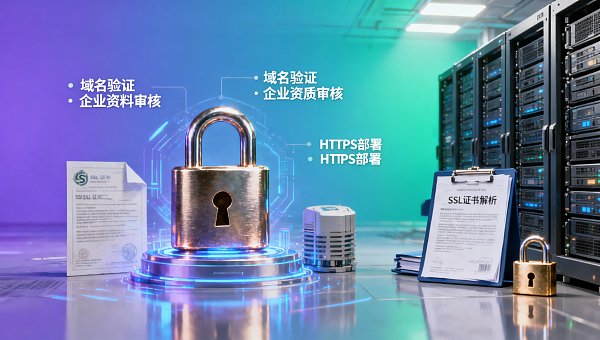
From a practical perspective, SSL certificate application materials can be divided into 3 major categories: domain materials, enterprise/personal identity materials, and technical deployment materials.
1. Domain-related materials
- The domain itself: it must be a registered domain that can be resolved normally.
- Domain management permissions: the applicant needs to be able to operate DNS resolution, or be able to receive verification emails sent to the domain administrator mailbox.
- WHOIS/registration information must be verifiable: in some scenarios, the domain registration information must be complete and authentic.
- List of domains to be protected: clarify whether it is a single domain, both www and non-www domains, multiple domains, or a wildcard certificate.
2. Entity identity materials
Different certificate types have different requirements, but the following information is generally needed:
- Company name: must match the business license.
- Business license or unified social credit code information: usually required for OV and EV certificates.
- Company office address and contact phone number: used for verification by the certificate authority.
- Authorized contact information: including name, position, email, and phone number.
- Explanation of the relationship between the applicant entity and domain usage: if the domain holder and the company name are inconsistent, supplementary proof may be required.
3. Technical deployment materials
- CSR file: that is, the certificate signing request file, usually generated by the server.
- Private key: generated together with the CSR and must be properly kept by the enterprise.
- Server environment information: such as Nginx, Apache, IIS, Tomcat, etc.
- Website deployment permissions: you need to be able to upload the certificate, modify the configuration, and restart the service.
- HTTPS redirection and compatibility modification plan: ensure that after deployment, webpages, images, JS, and CSS will not trigger mixed content warnings.
For most corporate websites, what truly needs to be collected in advance is not just the “business license,” but confirmation of who manages the domain, who can complete the verification, which server the certificate will be installed on, and who will maintain and renew it afterward. The earlier these issues are clarified, the smoother the application and go-live process will be.
How much do the required materials differ for different types of SSL certificates
Before applying, choosing the right certificate type is more important for enterprises than repeatedly supplementing materials later. Common SSL certificates are divided into three types: DV, OV, and EV:
DV certificate: suitable for basic encryption, with the fewest materials required
DV (Domain Validation) mainly verifies whether you have control over the domain. Common required materials include:
- Verifiable domain
- DNS resolution operation permission or administrator mailbox
- CSR file
This type of certificate is quick to apply for and is suitable for personal websites, test sites, and content display pages. However, if your website involves brand presentation, form submission, business cooperation, and marketing conversion, DV alone is usually not enough to reflect corporate credibility.
OV certificate: suitable for corporate websites, balancing security and trust
OV (Organization Validation), in addition to domain verification, also verifies that the enterprise truly exists, so it usually requires:
- Business license
- Company name, registered address, and phone number
- Contact information
- Domain control verification materials
- CSR file
For most corporate websites, brand sites, and marketing-oriented websites, an OV certificate is the more common and more balanced choice.
EV certificate: suitable for high-trust scenarios, with stricter review
EV (Extended Validation) has higher requirements in both material preparation and review depth, and usually also involves:
- Proof of legal business registration
- Proof of normal operating status
- Publicly searchable company phone number
- Signed authorization documents
- Stricter verification of contacts and application authorization
If a corporate website involves finance, customer data collection, large transactions, cross-border business, or strong brand endorsement needs, EV is more valuable, but the application cycle is usually longer as well.
What enterprises most easily overlook is not the application materials, but the “verification conditions”
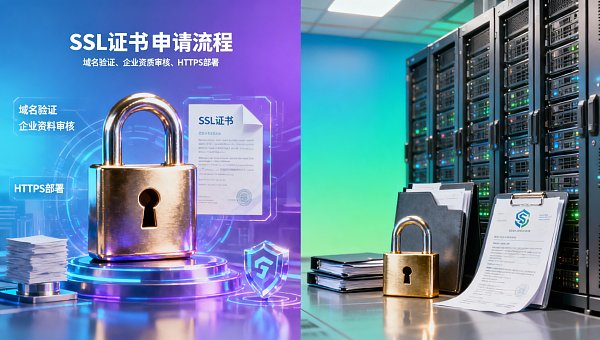
Many failed or delayed applications are not because the business license was not submitted, but because the verification chain was not fully connected. The following issues are the most common:
1. Domain verification email cannot receive messages
Some CA institutions send verification emails to standard mailboxes such as admin@, administrator@, and hostmaster@. If the enterprise has not configured these mailboxes, or if the mail system blocks the verification email, the process will be delayed.
2. DNS permissions are not in the hands of the internal team
The domain may be managed by an agent, a previous service provider, or another department. During the application, TXT records cannot be added or resolution cannot be modified in time, resulting in incomplete verification.
3. The domain entity does not match the business license entity
For example, the domain is registered under an individual’s name, but the website is actually used for company business; or the relationships among the parent company, subsidiary, and brand company are complex. In such cases, additional authorization statements or proof of entity relationship may be required.
4. CSR generation errors
If the domain name in the CSR is filled in incorrectly, or if the encryption algorithm and key length do not meet the requirements, the certificate may still not be usable directly after issuance.
5. The server installation environment was not confirmed in advance
Passing the certificate application is only the first step. Actual go-live also depends on whether the server supports a complete certificate chain configuration, whether port 443 is open, and whether redirection capability is available.
Therefore, from a project management perspective, the most worthwhile thing to do before applying for SSL is not to submit immediately, but to first conduct a “verification conditions checklist.” This is especially critical for technical evaluators and after-sales maintenance teams.
A more enterprise-friendly checklist of materials for SSL certificate applications
If you want to reduce communication costs, you can prepare directly according to the following checklist:
Basic essentials
- A complete list of domain names requiring certificate application
- Domain management backend login permissions or DNS operation permissions
- Server type and deployment environment information
- CSR file
- Contact details of the person responsible for certificate installation
Recommended advance preparation for OV/EV applications
- Scanned copy or clear photo of the business license
- Chinese and English company names (if international business is involved)
- Company registered address and office address
- Company landline number
- Name, position, email, and mobile number of the authorized contact
- If necessary, company authorization letter
Recommended confirmation before deployment
- Whether HTTPS is enabled across the entire site
- Whether HTTP is set to automatically redirect to HTTPS
- Whether mixed content issues in images, scripts, and API links have been checked
- Whether the sitemap, canonical, and resource reference paths have been updated
- Whether the HTTPS version of the site has been submitted in search engine management tools
If the enterprise itself is carrying out a website upgrade, brand website revamp, or global marketing layout, the SSL certificate should not be handled in isolation, but should be planned together with website architecture, SEO standards, form security, and content asset migration. Especially for manufacturing, environmental protection, packaging, and industrial corporate websites, the site must not only showcase brand strength, but also support inquiry conversion. For example, some industry websites that emphasize visual professionalism and lead conversion adopt a single-column information architecture, waterfall-style solution presentation, online appointment forms, and fully responsive design, considering security deployment and user experience simultaneously. Similar to digital website solution thinking such as Papermaking, Packaging, Environmental Protection, the essence is also to advance “credible presentation, clear content, and stable conversion” within the same project framework.
Why SSL certificates are not only a security issue, but also affect SEO and marketing performance
What many business managers care about is: is it worth preparing these materials? The answer is yes, and the impact goes beyond the technical level.
1. Improve user trust
When a website enables HTTPS, the browser no longer displays “Not Secure,” and users feel more at ease when submitting forms, viewing product pages, and sending inquiries. For visitors encountering the brand for the first time, this is a basic threshold of trust.
2. Beneficial for search engine crawling and website standardization
HTTPS has already become a basic configuration for modern websites. Although SSL is not the only factor determining rankings, it has a positive effect on search engine friendliness, page standard management, and redirect consistency.
3. Reduce risks for marketing landing pages
If advertising campaigns, social media promotions, SEO content pages, and campaign landing pages are not deployed with HTTPS, it can easily affect user dwell time and conversion, and some platforms even restrict insecure pages.
4. Facilitate future expansion of membership, forms, payments, and other functions
If the website will connect in the future to online customer service, appointment systems, CRM lead collection, API interfaces, or login modules, then SSL is a foundational capability, not an optional item.
From a long-term operations perspective, an SSL certificate is the shared foundation of website compliance, security, brand credibility, and marketing efficiency. The earlier an enterprise standardizes deployment, the lower the subsequent costs.
How to determine which certificate type you should choose before applying, and how to avoid detours
If you have not yet determined the certificate type, you can quickly judge it as follows:
- Only basic encryption, limited budget, simple website: you may consider a DV certificate.
- Corporate website, brand presentation, mainly focused on inquiry conversion: give priority to an OV certificate.
- High trust, high compliance, finance, or important customer scenarios: evaluate an EV certificate.
- Many subdomains: consider a wildcard certificate or a multi-domain certificate.
At the same time, it is recommended to complete the following actions before applying:
- Organize all domains and subdomains that need to enable HTTPS;
- Confirm who holds the permissions for domains, servers, and mailboxes;
- Verify whether the enterprise entity information is consistent with the actual usage scenario;
- Generate the correct CSR first, then submit the application;
- Include installation, redirection, SEO checks, and renewal reminders in the same process.
For enterprises hoping to use their official website to undertake brand presentation and customer acquisition conversion, the website is not something that is “finished once it goes live,” but a continuously operated asset. Whether in industrial manufacturing, environmental services, or packaging, the website’s security foundation and presentation efficiency should be planned together. If the enterprise is promoting a more systematic digital portal construction, it may also refer to design directions like Papermaking, Packaging, Environmental Protection that balance brand image, industry solution presentation, and mobile consultation experience, so that SSL, content structure, and conversion paths are all handled correctly together.
Summary: the key to preparing for an SSL certificate application is not “how many materials there are,” but “whether the preparation is correct”
Returning to the title question, what materials need to be prepared for the SSL certificate application process? The core can be summarized into three categories: domain control materials, enterprise entity materials, and technical deployment materials. If applying for DV, the focus is on domain verification; if applying for OV or EV, you also need to prepare the business license, contact information, and more complete enterprise verification materials.
However, from the perspective of actual enterprise operations, what truly determines efficiency is not the surface-level materials, but whether you have confirmed in advance the domain permissions, verification methods, server environment, and subsequent HTTPS transformation plan. If prepared properly, an SSL application can proceed very smoothly; if preparation is incomplete, repeated rework often occurs during the verification, installation, and SEO transition stages.
Therefore, the most prudent approach is to regard SSL certificate application as a fundamental part of the website construction and operation system, rather than a temporary technical task. Only in this way can it meet security requirements while also laying a more solid foundation for search optimization, user trust, and business conversion.
Related Articles
 What exactly should be the focus of a foreign trade website?!!!
 Attention! Builders' must-see: Yibingbao AI components updated, design efficiency directly doubled!
 China's foreign trade sees a turnaround: imports surge by 22%! Foreign trade professionals should quickly take note of the new trends in the second half of the year

Related Products
 EasyCamp SaaS Smart Website Marketing SystemE-Yingbao SaaS Smart Website Marketing System: AI-powered, zero-code website building. Rapidly launch multilingual independent e-commerce sites in just 10 minutes. Global server acceleration and AI-driven SEO optimization empower businesses to efficiently connect with global markets. The seamless integration of technology and user-friendly operation makes building e-commerce sites incredibly simple.
 AI+SEM Intelligent Advertising Marketing SystemAI+SEM drives intelligent ad creation, empowering full-funnel precision advertising marketing. The system automatically generates weekly/monthly reports, AI recommends keywords and target countries, monitors core metrics in real-time with intelligent alerts, and enables one-click high-conversion ad solutions to help quickly acquire customers and improve ROI.
 AI+SEO Dual Engine Optimization ServiceEasyWin AI+SEO Dual Engine Optimization System leverages AI-powered keyword mining, content generation, and comprehensive technical optimization to help foreign trade enterprises acquire high-quality organic traffic, significantly improving search rankings and conversion rates.
 AI+SNS Social Media Marketing SystemYingbao AI+SNS Social Media Marketing System - Precision social capture for the social media era. Supports one-click content synchronization across major platforms like Facebook and LinkedIn. AI intelligently rewrites posts for enhanced relevance. 24/7 AI customer service and user profiling analysis empower businesses to efficiently expand into global markets.
 AI+SEO营销解决方案易营宝AI+SEO营销解决方案,通过AI批量写作、智能生成TDK、精准关键词扩词等功能,全面优化网站SEO效果,提升流量与转化率。助力企业构建高效智能网站新生态。
 AI+SEM Advertising Marketing SolutionsAI+SEM Advertising Marketing Solution leverages AI technology to deeply empower SEM ad campaigns. It automatically generates weekly/monthly reports using AI, presenting account data across multiple dimensions for comprehensive insights into campaign performance and trends. The system precisely recommends keywords and target countries, intelligently generates high-conversion ad copy, and enables one-click activation of efficient campaign plans to help businesses rapidly acquire customers. Simultaneously, it monitors core metrics in real time, intelligently identifies abnormal fluctuations, and issues timely alerts to ensure stable, high-return advertising results.
 Domain Name ServicesEasyWin provides professional domain name services, including intelligent queries, one-stop registration, brand protection, and full lifecycle management, helping businesses build a digital brand image.
 EasyOperate B2C Cross-Border E-Commerce Platform & Independent WebsiteEasyStore B2C Cross-border E-commerce Independent Store is an intelligent website building and cross-border e-commerce integrated solution independently developed by EasyStore Information Technology (Beijing) Co., Ltd. The system is specially designed for small and medium-sized as well as large export enterprises, integrating 'website building, operation, marketing, advertising, and conversion' into one, helping enterprises quickly establish cross-border e-commerce independent stores to achieve brand globalization and global sales growth.
The platform supports multiple languages, multiple currencies, and multi-channel marketing, with built-in AI intelligent translation and SEO optimization systems, suitable for mainstream markets such as Southeast Asia, Europe and America, Latin America, and the Middle East, assisting Chinese manufacturing enterprises in efficiently deploying international e-commerce strategies. SSL证书易营宝提供专业SSL安全证书服务,包括单域名和泛域名证书,确保网站数据传输加密、身份验证和完整性保护,助力企业建立安全可信的在线业务环境。









