









- How to view pricing in the global traffic ecosystem? Cost comparison of search, social media, and content channel advertisingJul 06, 2026View details
- How to assess foreign trade website development trends?Looking at 2026 changes from multilingual,AI content to conversion pathsJul 04, 2026View details
- What are the new trends in multilingual marketing data analytics tools in 2026? Focus on attribution、automation and complianceJul 04, 2026View details
- Is Brand Globalization Marketing Consulting Worth Buying? At What Stage Should Companies Bring It InJul 01, 2026View details
- Cross-Border Marketing Trend Research: Why More and More Companies Are Starting to Deploy AI Search and GEO OptimizationJun 30, 2026View details
- Cross-Border Marketing Trend Research: How Independent Sites, AI Content, and Short-Video Customer Acquisition Are ChangingJun 30, 2026View details
- How Can a Brand Updates Page Be Made More SEO-Friendly? Analysis of Update Frequency, Content Structure, and Internal Linking StrategyJun 28, 2026View details
- What stages does the cross-border services ecosystem include? How do website building, promotion, payment, and compliance work togetherJun 22, 2026View details
Why Does Learning Meta Advertising Techniques Make Scaling Harder and Harder
After learning a lot of Meta advertising techniques, many people instead find it increasingly difficult to scale. The problem often does not lie in the operation itself, but in the imbalance of coordination among audience, creatives, data, and strategy. This article will break down the reasons and solutions from a practical perspective.
For companies researching advertising solutions, the real challenge is not “knowing how to build an ad set,” but understanding why the same budget, the same product, and even the same creative framework can produce results that differ by 2 to 5 times in different teams’ hands. Especially in an integrated website + marketing service scenario, Meta advertising techniques must be optimized in sync with landing pages, data feedback, content systems, and conversion paths in order to achieve stable scaling.
Easymarketing Information Technology (Beijing) Co., Ltd. has long served enterprises with global growth needs, providing full-funnel solutions centered on intelligent website building, SEO optimization, social media marketing, and advertising. For decision-makers in the information research stage, what is truly worth focusing on is not isolated tactics, but the systematic capability from account structure to conversion assets.
Why the more Meta advertising techniques you learn, the harder it becomes to scale
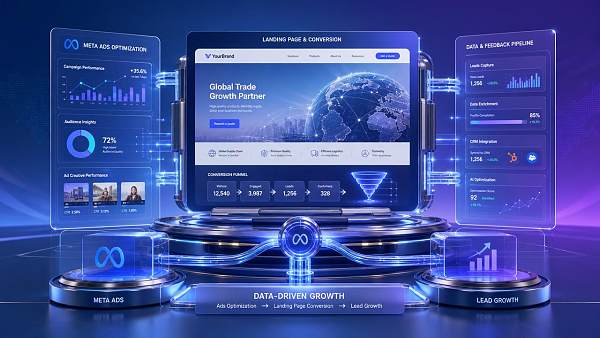
Many media buyers make rapid progress in the first 30 days, but begin to hit a bottleneck in the 2nd month. The reason is usually not that the platform has become more difficult, but that understanding starts to fragment: they have learned many techniques, but have not established priorities. If Meta advertising techniques are detached from business goals, situations can easily arise where click-through rates are high but inquiries are few, add-to-carts are many but transactions are low, or costs decrease in the short term but volume cannot be sustained.
1. The audience becomes increasingly “broad,” but intent becomes increasingly weak
Many teams mistakenly believe that scaling means continuously expanding interest packs, age groups, and regions. In reality, once the cold-start phase ends, every 20% to 30% increase in audience expansion may be accompanied by a simultaneous decline in intent density. Without new creative angles and new conversion landing pages, even broader traffic is difficult to turn into effective leads.
Typical signs
- CTR remains at 1.5% to 2.5%, but the form submission rate is below 3%
- CPM increases by 10% to 40%, while conversion costs rise in parallel
- After the share of new audiences increases, retargeting performance within 7 days becomes significantly worse
2. The quantity of creatives is increasing, but the quality of creatives is not upgrading
One of the most commonly misunderstood points in Meta advertising techniques is equating “uploading more creatives” with “continuous testing.” If 10 creatives only differ in color, copy order, or the first 3-second cover, then the platform is still learning the same expression logic. What truly creates a gap is often the reconstruction of value proposition structure, scenario presentation, trust evidence, and action guidance.
For B2B companies, creatives should at least include 3 directions: pain-point education, solution explanation, and case-study endorsement. It is recommended to keep 4 to 6 variations for each type, forming at least 12 rotatable assets. Otherwise, when frequency exceeds 5, user fatigue will accelerate significantly, making scaling more difficult.
3. Incomplete data feedback means the algorithm “cannot understand” your customers
For many companies, difficulty in scaling is not because the ads lack exposure, but because the quality of website-side data is insufficient. Metrics such as page dwell time, key button clicks, form completion, WhatsApp inquiry initiation, and CRM feedback on deal stages—if only the final step is recorded, the platform will have too few optimization signals. For accounts with fewer than 20 daily conversions, data gaps will magnify model bias.
This is where the value of integrated website and marketing services lies: website building, tracking, advertising, remarketing, and sales follow-up must all work together. Otherwise, no matter how many Meta advertising techniques you learn, you are only optimizing surface-level actions rather than the conversion chain itself.
The table below can be used to quickly identify the common root causes of “learning a lot but still failing to scale,” and is suitable for companies to check item by item during campaign reviews.
From this table, it can be seen that the difficulty of Meta advertising techniques is no longer just about ad manager settings, but about the coordination of front-end traffic, mid-funnel content, and back-end data. If companies focus only on bidding and audiences, they can easily miss the key variables that truly affect scaling.
If you want stable scaling, first break the advertising chain into 4 key modules
In practice, a more effective method is not to keep piling up fragmented techniques, but to place Meta advertising techniques within a complete growth chain. An account that can scale sustainably usually needs to meet at least 4 conditions at the same time: audiences can be tested, creatives can be iterated, pages can convert, and data can be fed back.
1. Audience module: segment first, then scale
It is recommended to divide audiences into at least 3 layers: cold-start new customer layer, engagement remarketing layer, and on-site high-intent layer. Budget allocation can start with an initial test ratio of 50%, 30%, and 20%, and then be adjusted based on 7-day data. The advantage of doing this is that it preserves room for exploration while preventing high-value audiences from being diluted by low-quality traffic.
2. Creative module: not more, but structured
Creative testing is recommended to follow a “3×3” method, meaning 3 core appeals multiplied by 3 expression formats. For example, efficiency improvement, lower customer acquisition cost, and overseas growth can correspond to short videos, carousel images, and single-image explanations. Each testing cycle should be controlled within 5 to 7 days to avoid drawing conclusions too frequently within 24 hours and mistakenly eliminating high-potential creatives.
3. Page module: ads are responsible for attraction, websites are responsible for conversion
In an integrated website + marketing service scenario, a landing page is not simply a display page, but a conversion device. Within 5 seconds, the first screen should clearly explain the target audience, core benefits, basis for credibility, and the next action. If the page requires more than 3 layers of navigation, or if there is no clear CTA on the first screen, the conversion rate is usually significantly reduced.
Some companies, when organizing internal training materials, draw on methodological frameworks from different industries, such as Discussion on Human Resource Management Optimization Strategies for Dispatch Offices in the New Era, which emphasizes organizational collaboration and process optimization. Although the industries differ, for advertising teams, role collaboration, process clarity, and unified execution standards also directly affect advertising scaling efficiency.
4. Data module: at minimum, achieve three-stage feedback of “front, middle, and back”
The front stage is visits and clicks, the middle stage is forms and inquiries, and the back stage is sales follow-up and deal labels. If a company can steadily feed back more than 30 high-quality events per week, platform optimization is usually more stable. For B2B business, looking only at the number of forms is not enough; it is also necessary to distinguish among 3 levels: invalid inquiries, follow-up-worthy leads, and valid business opportunities.
The table below is suitable for companies to use when screening service providers or building their own teams, in order to determine whether a set of Meta advertising techniques truly has implementation capability.
If a team can only talk about advertising actions but cannot answer questions about page conversion, sales handoff, and data attribution, then the so-called Meta advertising techniques are most likely only partial experience and are difficult to support sustainable business growth.
The 3 most common misconceptions companies face in practice
Even with a sufficient budget, companies may still repeatedly make mistakes because the method is wrong. Especially when cross-border customer acquisition, brand promotion, and lead generation are carried out in parallel, wrong actions are often rapidly amplified within 2 weeks.
Misconception 1: Overreliance on a single winning creative
Strong early performance of one creative does not mean it can support long-term scaling. When the budget is increased to 2 or 3 times the original amount, frequency, audience overlap, and creative fatigue will appear simultaneously. The correct approach is to retain the winning creative while preparing at least 2 new versions with the same selling point but different expressions to take over.
Misconception 2: Looking only at ad data, not at on-site behavior
CTR, CPC, and CPM can only indicate the attractiveness of the ad itself; they cannot directly prove business effectiveness. For B2B websites, more critical data includes the proportion of page visits lasting more than 30 seconds, button click heat zones, form abandonment rate, and inquiry initiation rate. These metrics are often more helpful than simply lowering click costs when judging scaling potential.
Misconception 3: Treating scaling as simply increasing the budget
When an account still does not have a stable creative set and conversion page, increasing the budget by 20% may not be a major issue, but a one-time increase of 50% or even 100% often disrupts the learning rhythm. A safer approach is phased scaling—for example, observing once every 48 hours, then increasing gradually by 15% to 25%, while simultaneously checking whether lead quality is declining.
A more suitable execution checklist for companies
- First clarify 1 core conversion goal, and do not ask the same ad to pursue exposure, engagement, and lead capture at the same time.
- Hold 1 review meeting every week and check at least 6 data points: CTR, CPC, CPM, CVR, valid lead rate, and sales feedback.
- Update the creative pool every 7 to 10 days, and review the landing page conversion path every 14 days.
- Review CRM data every month to determine whether the leads brought by ads have truly entered the business opportunity stage.
If companies hope to truly turn Meta advertising techniques into a growth capability, they cannot just pursue “knowing how to run ads”; they must establish an operating mechanism that can “continuously validate, continuously optimize, and continuously scale.” This is also why integrated services are more valuable than isolated ad placement services.
How to choose the advertising support solution that suits you better
For companies in the information research stage, the first step in choosing a solution is to determine which category they belong to: starting from zero, already advertising but experiencing unstable performance, or expanding across regions. At different stages, the key reliance on Meta advertising techniques is not the same.
Companies starting from zero
It is recommended to first complete the website foundation, tracking system, and the first batch of creative assets. The budget does not necessarily need to be large, but the structure must be complete. The goal of the first 2 to 4 weeks should be to establish the minimum viable closed loop, rather than rushing to pursue large-scale volume.
Companies with unstable performance
The focus should be on checking creative fatigue, page handoff, and the quality of feedback events. Many accounts do not lack techniques; they lack a consistent review methodology. When necessary, execution efficiency can be improved by streamlining team processes, for example by referring to the role division and collaboration perspective emphasized in Discussion on Human Resource Management Optimization Strategies for Dispatch Offices in the New Era, and linking creatives, advertising, websites, and sales feedback together.
Companies expanding across regions
These companies need localized content, language adaptation, and multi-site coordination even more. Especially in different national markets, users show clear differences in preferred proof formats, CTA expressions, and form tolerance. If a single page and unified creatives are still used, conversion rates can easily fluctuate by more than 30%.
When Meta advertising techniques are placed back into the complete business process, they are no longer the isolated experience of a single role, but the result of the joint effect of websites, content, data, and sales. For companies seeking stable customer acquisition and improved overseas growth efficiency, what is more worth focusing on is an integrated solution that is executable, reviewable, and scalable.
Relying on many years of digital marketing service experience, Easymarketing Information Technology (Beijing) Co., Ltd. can connect website building, SEO, social media, and advertising to help companies reduce trial-and-error cycles and improve lead quality and advertising efficiency. If you are evaluating the direction of Meta advertising, or hope to optimize the performance of your existing account, feel free to contact us now to obtain a customized solution better suited to your current business stage and learn more about our solutions.
Related Articles



Related Products
 EasyCamp SaaS Smart Website Marketing SystemE-Yingbao SaaS Smart Website Marketing System: AI-powered, zero-code website building. Rapidly launch multilingual independent e-commerce sites in just 10 minutes. Global server acceleration and AI-driven SEO optimization empower businesses to efficiently connect with global markets. The seamless integration of technology and user-friendly operation makes building e-commerce sites incredibly simple.
 AI+SEM Intelligent Advertising Marketing SystemAI+SEM drives intelligent ad creation, empowering full-funnel precision advertising marketing. The system automatically generates weekly/monthly reports, AI recommends keywords and target countries, monitors core metrics in real-time with intelligent alerts, and enables one-click high-conversion ad solutions to help quickly acquire customers and improve ROI.
 AI+SEO Dual Engine Optimization ServiceEasyWin AI+SEO Dual Engine Optimization System leverages AI-powered keyword mining, content generation, and comprehensive technical optimization to help foreign trade enterprises acquire high-quality organic traffic, significantly improving search rankings and conversion rates.
 AI+SNS Social Media Marketing SystemYingbao AI+SNS Social Media Marketing System - Precision social capture for the social media era. Supports one-click content synchronization across major platforms like Facebook and LinkedIn. AI intelligently rewrites posts for enhanced relevance. 24/7 AI customer service and user profiling analysis empower businesses to efficiently expand into global markets.
 AI+SEO营销解决方案易营宝AI+SEO营销解决方案,通过AI批量写作、智能生成TDK、精准关键词扩词等功能,全面优化网站SEO效果,提升流量与转化率。助力企业构建高效智能网站新生态。
 AI+SEM Advertising Marketing SolutionsAI+SEM Advertising Marketing Solution leverages AI technology to deeply empower SEM ad campaigns. It automatically generates weekly/monthly reports using AI, presenting account data across multiple dimensions for comprehensive insights into campaign performance and trends. The system precisely recommends keywords and target countries, intelligently generates high-conversion ad copy, and enables one-click activation of efficient campaign plans to help businesses rapidly acquire customers. Simultaneously, it monitors core metrics in real time, intelligently identifies abnormal fluctuations, and issues timely alerts to ensure stable, high-return advertising results.
 Domain Name ServicesEasyWin provides professional domain name services, including intelligent queries, one-stop registration, brand protection, and full lifecycle management, helping businesses build a digital brand image.
 EasyOperate B2C Cross-Border E-Commerce Platform & Independent WebsiteEasyStore B2C Cross-border E-commerce Independent Store is an intelligent website building and cross-border e-commerce integrated solution independently developed by EasyStore Information Technology (Beijing) Co., Ltd. The system is specially designed for small and medium-sized as well as large export enterprises, integrating 'website building, operation, marketing, advertising, and conversion' into one, helping enterprises quickly establish cross-border e-commerce independent stores to achieve brand globalization and global sales growth.
The platform supports multiple languages, multiple currencies, and multi-channel marketing, with built-in AI intelligent translation and SEO optimization systems, suitable for mainstream markets such as Southeast Asia, Europe and America, Latin America, and the Middle East, assisting Chinese manufacturing enterprises in efficiently deploying international e-commerce strategies. SSL证书易营宝提供专业SSL安全证书服务,包括单域名和泛域名证书,确保网站数据传输加密、身份验证和完整性保护,助力企业建立安全可信的在线业务环境。









