









- How to view pricing in the global traffic ecosystem? Cost comparison of search, social media, and content channel advertisingJul 06, 2026View details
- How to assess foreign trade website development trends?Looking at 2026 changes from multilingual,AI content to conversion pathsJul 04, 2026View details
- What are the new trends in multilingual marketing data analytics tools in 2026? Focus on attribution、automation and complianceJul 04, 2026View details
- Is Brand Globalization Marketing Consulting Worth Buying? At What Stage Should Companies Bring It InJul 01, 2026View details
- Cross-Border Marketing Trend Research: Why More and More Companies Are Starting to Deploy AI Search and GEO OptimizationJun 30, 2026View details
- Cross-Border Marketing Trend Research: How Independent Sites, AI Content, and Short-Video Customer Acquisition Are ChangingJun 30, 2026View details
- How Can a Brand Updates Page Be Made More SEO-Friendly? Analysis of Update Frequency, Content Structure, and Internal Linking StrategyJun 28, 2026View details
- What stages does the cross-border services ecosystem include? How do website building, promotion, payment, and compliance work togetherJun 22, 2026View details
Which Signals to Identify Before Adjusting Your Social Media Marketing Strategy
Before adjusting your social media marketing strategy, first look at key signals such as traffic fluctuations, engagement quality, conversion costs, and user feedback. Only by identifying the source of the problem can you avoid making blind changes and make optimization more precise and efficient.
Why a social media marketing strategy should not be changed the moment data drops
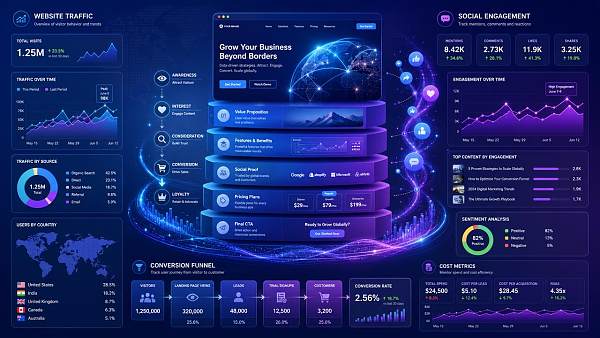
Many operators rush to change content direction, ad settings, or posting times as soon as they see declining views or slower follower growth. But in most cases, changes in data do not necessarily mean the strategy has failed.
When users search for “social media marketing strategy,” their core intent is often not to hear concepts, but to know: when adjustments should be made, what they should be based on, and how to avoid making pointless changes or even making things worse.
For execution teams, the biggest concern is not poor data itself, but not knowing where the problem lies. Traffic, engagement, conversions, comment feedback, and platform rules often need to be viewed together in order to make an effective judgment.
Therefore, what is truly worth doing first is not changing the plan immediately, but identifying the signals. Only after confirming whether the issue is with content, channels, ad placement, or the landing page can subsequent optimization stay on track.
First, look at traffic fluctuations: determine whether it is a short-term anomaly or a sustained decline
Traffic is the metric most easily noticed, but it is also the one most easily misread. A one-day drop or one underperforming piece of content often does not directly mean the current social media marketing strategy must be rebuilt.
A more valuable approach is to look at trend cycles. It is recommended to pull at least 7-day, 30-day, or even 90-day data to compare the changes in organic traffic, recommended traffic, paid traffic, and search traffic.
If only individual content performs poorly, the issue may lie in the topic selection or creative assets. If multiple accounts and multiple content formats decline at the same time, it is more likely related to the platform distribution mechanism, industry popularity, or strategy structure.
You should also pay attention to whether traffic sources are overly concentrated. If you rely on recommendations from one platform for a long time, once the algorithm preference changes, overall performance can quickly become unbalanced. At this point, the focus of adjustment should be the traffic structure, rather than blindly rewriting copy.
Then look at engagement quality: buzz does not equal effectiveness, and low engagement does not necessarily mean failure
Many teams treat likes, comments, and shares as the only reference, but the real meaning of engagement data lies in judging whether the content resonates with the target audience, not simply in looking at the size of the numbers.
If there are many likes, but most comments are meaningless emojis, giveaway participation, or generic praise, it indicates that the content may only be “attention-grabbing,” but may not necessarily help with inquiries, lead capture, or transactions. This kind of popularity is not always worth replicating.
On the other hand, some content may not have high engagement volume, but if the comments section contains a large number of specific questions, product comparisons, purchasing needs, and discussions of use cases, it often indicates that the content is high-quality and has even stronger commercial value.
So before adjusting your social media marketing strategy, you should first determine whether what you lack is exposure or high-quality engagement. If the goal is customer acquisition, prioritizing metrics such as “effective comment rate” and “direct message inquiry rate” will be closer to business results.
Whether conversion costs are rising determines whether you should optimize content or rebuild ad placement
For operators responsible for execution, one of the most critical signals is conversion cost. If traffic increases but conversions do not, or inquiries increase but closed deals worsen, it indicates that the problem may not necessarily be at the front end of the platform.
It is recommended to break social media operations into a complete chain: content reach, click-through, page browsing, form submission, customer service handoff, and sales conversion. The clearer the chain is, the easier it is to identify which stage is causing the loss.
For example, if the ad click-through rate is normal but post-click dwell time is very short, the problem may be that the landing page content does not match. If the form submission rate is good but follow-up conversions are weak, the issue may be lead quality or insufficient sales follow-up efficiency.
This is also why social media operations cannot focus only on the platform backend. When foreign trade companies acquire overseas customers, social media content and independent site conversion must work together; otherwise, even a strong ad budget may be wasted on inefficient pages.
If a company hopes to shorten the path from content exposure to conversion handoff, it can optimize website building and the SEO system together. For example, Yiyingbao SaaS Intelligent Website Building Marketing System supports the rapid creation of multilingual independent foreign trade websites, making it more suitable for scenarios that require global traffic conversion.
The “hidden signals” in user feedback often appear earlier than backend numbers
Many strategic issues already appear in user feedback before backend data shows an obvious decline. For example, comments such as “I can’t understand it,” “This feels too much like an ad,” or “The differences were not explained clearly” are clear signals of content deviation.
There are also some more subtle forms of feedback worth paying attention to. For example, if direct messages repeatedly ask the same question, it indicates that your content communication is incomplete; if saves are high but shares are low, it may indicate that the content is useful but not shareable enough.
If users frequently ask about pricing, delivery cycles, case authenticity, or after-sales details, it shows they have entered the decision-making stage. At this point, the strategic focus should shift from brand exposure to trust building and conversion promotion.
Execution teams can build a simple feedback tag library, such as “pricing concerns,” “product not understood,” “unclear needs,” and “competitor comparison,” and review it once a week. This can better guide follow-up topic selection and creative optimization than looking at page views alone.
Do not ignore platform changes: sometimes it is not that you did it wrong, but that the environment changed
One important reason why social media marketing strategies need regular calibration is that platform rules are constantly changing. Content distribution logic, ad review standards, trending formats, and user retention habits may all change suddenly.
For example, if a platform begins to favor short videos, native engagement, or continuous update mechanisms, but you still execute according to the old rhythm of image-and-text posts, traffic will naturally be affected. If you only revise the copy at this time, it often will not solve the root problem.
To judge platform changes, you can see whether peer accounts in the same category are fluctuating at the same time, and you can also compare data differences across different content formats. If short videos are growing while image-and-text posts are generally declining, that indicates structural adjustment is more important than optimizing a single post.
Operators should also record the timing of platform actions, such as feature redesigns, changes in traffic entry points, and tighter ad rules. Incorporating these external variables into review analysis can help avoid mistaking environmental issues for team execution problems.
Under what circumstances should you make minor changes, and under what circumstances must you restructure the strategy
If the problem appears only in a certain type of content, a certain time period, or a certain channel, it is usually suitable to make localized optimizations, such as adjusting headline structure, creative format, posting time, or audience targeting, without completely overturning the original plan.
But if you have already experienced declining organic traffic, lower engagement quality, rising conversion costs, and continuously worsening user feedback over multiple cycles, then this is not a problem that can be solved with minor fixes.
At this time, the social media marketing strategy needs to be restructured, including redefining target audiences, content matrix, channel combinations, advertising rhythm, and on-site and off-site conversion methods, so as to avoid continuing to waste resources on low-efficiency paths.
Especially for teams that simultaneously operate social media, SEO, and independent websites, strategy restructuring should place even greater emphasis on coordination. Social media is responsible for reach and interest generation, the website is responsible for conversion handoff, and search optimization is responsible for amplifying long-term customer acquisition capabilities.
For example, when planning overseas business expansion, tools with AI website building, multilingual translation, global server acceleration, and intelligent SEO capabilities can significantly improve the conversion efficiency of social media traffic and reduce the problem of “bringing users in but failing to retain them.”
A troubleshooting checklist you can directly apply before making adjustments
First, look at the data cycle: is it a one-time fluctuation, or a continuous decline. Second, look at traffic sources: is one entry point failing, or is overall exposure decreasing. Third, look at engagement quality: is the buzz high but without conversion, or is engagement low but precise.
Fourth, look at the conversion chain: at which step are clicks, dwell time, inquiries, and transactions dropping. Fifth, look at user feedback: what exactly are they complaining about, what do they care about, and what are they repeatedly asking about. Sixth, look at whether the platform has undergone obvious changes.
Seventh, look at whether the landing page matches the social media content. If the content talks about value, but the landing page only piles up specifications, users will quickly leave. For companies that need international marketing, this step is especially critical.
If you find that the problem is not with the front-end content, but with website loading speed, multilingual experience, or page conversion capability, it means subsequent adjustments should not remain only at the social media level, but should be optimized from the perspective of the entire chain.
In this case, platforms like Yiyingbao SaaS Intelligent Website Building Marketing System, which balance website building, global access, localization, and SEO conversion capabilities, can help execution teams more quickly complete the closed loop from traffic to conversion.
Summary: identify signals first, then adjust strategy, so as to avoid ineffective optimization
Adjustments to a social media marketing strategy should not rely on intuition, nor should the entire plan be overturned because of one or two instances of abnormal data. The truly efficient approach is to first identify these five categories of signals: traffic, engagement, conversion, feedback, and platform changes.
For operators, the most important thing is not to “change quickly,” but to “change accurately.” Only by first determining whether the problem comes from content, channels, ad placement, or the landing page can the subsequent actions be more effortless and more likely to produce results.
If you are facing data fluctuations, you may wish to first review each item according to the troubleshooting logic in this article. Find the cause first, then make adjustments; this is the more reliable path to keeping your social media marketing strategy growing steadily over the long term.
Related Articles



Related Products
 EasyCamp SaaS Smart Website Marketing SystemE-Yingbao SaaS Smart Website Marketing System: AI-powered, zero-code website building. Rapidly launch multilingual independent e-commerce sites in just 10 minutes. Global server acceleration and AI-driven SEO optimization empower businesses to efficiently connect with global markets. The seamless integration of technology and user-friendly operation makes building e-commerce sites incredibly simple.
 AI+SEM Intelligent Advertising Marketing SystemAI+SEM drives intelligent ad creation, empowering full-funnel precision advertising marketing. The system automatically generates weekly/monthly reports, AI recommends keywords and target countries, monitors core metrics in real-time with intelligent alerts, and enables one-click high-conversion ad solutions to help quickly acquire customers and improve ROI.
 AI+SEO Dual Engine Optimization ServiceEasyWin AI+SEO Dual Engine Optimization System leverages AI-powered keyword mining, content generation, and comprehensive technical optimization to help foreign trade enterprises acquire high-quality organic traffic, significantly improving search rankings and conversion rates.
 AI+SNS Social Media Marketing SystemYingbao AI+SNS Social Media Marketing System - Precision social capture for the social media era. Supports one-click content synchronization across major platforms like Facebook and LinkedIn. AI intelligently rewrites posts for enhanced relevance. 24/7 AI customer service and user profiling analysis empower businesses to efficiently expand into global markets.
 AI+SEO营销解决方案易营宝AI+SEO营销解决方案,通过AI批量写作、智能生成TDK、精准关键词扩词等功能,全面优化网站SEO效果,提升流量与转化率。助力企业构建高效智能网站新生态。
 AI+SEM Advertising Marketing SolutionsAI+SEM Advertising Marketing Solution leverages AI technology to deeply empower SEM ad campaigns. It automatically generates weekly/monthly reports using AI, presenting account data across multiple dimensions for comprehensive insights into campaign performance and trends. The system precisely recommends keywords and target countries, intelligently generates high-conversion ad copy, and enables one-click activation of efficient campaign plans to help businesses rapidly acquire customers. Simultaneously, it monitors core metrics in real time, intelligently identifies abnormal fluctuations, and issues timely alerts to ensure stable, high-return advertising results.
 Domain Name ServicesEasyWin provides professional domain name services, including intelligent queries, one-stop registration, brand protection, and full lifecycle management, helping businesses build a digital brand image.
 EasyOperate B2C Cross-Border E-Commerce Platform & Independent WebsiteEasyStore B2C Cross-border E-commerce Independent Store is an intelligent website building and cross-border e-commerce integrated solution independently developed by EasyStore Information Technology (Beijing) Co., Ltd. The system is specially designed for small and medium-sized as well as large export enterprises, integrating 'website building, operation, marketing, advertising, and conversion' into one, helping enterprises quickly establish cross-border e-commerce independent stores to achieve brand globalization and global sales growth.
The platform supports multiple languages, multiple currencies, and multi-channel marketing, with built-in AI intelligent translation and SEO optimization systems, suitable for mainstream markets such as Southeast Asia, Europe and America, Latin America, and the Middle East, assisting Chinese manufacturing enterprises in efficiently deploying international e-commerce strategies. SSL证书易营宝提供专业SSL安全证书服务,包括单域名和泛域名证书,确保网站数据传输加密、身份验证和完整性保护,助力企业建立安全可信的在线业务环境。









