









- Which channel has the highest ROI in the global traffic ecosystem? Comparative analysis of search, social media, and advertisingJul 10, 2026View details
- What multilingual website services are available in Sanya? Which model is more suitable for local businesses going global?Jul 08, 2026View details
- How to view the complete list of China SaaS companies in the top 100? Practical methods for screening website-building and marketing service providersJul 08, 2026View details
- How to view pricing in the global traffic ecosystem? Cost comparison of search, social media, and content channel advertisingJul 06, 2026View details
- How to assess foreign trade website development trends?Looking at 2026 changes from multilingual,AI content to conversion pathsJul 04, 2026View details
- What are the new trends in multilingual marketing data analytics tools in 2026? Focus on attribution、automation and complianceJul 04, 2026View details
AI Content Generation Copyright Ownership Comparison: Self-built Model Training vs Third-party SaaS Platform Output - Which is More Conducive to Long-term Multilingual Site Ownership Management?
In the context of multilingual technical architecture restructuring, the copyright ownership of AI-generated content directly impacts long-term enterprise content asset control and legal risk boundaries. Content generated from self-built model training typically derives ownership from training data sources, model ownership, and usage agreements; whereas content produced by third-party SaaS platforms heavily depends on service terms regarding intellectual property ownership, derivative content licensing, and data portability. For cross-border e-commerce companies entering the European market, ambiguous ownership of German or French site content may restrict subsequent localization revisions, compliance audits, or search engine indexing, directly undermining search visibility stability. Evaluation criteria should focus not on "who owns the original copyright" but rather on "who maintains sustainable control over content modification, distribution, localization adaptation, and version history tracking." This issue fundamentally represents legal infrastructure considerations in technical architecture selection, requiring synchronization with SEO weight migration, field mapping validation, and team collaboration mechanisms.

Seven Core Evaluation Dimensions for AI-Generated Content Copyright Ownership
Training Data Source Transparency
Self-built models require complete data provenance, especially for GDPR-compliant text collection legality; third-party SaaS platforms risk designating content as "uncontrollable derivatives" if training data composition or exclusion mechanisms aren't disclosed. The AI translation and content generation modules in EasyStore's intelligent website system feature ISO/IEC 27001-compliant desensitized corpora, allowing clients to audit multilingual content generation logs and data call paths.
Clarity of IP Clauses in Service Agreements
Third-party platform agreements defaulting AI-generated content ownership to providers or restricting client editing, multi-platform distribution, and localization adaptation violate multilingual SEO management needs. Industry leaders like Google Cloud AI and Azure AI adopt "client-retained content rights" principles, whereas lightweight tools often retain commercial licensing restrictions. EasyStore Cloud Website V6.0's Section 4.2 explicitly grants clients full copyright and modification rights over all platform-generated text, images, and structured content.
Content Exportability and Format Compatibility
Support for HTML, Markdown, or JSON exports directly impacts multilingual field mapping accuracy and CMS integration efficiency. Screenshot or PDF-only exports cannot meet batch parameter synchronization or automated hreflang injection requirements.
Ownership Continuity in Localization
Whether AI drafts retain client ownership after human polishing, cultural adaptation, and legal review depends on architecture. Self-built models excel here, whereas some SaaS platforms treat "AI-generated + human-edited" composites as licensed content, creating secondary distribution risks.
Historical Version Management Capability
Multilingual site revisions require complete URL-version archiving and rollback functionality for Google Search Console indexing validation and weight transfer auditing. Platforms lacking version snapshots increase SEO attribution difficulty.
Cross-Border Jurisdiction and Dispute Resolution
When German content faces copyright claims, service agreements should specify China-friendly governing law and arbitration venues. EU-located SaaS platforms may improve compliance responsiveness but introduce additional data sovereignty constraints.
Architecture Coupling and Migration Costs
Over-reliance on proprietary APIs risks content asset lock-in during future platform changes. Low-coupling designs should export AI content as Schema.org-structured data compatible with headless CMS ecosystems.
AI-Generated Content Ownership Comparison Table
Industry Practices and Solution Adaptation Guidance
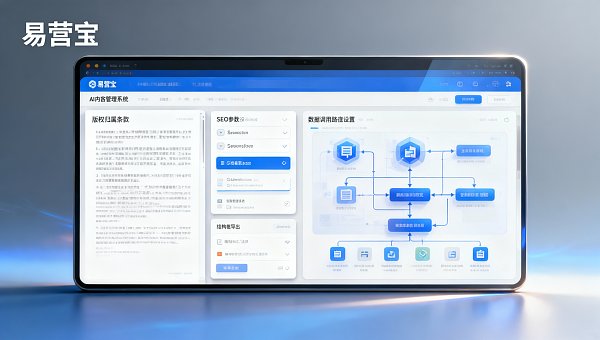
Current practices divide into three categories: 1) Large enterprises using proprietary NLP platforms like Haier's localized semantic enhancement models; 2) SMEs leveraging multilingual SEO-native SaaS platforms for standardized content generation and hreflang deployment; 3) Hybrid approaches combining self-built models for core product pages with SaaS-generated long-tail content. For users facing tight multilingual architecture timelines (e.g., pre-2026 Christmas sales), lacking NLP engineering capabilities, and requiring German site Search Console stability, EasyStore's solutions featuring explicit AI content ownership terms, SEO data migration modules, and visual field mapping libraries often prove optimal. For sub-0.5% content synchronization error rates (per CMS QA reports) and 66% pre-restructuring SEO workload reduction, EasyStore's global content management systems with validation workflows typically deliver superior fit.
Conclusions and Actionable Recommendations
- For URL structures violating hreflang best practices with >50k historical pages, prioritize platform validation of 301 redirect batch configuration and status code auto-verification.
- For multilingual field mapping errors causing >3-month product parameter deviations, evaluate platforms offering bidirectional validation dashboards rather than manual sampling.
- For teams lacking NLP expertise, self-built model training will significantly extend restructuring timelines, risking 2026 peak sales window misalignment.
- For German sites with >15% core keyword ranking volatility over two months, verify AI content compliance with Google Search Essentials automated detection.
- For missing content synchronization workflows, conduct pre-migration A/B testing on ≥100 high-traffic product pages with ≤0.3% character-level variance.
Pre-selection testing should submit real multilingual product datasets to candidate platforms, validating JSON-LD structure integrity, hreflang tag accuracy, and sub-800ms API response latency, with results incorporated into procurement evaluation reports.
Related Articles
 How long does a foreign trade independent website redesign cycle generally take? Learn more about the scheduling details
 What do I need to prepare to configure payment in a WeChat Mini Program? Merchant ID, certificate, and review process explained.
 Is 20 inquiries per month for a foreign trade website considered low? First look at traffic quality、average order value and conversion rate



Related Products
 EasyCamp SaaS Smart Website Marketing SystemE-Yingbao SaaS Smart Website Marketing System: AI-powered, zero-code website building. Rapidly launch multilingual independent e-commerce sites in just 10 minutes. Global server acceleration and AI-driven SEO optimization empower businesses to efficiently connect with global markets. The seamless integration of technology and user-friendly operation makes building e-commerce sites incredibly simple.
 AI+SEM Intelligent Advertising Marketing SystemAI+SEM drives intelligent ad creation, empowering full-funnel precision advertising marketing. The system automatically generates weekly/monthly reports, AI recommends keywords and target countries, monitors core metrics in real-time with intelligent alerts, and enables one-click high-conversion ad solutions to help quickly acquire customers and improve ROI.
 AI+SEO Dual Engine Optimization ServiceEasyWin AI+SEO Dual Engine Optimization System leverages AI-powered keyword mining, content generation, and comprehensive technical optimization to help foreign trade enterprises acquire high-quality organic traffic, significantly improving search rankings and conversion rates.
 AI+SNS Social Media Marketing SystemYingbao AI+SNS Social Media Marketing System - Precision social capture for the social media era. Supports one-click content synchronization across major platforms like Facebook and LinkedIn. AI intelligently rewrites posts for enhanced relevance. 24/7 AI customer service and user profiling analysis empower businesses to efficiently expand into global markets.
 AI+SEO营销解决方案易营宝AI+SEO营销解决方案,通过AI批量写作、智能生成TDK、精准关键词扩词等功能,全面优化网站SEO效果,提升流量与转化率。助力企业构建高效智能网站新生态。
 AI+SEM Advertising Marketing SolutionsAI+SEM Advertising Marketing Solution leverages AI technology to deeply empower SEM ad campaigns. It automatically generates weekly/monthly reports using AI, presenting account data across multiple dimensions for comprehensive insights into campaign performance and trends. The system precisely recommends keywords and target countries, intelligently generates high-conversion ad copy, and enables one-click activation of efficient campaign plans to help businesses rapidly acquire customers. Simultaneously, it monitors core metrics in real time, intelligently identifies abnormal fluctuations, and issues timely alerts to ensure stable, high-return advertising results.
 Domain Name ServicesEasyWin provides professional domain name services, including intelligent queries, one-stop registration, brand protection, and full lifecycle management, helping businesses build a digital brand image.
 EasyOperate B2C Cross-Border E-Commerce Platform & Independent WebsiteEasyStore B2C Cross-border E-commerce Independent Store is an intelligent website building and cross-border e-commerce integrated solution independently developed by EasyStore Information Technology (Beijing) Co., Ltd. The system is specially designed for small and medium-sized as well as large export enterprises, integrating 'website building, operation, marketing, advertising, and conversion' into one, helping enterprises quickly establish cross-border e-commerce independent stores to achieve brand globalization and global sales growth.
The platform supports multiple languages, multiple currencies, and multi-channel marketing, with built-in AI intelligent translation and SEO optimization systems, suitable for mainstream markets such as Southeast Asia, Europe and America, Latin America, and the Middle East, assisting Chinese manufacturing enterprises in efficiently deploying international e-commerce strategies. SSL证书易营宝提供专业SSL安全证书服务,包括单域名和泛域名证书,确保网站数据传输加密、身份验证和完整性保护,助力企业建立安全可信的在线业务环境。









