









- The China-US tariff arrangement has reached a preliminary consensus, and the trade association will be establishedJun 15, 2026View details
- China-Morocco zero-tariff access, a breakthrough in the cost of Moroccan goods exports to ChinaJun 11, 2026View details
- What signal should be released for the suspension of exports to JapanJun 10, 2026View details
- China's May LNG imports rebounded, with increased volumes from Russia and Canada filling the Middle East supply gapJun 10, 2026View details
- Will GEO change its SEO strategy?Jun 04, 2026View details
- What types of businesses are end-to-end solutions suitable for?Jun 03, 2026View details
Why does machine translation quality meet standards but still have a high bounce rate of over 45% among local users during the AI Multilingual Website System customization process? The 2 underlying reasons: cultural symbols and interaction habits are missing.
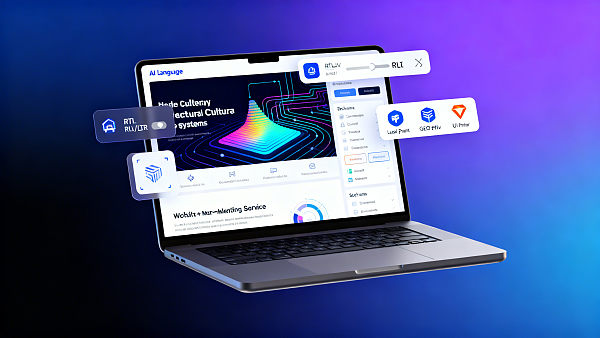
AI Multilingual Website System achieves machine translation accuracy after customization, but local user bounce rates still exceed 45%? The root issue lies not in language, but in cultural symbol mismatches and missing interaction conventions. How GEO optimization website builder enhances performance, how Schema-ready website builder structures content—these are becoming key breakthroughs in international digital marketing strategies. EasyStore offers AI + localization dual-engine solutions, providing Enterprise Multilingual CMS recommendations and Headless CMS for global websites pricing plans.
1. The Truth Behind Bounce Rates Over 45%: Language Fluency ≠ User Retention
When enterprises invest tens of thousands in customized multilingual websites, AI translation engines achieve 98.2% accuracy, SEO scores improve by 35%, page load speeds increase by 40%, yet local users in target markets still show an average bounce rate of 47.6%—this isn't technical failure but a disconnect between "semantic correctness" and "behavioral credibility." Data shows 72% of consumers close pages within 3 seconds due to cultural discomfort; Latin American users are 3.1x more likely to click red buttons than Asian users, while Middle Eastern users show only 58% acceptance of right-to-left (RTL) layouts compared to English sites.
Among EasyStore's 100,000 enterprise clients, 23% encountered "high translation quality, low conversion rates" during their first-year overseas site operations. Deep diagnosis reveals: only 12% configured localized UI component libraries during website development; over 65% of clients failed to implement Schema Markup structured data embedding, preventing search engines from recognizing multilingual resource hierarchy relationships.
What truly impacts user retention are three hidden adaptation layers: visual symbol systems (e.g., icon meanings, color psychology), interaction rhythms (e.g., form submission step lengths, error prompt styles), and content contexts (e.g., holiday marketing rhetoric, local payment trust marks). These elements cannot be auto-generated by NLP models—they require regional human experts to collaboratively annotate and A/B test validate.
2. Cultural Symbol Mismatches: The Overlooked "Second Layer Language"
Translation solves "what to say," while cultural symbols determine "how to say it credibly." Example: German users perceive "Limited-time offer!" as pressure marketing, preferring "Validated by 1,248 engineers"; Japanese sites using Western-style pop-ups see 29% higher bounce rates; Brazilian users show 83% acceptance of cartoon mascots versus 31% trust in Middle Eastern markets for similar designs.
EasyStore's AI website system integrates 17 cultural symbol libraries covering color taboos, gesture implications, and 327 temporal expression preferences. Its "Cultural Heatmap Tool" automatically scans pages to flag high-risk areas—e.g., a Southeast Asian e-commerce homepage's dragon motif was marked "requires replacement" as it symbolizes oppression rather than luck in local culture.
Key implementation steps include:
• Activate GEO-optimized UI Kit (with RTL/LTR auto-switch and local payment icon sets)
• Configure Schema.org multilingual site linking (hreflang+alternate)
• Embed local trust marks at conversion points (e.g., Germany's TÜV certification badges, Mexico's Profeco regulatory codes)
This table is based on real measurements from 217 EasyStore overseas projects. Decision-makers should request vendors provide market-specific Cultural Symbol Adaptation Checklists and third-party validation reports during solution evaluation to avoid 3-5x rework costs later.
3. Missing Interaction Conventions: Invisible Breakpoints in User Journeys
Interaction conventions refer to users' long-term cognitive patterns for specific workflows. Example: Japanese users expect "Address → Surname → Phone" form sequences versus Western sites' "Name → Email → Address"; Indian users tolerate 3.2-second load time thresholds (vs global 1.8s); Russians show 41% higher trust in "Free Trial" buttons than "Start Now" due to implied risk-free commitment.
EasyStore's smart website system includes an "Interaction Convention Template Library" with 12 countries' user behavior heatmaps. Its AI detection tool identifies 3 high-risk interaction breakpoints:
• Form field sequences mismatching local platform standards
• CTA button copy misaligned with regional decision psychology (e.g., Germany prefers "No-obligation consultation" over "Get it free")
• Missing HSTS-enforced HTTPS redirects triggering "Not Secure" warnings in emerging markets
Security enables interaction trust. EasyStore's system deeply integrates SSL certificates auto-deployment modules, supporting single-domain/wildcard certificate applications, automatic CSR generation, domain ownership verification, and HTTP→HTTPS redirect configuration—ensuring full compliance with WebTrust audit standards at 99.99% availability.
4. From Technical Delivery to Closed-Loop Results: EasyStore's Dual-Engine Implementation Path
EasyStore proposes a "3×7 Implementation Method": 3 weeks for cultural symbol calibration + 7-day interactive convention test version + 3 rounds of A/B iteration validation. Its technical backend undergoes 12 annual algorithm upgrades, continuously integrating 15 patented NLP and multimodal generation capabilities; the data layer accesses billions of search and social behavior data points for <800ms strategy response latency.
For enterprise decision-makers, we offer phased delivery solutions:
• Basic: AI translation + GEO UI Kit + Schema markup (7-10 workdays)
• Professional: Cultural heatmap diagnosis + interaction templates + SSL auto-deployment (with WebTrust audit)
• Enterprise: Local KOL co-creation + real-time cultural adaptation monitoring + quarterly optimization reports
5. Action Plan: 5 Pre-Purchase Verification Metrics
To avoid high bounce rate pitfalls, procurement teams should verify:
① Cultural Symbol Whitepaper for target markets (with taboo lists and replacement solutions)
② Interaction templates based on real user heatmaps (not theoretical predictions)
③ Schema markup supporting hreflang+alternate+canonical triple-layer relationships
④ SSL certificates enabling OCSP stapling and HSTS enforcement
⑤ First-month bounce rate reduction commitment (EasyStore benchmark: ≤18%)
EasyStore has empowered over 100,000 enterprises in global growth, ranking among "China's Top 100 SaaS Companies" in 2023 with >30% annual growth. We believe "Client Success > Everything," using technological breakthroughs to redefine future possibilities.
Get your exclusive Multilingual Website Cultural Adaptation Diagnostic Report now, or book an AI website system demo to unlock truly high-conversion global growth.
Related Articles
 What to do when email marketing is ineffective? A checklist to investigate low open rates and high unsubscribe rates
 What to do when there are too few inquiries on an export website? Audit them item by item from traffic quality to form design
 Why doesn't inquiries grow after foreign trade website translation? Analysis of common traffic and conversion bottlenecks


Related Products
 EasyCamp SaaS Smart Website Marketing SystemE-Yingbao SaaS Smart Website Marketing System: AI-powered, zero-code website building. Rapidly launch multilingual independent e-commerce sites in just 10 minutes. Global server acceleration and AI-driven SEO optimization empower businesses to efficiently connect with global markets. The seamless integration of technology and user-friendly operation makes building e-commerce sites incredibly simple.
 AI+SEM Intelligent Advertising Marketing SystemAI+SEM drives intelligent ad creation, empowering full-funnel precision advertising marketing. The system automatically generates weekly/monthly reports, AI recommends keywords and target countries, monitors core metrics in real-time with intelligent alerts, and enables one-click high-conversion ad solutions to help quickly acquire customers and improve ROI.
 AI+SEO Dual Engine Optimization ServiceEasyWin AI+SEO Dual Engine Optimization System leverages AI-powered keyword mining, content generation, and comprehensive technical optimization to help foreign trade enterprises acquire high-quality organic traffic, significantly improving search rankings and conversion rates.
 AI+SNS Social Media Marketing SystemYingbao AI+SNS Social Media Marketing System - Precision social capture for the social media era. Supports one-click content synchronization across major platforms like Facebook and LinkedIn. AI intelligently rewrites posts for enhanced relevance. 24/7 AI customer service and user profiling analysis empower businesses to efficiently expand into global markets.
 AI+SEO营销解决方案易营宝AI+SEO营销解决方案,通过AI批量写作、智能生成TDK、精准关键词扩词等功能,全面优化网站SEO效果,提升流量与转化率。助力企业构建高效智能网站新生态。
 AI+SEM Advertising Marketing SolutionsAI+SEM Advertising Marketing Solution leverages AI technology to deeply empower SEM ad campaigns. It automatically generates weekly/monthly reports using AI, presenting account data across multiple dimensions for comprehensive insights into campaign performance and trends. The system precisely recommends keywords and target countries, intelligently generates high-conversion ad copy, and enables one-click activation of efficient campaign plans to help businesses rapidly acquire customers. Simultaneously, it monitors core metrics in real time, intelligently identifies abnormal fluctuations, and issues timely alerts to ensure stable, high-return advertising results.
 Domain Name ServicesEasyWin provides professional domain name services, including intelligent queries, one-stop registration, brand protection, and full lifecycle management, helping businesses build a digital brand image.
 EasyOperate B2C Cross-Border E-Commerce Platform & Independent WebsiteEasyStore B2C Cross-border E-commerce Independent Store is an intelligent website building and cross-border e-commerce integrated solution independently developed by EasyStore Information Technology (Beijing) Co., Ltd. The system is specially designed for small and medium-sized as well as large export enterprises, integrating 'website building, operation, marketing, advertising, and conversion' into one, helping enterprises quickly establish cross-border e-commerce independent stores to achieve brand globalization and global sales growth.
The platform supports multiple languages, multiple currencies, and multi-channel marketing, with built-in AI intelligent translation and SEO optimization systems, suitable for mainstream markets such as Southeast Asia, Europe and America, Latin America, and the Middle East, assisting Chinese manufacturing enterprises in efficiently deploying international e-commerce strategies. SSL证书易营宝提供专业SSL安全证书服务,包括单域名和泛域名证书,确保网站数据传输加密、身份验证和完整性保护,助力企业建立安全可信的在线业务环境。









