









- Which channel has the highest ROI in the global traffic ecosystem? Comparative analysis of search, social media, and advertisingJul 10, 2026View details
- What multilingual website services are available in Sanya? Which model is more suitable for local businesses going global?Jul 08, 2026View details
- How to view the complete list of China SaaS companies in the top 100? Practical methods for screening website-building and marketing service providersJul 08, 2026View details
- How to view pricing in the global traffic ecosystem? Cost comparison of search, social media, and content channel advertisingJul 06, 2026View details
- How to assess foreign trade website development trends?Looking at 2026 changes from multilingual,AI content to conversion pathsJul 04, 2026View details
- What are the new trends in multilingual marketing data analytics tools in 2026? Focus on attribution、automation and complianceJul 04, 2026View details
How to choose a website system compared with responsive websites: template sites, SaaS, and custom development
When making website construction decisions, the real challenge is often not choosing a system that can go live, but determining whether it can support ongoing promotion, content expansion, and sustained conversion. When evaluating website systems around responsive design, the core consideration is not only whether the page is adaptable, but also the differences between template sites, SaaS, and custom development in terms of cost structure, SEO fundamentals, marketing coordination, and long-term maintenance.
This issue is even more important in the integrated website and marketing services scenario. A website is not just a display window; it also needs to carry search traffic, advertising visits, social media referrals, and multilingual content distribution. If the system selection is off from the start, later revision, indexing, ad tracking, and overseas growth efficiency will all be affected.
First, understand what “responsive” really means
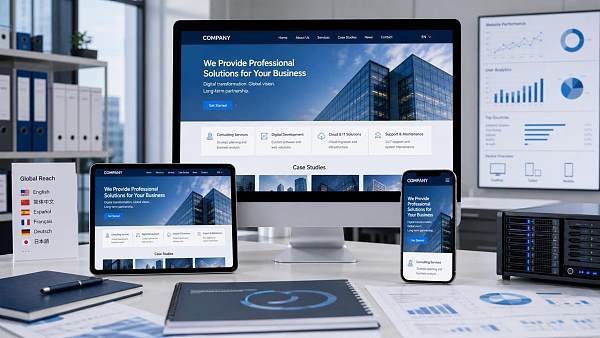
Many discussions simply interpret responsive design in website systems as “whether it can be viewed on a mobile phone.” That only captures part of it. True responsive design involves page layout, loading speed, component adaptation, content priority, and interaction consistency across different devices.
If a website serves overseas customer acquisition, an additional layer of judgment is needed: whether responsive performance affects search engine crawling, landing page quality scores, and inquiry conversion paths. In other words, responsive design is not a visual issue; it is a business efficiency issue.
Under this premise, the differences between template sites, SaaS, and custom development become meaningful. All three can be responsive, but the extent to which they do so, the cost involved, and whether they can continue to be optimized later are not the same.
The underlying differences among the three solutions are not only in the development approach
Template sites are usually assembled quickly with ready-made themes and modules. Their advantages are fast launch and low cost, making them suitable for basic validation and display needs. However, this type of solution is often limited in code structure, component reuse, page hierarchy, and functional expansion.
SaaS website-building platforms emphasize standardization capabilities. Responsive templates, backend management, forms, content publishing, and basic SEO settings are often preset. If the platform itself also takes marketing capabilities into account, the connection from website building to promotion will be smoother.
Custom development is more oriented toward business logic design. Information architecture, interaction flows, interface integration, multilingual mechanisms, and permission systems can all be built around real scenarios, but the investment cycle, collaboration cost, and later maintenance requirements are also higher.
Why is website system comparison with responsive design more emphasized now
On the one hand, access terminals are becoming increasingly fragmented. Overseas customers may first click an ad on mobile and then return to a desktop to complete an inquiry. If information breaks across devices on the page, lead loss becomes very obvious.
On the other hand, websites are already part of a more complete marketing chain. Search engine indexing, ad tracking, social media redirects, and AI search visibility improvement all require a stable site structure, lightweight pages, and manageable content.
This is also why many companies are re-examining website systems from a responsive design perspective. In the past, the focus was simply on “having a site available”; now the focus is more on “whether the website can be promoted, indexed, converted, and operated sustainably.”
From a real business perspective, which solution fits which scenarios better
If the goal is to quickly launch a basic corporate website, with simple content and low update frequency, a template site still has value. Especially during budget-sensitive stages, it can help quickly complete brand exposure and basic information delivery.
But once the scenario involves foreign trade lead generation, cross-border e-commerce, multilingual websites, or advertising landing pages, SaaS is often more balanced. The reason is straightforward: it needs to deliver both a responsive experience and backend efficiency, SEO settings, form conversion, and data tracking.
Custom development is more suitable for projects with complex processes, many system integrations, strict brand standards, or unique interaction logic. For example, multi-role permissions, quotation systems, regional content distribution, and dedicated inquiry workflows are difficult to solve directly with templates.
- Display-oriented corporate websites: prioritize launch speed and later modification costs.
- Foreign trade marketing websites: focus on multilingual support, SEO structure, and lead-handling capabilities.
- Cross-border e-commerce stores: require coordination among product, payment, logistics, and marketing plugins.
- Advertising landing pages: pay more attention to loading speed, conversion paths, and batch reuse efficiency.
When evaluating, do not look only at the upfront price
When comparing website systems with responsive design, the upfront quote is the easiest part to amplify, but what truly affects total cost is often the difficulty of later adjustments. Whether a page structure needs to be redeveloped after a change, whether language versions need to be rebuilt repeatedly, all will continue to increase investment.
The same applies to SEO. A template may look affordable, but if title tags, descriptions, link structure, image compression, structured data, and sitemap cannot be controlled, the room for later optimization becomes very limited. The budget saved in this way may need to be doubled back into promotion later.
What is more worth paying attention to is whether the system and marketing are connected. After a website goes live, much of the traffic comes from search, advertising, and social media. If the website-building platform cannot stably support landing pages, conversion tracking, content updates, and page iteration, marketing efficiency will be held back by the system itself.
Several easily overlooked judgment points
- Does the mobile first screen retain core conversion information, rather than just scaling down the layout.
- Can the backend independently manage different language pages, rather than just duplicating static pages.
- Does it support later category expansion, topic page construction, and batch landing page generation.
- Can it balance SEO optimization and ad placement, rather than leaning toward a single use case.
Looking at website building and marketing together leads to more accurate judgment
At present, the problem with many projects is not the website itself, but the fact that website and marketing tools are separated. After a site goes live, if SEO, ad tracking, social media redirects, and data analysis are added later, a second round of reconstruction is often needed, which is inefficient and risky.
This is also why integrated solutions are receiving more attention. Platforms like 易营宝, which support long-term overseas growth scenarios, usually consider cloud intelligent website building, multilingual management, SEO optimization, ad placement, and AI search visibility improvement within the same framework.
For businesses that need to cover North America, Europe, Southeast Asia, Japan and South Korea, the Middle East, and other regions, this approach is practical. If site structure, content deployment, and traffic channels are planned in a unified way from the beginning, responsive experiences are more likely to be converted into real growth results.
How to judge the next step
If you are still comparing different website system options with responsive design, it is recommended to first break the requirements into three layers: current launch goals, expansion needs over the next two years, and the degree of coordination with marketing channels. This is closer to a real decision than simply comparing quotes.
Next, you can create an evaluation checklist that includes at least responsive performance, controllable SEO items, multilingual capabilities, content maintenance efficiency, data tracking, API expansion, and revision costs. Putting these items on the same sheet makes the differences very clear.
In short, template sites are suitable for a light start, SaaS is suitable for pursuing efficiency and growth synergy, and custom development is suitable for highly complex businesses. The truly appropriate solution is not the one with the most features, but the one that can stably support promotion, indexing, and conversion at the current stage.
When the comparison range returns to the business goal itself, comparing website systems with responsive design is no longer just a technical choice, but a judgment about long-term operating methods. First sort out the scenario, then verify the system boundaries, and it is often faster to find the right path.
Related Articles
 Comparison between Easyyingbao and WordPress: Which is better suited for the long-term operation of foreign trade enterprises?
 How to choose a WhatsApp service provider? Assessing account stability, API capabilities, and compliance risks
 How to choose a GEO generative engine optimization company? Capability boundaries, deliverables, and evaluation criteria
Related Products
 EasyCamp SaaS Smart Website Marketing SystemE-Yingbao SaaS Smart Website Marketing System: AI-powered, zero-code website building. Rapidly launch multilingual independent e-commerce sites in just 10 minutes. Global server acceleration and AI-driven SEO optimization empower businesses to efficiently connect with global markets. The seamless integration of technology and user-friendly operation makes building e-commerce sites incredibly simple.
 AI+SEM Intelligent Advertising Marketing SystemAI+SEM drives intelligent ad creation, empowering full-funnel precision advertising marketing. The system automatically generates weekly/monthly reports, AI recommends keywords and target countries, monitors core metrics in real-time with intelligent alerts, and enables one-click high-conversion ad solutions to help quickly acquire customers and improve ROI.
 AI+SEO Dual Engine Optimization ServiceEasyWin AI+SEO Dual Engine Optimization System leverages AI-powered keyword mining, content generation, and comprehensive technical optimization to help foreign trade enterprises acquire high-quality organic traffic, significantly improving search rankings and conversion rates.
 AI+SNS Social Media Marketing SystemYingbao AI+SNS Social Media Marketing System - Precision social capture for the social media era. Supports one-click content synchronization across major platforms like Facebook and LinkedIn. AI intelligently rewrites posts for enhanced relevance. 24/7 AI customer service and user profiling analysis empower businesses to efficiently expand into global markets.
 AI+SEO营销解决方案易营宝AI+SEO营销解决方案,通过AI批量写作、智能生成TDK、精准关键词扩词等功能,全面优化网站SEO效果,提升流量与转化率。助力企业构建高效智能网站新生态。
 AI+SEM Advertising Marketing SolutionsAI+SEM Advertising Marketing Solution leverages AI technology to deeply empower SEM ad campaigns. It automatically generates weekly/monthly reports using AI, presenting account data across multiple dimensions for comprehensive insights into campaign performance and trends. The system precisely recommends keywords and target countries, intelligently generates high-conversion ad copy, and enables one-click activation of efficient campaign plans to help businesses rapidly acquire customers. Simultaneously, it monitors core metrics in real time, intelligently identifies abnormal fluctuations, and issues timely alerts to ensure stable, high-return advertising results.
 Domain Name ServicesEasyWin provides professional domain name services, including intelligent queries, one-stop registration, brand protection, and full lifecycle management, helping businesses build a digital brand image.
 EasyOperate B2C Cross-Border E-Commerce Platform & Independent WebsiteEasyStore B2C Cross-border E-commerce Independent Store is an intelligent website building and cross-border e-commerce integrated solution independently developed by EasyStore Information Technology (Beijing) Co., Ltd. The system is specially designed for small and medium-sized as well as large export enterprises, integrating 'website building, operation, marketing, advertising, and conversion' into one, helping enterprises quickly establish cross-border e-commerce independent stores to achieve brand globalization and global sales growth.
The platform supports multiple languages, multiple currencies, and multi-channel marketing, with built-in AI intelligent translation and SEO optimization systems, suitable for mainstream markets such as Southeast Asia, Europe and America, Latin America, and the Middle East, assisting Chinese manufacturing enterprises in efficiently deploying international e-commerce strategies. SSL证书易营宝提供专业SSL安全证书服务,包括单域名和泛域名证书,确保网站数据传输加密、身份验证和完整性保护,助力企业建立安全可信的在线业务环境。









